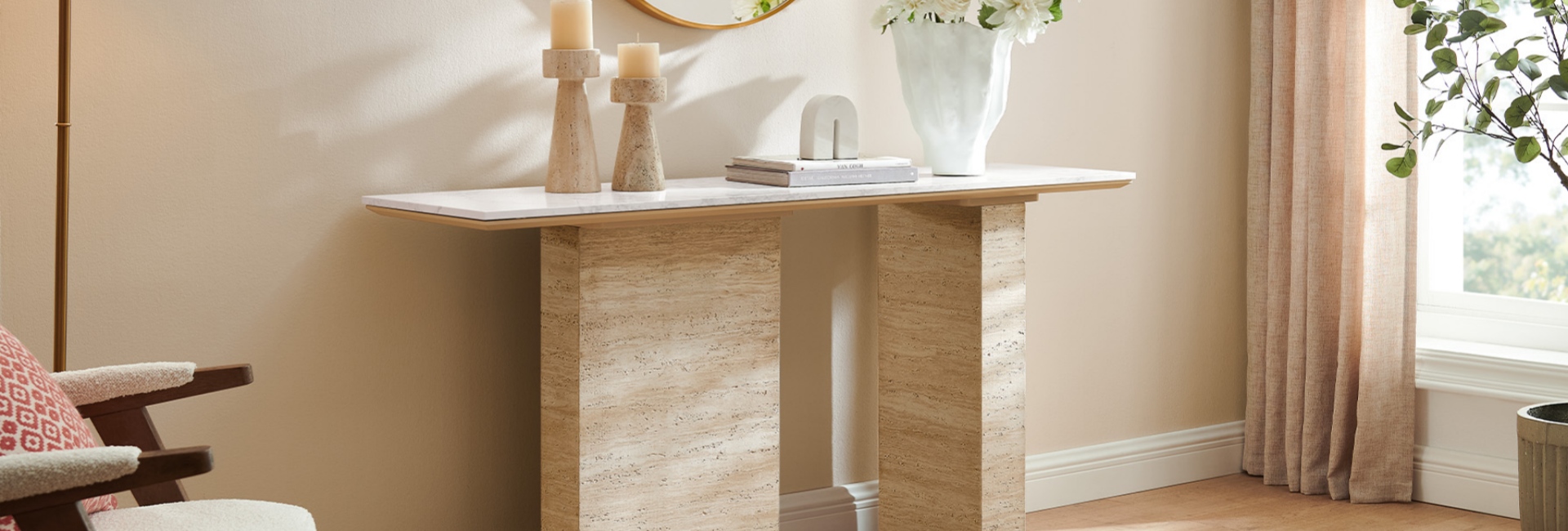
Console table decoration ideas usually fail for one simple reason: too many objects and not enough intent.
At Hernest, we think a well-styled console should feel like part of the room, not a collection of accessories placed on top of a table. A simple three-part formula — anchor, height, layer — is a good place to start.
Put something substantial on the wall behind the table. Add one element that gives the surface some height. Then layer in a few pieces that are either useful, personal, or visually interesting.
The goal isn't to fill every inch. It's to create enough structure that the console feels finished while still leaving room for everyday life.
Table of Contents
- Start With an Anchor: Mirror or Artwork Above the Table
- Add Height So the Surface Doesn't Fall Flat
- The Rule of Three: Anchor, Height, Layer
- Layer With Books, Trays, and Catchalls
- Bring in Greenery and Natural Materials
- Build a Color Palette That Works With the Room
- Style by Room: Where the Console Lives
- Console Table Decoration Ideas Start With the Right Table
- Common Mistakes That Make a Console Look Staged
- A 60-Second Styling Checklist
- Seasonal Swaps Without Rebuying Everything
- FAQs
Start With an Anchor: Mirror or Artwork Above the Table
The wall above a console usually needs something with enough visual weight to connect the furniture to the room. A mirror or piece of artwork can fill that vertical space while establishing the scale for everything underneath it.
In an entryway, a mirror has an obvious practical benefit: it's the last place to check your reflection before heading out. In a living room or hallway, artwork can play the same anchoring role without adding another reflective surface.
Round, arched, or rectangular — pick by the wall
The shape of the anchor affects the overall feel of the arrangement.
A round or arched mirror softens the straight lines of a rectangular console and works especially well when the surrounding space feels narrow or angular. A rectangular mirror or artwork feels more tailored and tends to suit a longer wall.
You don't need a gallery wall, either. One larger piece often creates a calmer focal point than several small frames competing with one another.
Size the anchor to about two-thirds of the table
A useful starting point is to choose a mirror or artwork that's roughly two-thirds to three-quarters of the console's width.
For a 60-inch console, that means an anchor around 40 to 45 inches wide. The exact size can vary with the wall and the shape of the piece, but the goal is to make the anchor feel connected to the console without overwhelming it.
For placement, leave roughly 4 to 6 inches between the tabletop and the bottom of the mirror or artwork. That keeps the two pieces visually connected while leaving enough room for a lamp or vase.
Add Height So the Surface Doesn't Fall Flat
Once the wall anchor is in place, look at the tabletop.
If every object sits at roughly the same height, the arrangement can feel flat. One taller element gives the eye somewhere to travel and creates contrast against the horizontal surface of the console.
Lamps versus branches: which to reach for
A table lamp is one of the easiest ways to add both height and function. It brings a warm pool of light to an entryway, living room, or hallway without changing the overall furniture arrangement.
Place the lamp toward one side rather than directly in the center. On the other side, balance it with a taller vase, branches, or another vertical object.
If the area already has enough lighting, a tall ceramic vase with faux eucalyptus, olive branches, or dried grass can provide the same visual lift without adding another light source.
The goal is balance, not identical objects. A little variation in shape and height keeps the arrangement from looking too formal.
How tall should a console table lamp be?
For a console around 30 inches tall, a lamp in the 24- to 30-inch range is a practical starting point.
The shade should sit roughly level with the mirror or artwork without covering too much of it. A single sculptural lamp can create a more relaxed, asymmetrical look, while two matching lamps give you a more traditional and symmetrical arrangement.
The Rule of Three: Anchor, Height, Layer
Once the main pieces are in place, the rest becomes much easier.
Think of console styling in three zones:
The arrangement doesn't need to be perfectly symmetrical. A tall lamp on one side and a smaller grouping of books and accessories on the other can feel more natural than matching everything piece for piece.
And don't overlook the empty space. Keeping roughly one-third of the tabletop open gives the arrangement room to breathe and leaves space for the things you actually put down during the day.
Layer With Books, Trays, and Catchalls
The smaller pieces are where personality comes in, but this is also where a console can quickly become cluttered.
Choose objects that have a reason to be there.
Why a tray is the quiet hero
A tray gives everyday items a defined place. Keys, sunglasses, mail, and other small essentials look much more intentional when they're grouped together rather than spread across the tabletop.
The tray should be proportional to the console. On a 60-inch table, a tiny dish can disappear visually, while an oversized tray can take up more usable space than necessary.
Wood, stone, ceramic, or lined metal trays can all work. Choose a material that connects with finishes already present in the room rather than introducing another unrelated texture.
Stacking books as risers
Two or three coffee-table books can add height without making the arrangement feel overworked.
Use them as a base for a small sculpture, candle, bowl, or decorative object. Neutral covers tend to keep the composition quiet, while one stronger color can add a controlled accent.
Keep the stack low. The books should support the arrangement, not become the main event.
Bring in Greenery and Natural Materials
A console is made from hard, structured materials, so something organic can help soften the overall look.
A vase of branches, a small potted plant, or a trailing plant can introduce movement without requiring a large amount of decoration. Faux olive branches are also a practical choice when you want the shape and texture of greenery without regular maintenance.
Natural materials can create the same effect. Wood, stone, ceramic, linen, woven fibers, and unlacquered brass all bring texture without requiring bright colors.
Try pairing contrasting surfaces, such as a smooth glass vase with a rough ceramic bowl or a metal frame with a woven basket. The contrast keeps the arrangement interesting while allowing the furniture to remain the focus.
Build a Color Palette That Works With the Room
The easiest way to make console decor feel cohesive is to start with colors that already exist in the room.
Look at the flooring, wall color, furniture, hardware, and lighting. Pick two or three tones from that existing palette and repeat them through the accessories.
If the console has a warm wood finish, for example, echo that tone in a frame or bowl. If the room already uses black and brass, those finishes can carry through to the lamp or tray.
The goal isn't to make everything match. Repetition creates cohesion; variation keeps it interesting.
Style by Room: Where the Console Lives
A console can serve very different purposes depending on where you place it. The same styling principles apply, but the balance between decoration and function changes with the room.
Entryway: function first
The entryway is where practicality matters most.
Start with a tray or bowl for keys, a mirror for a final check before leaving, and enough open surface to put down a bag or mail.
Keep taller pieces toward one side and make sure the console doesn't interfere with the walkway. A natural-fiber runner beneath the table can add warmth without requiring additional tabletop accessories.
Behind the sofa: keep it low
A console behind a sofa is usually viewed from across the room, so the arrangement should respect the sightline.
Keep the styling relatively low and horizontal. A pair of lamps, a long tray, a short stack of books, or a few low decorative objects can work well.
Avoid anything tall enough to block the view across the room. If you need additional storage, a basket underneath the console can hold throws or magazines without adding visual clutter to the tabletop.
Hallway: go narrow and reflective
Hallways leave less room for furniture, which makes depth especially important.
A console under about 14 inches deep can help preserve the walkway. A mirror above it can reflect available light and make the corridor feel more open.
There may not be enough floor space for a large plant or oversized accessories. One vase and a small dish can be enough.
Dining room: let the console work harder
In a dining room, a console can function as both display furniture and additional storage.
Look for drawers or cabinets if you plan to keep linens, serving pieces, or barware nearby. The tabletop can then hold serving pieces, artwork, or a simple arrangement when the furniture isn't being used for entertaining.
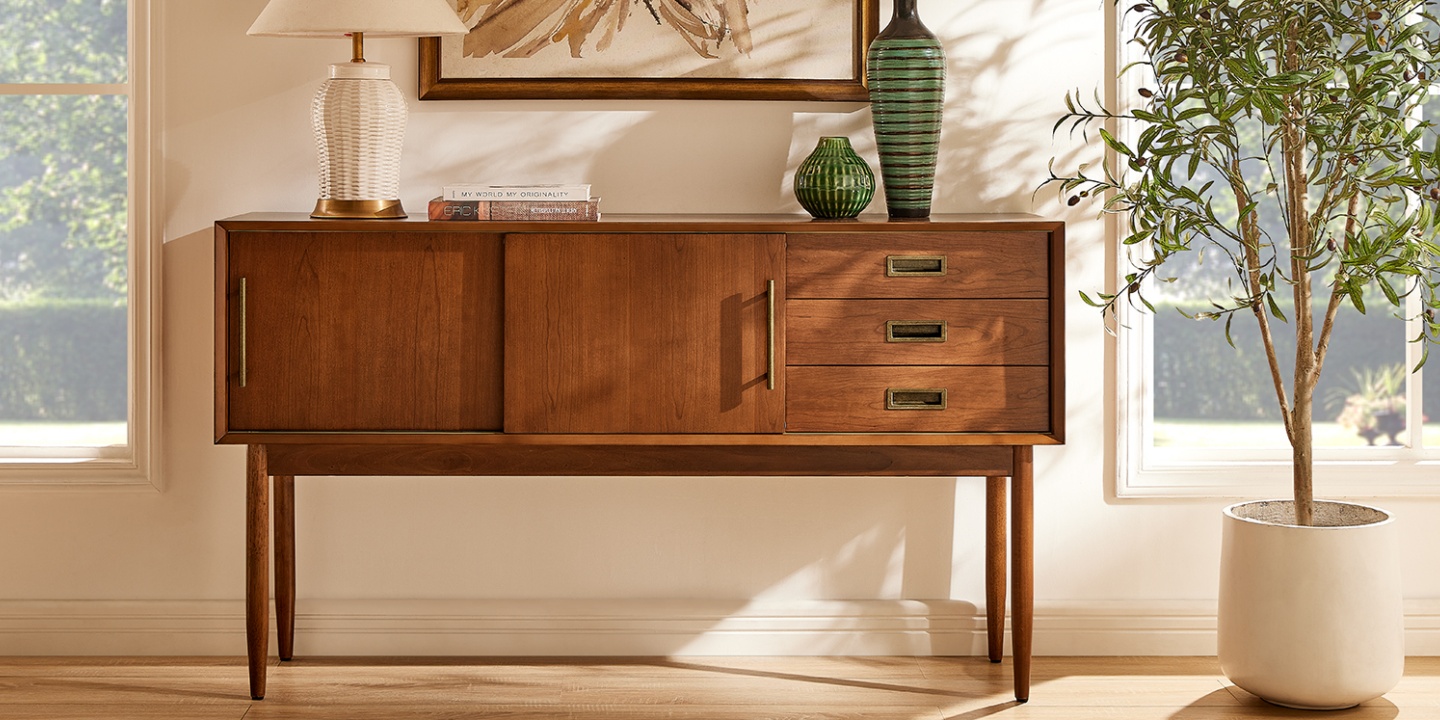
The Kaden 60" Mid-Century Console Table is designed with this kind of flexibility in mind. It has three drawers and a cabinet with adjustable shelves, while its 60-inch width gives you enough surface area for both storage and display.
At 33.9 inches tall, it also has the presence of a compact sideboard while maintaining a console-style footprint.
Bedroom: vanity or quiet landing
A console doesn't have to stay in the living room.
Placed beneath a window or along an open bedroom wall, it can provide a simple surface for a tray, candle, books, or a small mirror. Add a stool and it can become a compact vanity without taking up the space of a dedicated dresser.
Bedrooms generally benefit from a lighter touch. A few well-chosen objects are usually more effective than a crowded arrangement.
Console Table Decoration Ideas Start With the Right Table
Decor can only solve part of the problem. If the console is too deep, too wide, or too tall for the room, even a carefully styled surface can feel awkward.
For a narrow entryway, depth is often the first measurement to check. A console deeper than about 16 inches can begin to reduce comfortable walkway space, depending on the layout.
Width matters too. When the wall allows it, leaving around 12 inches of visual space on each side can help the console feel proportionate rather than wall-to-wall. In a tighter room, though, protecting the walkway matters more than maintaining equal space on both sides.
Height changes the proportions of the accessories as well. A 30-inch console pairs naturally with a lamp around 24 to 30 inches tall, while a taller console may need shorter accessories.
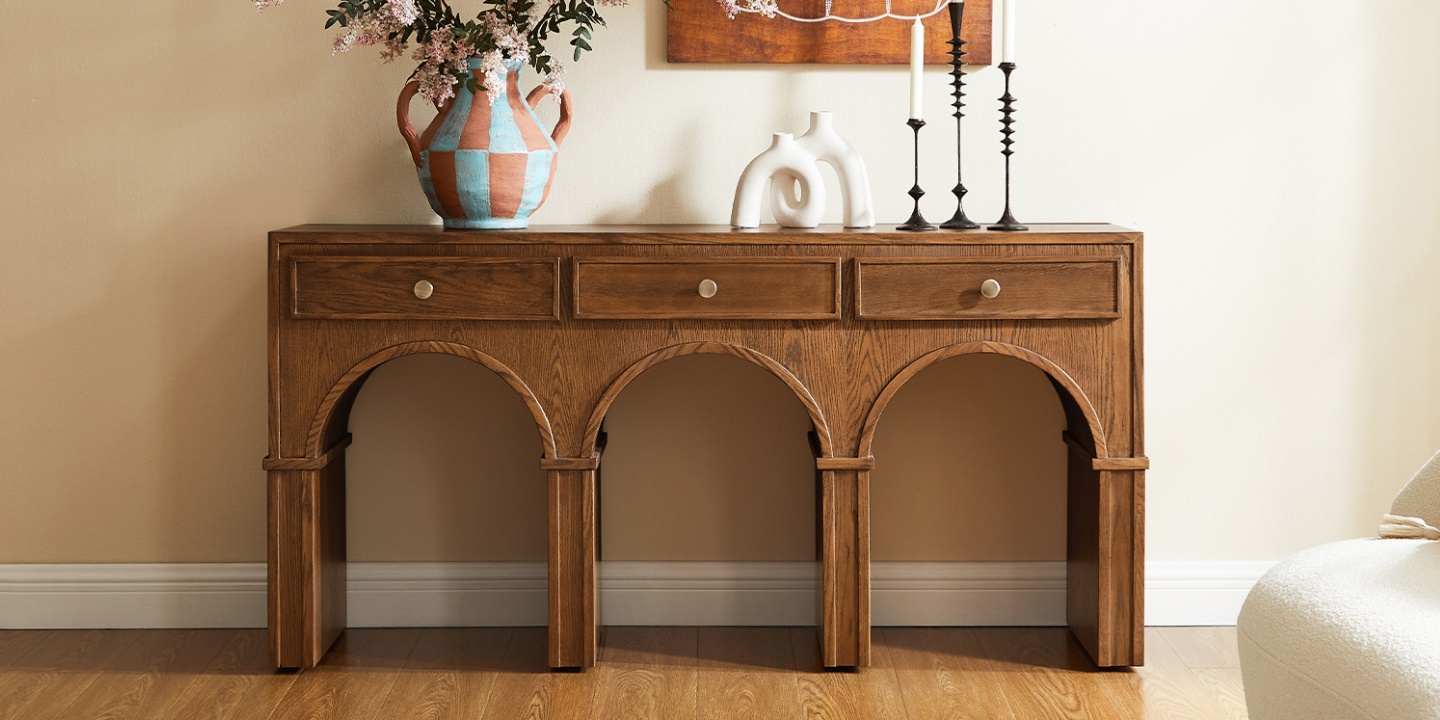
The Solvind 60" Arch Console Table is one example of a narrow console designed around these proportions. At 60.2 inches wide, 15.9 inches deep, and 30.1 inches tall, it works well where you want a substantial piece without the footprint of a deeper sideboard.
Its solid-oak frame and American oak veneer highlight the natural grain, while the arched structure adds an architectural detail that can work as part of the room's visual composition.
Material is another consideration when a console will see everyday use. Solid oak is relatively hard compared with many common furniture woods; the Janka hardness scale provides a useful way to compare species. The Wood Database offers species-level comparisons.
If you're comparing two 60-inch Hernest consoles, the right choice depends more on how you plan to use the piece than on one being universally better:
Both have a recommended weight capacity of 200 pounds and include levellers for uneven floors.
For more sizes, finishes, and designs, explore the Hernest console table collection.
Common Mistakes That Make a Console Look Staged
Most console styling problems come down to proportion and editing rather than a lack of decoration.
Too deep for the spot. Measure the usable walkway, not just the wall. A table can fit the wall and still make the room uncomfortable.
Mirror hung too high or too small. The anchor should feel connected to the console rather than floating above it.
Too many small objects. A dozen tiny accessories create visual noise. A few larger pieces usually have more impact.
Ignoring function. If keys, mail, remotes, or other everyday items have nowhere to go, the surface will quickly become cluttered.
Perfect symmetry. Matching both sides exactly can feel static. Small differences in height and shape usually make the arrangement feel more relaxed.
A 60-Second Styling Checklist
Before you call the arrangement finished, ask:
Is there a substantial mirror or artwork above the table?
Is there one tall element adding vertical height?
Are the smaller objects grouped rather than scattered?
Is at least a third of the tabletop still open?
Does at least one item serve a practical purpose?
Do the colors and materials connect with the rest of the room?
If the answer is yes, the console should feel finished without feeling overdecorated.
Seasonal Swaps Without Rebuying Everything
A console doesn't need to be completely restyled every season.
Keep the table and wall anchor consistent, then rotate a few smaller accessories.
In spring, try pale ceramics and flowering branches. Summer works well with lighter greenery, woven textures, and softer colors. Fall can bring in amber glass, warm branches, and natural textures. In winter, evergreen cuttings, brass candlesticks, or a simple garland can shift the mood.
The key is to change a few supporting pieces rather than turning the entire console into a seasonal display. One substantial vase or arrangement usually looks more intentional than a collection of small themed decorations.
FAQs
How can I decorate my console table?
Start with a mirror or artwork as a wall anchor, add one taller element such as a lamp or vase, then layer in a few smaller objects. Keep roughly a third of the tabletop open so the arrangement doesn't feel crowded.
Should a mirror be wider than the console table?
Usually not. A mirror or artwork that's about two-thirds to three-quarters of the console's width is a useful starting point. For a 60-inch console, that's roughly 40 to 45 inches wide.
How tall should a console table lamp be?
For a console around 30 inches tall, a 24- to 30-inch lamp is a practical starting point. The shade should sit roughly level with the wall art or mirror without blocking it.
How do I keep a console table from looking cluttered?
Edit before adding. Group small items on a tray, vary the heights of your accessories, and leave negative space on the tabletop. Keeping about one-third of the surface open is a useful guideline.
Can a console table work as a buffet in the dining room?
Yes. A console with drawers or cabinet storage can hold linens, serving pieces, and barware while providing a surface for serving or display. A deeper sideboard-style piece may be better if you need substantial storage.
What style of console table goes with a mid-century room?
Look for clean lines, tapered legs, warm wood tones, and restrained hardware. Architectural details such as an arch can add interest while keeping the overall silhouette simple. The finish should also relate to the wood tones already in the room.