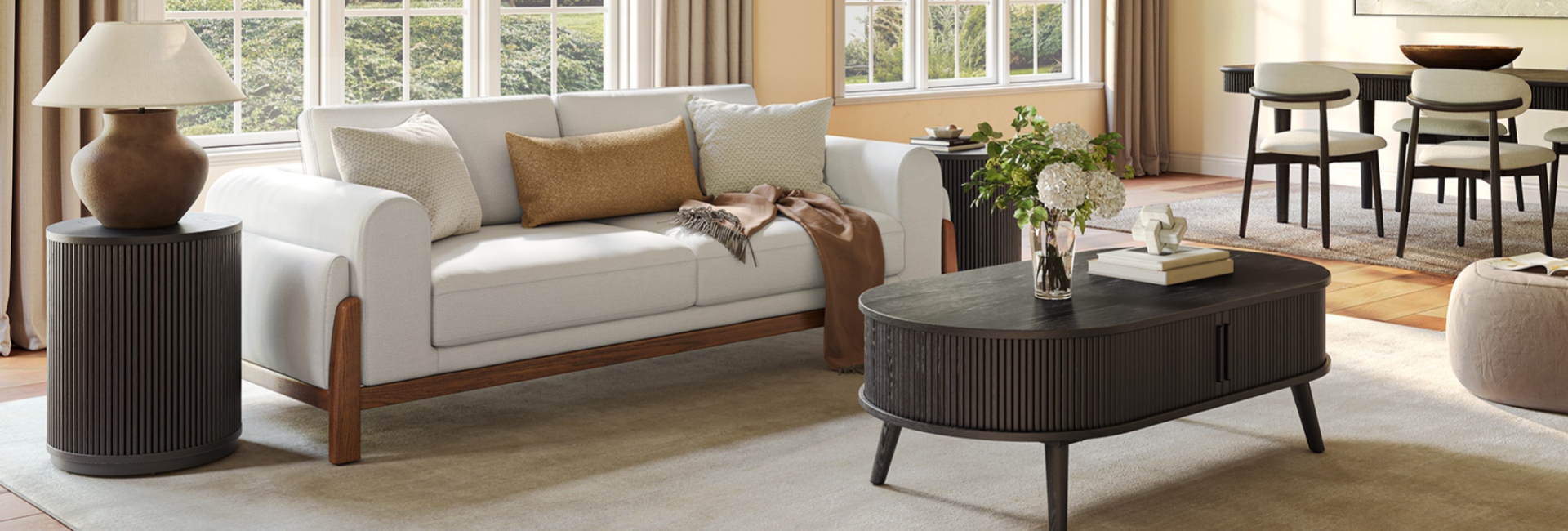
A wood frame sofa is worth buying when the frame is made from properly dried hardwood, the joints are doweled or corner-blocked rather than relying on staples, and the construction suits the humidity of your home. Get those basics right and the sofa has a much better chance of outliving its upholstery. Get them wrong and you may hear about it in eighteen months, usually as a creak from the left arm every time someone sits down.
Here's the frustrating part: none of this is obvious in a product photo. You can zoom in on the chenille texture, count the cushions, read 400 reviews about how soft the seat is, and still learn almost nothing about the structure underneath. So this guide focuses on the part you can't see: what the frame is made of, how it's joined, how to test it in a showroom, and what to ask when you're buying online.
Table of Contents
- What a Wood Frame Sofa Actually Is
- The Frame Is the Part You Don't Want to Replace
- Solid Wood, Plywood, and Everything In Between
- What Type of Wood Is Best for Sofa Frames?
- What Kiln-Dried Really Means
- Joinery: Where Good Frames Are Won or Lost
- Suspension and Cushions Ride on the Frame's Shoulders
- The 6-Minute Showroom Test
- What to Ask When You're Buying Online
- Sizing a Wood Frame Sofa to a Real Room
- Living With Exposed Wood: Care That Actually Matters
- Repair It, Reupholster It, or Replace It
- What to Look for at Different Price Levels
- FAQs
- What type of wood is best for sofa frames?
- Is a solid wood frame sofa better than a plywood frame?
- How long does a wood frame sofa last?
- How can I tell if a sofa really has a solid wood frame?
- Why does my wood frame sofa creak, and can I fix it?
- Are wood frame sofas comfortable, or do they feel too firm?
- Do wood frame sofas work in small apartments?
- How much should I spend on a solid wood frame sofa?
- How do you clean and care for the exposed wood on a sofa?
What a Wood Frame Sofa Actually Is
The phrase gets used in two different ways, and shoppers can easily miss the distinction.
Exposed Wood vs. Hidden Structure
Sometimes "wood frame sofa" means the wood is part of the visible design: a wood rail along the arms, an exposed base, or legs that read as furniture rather than hardware. Other times, it simply means the internal skeleton is made from wood and is completely covered by foam and upholstery.
Plenty of sofas are both.
The distinction matters because exposed wood affects the way a sofa looks in a room, while the hidden frame has much more to do with structural durability. A 90-inch sofa with a visible wood base can look lighter than a skirted sofa of the same width. What happens underneath the fabric determines how the piece holds up to years of use.
Why "Wood Frame" on a Spec Sheet Isn't Enough
"Wood frame" is not a complete construction specification.
Particleboard is technically a wood-based material. So is a thin softwood strip stapled behind a back panel. When a listing says "solid wood frame" without identifying the species, drying method, or joinery, treat that as an unanswered question rather than proof of quality.
A more useful specification tells you where the materials are used. "American ash wood and plywood frame" identifies the species and acknowledges the engineered panels. "Solid wood and plywood frame" is also more informative than simply saying "wood frame."
The more specific the construction description, the easier it is to judge what you're actually buying.
The Frame Is the Part You Don't Want to Replace
Foam can be replaced. Covers can sometimes be removed or replaced. Springs can be repaired or re-clipped. A damaged structural rail is a different problem because reaching it usually means removing upholstery first.
That's the real reason frame quality matters.
A sofa can look tired because the cushions have softened or the fabric has worn long before the frame itself reaches the end of its useful life. If the frame is sound, those components can often be repaired or replaced. If the frame is failing, the economics become much harder to justify.
Frame problems are also easy to mistake for ordinary wear. Watch for cushions that no longer sit squarely, a seat that feels noticeably lower on one side, a back that moves when you push it, or a popping or creaking sound that happens in exactly the same spot every time.
Those are reasons to inspect the structure rather than simply replacing the cushions.
Solid Wood, Plywood, and Everything In Between
The material matters, but where that material is used matters just as much.
The key point is that a well-made sofa does not have to be made entirely from solid lumber.
Where Plywood Beats Solid Wood
Plywood gets treated as a downgrade when it shouldn't.
Its cross-laminated veneers can resist warping better than a wide solid board, and the alternating grain directions reduce the tendency of a panel to split along a single grain line. For a flat seat deck or a curved arm panel, quality plywood can be the more practical engineering choice.
Look for furniture-grade plywood with multiple layers and minimal visible voids at a cut edge. Seven or more plies can be a useful quality indicator, but ply count alone does not prove that a frame is well built.
A hybrid construction often makes the most sense: hardwood where the load concentrates, plywood where a stable panel is needed.
Where Particleboard Falls Short
Particleboard can hold a fastener, but repeated loading can compress the material around the fastener and weaken the connection. Moisture can make the problem worse.
That doesn't mean every particleboard component makes a sofa unusable. A decorative or lightly loaded panel is different from a seat rail, leg mount, or arm post.
For those structural areas, I'd want a material designed to handle repeated loads rather than one that relies heavily on a fastener staying buried in a compressed particle structure.
What Type of Wood Is Best for Sofa Frames?
For structural members, kiln-dried hardwood is a strong starting point. Common choices include oak, hard maple, ash, beech, and birch.
Density and hardness help a frame resist repeated loading and give screws and dowels a better material to hold onto. But species is only one part of the equation. A poorly joined hardwood frame can still fail, while a well-designed frame can use different materials effectively.
The USDA Forest Service's Wood Handbook provides useful side-hardness data for common wood species.
The numbers help illustrate the difference, but don't mistake hardness for a complete frame-quality score. Joinery, lumber dimensions, drying, and overall design still matter.
Hardwoods Worth Paying Attention To
Ash deserves more attention than it usually gets. It's strong, handles curved components well, and has a straight, open grain that works especially well when the wood is visible.
The Polaris 82" Sofa is a useful example of how a specific species can appear on a real furniture specification. Its construction uses American ash wood and plywood, with solid timber legs tied into the wooden base. The 82-inch width also makes it a useful reference for rooms that need a substantial sofa without going all the way to a 90-plus-inch piece.

Softwoods and Rubberwood: When They're Fine
Rubberwood, also called parawood, is a plantation-grown hardwood that can work well in furniture when it has been properly dried and processed.
Pine can also be appropriate for secondary components or lighter-use furniture. The question isn't simply whether a species is hardwood or softwood. It's whether the material, dimensions, drying, and joinery are appropriate for the load the component has to handle.
For a sofa used heavily every day, I'd put more confidence in a well-specified hardwood frame than an unspecified softwood construction.
What Kiln-Dried Really Means
Wood is hygroscopic, which means it continually exchanges moisture with the surrounding air. It expands as it absorbs moisture and shrinks as it loses it.
That matters in a sofa frame because the lumber does not stop moving simply because the sofa has been upholstered. If wood is assembled before it reaches an appropriate moisture level, continued drying or moisture absorption can put stress on joints and change the dimensions of the frame.
The USDA Forest Service's Wood Handbook notes that hardwood lumber used for furniture and similar interior applications is commonly dried to moisture levels appropriate for the environment in which it will be used. The exact target depends on the expected indoor conditions.
Why Your Climate Changes the Answer
The useful concept here is equilibrium moisture content, not one magic number that applies to every home.
A frame built from lumber that is much drier than the environment around it can absorb moisture and swell. A frame that is significantly wetter than a very dry home can lose moisture and shrink.
That's why manufacturers need to dry furniture lumber with its intended environment in mind.
For homeowners, keeping indoor relative humidity reasonably stable is more useful than chasing a particular frame moisture number. A range around 35% to 50% relative humidity is a practical target for many homes and can also help protect hardwood floors and other wood furniture.
The First Winter Test
Wood can make small sounds as it adjusts to a new indoor environment, especially during the first heating season.
A faint tick or occasional settling noise is not automatically a structural problem. What deserves attention is a sound that becomes louder or more frequent, or a creak that you can reproduce every time you sit in the same location.
If that happens while the sofa is still under warranty, document it rather than waiting for the problem to become worse.
Joinery: Where Good Frames Are Won or Lost
Two frames can use the same species of wood and still perform very differently. The connection between the pieces is a major part of the difference.
What you want to see or hear about:
Mortise-and-tenon: A shaped section of one piece fits into a matching opening in another and is secured with adhesive. It's an old technique for a reason.
Double dowels plus glue: Two dowels help resist rotation better than relying on a single dowel.
Glued and screwed corner blocks: The glue creates a bonded surface while the screws clamp the joint and provide additional mechanical support.
Legs integrated into the frame: A structural leg connection is preferable to a small fastener driven into a weak panel.
What I'd be cautious about is a frame that relies primarily on staples for structural connections. Staples are useful for upholstery and dust-cover attachment, but I would not want them carrying the main loads of a sofa frame.
Corner Blocks, Glued and Screwed
A corner block reinforces the inside of a frame joint and helps resist racking, which is the sideways deformation that can gradually turn a square frame into something less square.
A simple question to ask a furniture seller is:
"Does the frame have corner blocks, and are they glued and screwed?"
A detailed answer tells you much more than a generic claim such as "built for durability."
How Legs Attach
Legs deserve their own inspection because they experience leverage every time the sofa is moved sideways or loaded unevenly.
Integrated legs that form part of the frame structure can provide a strong connection. Bolted legs attached through a properly reinforced base can also be effective and are convenient for shipping.
A small fastener driven into an engineered panel is less reassuring when that connection is expected to handle repeated movement.
If your sofa arrives with removable legs, check that the hardware is tight after the piece has settled into your home. There's no harm in checking again several months later.
Suspension and Cushions Ride on the Frame's Shoulders
A strong frame does not make a sofa comfortable by itself. The frame supports the suspension, and the suspension supports you.
Eight-way hand-tied coils are a traditional premium suspension system. Sinuous springs, made from heavy S-shaped steel wire attached to the frame rails, are a common practical choice in modern upholstered furniture.
Well-tensioned sinuous springs can provide consistent support without the complexity of hand-tying. Webbing can also be useful as part of a properly engineered suspension system, but the construction details matter more than the word "webbing" on a specification sheet.
Cushion foam is another separate consideration. High-resiliency polyurethane foam generally retains its shape better than lower-quality comfort foam. Fiber-wrapped foam adds a softer outer feel around a supportive core.
The American Home Furnishings Alliance publishes industry standards and resources covering furniture materials and upholstery-related specifications.
This is why a sofa should be judged as a system rather than by the frame alone. Hardwood and plywood construction, appropriate suspension, and well-specified cushion materials work together.
The 6-Minute Showroom Test
Do this in the store. Nobody will stop you.
If you only have time for two checks, make them the lift test and the rack test. They reveal unwanted structural movement faster than almost anything else you can do without taking the sofa apart.
1. The Lift Test
Lift one front leg about six inches off the floor.
The other front leg should respond with it rather than lagging dramatically behind. If the frame twists noticeably before the second leg moves, that's a reason to ask more questions about the structure.
2. The Rack Test
Grip the two front corners and gently push one forward while pulling the other back.
A well-built frame should resist this movement. Noticeable racking suggests that the frame is allowing too much lateral movement.
3. The Arm Wiggle
Grab one arm and try to move it independently of the back.
There should not be obvious independent movement. If the arm shifts while the rest of the sofa stays still, ask how that section is attached to the frame.
4. The Drop
Sit down firmly, harder than you would politely.
Listen for clunks, knocks, or repeated creaks. One small settling sound doesn't automatically mean a defect. A repeatable structural noise deserves investigation.
5. Squeeze the Arm
Press the padded area around the top and sides of the arm.
You shouldn't immediately feel a hard structural edge through a normal layer of padding. An unusually thin padded area can become uncomfortable and may also indicate where the construction has limited room for cushioning.
6. Note the Weight
Try to move the sofa slightly.
A heavier sofa can indicate denser materials or more substantial construction, but weight is supporting evidence, not proof. Some inexpensive furniture is heavy simply because of the materials used in its base.
What to Ask When You're Buying Online
Most sofa shoppers don't get to inspect the frame before purchasing. That's fine, but then the specification sheet has to do the work of your hands.
Ask these questions in writing and keep the answers:
What species of wood is used for the structural frame, and is it kiln-dried?
Where is plywood used, and what type of plywood is it?
How are the frame joints constructed: dowels, mortise-and-tenon, corner blocks, or another method?
Is the frame covered separately by the warranty, and for how long?
What type of suspension is used?
What type of cushion foam is used?
A brand that can answer those questions specifically is giving you information that a review score can't.
Sizing a Wood Frame Sofa to a Real Room
Frame quality is wasted if the sofa doesn't fit through the door.
Measure the room before you fall in love with a particular size. A main walkway generally needs around 30 to 36 inches of clearance, while about 18 inches between a sofa and coffee table is a useful starting point for comfortable circulation.
For wall placement, a sofa occupying roughly two-thirds of the wall can create a balanced proportion, although the right ratio depends on the room and the rest of the furniture.
Then measure the route the sofa will actually travel:
Narrowest doorway
Hallway width
Stair width and tightest turn
Elevator dimensions, if applicable
Ceiling height along difficult turns
Width is not always the dimension that causes a delivery problem. Depth and diagonal clearance can matter more when a sofa has to turn through a doorway.
Rough Sofa Width Guide
60–72 inches: Apartment living rooms, dens, guest rooms, and smaller spaces
80–86 inches: Medium living rooms and walls around 11–13 feet wide
90–96 inches: Larger living rooms and open-concept spaces with longer sight lines
For the larger end of that range, the Morgenlys 95" Sofa provides a useful real-world reference. It combines a solid wood and plywood frame with wood accents, sinuous spring suspension, reinforced elastic webbing, and fiber-wrapped HR foam cores.
If your room needs an L-shaped configuration instead, the same measuring logic applies to a sectional sofa. Just remember that you're measuring two dimensions instead of one.
Living With Exposed Wood: Care That Actually Matters
Most sofa care advice is longer than it needs to be.
Keep exposed wood away from prolonged direct afternoon sun. UV exposure can change the appearance of both wood and upholstery, and uneven fading is difficult to reverse.
Keep indoor humidity reasonably stable, especially during dry winters or humid summers. For exposed wood, use a barely damp cloth and dry the surface afterward. Avoid all-purpose sprays and oil soaps unless the finish manufacturer specifically recommends them.
Rotate and flip seat cushions according to the manufacturer's instructions so one favorite sitting spot doesn't take all the compression.
Felt pads under sofa legs are also worth using on hardwood floors, particularly if you move the sofa occasionally for cleaning.
Spills are where upholstery construction matters. A spill-resistant finish can give you more time to blot a liquid before it reaches the padding, while removable covers can make routine cleaning much easier.
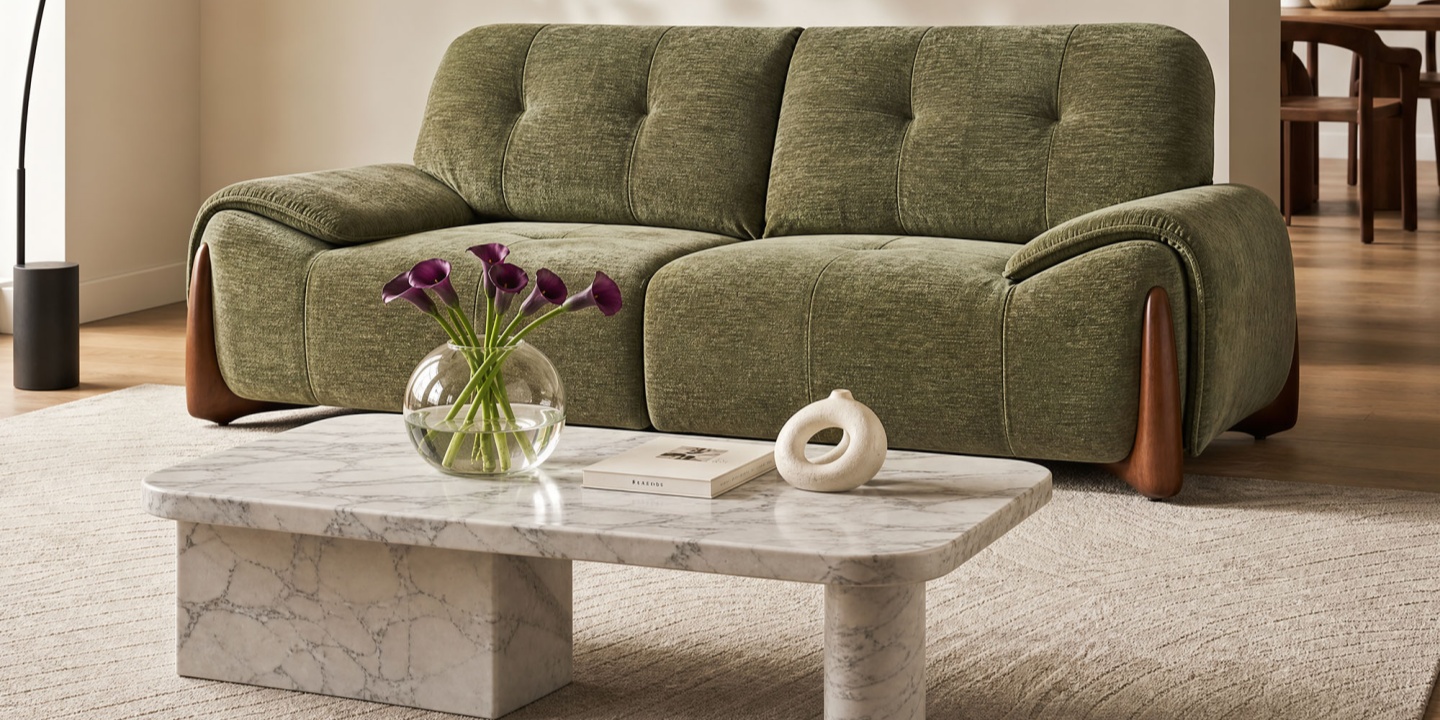
The Frosta 91" Sofa is a useful example. It combines a solid wood and plywood frame with round solid wood legs, curved arms, spill-resistant upholstery treatment, and removable cushion covers.
That last detail matters more than it sounds if you have children, pets, or a habit of eating dinner on the sofa.
One honest trade-off: a substantial frame can be heavy. Plan the delivery route before ordering, and keep furniture sliders handy if you expect to move it for cleaning.

Repair It, Reupholster It, or Replace It
Here's the DIY line, since nobody else draws it clearly.
Do it yourself: Tighten accessible leg bolts and visible frame hardware, replace feet, re-clip an accessible popped spring, replace removable cushion foam, wash removable covers, or repair a loose decorative wood trim piece when the manufacturer allows it.
Call a professional: Anything that requires removing upholstery. A cracked rail, failed corner block, broken arm post, or damaged leg mount usually means opening up the upholstered structure. An upholstery professional can determine whether the frame can be repaired and whether re-covering makes financial sense.
Replace it: Consider replacement when the frame uses weak structural materials, multiple joints are failing, or the repair and re-covering cost approaches that of a comparable new sofa with better construction.
A good hardwood frame can be worth reupholstering because the structural foundation may still have years of useful life left. Doing the same to a failing engineered-board frame is harder to justify.
What to Look for at Different Price Levels
Price is useful context, but it should never be treated as proof of construction quality.
At the lower end of the market, pay particular attention to whether the seller identifies the frame material, structural wood species, and joinery. If those details are missing, don't assume that a higher price solves the problem.
In the middle of the market, look for a clearly specified hardwood-and-plywood construction, appropriate joinery, and a suspension system that is described rather than hidden behind phrases such as "premium comfort."
At the higher end, you may find more traditional joinery, heavier hardwood construction, hand-tied suspension, and higher-end upholstery materials. Those features can justify a higher price, but design, brand positioning, and upholstery can also add substantially to the cost.
The better question isn't:
"How much does this sofa cost?"
It's:
"What construction am I getting for the money?"
That's the comparison that remains useful even when furniture prices change.
FAQs
What type of wood is best for sofa frames?
Kiln-dried hardwood is a strong choice for structural rails, legs, and arm posts. Oak, hard maple, ash, beech, and birch are common options. The species matters, but so do drying, lumber dimensions, and joinery.
Is a solid wood frame sofa better than a plywood frame?
Solid hardwood is a strong choice for high-stress structural members, while quality plywood can be better for flat or curved panels because its cross-laminated layers resist warping. A well-designed sofa can use both.
How long does a wood frame sofa last?
A well-built hardwood frame can remain structurally sound for 15 to 25 years or more under normal use, while upholstery, foam, and suspension components may need attention sooner. Actual service life depends on construction, usage, and environment.
How can I tell if a sofa really has a solid wood frame?
Look for a named wood species and clear information about the frame construction. Then use the lift and rack tests if you can inspect the sofa in person. A frame-specific warranty is useful supporting evidence.
Why does my wood frame sofa creak, and can I fix it?
Occasional settling sounds can happen as wood adjusts to a new indoor environment. A creak that gets louder or happens in exactly the same spot may indicate a loose fastener, spring connection, or frame joint. Check accessible hardware first; structural problems are better handled under warranty or by an upholstery professional.
Are wood frame sofas comfortable, or do they feel too firm?
Comfort comes primarily from the suspension and cushions, not from the frame material itself. A rigid, well-built frame paired with appropriate springs and high-resiliency foam can feel supportive rather than hard.
Do wood frame sofas work in small apartments?
Yes. A raised base and exposed legs can visually lighten a larger sofa, while the right width keeps the room from feeling crowded. Measure both the room and the delivery route before ordering.
How much should I spend on a solid wood frame sofa?
Don't use price as a shortcut for construction quality. At any price, look for a clearly identified structural material, appropriate joinery, a suitable suspension system, and a warranty that explains what happens if the frame fails.
How do you clean and care for the exposed wood on a sofa?
Wipe finished wood with a barely damp cloth and dry it afterward. Keep it away from prolonged direct sun, maintain reasonably stable indoor humidity, use felt pads under the legs, and rotate cushions according to the manufacturer's care instructions.