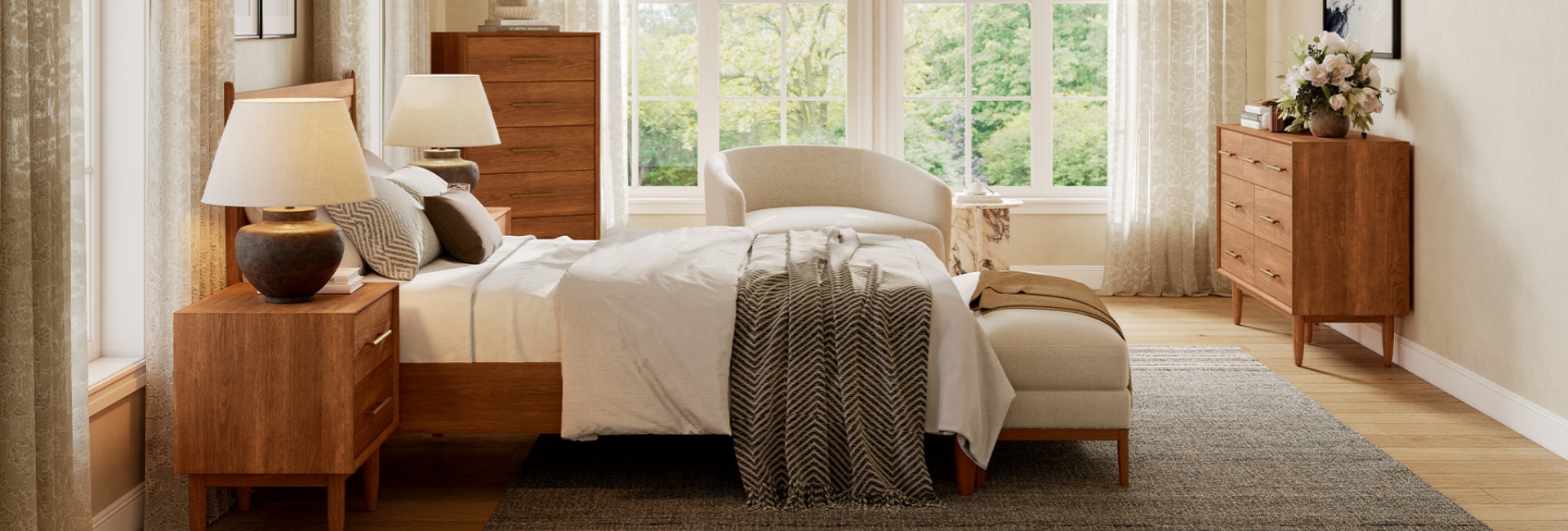
A mid-century modern bedroom design works because the basics are simple: low-profile furniture, warm wood, and a calm palette with just enough color to keep the room from feeling flat. The style feels restful rather than overly decorated, which makes it especially well suited to a bedroom. If you're starting with a blank room, get the furniture silhouette, wood tone, and color base right first. The smaller decisions become much easier after that.
Mid-century modern became widely associated with postwar design in the mid-20th century, when designers increasingly focused on furniture that was useful, uncomplicated, and suited to everyday life. The same less-is-more thinking appeared in the architecture of the era, and the style has stayed relevant because those principles still work. Here's how we'd build a mid-century modern bedroom today, piece by piece, using furniture you can actually live with.
Table of Contents
- What a Mid-Century Modern Bedroom Actually Looks Like
- Choosing the Right Wood Tone for a Mid-Century Modern Bedroom
- The Color Palette That Makes Mid-Century Bedrooms Work
- The Bed Is the Anchor
- Nightstands, Symmetry, and Bedside Calm
- Storage That Earns Its Footprint
- Small Bedroom? Go Vertical With a Chest
- Lighting That Does the Heavy Lifting
- Textiles, Texture, and Bedding
- Bringing It Together: A Six-Step Plan
- Common Mistakes That Break the Look
- Mixing Mid-Century With Other Styles
- FAQs
- What does a mid-century modern bedroom look like?
- What colors are suitable for a mid-century bedroom?
- What wood is best for mid-century modern bedroom furniture?
- Is mid-century modern a good style for a small bedroom?
- What rug size fits a Queen or King bed?
- How can I mix mid-century modern with other styles?
What a Mid-Century Modern Bedroom Actually Looks Like
Before you shop, it helps to know what defines the style. A mid-century bedroom isn't a collection of period props. It's a room where the furniture has a clear purpose, the silhouettes are easy to read, and the overall composition leaves some breathing room.
Clean Lines and Low Profiles
The silhouette is one of the clearest signals of mid-century style. Beds, dressers, and nightstands tend to have streamlined shapes and tapered legs that lift the furniture visually off the floor. That extra view of the floor helps the room feel more open, especially when space is limited.
Avoid bulky, ornate, or heavily carved pieces if you want to keep that visual lightness. You don't need every item to look identical, but the main furniture should share the same simple design language.
Warm Wood as the Foundation
Wood does much of the visual work in a mid-century bedroom. Walnut, teak, and oak are classic choices, and each creates a slightly different mood. What matters most is the overall warmth and consistency of the finish.
Visible grain helps the furniture feel natural rather than overly finished. For bedroom furniture, construction also matters. Kiln-dried wood and well-made joinery can contribute to long-term stability, so don't judge a piece by its silhouette alone.
The Neutral-Plus-Pop Formula
Walls and larger surfaces usually stay quiet: warm white, beige, oatmeal, or soft greige all work well. Then bring in one or two stronger colors through smaller elements such as a throw, pillow, artwork, or lampshade.
Mustard, olive, burnt orange, teal, and terracotta all fit naturally within the mid-century palette. The restraint is what keeps those colors effective. Too many competing accent colors can make the room feel busy and take attention away from the furniture.
Lighting is another important part of the look. Sculptural fixtures, globe pendants, starburst mirrors, and warm bulbs around 2700K can change the character of the room after dark.
Choosing the Right Wood Tone for a Mid-Century Modern Bedroom
Choose your dominant wood tone early. It gives the rest of the room something to work around, from wall color to textiles and accent pieces.
Walnut reads deep and sophisticated. Teak has a golden warmth that feels closely tied to classic mid-century interiors. Warm oak is lighter and more casual, while a reddish-brown finish such as Hernest's Brown Cherry creates a warmer, more approachable look.
The easiest approach is to repeat one dominant finish across the main furniture rather than trying to make several different wood tones compete for attention.
For example, Hernest's Kaden bedroom collection features a Brown Cherry finish and is crafted of rubber wood and engineered wood with cherry veneers. All wood is kiln-dried for added durability. Because the pieces share the same finish and tapered-leg design, they can be combined without making the room feel overly matched.
Here's how common wood tones can shape the room:
If you already own a wood finish you love, use it as your starting point. A second wood can work as an accent, but keeping one finish dominant usually creates a more cohesive room.
The Color Palette That Makes Mid-Century Bedrooms Work
Once the wood tone is established, choose colors that support it rather than compete with it.
Start With Warm Neutrals
Warm off-white, cream, soft greige, mushroom gray, and oatmeal create an easy backdrop for wood furniture. Very cool whites can make warm wood feel more pronounced and the room more stark than intended.
If you want more contrast, consider a single deep olive or moss-green wall behind the bed. A darker accent wall can add depth without making the entire room feel heavy.
Add Earthy Accents in Small Doses
Mustard yellow, olive green, burnt orange, teal, and terracotta are all useful mid-century accents. Use them through textiles, artwork, lighting, or one upholstered chair rather than spreading the same color across every surface.
For example, a mustard throw or olive pillow can echo the warmth of a wood frame without turning the bedroom into a themed space.
Let the Wood Be a Color Too
Your wood furniture occupies a large visual area, so it should be treated as part of the color palette.
If the bed and dresser have a warm Brown Cherry finish, for example, wall colors with similar warmth will generally sit more comfortably beside them. Accent colors can then provide contrast without fighting the furniture.
Think of the wood as the anchor and the stronger colors as supporting elements.
The Bed Is the Anchor
The bed is usually the largest piece in the room, so it sets the direction for everything around it. For a mid-century bedroom, look for a streamlined frame with a low visual profile and a headboard that adds structure without overwhelming the wall.
Headboard: Openwork Beats Bulky
An openwork or slatted headboard can keep the wall visible behind the bed and make the overall composition feel lighter. A heavily padded or oversized headboard can work in other styles, but it often introduces more visual weight than a mid-century room needs.
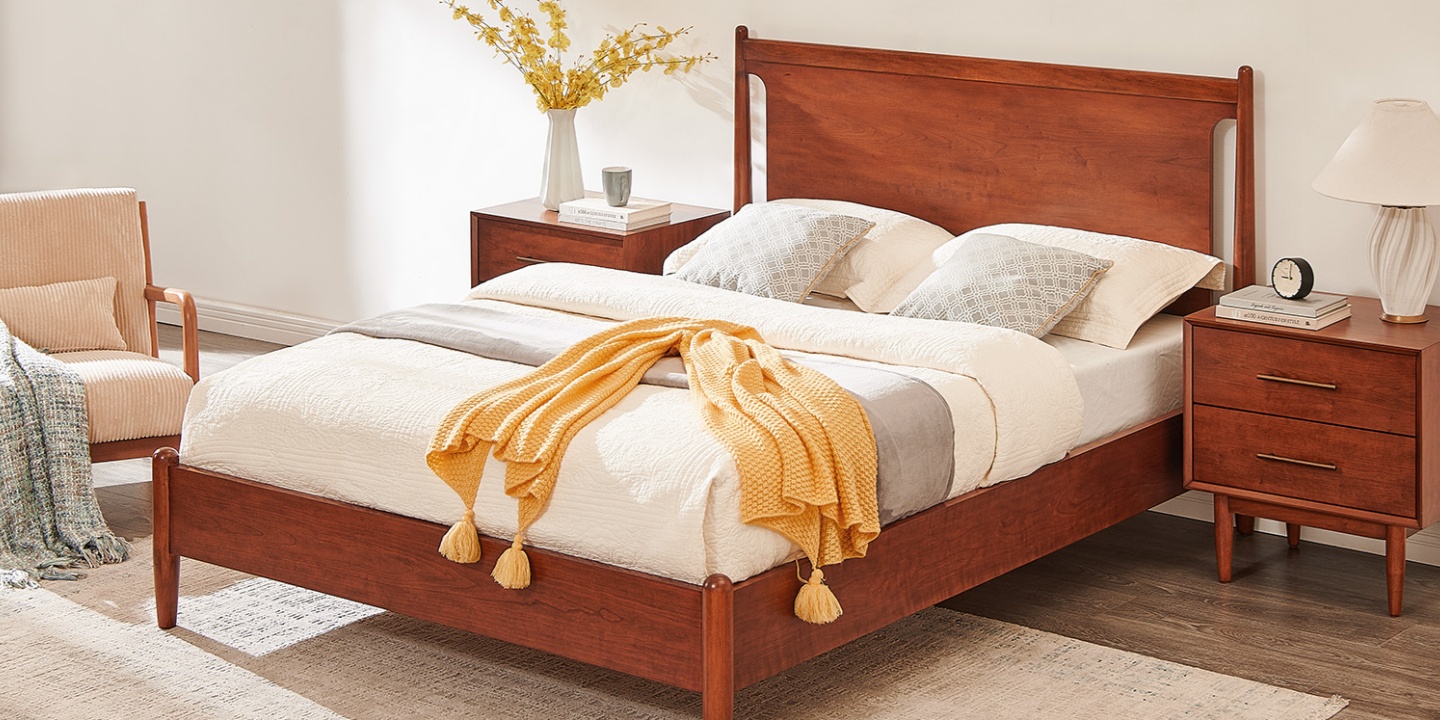
The Kaden Mid-Century Bed carries that look with an openwork headboard, tapered solid-wood legs, and a warm Brown Cherry finish. It comes in Queen and King sizes and is crafted of rubber wood and engineered wood with cherry veneers. All wood is kiln-dried for added durability. Three middle support legs provide additional mattress support.
For placement, start with the longest uninterrupted wall when the room allows. Center the headboard on that wall and leave roughly 24 to 30 inches of walking space around the main circulation areas. Keeping the nightstands close to mattress height also helps the furniture line up visually.
Nightstands, Symmetry, and Bedside Calm
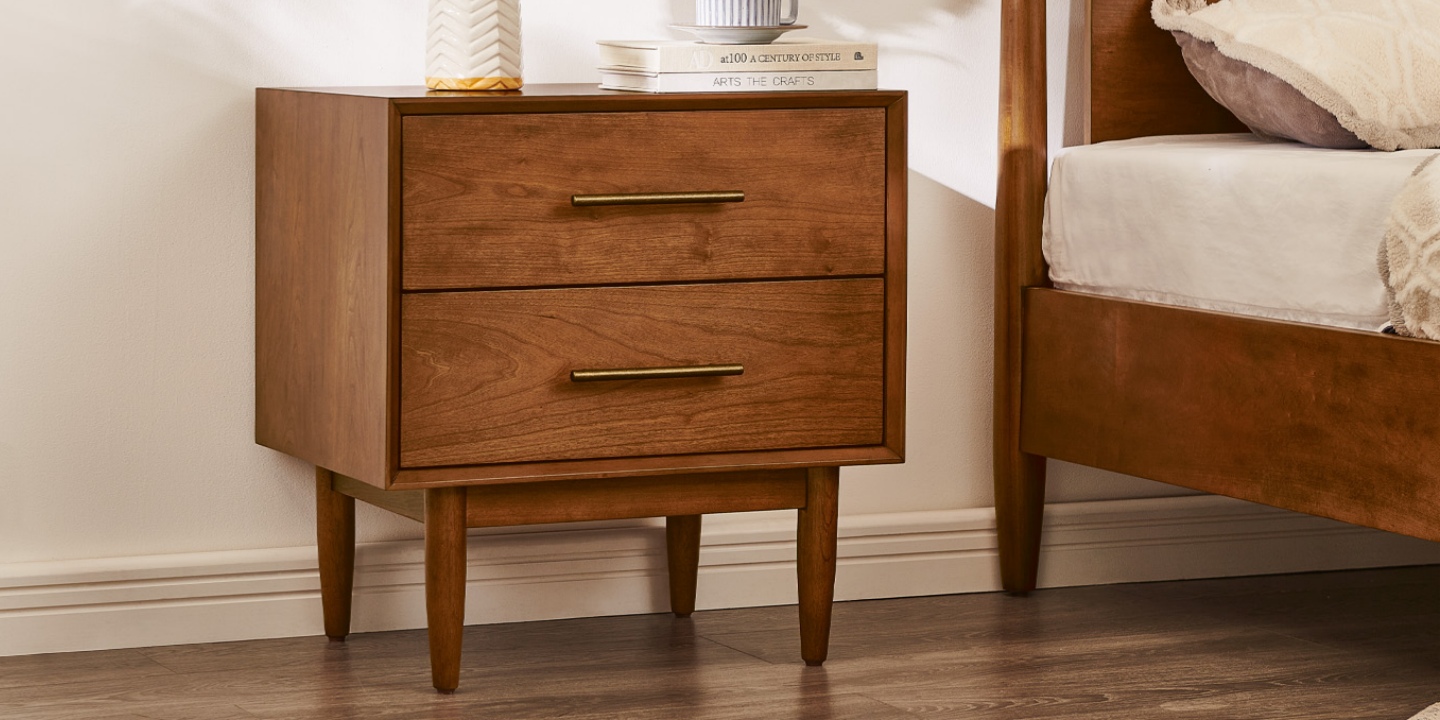
Nightstands are small, but they have a noticeable effect on the balance of the room. A slim pair at roughly mattress height keeps the bedside area useful without making it feel crowded.
Two matching or closely related pieces create symmetry, while their open space underneath helps preserve the room's sense of floor area.
The Kaden 23" Mid-Century Nightstand is 23.6 inches wide with two dovetail-jointed drawers, beveled front edges, and antique bronze hardware. Its proportions make it practical beside a larger bed without visually competing with the headboard.
Keep the surface simple. A lamp, a book, and one small object are usually enough. The less you have to move before bedtime, the better.
Storage That Earns Its Footprint
Storage should solve a problem without becoming the visual focus of the room. A long, low dresser can anchor the wall opposite the bed while providing a useful surface for a lamp, artwork, or mirror.
Dovetail Joints Matter
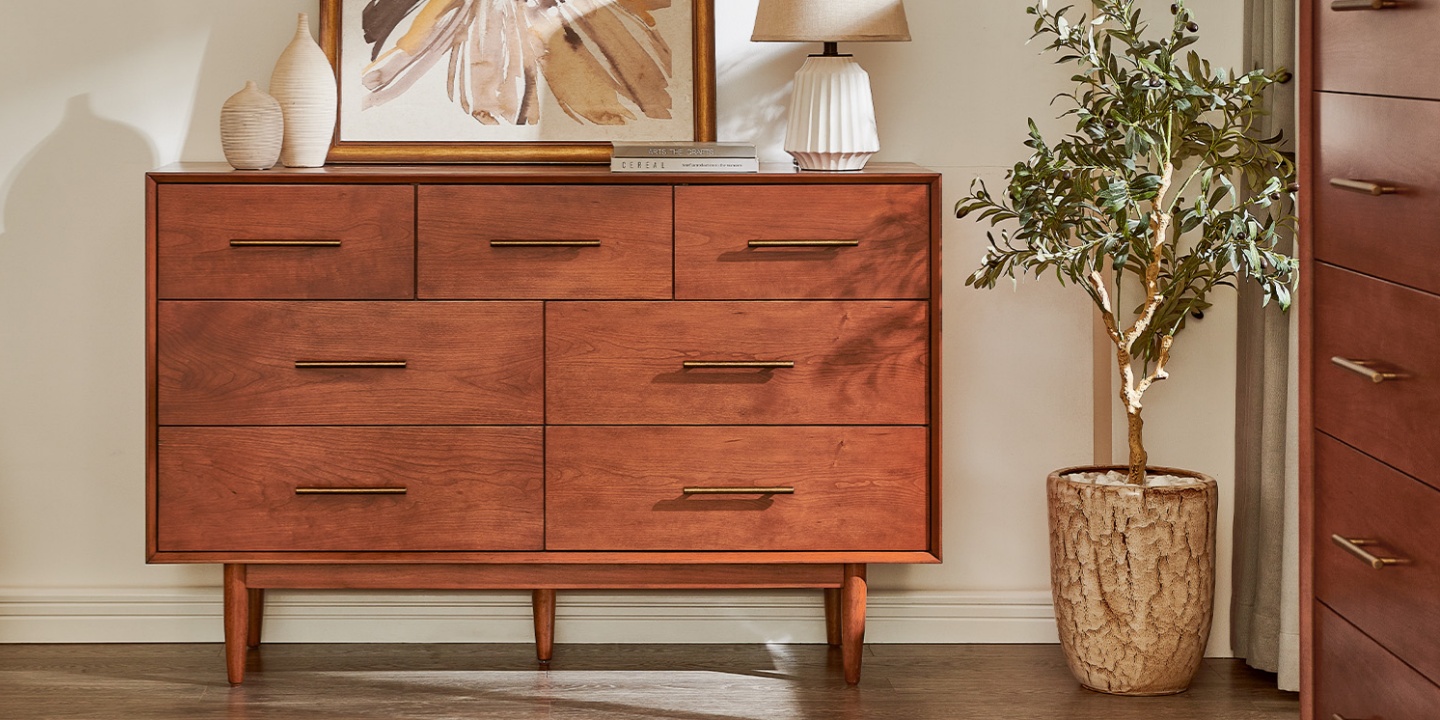
Drawer construction is worth checking when you're comparing dressers. Dovetail joints interlock the drawer sides at the corners, providing a stronger connection than basic butt joints or staples and helping the drawers handle repeated use.
The Kaden 55" Mid-Century 7-Drawer Dresser is 55.8 inches wide with seven dovetail-jointed drawers, beveled front edges, and antique bronze hardware. It also includes an anti-tip kit, which should be used to secure the dresser to the wall.
Place the dresser opposite the bed when the room allows, or use it along another uninterrupted wall. Leave enough clearance for the drawers to open comfortably and keep the top relatively restrained. One lamp and one framed print can be enough.
Small Bedroom? Go Vertical With a Chest
When floor space is limited, vertical storage can be more useful than adding another wide piece. A chest trades width for height, giving you substantial drawer storage without taking up as much floor area.
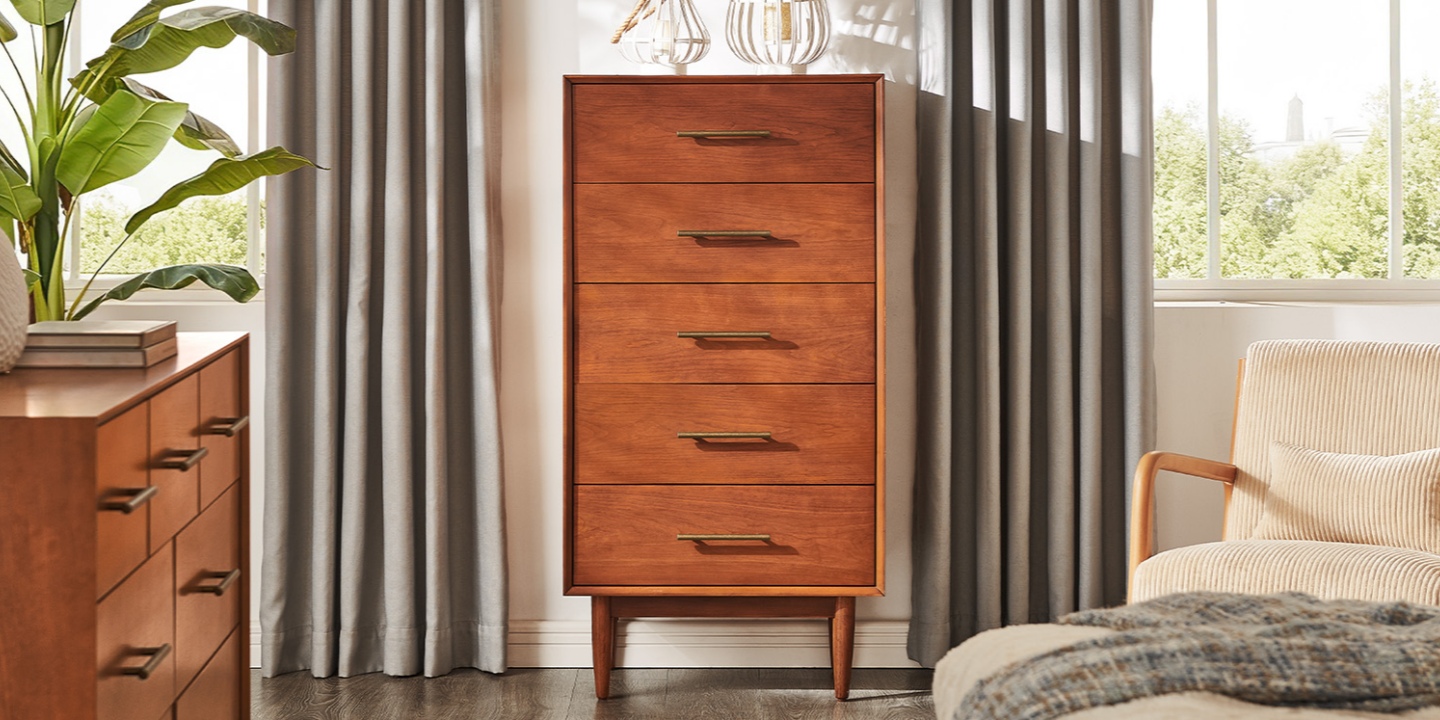
The Kaden 26" Mid-Century 5-Drawer Chest is 26.8 inches wide with five dovetail-jointed drawers and an anti-tip kit. Its proportions make it useful beside a closet or in a corner where a wider dresser would take up too much room.
One caveat: a tall chest naturally draws the eye upward. That's useful when you want some vertical variation, but it can feel heavy if the rest of the room is already crowded. Give it some visual space and let the surrounding furniture stay relatively streamlined.
Lighting That Does the Heavy Lifting
Lighting is easy to underestimate in a bedroom. A single ceiling fixture can provide enough illumination, but it rarely creates the layered atmosphere that works well with mid-century furniture.
Start with a statement fixture such as a sputnik chandelier or globe pendant. At the bedside, ceramic or brass table lamps with drum shades provide softer light for reading. If the room has a chair or reading corner, an arc floor lamp can add another layer without taking up nightstand space.
Wall-mounted swing-arm sconces are another practical option when you want to keep the nightstand surface clear.
Bulb temperature also matters. Warm bulbs around 2700K tend to keep wood tones rich and the room comfortable after dark. Cooler light can make warm finishes look flatter and more stark.
Textiles, Texture, and Bedding
Mid-century rooms should feel comfortable, not overly decorated. Let the furniture provide the structure and use textiles to soften the harder surfaces.
For bedding, solid linen or cotton percale in cream, oatmeal, or warm white provides an easy base. Add one or two pillows that echo the accent color already used elsewhere in the room rather than introducing another unrelated shade.
A chunky knit throw at the foot of the bed adds texture and has a practical purpose during cooler nights.
Mixing materials keeps the room from feeling visually flat. Smooth wood grain can sit alongside a wool rug, woven shades, cotton bedding, or a leather or upholstered chair. A small amount of metal in the lighting or hardware can provide contrast without overwhelming the natural materials.
Bringing It Together: A Six-Step Plan
You don't need to choose everything at once. Work through the room in an order that keeps the larger decisions from fighting each other.
Measure the room. Note wall widths, ceiling height, doors, windows, and existing furniture before buying anything.
Plan clearance. Aim for roughly 24 to 30 inches of walking space around the bed where possible, with more on the main circulation side if the room allows.
Lock the wood tone. Choose one dominant finish and use it across the main furniture pieces.
Set the palette. Start with warm neutrals, then add one or two earthy accent colors.
Place the major furniture. Position the bed first, then the dresser or chest, followed by nightstands and any accent chair.
Layer lighting and textiles. Add rugs, bedding, lamps, artwork, and smaller accessories after the furniture layout is settled.
Rug Size Guide
An 8x10-foot rug is a common starting point for a Queen bed, while a 9x12-foot rug usually provides enough coverage around a King. The exact choice depends on the room dimensions and how much floor you want visible.
Common Mistakes That Break the Look
A few choices can make an otherwise well-planned room feel less cohesive.
Turning the room into a period set. You don't need every object to look like it came from the same decade. A modern print, personal photograph, or inherited textile can make the room feel lived in.
Using several wood finishes equally. Different woods can coexist, but giving every finish the same visual weight makes the room harder to pull together. Let one finish lead.
Relying on one harsh ceiling light. Warm wood and soft bedding need more than a single overhead source. Add bedside or accent lighting to create depth.
Overloading every surface. Mid-century interiors benefit from some empty space. A clear nightstand or lightly styled dresser gives the furniture room to breathe.
Ignoring scale. A room where every piece is low and horizontal can feel visually flat. A floor lamp, plant, mirror, or chest can provide useful vertical contrast.
Mixing Mid-Century With Other Styles
Mid-century modern works well with other styles because its clean lines are relatively easy to combine with different materials and textures. Keep the main furniture language consistent, then let the secondary style show up in smaller details.
With boho: Add rattan, houseplants, and a patterned rug. Keep the wood furniture streamlined so the room doesn't become overly layered.
With Scandinavian: Use lighter woods, wool, and fewer accessories for a quieter interpretation.
With coastal: Bring in blue-gray linen, lighter finishes, and natural textures while keeping the furniture silhouettes clean.
With Japandi: Pair warm wood with restrained accessories, natural materials, and a muted palette.
The easiest rule is to let mid-century define the furniture while the second style influences the textures and accessories. That gives the room a point of view without making it feel like two themes competing for attention.
FAQs
What does a mid-century modern bedroom look like?
It is typically calm and uncluttered, with streamlined furniture, tapered legs, warm wood, and a neutral palette supported by one or two earthy accent colors. Sculptural lighting and simple textiles complete the look.
What colors are suitable for a mid-century bedroom?
Warm neutrals such as cream, beige, oatmeal, and soft greige make good base colors. Mustard, olive, burnt orange, teal, and terracotta work well as smaller accents. Your wood finish should also be treated as part of the overall palette.
What wood is best for mid-century modern bedroom furniture?
Walnut, teak, and oak are classic choices, but there isn't one correct wood. The more useful rule is to choose a dominant tone and repeat it across the main furniture so the room feels cohesive.
Is mid-century modern a good style for a small bedroom?
Yes. Streamlined furniture with visible space underneath can make a small room feel more open. A vertical chest can also provide storage without using as much floor area as a wide dresser.
What rug size fits a Queen or King bed?
An 8x10-foot rug is a common choice for a Queen bed, while a 9x12-foot rug generally gives a King bed more generous coverage. Room dimensions and furniture placement should guide the final size.
How can I mix mid-century modern with other styles?
Keep the main furniture in the mid-century language—streamlined shapes, warm wood, and simple proportions—then introduce another style through textiles, plants, artwork, or accessories. Boho, Scandinavian, coastal, and Japandi can all work well.