In traditional feng shui, the preferred sofa position is usually against a solid wall, with a clear view of the main entrance and enough distance from the direct path of the doorway. This arrangement is often called the command position. It is intended to create a sense of support and awareness of the room.
Real living rooms do not always have the right wall, proportions, or doorway placement to follow this principle exactly. A sofa may need to sit near a window, float in an open-plan space, or face a television rather than the entrance. In these situations, practical considerations such as comfortable circulation, natural light, and access to doors and windows should guide the final layout.
You do not need to follow every traditional feng shui guideline to create a balanced living room. Start with a sofa position that makes the space comfortable and functional, then use feng shui principles as a framework for refining the arrangement.
Table of Contents
- Feng Shui Sofa Placement Starts With the Command Position
- Why a Solid Wall Behind the Sofa Is Preferred
- Can You Put a Sofa in Front of a Window?
- Which Direction Should a Sofa Face in Feng Shui?
- Common Sofa Placement Mistakes to Avoid
- Coffee Tables and Seating Shapes
- Sofa Materials, Shapes, and Colors in Feng Shui
- Feng Shui Sofa Placement for Open-Plan and Small Living Rooms
- How to Choose a Sofa That Fits Your Feng Shui Layout
- Feng Shui Sofa Placement Checklist
- Final Thoughts
- FAQs
- Where should a sofa be placed in feng shui?
- What is the command position for a sofa?
- Is it bad feng shui to put a sofa in front of a window?
- Which direction should a sofa face in feng shui?
- Is a curved sofa better for feng shui than a straight sofa?
- What sofa color is best for feng shui?
- How much space should be left behind a sofa?
- Should a sofa face the front door?
Feng Shui Sofa Placement Starts With the Command Position
The command position is one of the most widely discussed concepts in traditional feng shui. For a sofa, it generally means sitting in a position where you can see the main entrance without being directly aligned with the doorway, ideally with a solid wall behind you.
The idea is that a clear view of the entrance and a supported back create a greater sense of stability. This is a traditional design principle rather than a scientifically established requirement for arranging furniture.
For a useful overview of the concept, see the International Feng Shui Guild's guide to the command position.
Find the Best Wall for Your Sofa
Start by identifying the main entrance to the living room and the walls that can accommodate your sofa. If possible, choose a wall that lets people seated on the sofa see the entrance without placing the seating directly in the doorway's path.
Measure the available wall before choosing a sofa. Include the width of the furniture, its depth, nearby side tables, and enough room to move around it. A sofa that technically fits against a wall can still make the room feel cramped if it obstructs a walkway or leaves too little space for other furniture.
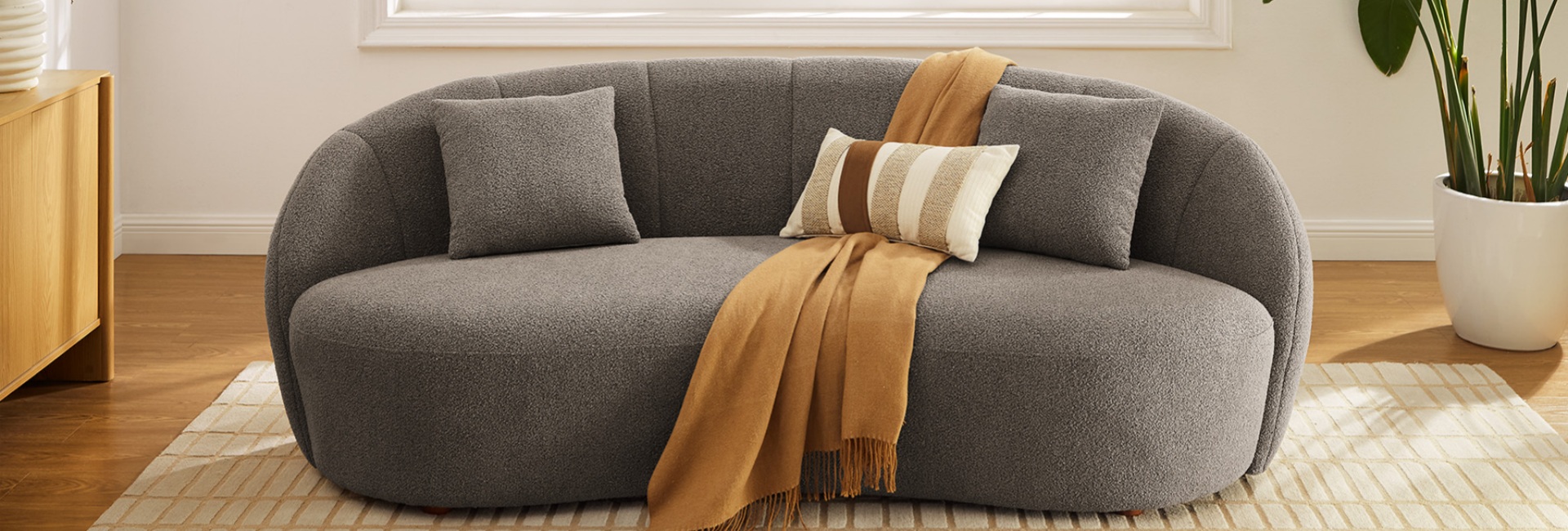
For example, the Frosta 91-Inch Chenille Sofa has a curved back and arms that give it a softer outline. Before choosing a similar shape for a particular wall, check the full dimensions against the room rather than judging fit by width alone.
Keep the Entrance in View Without Blocking the Room
A sofa does not have to face the front door directly. In many layouts, placing it perpendicular to the entrance or at an angle provides a view of the doorway while preserving a more comfortable seating arrangement.
Avoid placing the sofa where it blocks the natural route from the entrance to the rest of the room. If people must squeeze around an armrest or walk between the sofa and a coffee table to enter the space, the layout needs adjustment.
When the ideal command position is not possible, prioritize a clear walkway and a practical furniture arrangement. A comfortable, usable room is more important than forcing a traditional layout into a space that cannot support it.

Frosta 91-Inch Sofa
View Product
Why a Solid Wall Behind the Sofa Is Preferred
Traditional feng shui generally favors placing the main sofa against a solid wall. Symbolically, the wall represents support and stability. It also creates a clear visual boundary for the seating area.
From a practical design perspective, a wall-backed sofa can make furniture placement easier, particularly in smaller living rooms. It establishes a natural anchor for the arrangement and can leave the center of the room open for circulation.
However, a solid wall is not a universal requirement. A sofa can work well in the middle of a room or near a window when the overall layout is thoughtfully planned.
What If You Cannot Place the Sofa Against a Wall?
In an open-plan living room, placing the sofa away from the wall can help define the boundary between the seating area and a dining space or kitchen. The back of the sofa then becomes part of the room's visual layout.
To make this arrangement feel intentional:
-
Place a console table behind the sofa if there is enough clearance.
-
Use a rug to visually connect the sofa, coffee table, and other seating.
-
Add a floor lamp or a carefully positioned plant to help define the seating zone.
-
Keep the route between the sofa and nearby furniture clear.
-
Check that the back of the sofa looks finished from the adjoining room.
In traditional feng shui, some people use a console or another substantial piece of furniture behind a floating sofa to create a stronger sense of support. Treat this as a styling option rather than a mandatory fix.
Can You Put a Sofa in Front of a Window?
Yes. You can place a sofa in front of a window if the room layout requires it. Traditional feng shui generally prefers a solid wall behind the main seating, but a window-side arrangement is not automatically wrong.
The practical questions are whether the sofa blocks too much daylight, interferes with window operation, restricts access to curtains or blinds, or makes the seating area uncomfortable.
A low-backed sofa may preserve more of the view and allow light to travel through the room. In a smaller space, placing the sofa near a window can also free up a more useful wall for storage or a television.
How to Make a Window-Side Sofa Work
Consider the window's size, sill height, and how the room is used before deciding where the sofa should go.
-
Protect window access. Make sure you can open windows, operate blinds, and reach curtain panels without moving the sofa every time.
-
Check the sofa's height. A tall back may cover a large part of the window, while a lower profile can keep more of the glass visible.
-
Leave room for window treatments. Curtains should be able to hang and move freely rather than becoming trapped behind the furniture.
-
Avoid forcing the sofa against the glass. Leave enough room for the window hardware, cleaning, and any ventilation needs.
-
Consider a visual buffer. If the layout allows, a narrow console behind the sofa can create a more defined boundary between the seating and window area.
The amount of space needed will depend on the window design, furniture dimensions, and how frequently the window is used. There is no single gap that works for every room.
Which Direction Should a Sofa Face in Feng Shui?
There is no single compass direction that is best for every sofa. Recommendations can vary among feng shui schools and may depend on the home's orientation, the room's layout, and the particular system being followed.
For most everyday living rooms, begin with the practical layout. The sofa should support conversation, provide a comfortable view of the room, and work with the location of the television, windows, and other furniture.
Consider Natural Light and Screen Glare
Notice how daylight moves through the room during the hours when you normally use it. A sofa facing a bright window may be comfortable for conversation but could create glare on a television opposite it. Direct sunlight can also make a seat too warm at certain times of day.
If the living room is used mainly for watching television, test the viewing angle and screen reflections before settling on the final position. If the room is primarily for conversation, consider how easily people seated on the sofa can interact with someone in an armchair or adjacent seating.
These practical factors are not substitutes for traditional feng shui teachings. They are additional considerations that help make the room work for everyday life.
Should You Choose a Lucky Compass Direction?
Some feng shui systems use compass directions and personal or household information to recommend particular orientations. Those recommendations are not identical across all traditions, so it is misleading to claim that every sofa should face south, east, or another fixed direction.
If you follow a specific school of feng shui, use its guidance consistently. Otherwise, choose an orientation that balances the entrance, light, conversation, and circulation rather than changing a functional layout to meet a universal direction rule.
Common Sofa Placement Mistakes to Avoid
Even when a layout follows several traditional feng shui principles, it may not feel right if the furniture interferes with how the room is used. Check these common problems before finalizing the arrangement.
Blocking the main walkway. A sofa should not make it difficult to move from the entrance to another part of the home. Look at the route people actually take, not just the space visible on a floor plan.
Sitting directly in the doorway's path. In traditional feng shui, this is generally less desirable than a position where the entrance remains visible but the sofa is not directly aligned with it. If the room is too narrow to avoid this completely, prioritize a safe and convenient route.
Leaving the seating area without a clear anchor. A floating sofa can work well, but without a rug, side table, console, or coordinated seating, the arrangement may feel disconnected from the rest of the room.
Ignoring windows and natural light. Furniture should not unnecessarily block daylight, access to window treatments, or ventilation. A layout that looks balanced from one angle may be inconvenient in daily use.
Overlooking the space needed for moving parts. Extendable seats, recliners, drawers, and other moving components require room to operate. Check the full footprint of the furniture in use, not only its closed dimensions.
Forcing symmetry into an awkward layout. Matching lamps and side tables can look balanced, but they are not essential. A single side table, floor lamp, or appropriately sized accent chair may work better when the room has uneven dimensions.
Placing furniture where it creates an uncomfortable overhead or corner condition. If a low ceiling beam, projecting corner, or sharp furniture edge makes a seat feel awkward, consider shifting the sofa or changing the surrounding furniture. These concerns are best assessed in the context of the actual room rather than treated as universal prohibitions.
Coffee Tables and Seating Shapes
The sofa should work with the coffee table and other seating, not be planned in isolation. The size, shape, and placement of these pieces affect how easily people can move through the room and how naturally the furniture supports conversation.
A rectangular coffee table often pairs well with a straight sofa. A round or oval table can soften an arrangement with several straight edges, while a compact table may be more practical in a narrow room. Choose a shape based on the sofa's proportions and the available floor space rather than assuming one form is inherently better in feng shui.
The same principle applies to seating layouts:
-
Straight sofa: Works well along a wall and can keep the arrangement simple.
-
L-shaped seating: Helps define a corner or separate a living area from an adjoining zone.
-
U-shaped seating: Can encourage conversation in a larger room but requires enough space to avoid crowding.
-
Sofa with separate chairs: Offers flexibility when you want to adjust the seating arrangement or preserve an open route through the room.
Whatever the configuration, make sure the coffee table is easy to reach from the main seats and does not interrupt the natural path through the room. The right proportions depend on the dimensions of the furniture and the people using it.
Sofa Materials, Shapes, and Colors in Feng Shui
Traditional feng shui interpretations associate certain colors and materials with different elements and symbolic qualities. These associations can inform a decorating scheme, but they should not be presented as proven ways to attract luck or produce a specific outcome.
When selecting a sofa, consider how its upholstery, color, and silhouette work with the room's lighting, flooring, wall color, and other furniture.
Choose Upholstery for the Way You Live
Fabric, chenille, microfiber leather, and other upholstery options create different visual and tactile effects. The best choice depends on household needs, maintenance preferences, and the overall design.
For example, the Rufus 92-Inch Sofa uses Juniper Chenille upholstery and channel-tufted detailing. Its green tone can be incorporated into a nature-inspired palette. In some traditional feng shui interpretations, green is associated with the wood element, but that association is a stylistic and symbolic choice rather than a universal rule for sofa color.
If you prefer a more neutral look, consider how beige, greige, brown, or other understated tones work with the flooring and wall color. Upholstery performance and cleaning requirements should also factor into the decision, especially in homes with children or pets.
Consider Shape and Visual Weight
A sofa's silhouette affects how much space it appears to occupy. Rounded arms and curved backs can soften a room dominated by straight lines, while a more angular design may suit a structured layout.
Neither shape is inherently better for feng shui. Choose one that fits the available space and the atmosphere you want to create. A bulky sofa may overwhelm a small room, while a very light-looking design may feel undersized in a large open-plan space.
The goal is to achieve proportions that feel appropriate to the room rather than follow a fixed rule about furniture shape.

Rufus 92-Inch Sofa
View Product
Feng Shui Sofa Placement for Open-Plan and Small Living Rooms
Open-plan and compact living rooms often need more flexibility than traditional layouts allow. The sofa may need to sit away from a wall, share space with a dining area, or fit around a doorway or window.
In these situations, establish the main seating zone first. Then arrange the remaining furniture around the way people enter, walk through, and use the room.
Open-Plan Living Rooms
A sofa can help separate a living area from a dining room or kitchen without requiring a physical divider. Position it so that the seating area feels distinct while leaving a clear path between the zones.
A rug can visually connect the sofa and coffee table. A console behind the sofa may add a surface for lighting or accessories, provided it does not make the route too narrow. If the sofa faces away from the entrance, consider whether people seated there can still see enough of the surrounding space for the arrangement to feel comfortable.
Small Living Rooms
In a small room, prioritize usable floor space over strict adherence to an idealized layout. A sofa against a wall may preserve the center of the room, but a corner arrangement or a carefully positioned compact sofa may work better depending on the location of the doors and windows.
Measure the full depth and width of each piece. Also account for the coffee table, side tables, and the space needed to sit down and stand up comfortably.
For a larger living area, the Warren 124-Inch Power Sofa Bed illustrates why it is important to plan for the furniture's operating footprint. Its powered seats extend forward, so the room needs sufficient clearance in front of the sofa when the seats are extended.
For any power sofa, check the manufacturer's dimensions and operating requirements before deciding where to place it. A layout that works when the seats are closed may become inconvenient when they are extended.
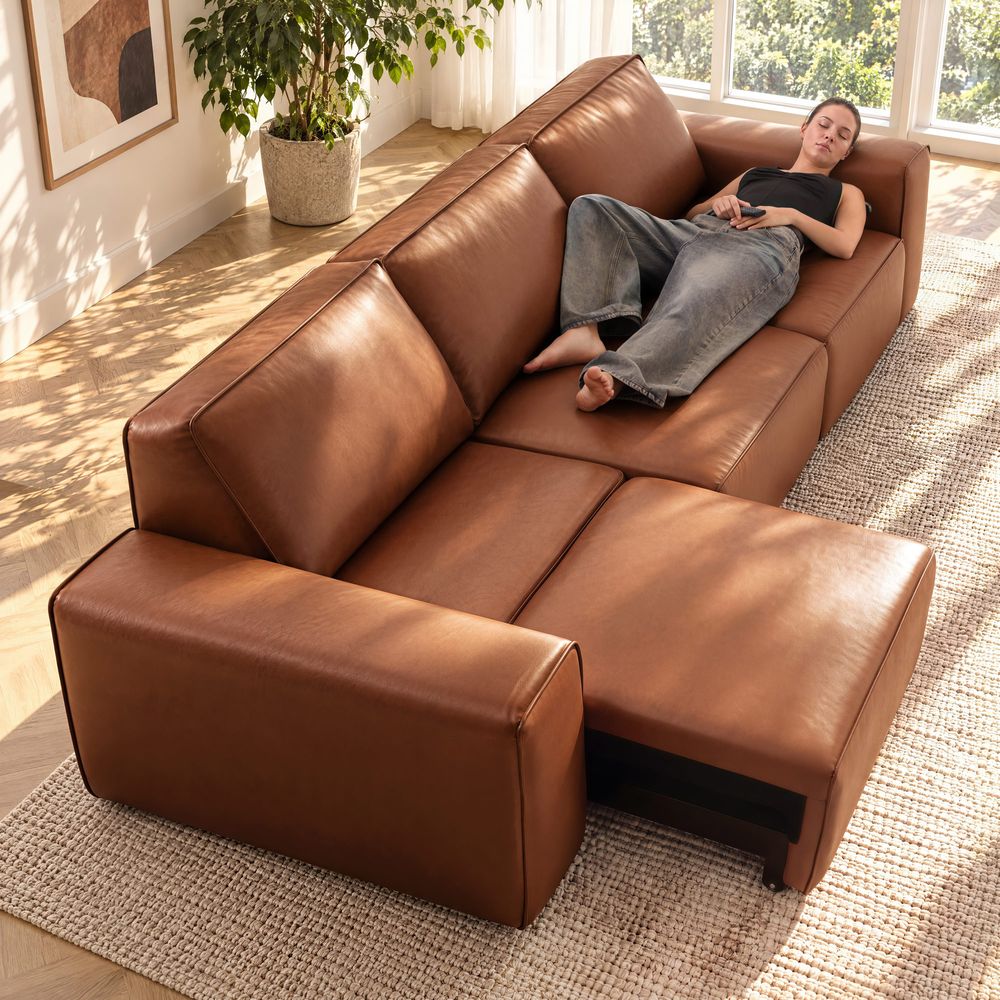
Warren 124-Inch Power Sofa Bed
View Product
How to Choose a Sofa That Fits Your Feng Shui Layout
The best sofa for a feng shui-inspired room is one that supports the intended layout without compromising comfort or everyday use. Before buying, check these details.
Measure the available area. Record the width and depth of the intended sofa location, along with doorways, windows, and nearby furniture. Check the full footprint rather than relying on a product name or width alone.
Consider the back of the sofa. If the sofa will float in the room, its rear appearance matters because it may be visible from the entrance, dining area, or kitchen. A console table can sometimes help finish the arrangement.
Plan for circulation. Make sure people can enter the room, reach other seats, and move between living areas without awkward detours. Do not sacrifice a comfortable route just to place the sofa against a particular wall.
Check functional requirements. Consider upholstery maintenance, seating depth, cushion support, and any moving parts. For a powered sofa, confirm how far the seat extends and whether that movement will affect nearby furniture.
Match the sofa to the room's scale. A sofa that is too large may dominate a compact living room, while a small sofa can feel disconnected in a spacious layout. Compare dimensions and proportions before making a decision.
Explore Hernest's sofas and loveseats collection to compare styles and sizes. Use the room's measurements and intended arrangement to narrow your options rather than choosing based on appearance alone.
Feng Shui Sofa Placement Checklist
Before finalizing your layout, use this practical checklist:
-
Can you see the main entrance from the sofa, if the room allows?
-
Is the sofa positioned so it does not unnecessarily block the doorway or main walkway?
-
Does the seating arrangement feel visually anchored, whether against a wall or in the middle of the room?
-
Can you open windows and use curtains or blinds without difficulty?
-
Is there enough room to move around the sofa and reach the coffee table?
-
Does the sofa's size suit the room and the other furniture?
-
If the sofa has powered or moving components, is there enough space for them to operate?
-
Does the arrangement support the way your household actually uses the room?
You do not need every answer to be yes for the room to work. Use the checklist to identify practical issues and decide which traditional feng shui principles are most relevant to your layout.
Final Thoughts
Feng shui sofa placement offers a useful framework for thinking about support, visibility, and the flow of a living room. A solid wall behind the sofa and a view of the entrance are common traditional preferences, but they are not the only factors that determine whether a layout works.
Start with the room's actual dimensions, windows, doors, and everyday routines. Then adjust the sofa's position, surrounding furniture, and visual balance to create a space that feels comfortable and functions well. The strongest layout is one that respects the principles you value without making the room harder to use.
FAQs
Where should a sofa be placed in feng shui?
Traditional feng shui generally favors placing the sofa against a solid wall, with a clear view of the main entrance and outside the doorway's direct path when possible. The final position should also allow comfortable movement through the room.
What is the command position for a sofa?
The command position is a traditional feng shui arrangement in which the main seat has a view of the entrance without being directly aligned with it. A solid wall behind the sofa is generally preferred as a symbol of support.
Is it bad feng shui to put a sofa in front of a window?
Not necessarily. Traditional feng shui usually prefers a solid wall behind the sofa, but a window-side sofa can still be practical. Keep the window accessible, avoid unnecessarily blocking daylight, and choose a position that works with the room's layout.
Which direction should a sofa face in feng shui?
There is no universally correct direction for every sofa. Recommendations vary by feng shui tradition. For everyday planning, consider the entrance, natural light, conversation, and the location of other furniture before deciding on the sofa's orientation.
Is a curved sofa better for feng shui than a straight sofa?
Neither shape is universally better. A curved sofa may soften a room with many straight lines, while a straight sofa may be easier to place along a wall. Choose the shape that fits the room's dimensions and supports comfortable movement.
What sofa color is best for feng shui?
There is no single best color for every living room. Traditional feng shui systems associate colors with different elements, but those interpretations vary. Choose a color that works with the room's existing palette, lighting, and practical needs.
How much space should be left behind a sofa?
There is no universal clearance that applies to every sofa and room. If the sofa is against a wall, leave enough space for the furniture's design, cleaning, cables, or ventilation where needed. If it floats in the room, make sure the space behind it supports comfortable circulation.
Should a sofa face the front door?
A sofa does not have to face the front door directly. In traditional feng shui, being able to see the entrance without sitting directly in its path is generally preferred. A side-facing arrangement may achieve this while providing a more practical seating layout.