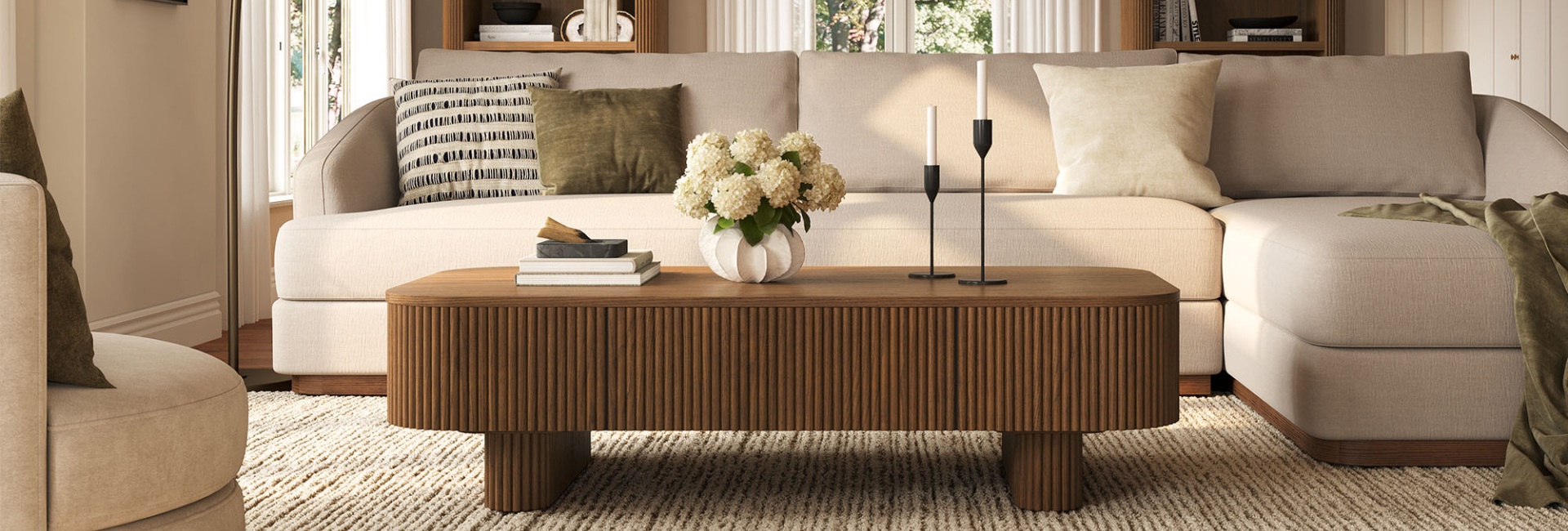
Choosing a coffee table for a sectional is less about picking a style you like and more about getting the proportions right. A sectional serves multiple seating positions at once, so the table needs to be accessible from the main seating area without blocking the chaise, walkway, or surrounding furniture.
A useful starting point is to size the coffee table to about two-thirds of the longest straight seating run, keep the tabletop level with or slightly below the seat cushion, and leave roughly 14 to 18 inches of space between the sectional and table. These guidelines are not hard rules, but they provide a practical starting point for most living rooms.
The sectional is the fixed piece. The coffee table should be adjusted around it.
Table of Contents
- Quick Answer: What Size Coffee Table Works With a Sectional?
- Why a Sectional Changes Coffee Table Sizing
- Four Measurements to Take Before Shopping
- What Size Coffee Table for a Sectional?
- How High Should a Coffee Table Be With a Sectional?
- How Much Space Should Be Between a Sectional and Coffee Table?
- Best Coffee Table Shapes for Different Sectionals
- Should a Sectional Have One Coffee Table or Two?
- Coffee Table Storage: Drawers, Lift Tops, and Open Surfaces
- How to Match the Coffee Table to Your Sectional
- Coffee Table Safety for Homes With Kids or Pets
- Common Coffee Table Mistakes With Sectionals
- A Quick Coffee Table for Sectional Checklist
- FAQs
- What type of coffee table is best for a sectional sofa?
- What is the best coffee table size for a sectional sofa?
- How far should a coffee table be from a sectional?
- Should a coffee table be lower than the couch?
- Is a round or rectangular coffee table better for a sectional?
- What coffee table works with an L-shaped sectional?
- What coffee table works with a U-shaped or curved sectional?
- What coffee table material works well for homes with kids or pets?
Quick Answer: What Size Coffee Table Works With a Sectional?
For most L-shaped sectionals, start with a coffee table about two-thirds the length of the longest straight seating run, without counting the chaise. A 90-inch main seating run, for example, can often work with a table around 54 to 60 inches long.
For height, aim for a tabletop that is level with the seat cushion or about 1 to 2 inches lower. Leave approximately 14 to 18 inches between the front of the sectional and the coffee table, then adjust the placement based on the chaise and nearby walkway.
The best shape depends on the sectional layout:
-
L-shaped sectional: Rectangle or oval
-
U-shaped sectional: Round or square
-
Curved sectional: Round
-
Modular or flexible layout: Nesting tables or two smaller tables
Why a Sectional Changes Coffee Table Sizing
A standard sofa gives you one long seating line, so positioning a coffee table is relatively straightforward. A sectional creates multiple seating angles, a corner, and often a chaise that extends farther into the room.
That changes how the table should be measured.
The commonly cited two-thirds rule still provides a useful starting point, but you should apply it to the longest straight seating run, rather than the entire sectional footprint. Including the chaise in the measurement can make the table unnecessarily long and leave less room for movement.
The shape of the sectional also matters. An L-shaped sectional has a different center point from a U-shaped or curved design. A table that works well in one configuration may feel too long, too narrow, or difficult to reach in another.
For example, the curved profile of the Krono Chaise Sectional Sofa calls for a more flexible approach to placement. Its rounded seating profile makes a hard rectangular table more visually prominent, while a table that follows the main seating run can create a more cohesive arrangement.
Think of the sectional as the starting point. The table should fit the seating arrangement rather than determine it.
Four Measurements to Take Before Shopping
Before choosing a coffee table, measure the sectional in its actual position in the room.
1. Measure the Seat Height
Measure from the floor to the top of the seat cushion. Many sectional seats fall around 17 to 19 inches high, but your own sectional should determine the final table height.
2. Measure the Longest Straight Seating Run
For an L-shaped sectional, measure the main straight section without including the chaise. This measurement is the starting point for the two-thirds sizing guideline.
3. Measure the Chaise Depth
The chaise extends farther into the room than the standard seating section. Knowing its depth helps you determine how far the coffee table can extend without interfering with the lounging area or walkway.
4. Measure the Available Walking Space
Look beyond the sectional itself. Measure the distance between the seating area and nearby walls, media consoles, accent chairs, or the main walkway.
These measurements help answer three practical questions:
-
Can everyone comfortably reach the table?
-
Can people move around the sectional without squeezing past it?
-
Does the table have enough visual weight to balance the sectional?
A right-facing chaise model such as the Valky Chaise Sectional Sofa shows why chaise depth matters. The chaise occupies more floor space than the standard seating section, so the table should be positioned around the actual seating and circulation pattern rather than simply centered within the room.
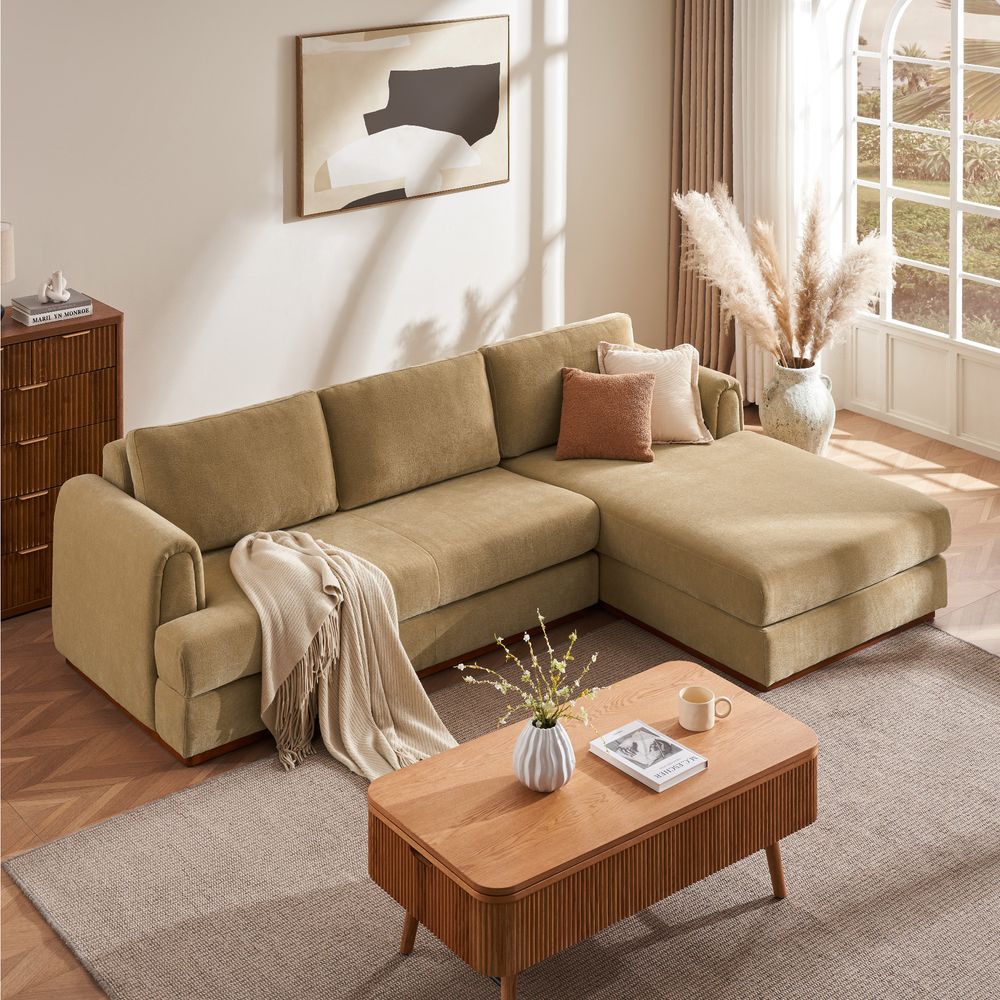
Valky Chaise Sectional Sofa
View Product
What Size Coffee Table for a Sectional?
A useful starting point is to make the coffee table approximately two-thirds the length of the longest straight seating run.
For example:
-
72-inch main seating run → about 48 inches
-
84-inch main seating run → about 56 inches
-
90-inch main seating run → about 60 inches
-
96-inch main seating run → about 64 inches
These are starting points, not fixed requirements. The available floor space, table shape, sectional depth, and surrounding furniture can justify choosing a shorter table.
For an L-shaped sectional, a coffee table around 28 to 32 inches deep is often practical because it provides enough surface without taking over the center of the room. U-shaped sectionals may accommodate a larger round or square table because the table is accessed from multiple sides.
Coffee Table Size and Shape by Sectional Layout
As a general guideline, avoid making a single coffee table longer than the main seating run unless the room has enough open floor space to support it.
If a large sectional makes one coffee table look undersized, consider two smaller tables instead of automatically choosing a much larger piece. This can provide a better balance between surface area and circulation.
How High Should a Coffee Table Be With a Sectional?
The coffee table should generally be level with the seat cushion or about 1 to 2 inches lower.
If your sectional has a 17-inch seat height, a table around 15 to 17 inches high may feel natural. A 19-inch seat could work with a table around 17 to 19 inches, depending on the design and how the table is used.
For low-profile sectionals with seats around 14 to 16 inches high, look toward the lower end of the range.
The goal is comfortable reach. A table that is noticeably higher than the seat can feel visually heavy and make it harder to reach drinks or other items while seated.
Measure your sectional instead of relying solely on a standard coffee table height.
How Much Space Should Be Between a Sectional and Coffee Table?
A common starting point is about 14 to 18 inches of clearance between the front edge of the sectional and the coffee table.
This range provides enough room for people to sit comfortably while keeping the table close enough to reach.
You may need to adjust it depending on the room:
-
Less than 14 inches: Can feel tight and restrict movement.
-
Around 14–18 inches: A practical range for many living rooms.
-
More than 18 inches: May make the table harder to reach, although a larger room may allow more space.
For an L-shaped sectional, center the table around the main seating run first. If the chaise user has difficulty reaching the table, adjust the table toward the chaise while checking that the main walkway remains clear.
A simple way to test the layout is to use painter's tape to mark the proposed table footprint. Sit in each seat, reach toward the center, stand up, and walk around the table. This lets you test the proportions before purchasing.
Best Coffee Table Shapes for Different Sectionals
The sectional's layout is usually the best starting point for choosing the table shape.
L-Shaped Sectionals: Rectangle or Oval
A rectangular coffee table is a practical match for most L-shaped sectionals because its long sides follow the main seating run.
An oval table provides a similar amount of usable surface while removing the sharp corners. That can be useful when the inside corner of the sectional sits close to a walkway.
A rectangular lift-top model can also add storage and work-from-home functionality. The Magnus 47-Inch Lift-Top Oak Coffee Table combines a rectangular profile with a lift top and hidden storage, making it suited to living rooms where the coffee table also needs to serve as a flexible work surface.
At 47 inches long, it can be considered for shorter main seating runs where a 55- or 60-inch table would take up too much floor space.
Oval Tables for Tighter Corners
An oval table can be particularly useful when the inside corner of an L-shaped sectional is close to a circulation path.
Removing the corners gives people more room to move around the table without sacrificing the full surface area of a rectangular design.
This is less about following a strict design rule and more about solving a practical circulation problem.
U-Shaped Sectionals: Round or Square
U-shaped sectionals have seating on three sides, so the center table needs to be accessible from multiple directions.
A round table works well because there is no single orientation. A square table can also work when the sectional has a relatively symmetrical footprint.
A starting point for a round table is around 42 to 48 inches in diameter, while a square table around 40 to 44 inches can work in a similarly proportioned layout.
For smaller U-shaped arrangements, reduce the table size rather than forcing a large table into the center.
Curved Sectionals: Round Tables
A round table is often the easiest shape to pair with a curved sectional because it follows the general flow of the seating and eliminates sharp corners.
The Magnus 39-Inch Round Lift-Top Oak Coffee Table uses a round top with tapered solid oak legs and hidden storage. Its smaller footprint can work where a rectangular table would interfere with the curve or surrounding circulation.
The table does not need to exactly mimic the sectional. The goal is to keep the center of the seating group visually balanced and easy to navigate.
Chaise and Modular Sectionals: Follow the Main Run
For a sectional with a chaise, a rectangular or oval table generally works well when its long side follows the main seating run.
Avoid extending the table so far toward the chaise that it becomes a barrier between the chaise and the rest of the room.
Modular sectionals require more flexibility. If you frequently change the configuration, nesting tables or two smaller coffee tables can be more practical than one large fixed piece.
Nesting tables provide one surface for everyday use and can be separated when additional surface area is needed. Two separate tables provide similar flexibility without requiring them to fit together.
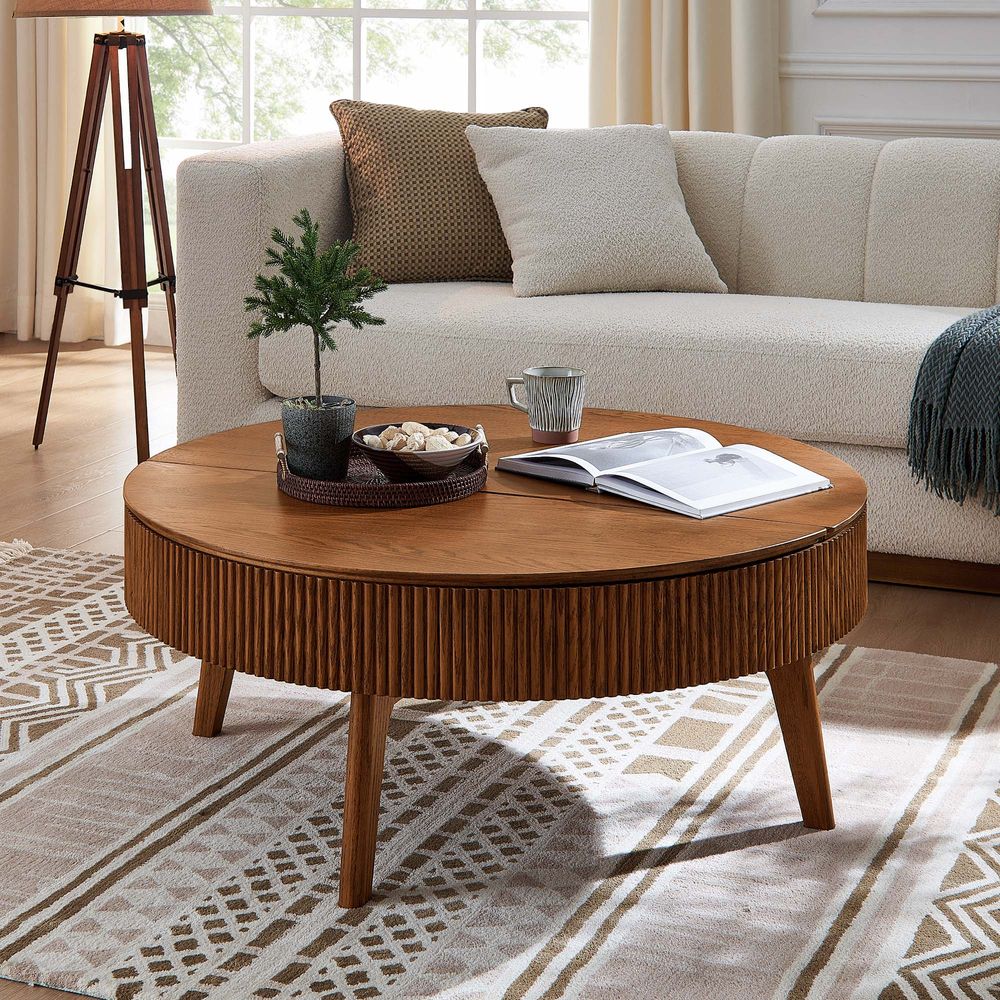
Magnus 39-Inch Lift-Top Oak Coffee Table
View Product
Should a Sectional Have One Coffee Table or Two?
One coffee table is not the only option.
Two smaller tables can make sense when:
-
The sectional is particularly large.
-
A single table would need to be unusually long.
-
The chaise sits far away from the main seating area.
-
You regularly rearrange a modular sectional.
-
The room has several circulation paths.
The key is proportion. Two tables should look intentional rather than like two unrelated pieces placed in the same room.
A nesting set offers another option. Keep the tables together for everyday use, then separate them when guests need additional surfaces.
For smaller rooms, two compact tables can also make it easier to maintain clear walkways than one oversized coffee table.
Coffee Table Storage: Drawers, Lift Tops, and Open Surfaces
The coffee table often becomes the central storage point in a living room. Remotes, books, chargers, and other everyday items tend to collect there.
A table with drawers or concealed storage can keep the surface clear without adding another storage cabinet to the room.
The Skimra 55-Inch Oak Coffee Table combines a 55-inch tabletop with hidden dovetail drawer. Its longer proportions can work with a larger L-shaped sectional where a smaller table would look undersized.
Lift-top tables provide another type of functionality. The top can raise to create a more convenient surface for working, eating, or using a laptop before returning to a standard coffee table height.
The trade-off is that the lifting mechanism can add weight and bulk. If you do not need the extra function, a fixed-top table may be simpler.
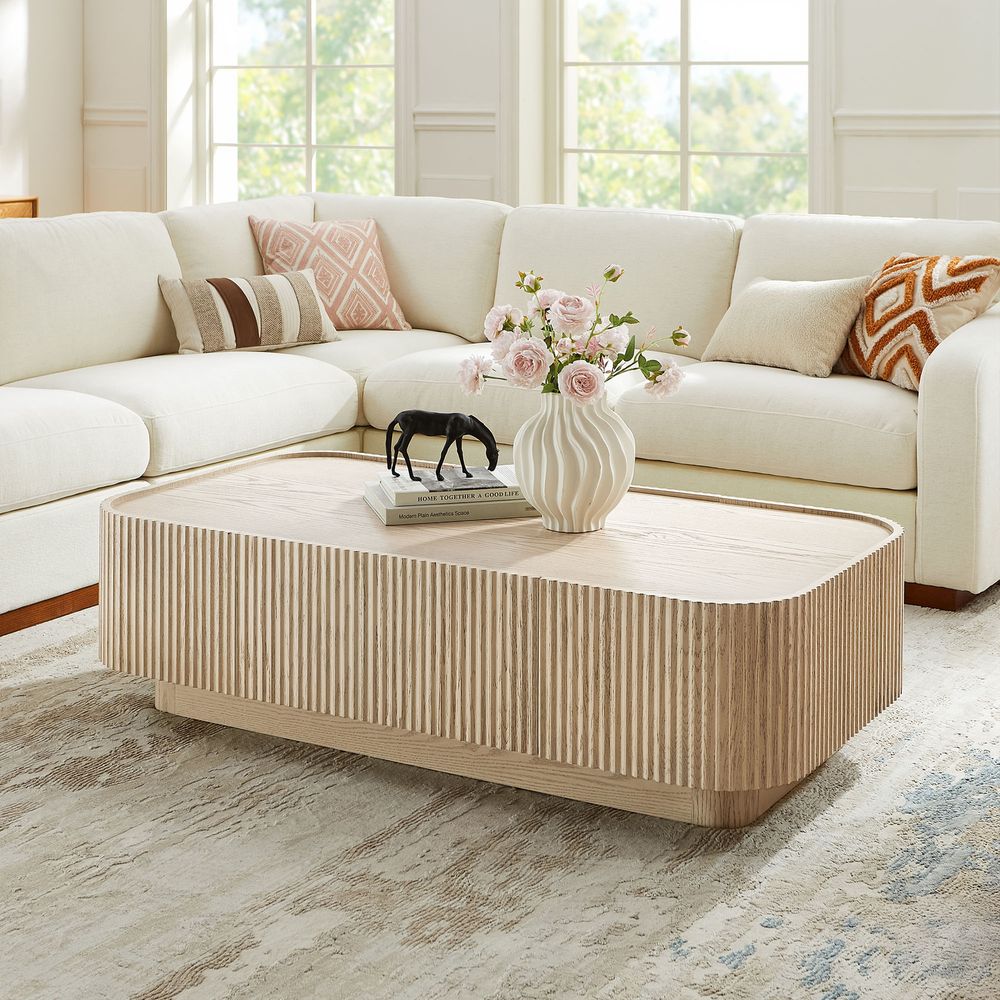
Skimra 55-Inch Oak Coffee Table
View Product
How to Match the Coffee Table to Your Sectional
The coffee table does not have to be an exact material or color match for the sectional or other wood furniture.
Instead, look for a relationship between the finishes.
For example, different wood species can work together when their tones complement each other. A warm oak table can work alongside other warm wood finishes without requiring an exact match.
Exact near-matches can sometimes look less intentional than complementary finishes. Consider:
-
Overall wood tone
-
Grain direction and visibility
-
Upholstery color
-
Metal accents
-
Visual weight
-
Existing flooring and media furniture
If the sectional has a strong color or textured upholstery, a simpler wood table can provide contrast without competing with the seating.
In a smaller room, a glass top or open base can preserve more visual space. In a larger room with several lighter pieces, a substantial wood table can help anchor the seating arrangement.
Coffee Table Safety for Homes With Kids or Pets
Stability matters when a coffee table is used in a home with young children or pets.
A low, wide base can provide a more grounded profile than a tall, narrow pedestal. Rounded corners can also reduce the impact of sharp edges in high-traffic areas.
The U.S. Consumer Product Safety Commission's Anchor It program provides general guidance on furniture stability and anchoring. For a coffee table specifically, focus on a stable base, secure construction, and a layout that leaves enough space for safe movement.
If children regularly climb on furniture, no coffee table shape or material should be treated as completely risk-free. Supervision and a stable room layout remain important.
Common Coffee Table Mistakes With Sectionals
Buying the Table Before Measuring the Sectional
A table that looks proportional online can feel completely different once it is placed next to a deep sectional.
Measure the sectional in its actual room position before shopping.
Making the Table Too Long
The chaise should not automatically be included in the two-thirds calculation. Start with the longest straight seating run and adjust based on the available floor space.
Choosing the Wrong Height
A table significantly higher than the seat can feel awkward to use. Start around the seat height or 1 to 2 inches below it.
Centering on the Entire Sectional Footprint
With an L-shaped sectional, the visual center of the whole sofa is not necessarily the best position for the coffee table.
Start with the main seating run and adjust toward the chaise if needed.
Ignoring the Walkway
A table can be correctly sized for the sectional but still be too large for the room.
Always check the path between the coffee table, chaise, media console, accent chairs, and nearby doors.
Matching Every Wood Finish Exactly
Furniture does not need to come from the same wood species or finish. Look for complementary tones and proportions instead of trying to make every piece identical.
A Quick Coffee Table for Sectional Checklist
Before choosing a table, check these six things:
-
Measure the seat height and look for a table at or slightly below the cushion.
-
Measure the longest straight seating run and use about two-thirds as a starting length.
-
Check the chaise depth so the table does not interfere with the lounging area.
-
Leave roughly 14–18 inches of clearance between the sectional and table, then adjust for the room.
-
Choose the shape based on the layout: rectangle or oval for L-shaped, round or square for U-shaped, and round for curved sectionals.
-
Tape the proposed footprint on the floor and test every seat before buying.
If one table cannot satisfy the layout without crowding the room, consider two smaller tables, a nesting set, or a storage ottoman.
For more options, explore Hernest's coffee tables and sectionals.
FAQs
What type of coffee table is best for a sectional sofa?
It depends on the sectional layout. Rectangular or oval tables generally work well with L-shaped sectionals, while round or square tables can suit U-shaped layouts. Round tables are often a practical choice for curved sectionals.
What is the best coffee table size for a sectional sofa?
A useful starting point is about two-thirds the length of the longest straight seating run, without counting the chaise. For a 90-inch main run, a table around 54 to 60 inches long may work well, depending on the room and surrounding furniture.
How far should a coffee table be from a sectional?
About 14 to 18 inches is a useful starting range between the sectional and coffee table. Adjust the distance based on the sectional depth, walkway, and how easily people can reach the table from each seat.
Should a coffee table be lower than the couch?
The tabletop should generally be level with the seat cushion or about 1 to 2 inches lower. Measure your sectional rather than relying on a standard table height, especially if the sofa has a low-profile seat.
Is a round or rectangular coffee table better for a sectional?
Rectangular tables work well with long L-shaped seating runs, while round tables are useful for U-shaped or curved layouts. Oval tables offer a middle ground when you want the surface of a rectangle without sharp corners.
What coffee table works with an L-shaped sectional?
A rectangular or oval table is usually a practical starting point. Position it around the main seating run and adjust it toward the chaise if the chaise user cannot comfortably reach the table.
What coffee table works with a U-shaped or curved sectional?
Round or square tables generally work well with U-shaped sectionals because they provide access from multiple sides. For curved sectionals, a round table often follows the seating arc more naturally and avoids sharp corners.
What coffee table material works well for homes with kids or pets?
Solid wood can be a practical choice because it provides a stable, substantial base. Rounded or softened edges can also be useful in high-traffic rooms. Regardless of material, choose a stable design and keep enough space around the table for safe movement.