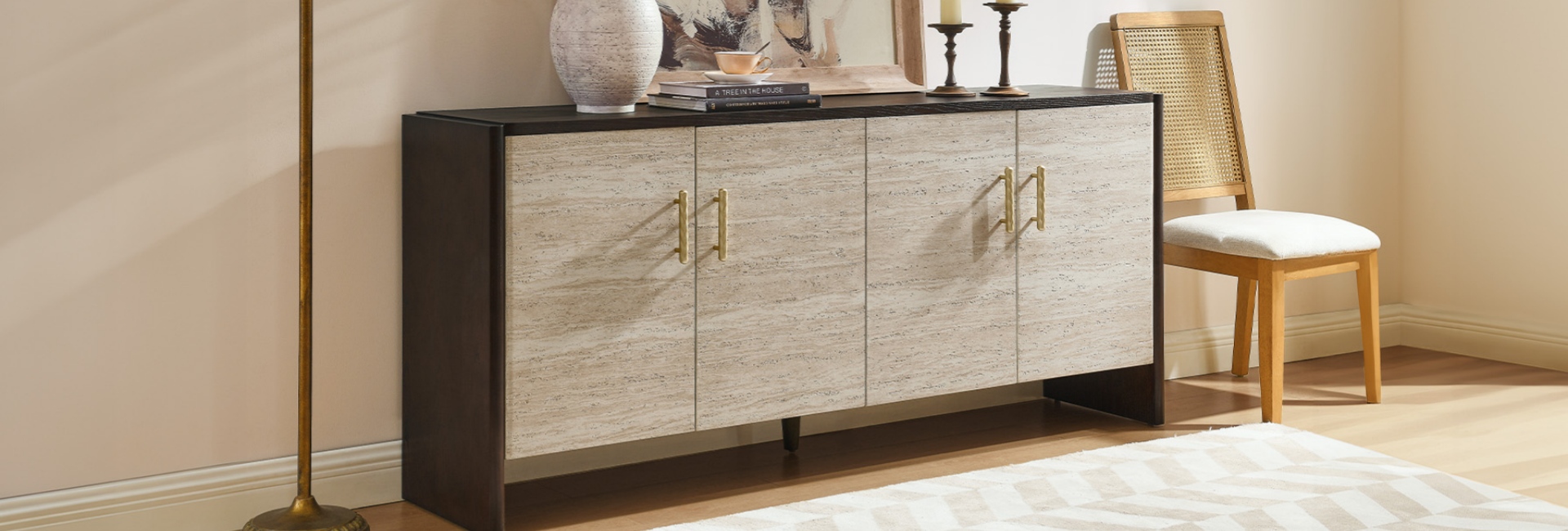
An entryway sideboard can solve one of the most common problems in a front-door hall: not having enough storage for the things you carry in and out every day. Keys, mail, sunglasses, the dog leash, a pair of shoes you actually wear, and the package that just arrived all need a place to land. A sideboard gives them a closed home while providing a surface to style, so the first thing guests see feels finished rather than frantic.
If you're standing in a narrow hallway wondering whether a low storage cabinet will fit, the answer usually comes down to depth and clearance. Get those measurements right, then choose the storage layout and finish that fit how you actually use the space.
Table of Contents
- Why an Entryway Sideboard Is an Upgrade Worth Considering
- What a Sideboard Is and What It's Used For
- How to Measure an Entryway So the Sideboard Fits
- Sideboard for Entryway: A Storage Map That Actually Sticks
- Sideboard With Drawers: Look at the Construction, Not Just the Finish
- Wood, Finish, and Why an Entryway Can Be Hard on Furniture
- Make It the Focal Point: Styling an Entryway Sideboard
- Common Entryway Sideboard Mistakes and the Easy Fixes
- Is a Sideboard Worth It in a Tiny Apartment Entry?
- Where to Start This Weekend
- FAQs
- Can you put a sideboard in an entryway?
- What is a sideboard used for?
- What is the difference between a sideboard and a console table?
- How deep should an entryway sideboard be?
- How wide should a sideboard be for an entryway?
- How much clearance do you need in front of an entryway sideboard?
- Should an entryway sideboard have drawers or cabinets?
- Which materials work well for an entryway sideboard?
- How do you style a sideboard in an entryway?
Why an Entryway Sideboard Is an Upgrade Worth Considering
Most people treat the entry as a pass-through, not a room. That makes sense until you notice how much daily activity happens there. Shoes, reusable bags, umbrellas, winter hats, packages, and other small items tend to collect on the floor or migrate to the nearest kitchen counter.
A basic console table gives you a ledge for a bowl of keys, but it doesn't offer much room to hide the rest. A sideboard is different because its main function is enclosed storage. Behind the doors and drawers, everyday items can have a designated place instead of becoming another pile to move later.
The other concern is size. A sideboard can look too substantial for an entryway if you choose one based only on its appearance. For this room, dimensions matter more than the name on the product page. A shallower model can preserve more walking space, while the right width can make a long wall feel intentional rather than crowded.
What a Sideboard Is and What It's Used For
A sideboard is a low storage cabinet, usually around waist height, with a combination of drawers, doors, or shelves. Traditionally, sideboards were used in dining rooms to hold china, linens, and serveware. Today, the same basic format works anywhere you need concealed storage and a usable surface.
Here's how the storage changes by room:
-
Dining room: dinnerware, flatware, table linens, and serveware.
-
Living room: board games, remotes, books, and other items you want out of sight.
-
Home office: paper, tech accessories, office supplies, or a printer.
-
Entryway: keys, mail, pet gear, scarves, umbrellas, bags, and everyday shoes that fit the cabinet dimensions.
Sideboard, Buffet, or Credenza? The Name Matters Less Than the Specs
Retailers often use these terms somewhat interchangeably. Historically, a buffet tended to be associated more closely with dining, while a credenza was often lower and could have sliding doors. A sideboard generally referred to a longer storage piece used for dining and serving.
Modern furniture catalogs don't always follow those distinctions consistently. For an entryway, the product label matters less than the specification sheet. Check the height, depth, width, interior storage, and door or drawer configuration. Those measurements tell you much more about whether the piece will work in your space.
Sideboard vs. Console Table: Which Works Better in an Entryway?
Both pieces can work near a front door, but they solve different problems. A console table is typically slimmer and more focused on display, while a sideboard gives you substantially more enclosed storage.
If your main problem is visible clutter, the enclosed storage of a sideboard can make a bigger difference. If you already have storage elsewhere and mainly want a styled landing spot, a console table may be enough.
How to Measure an Entryway So the Sideboard Fits
Measure before you choose a finish. In an entryway, three dimensions matter most: width, furniture depth, and the walking clearance left after the piece is installed.
Width: Leave Some Breathing Room
A practical starting point is to leave roughly 3 to 6 inches of wall space on each side of the sideboard rather than pushing it tightly from corner to corner.
For example, on a 60-inch wall, a 48- to 54-inch sideboard leaves some visual breathing room. For a longer wall or a generous foyer, a 72-inch sideboard can work well if the surrounding space supports it.
As a proportion guideline, a sideboard around two-thirds of the wall length can create a balanced look, but the surrounding furniture, doors, trim, and artwork also matter. Don't treat the ratio as a hard rule.
Sideboard Depth: Start Around 14–16 Inches for a Narrow Hall
Depth is often the measurement that determines whether an entryway feels comfortable or cramped.
For a narrow hallway, a sideboard around 14 to 16 inches deep is often easier to live with because it provides useful storage without projecting too far into the walking path. Many standard sideboards are closer to 18 to 20 inches deep, which can work well in dining or living rooms but may feel bulky in a corridor.
Before buying, measure from the wall outward and mark the proposed footprint with painter's tape. Walk through the space with a bag, coat, or laundry basket in your hands. That simple test gives you a better sense of the real-world clearance than the floor plan alone.
Walking Clearance: Aim for at Least 30 Inches
Furniture depth and walking clearance are two different measurements.
After accounting for the sideboard itself, aim for at least 30 inches of open floor in front of it. Around 36 inches can feel more comfortable in a busy hallway, especially when drawers or doors need to open into the circulation area.
If a door, closet, staircase, or another piece of furniture shares the same path, measure the entire route rather than checking the sideboard in isolation.
Sideboard for Entryway: A Storage Map That Actually Sticks
The advantage of a sideboard is not simply having more storage. It's being able to give different types of clutter a predictable home.
Drawers for the Daily Grab-and-Go
Use drawers for the small things you touch every day. Keys, wallets, sunglasses, spare change, dog leashes, and phone chargers are easier to manage when they have a dedicated compartment.
A simple divider tray can keep the contents from turning into one pile. Put the highest-frequency items in the top drawer so they are available with one quick pull.
Cabinets for Bulky or Less Attractive Items
Cabinets work better for things that take up more space or don't need to be visible. Depending on the cabinet dimensions, that can include reusable shopping bags, umbrellas, hats, scarves, pet supplies, or a few pairs of everyday shoes.
Adjustable shelves are especially useful because storage needs change. You may want room for taller boots in winter and baskets or folded bags during another season.
A Zoning Table You Can Copy
The exact arrangement will depend on the sideboard you buy, but the principle is simple: high-frequency items should be easiest to reach, while bulky or seasonal items can go farther inside.
Sideboard With Drawers: Look at the Construction, Not Just the Finish
If you're buying a sideboard with drawers, pay attention to how the drawers are built and operated. The finish is easy to evaluate from a product photo; construction details require a closer look at the specifications.
Dovetail Joints, Soft-Close, and Push-to-Open
Dovetail joints are interlocking joints commonly used in drawer construction. They connect the drawer sides and front securely and can be more durable than simpler joining methods.
Soft-close runners can be useful in a busy household because they reduce the impact when drawers close. Push-to-open fronts are another practical feature in a tight entryway because they eliminate protruding handles that can catch on clothing as people pass.
The Hernest Ragnar 72" Sideboard, for example, combines dovetail-jointed drawers with push-to-open doors and a Warm Brown Oak finish. At 72.2 inches wide, it is better suited to a longer entry wall or a larger foyer than a narrow corridor.
Shallow vs. Deep Drawers: Match the Drawer to the Contents
Shallow drawers work well for flat or small items such as mail, chargers, napkins, and other everyday accessories. Deeper drawers can hold bulkier items but are easier to overfill.
If a sideboard includes both, use the shallow drawer for daily grab-and-go items and the deeper drawer for less frequently used belongings. A divider or tray can keep the contents from disappearing into the back.
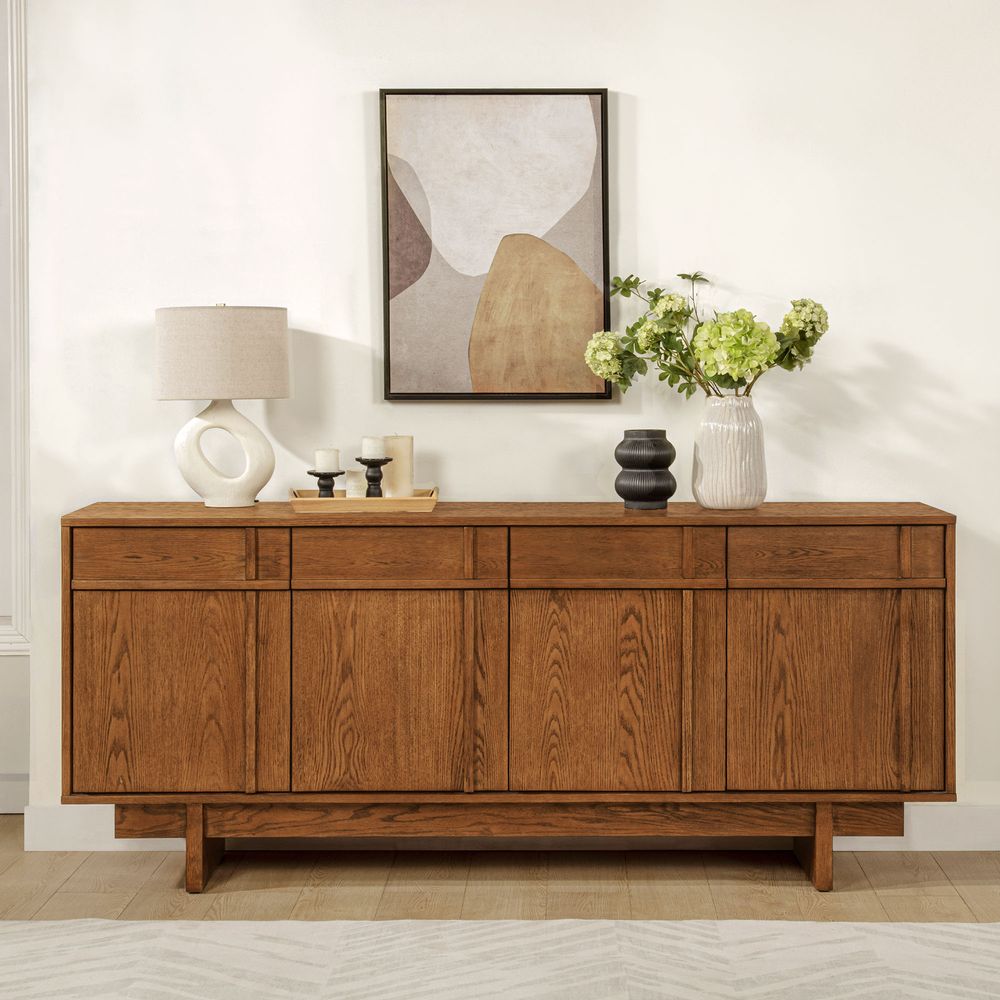
Ragnar 72" Oak Sideboard
View Product
Wood, Finish, and Why an Entryway Can Be Hard on Furniture
The entryway is a high-traffic part of the home. Bags swing against furniture, shoes get kicked off nearby, sunlight may fall across the surface, and the top can become a temporary landing spot for packages.
That makes material and finish worth considering alongside appearance.
Solid Oak, Rubber Wood, and Veneer: Read the Spec Sheet
Don't rely on the word "wood" alone when comparing sideboards. Look at which materials are used for the frame, panels, drawers, and veneer.
Solid oak can provide a durable frame and visible grain. Rubber wood is commonly used for supporting components, while engineered wood with an oak veneer can provide stable, consistent surfaces for larger panels.
Kiln-dried wood is another specification worth noticing because controlled drying reduces the amount of moisture in the material before construction. A wire-brushed finish can also add texture to the grain and make minor surface marks less noticeable than they might be on a very smooth, glossy finish.
Oak is one practical option for a busy entryway because it is relatively hard and durable. The Wood Database lists Janka hardness values of roughly 1,290 pounds-force for red oak and 1,360 pounds-force for white oak, although the exact value varies by species and sample.
The broader takeaway is more useful than any single hardness number: compare the construction, finish, and material placement rather than choosing a sideboard based only on the word "wood" in its title.
Walnut Tone vs. Black Oak: Connect the Finish to the Room
Finish can either blend the sideboard into the room or make it a focal point.
A Warm Brown Oak or walnut-toned finish can work naturally with medium and lighter floors, especially when repeated in another wood or metal detail elsewhere in the room. A matte or lower-sheen finish can also make everyday dust and fingerprints less noticeable.
Black Oak creates more contrast and can anchor a lighter entryway. It works particularly well against pale walls or light flooring when you want the furniture to stand out.
Rather than matching every finish in the room, pick one existing element—such as the floor tone, cabinet hardware, or another piece of furniture—and use it as the connection point.
The Hernest Vera 72" Sideboard is an example of a more visually prominent option. Its arched front and Black Oak finish give it a stronger presence than a conventional rectangular sideboard, while the dovetail drawers provide enclosed storage. At 72 inches wide, it is more appropriate for a wider wall or generous foyer than a narrow corridor.
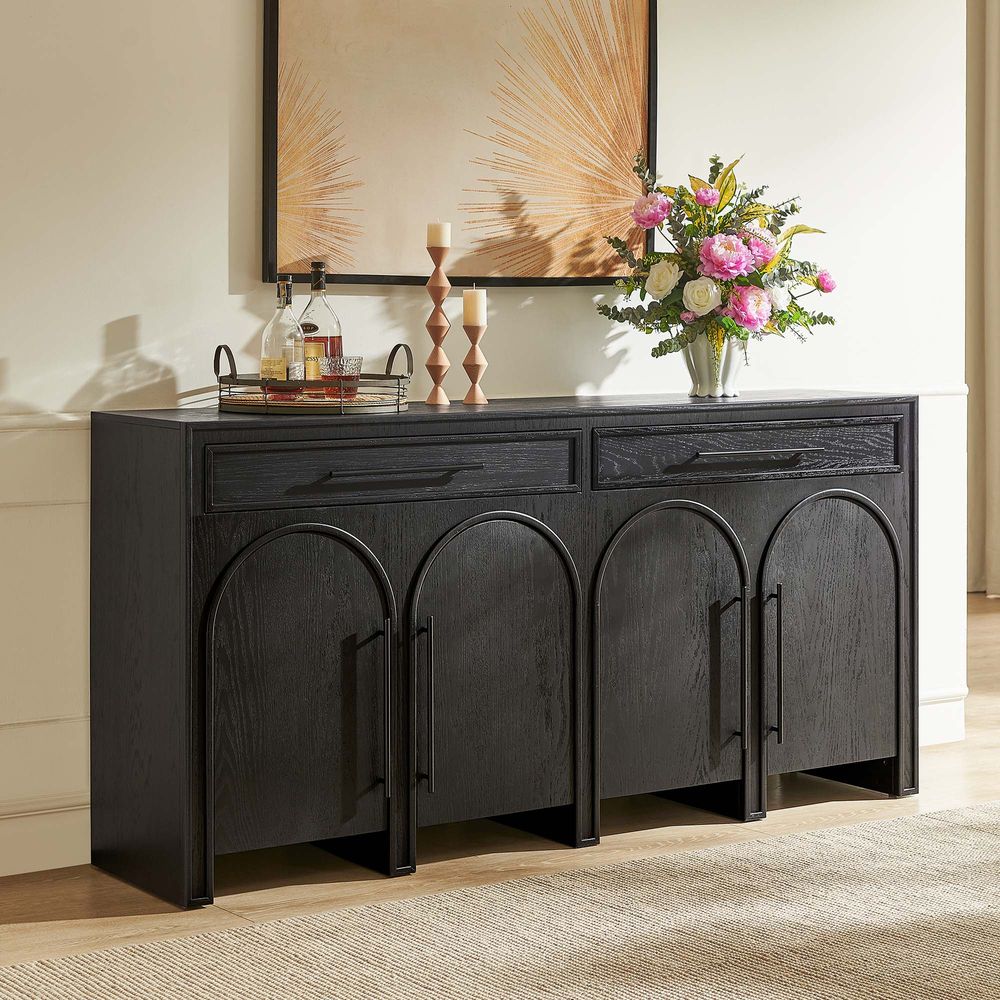
Vera 72" Sideboard
View Product
Make It the Focal Point: Styling an Entryway Sideboard
Once the storage is sorted, the top gives you a chance to make the entry feel finished. You don't need to cover every inch. A few well-placed pieces usually work better than a crowded display.
The Mirror Trick and a Simple Rule of Three
A mirror above the sideboard can reflect light and give you a convenient last-minute check before leaving the house. As a starting point, leave about 6 to 10 inches between the cabinet top and the bottom of the mirror, adjusting for the mirror's size and the proportions of the wall.
For the surface itself, try three different heights:
-
Tall: a lamp, vase, or branches
-
Medium: a small stack of books or decorative tray
-
Low: a bowl, candle, or catch-all dish
Keeping roughly a third of the surface open can prevent the arrangement from feeling crowded and leaves room for practical items.
Lighting and a Tray That Catches the Chaos
A small lamp on one end of the sideboard adds useful light in the evening and can make the entry feel warmer. A shallow tray on the other end creates a designated landing spot for coins, lip balm, keys, or other small items.
The tray also makes cleanup easier. Instead of moving several small objects individually, you can move the whole tray when you need the sideboard top for a package, plant, or other temporary item.
Common Entryway Sideboard Mistakes and the Easy Fixes
A few problems come up repeatedly when a sideboard is chosen for an entryway.
-
Going too deep for the hall. Measure the furniture depth and the remaining walking clearance separately. For a narrow corridor, a 14- to 16-inch-deep piece can be easier to accommodate.
-
Buying doors when you really need drawers. List what you plan to store before choosing the layout. Small, frequently used items are easier to organize in drawers.
-
Choosing a finish that fights the room. Connect the sideboard to one existing wood or metal tone rather than trying to match every finish.
-
Styling the top to the brim. Leave some negative space and rotate decorative pieces rather than treating every inch of the surface as display space.
Is a Sideboard Worth It in a Tiny Apartment Entry?
A slim sideboard can be useful in a small apartment, particularly when the home has no defined entryway.
If you don't have a separate hall, look for a piece around 14 to 16 inches deep and place it against a wall near the door, provided the remaining clearance works for your layout. A mirror above it can visually define the area without requiring a large piece of furniture.
A floating shelf with baskets can work when you mainly need a small drop zone, but it won't provide the same enclosed storage as a sideboard. If your clutter includes bags, shoes, pet supplies, or other bulky items, cabinet storage can be more practical.
The other advantage is flexibility. A sideboard bought for an apartment entry can later move to a dining room, bedroom, or living room when you change homes.
Where to Start This Weekend
You don't need to overhaul the whole entryway. Start with three measurements: the available wall width, the sideboard's front-to-back depth, and the walking clearance that will remain once it is in place.
Then decide whether your storage needs are mostly small daily items or bulkier belongings. That choice will tell you whether drawers, cabinets, or a combination of both makes more sense.
For a longer entry or generous foyer, a 72-inch piece like those in the Hernest sideboard can provide enough room to create separate storage zones. For a narrow corridor, keep the furniture depth modest and prioritize easy access to the items you use every day.
The right entryway sideboard doesn't just fill an empty wall. It gives everyday belongings a predictable place, preserves the walking path, and gives the front door a more finished look.
FAQs
Can you put a sideboard in an entryway?
Yes. A sideboard can work well in an entryway because it combines enclosed storage with a usable surface. In a narrow hall, look for a model around 14 to 16 inches deep and make sure the remaining walking clearance is comfortable.
What is a sideboard used for?
A sideboard provides storage and a surface for display or everyday use. In a dining room it can hold dinnerware and linens. In living rooms and offices it can hide games, electronics, or supplies. In an entryway it can organize keys, mail, bags, pet gear, and other daily items.
What is the difference between a sideboard and a console table?
A console table is generally slimmer and more focused on display, while a sideboard is designed around enclosed storage such as drawers, doors, and shelves. A sideboard can be more useful when an entryway has a genuine clutter problem, while a console may be sufficient when display space is the main goal.
How deep should an entryway sideboard be?
For a narrow hallway, around 14 to 16 inches deep is a practical starting point. Deeper 18- to 20-inch sideboards can work in larger foyers or rooms where there is more circulation space. Always check the remaining walking clearance rather than choosing depth by itself.
How wide should a sideboard be for an entryway?
Leave some space at both ends of the wall rather than filling the entire width. On a 60-inch wall, a 48- to 54-inch sideboard is one possible proportion. A 72-inch sideboard is better suited to a longer wall or a wider foyer.
How much clearance do you need in front of an entryway sideboard?
Aim for at least 30 inches of open floor in front of the sideboard, with around 36 inches providing more comfortable circulation in a busy area. If doors or drawers open toward the walkway, account for their movement when measuring.
Should an entryway sideboard have drawers or cabinets?
Both can be useful. Drawers are convenient for small daily items such as keys, wallets, mail, and chargers. Cabinets work better for bulkier belongings such as bags, umbrellas, hats, pet supplies, or shoes that fit the available interior dimensions.
Which materials work well for an entryway sideboard?
Oak is one practical choice for a high-traffic entry because it is relatively hard and durable. When comparing sideboards, also look at how solid wood, veneer, or engineered wood is used, along with the finish and drawer construction.
How do you style a sideboard in an entryway?
Start with a mirror above the sideboard, leaving roughly 6 to 10 inches between the cabinet top and mirror as a starting point. On the surface, combine a tall, medium, and low item, then add a lamp or shallow tray if useful. Leaving some of the top clear keeps the arrangement practical.