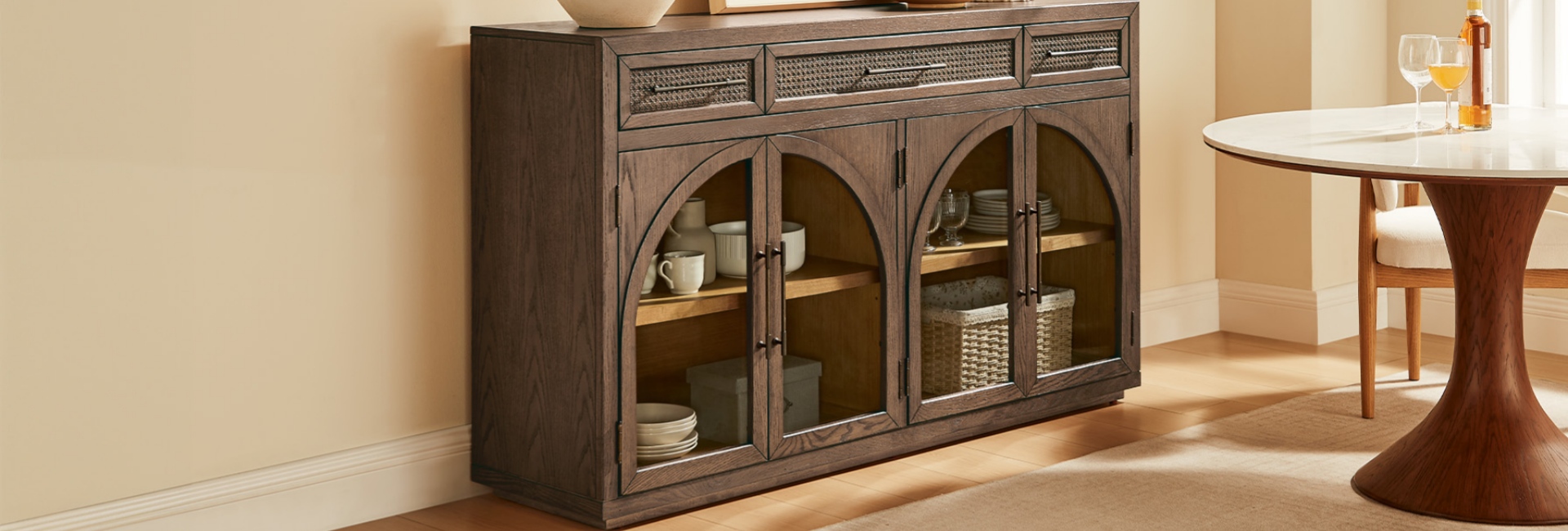
A sideboard with drawers can solve several everyday storage problems at once. It gives you a place to keep dining essentials, adds a useful serving surface, and fills an otherwise empty wall. The drawers are especially useful for smaller items that are easy to lose in a large cabinet.
Instead of stacking napkins and serving pieces on the kitchen counter or keeping them in a distant closet, you can keep frequently used items close to where you need them. This guide covers how to size a sideboard, choose the right mix of drawers and cabinets, compare materials, and style the top without making it another cluttered surface.
Table of Contents
- What Is a Sideboard With Drawers?
- How to Size a Sideboard for Your Room
- How Many Drawers Should a Sideboard Have?
- Drawers vs. Cabinets: How to Split Your Storage
- Materials That Matter: Solid Wood, Veneer, and Engineered Wood
- Choosing a Sideboard for Different Rooms
- How to Organize a Sideboard With Drawers
- Styling the Top Without Creating More Clutter
- Buy a Sideboard or Build One?
- Care and Longevity: Keep Your Sideboard Looking Its Best
- Final Takeaway
- FAQs
- How tall should a sideboard with drawers be?
- How deep should a dining room sideboard be?
- What size sideboard do I need for my dining table?
- What should I store in sideboard drawers versus cabinets?
- How many drawers should a sideboard have?
- Can a sideboard with drawers work as a TV stand or media console?
- How do I organize a sideboard so the drawers don't become a junk drawer?
- Should a sideboard match my dining table?
- What material is best for a sideboard, solid wood or engineered wood?
- How much clearance do I need in front of a sideboard?
What Is a Sideboard With Drawers?
A sideboard is a long, low storage cabinet designed to sit against a wall. It is most commonly used in dining rooms, but it can also work in living rooms, entryways, bedrooms, and other areas that need additional storage.
Many sideboards are around 48 to 72 inches wide and 30 to 36 inches tall, although dimensions vary considerably by design. Storage can include drawers, cabinets, open shelving, or a combination of all three.
The main advantage of drawers is accessibility. Flatware, napkins, placemats, remotes, keys, and other smaller items are easier to organize in drawers than on a deep cabinet shelf. Cabinets, meanwhile, provide better space for larger or less frequently used items.
Sideboard vs. Buffet vs. Credenza
The terms sideboard, buffet, and credenza are often used interchangeably by furniture retailers. There are traditional differences, but they are not always consistent from one product to another.
A buffet is often associated with dining and may be somewhat taller, particularly when it is designed primarily as a serving surface. A credenza is traditionally a longer, lower storage piece and is commonly used in dining rooms, living rooms, and offices. A sideboard is a more general term for a low storage cabinet that can serve several of these functions.
For shopping purposes, dimensions and storage layout are usually more useful than the label itself. Check the height, depth, drawer configuration, shelf dimensions, and overall width before deciding whether a particular piece will work in your room.
Why Choose Drawers?
Drawers are particularly useful for small items that you reach for regularly.
In a dining room, they can hold:
-
Flatware
-
Napkins
-
Placemats
-
Chargers
-
Coasters
-
Candles
-
Serving utensils
In an entryway, the same type of storage can hold keys, chargers, mail, and other everyday items. In a living room, drawers can keep remotes, batteries, controllers, and accessories out of sight.
A combination of drawers and cabinets is often practical because it separates smaller everyday items from larger pieces that need more vertical storage.
How to Size a Sideboard for Your Room
Most sideboard sizing mistakes happen before the furniture arrives. Measure the wall, surrounding furniture, doorways, and walking paths before you choose a piece.
Width: Match the Wall and the Table
As a starting point, a sideboard around two-thirds to three-quarters the length of a dining table can create a balanced proportion.
For example, a 72-inch dining table could work well with a sideboard around 48 to 54 inches wide. This is a starting point rather than a fixed rule. The shape of the room, the sideboard's design, and the amount of visual space around it all affect the final proportion.
If the sideboard is going against a wall without a dining table nearby, consider the wall itself. A piece that fills roughly 55 to 75 percent of the available wall can often feel more intentional than one that is either too small or almost wall-to-wall.
Also measure the route into the room. A 72-inch sideboard may fit the wall perfectly but still be difficult to bring through a doorway, stairway, elevator, or narrow hallway. Check the package dimensions and the narrowest part of the delivery path before ordering.
Height: A Practical 30-to-36-Inch Range
Many sideboards fall between 30 and 36 inches tall. For a dining room, around 32 to 34 inches can be a practical range because the top remains comfortable for serving while maintaining a relatively low profile.
Height should also relate to the furniture around it. A very low sideboard may feel more like a media cabinet, while a much taller piece can visually shift toward hutch-style storage.
If you plan to use the top as a serving surface, make sure the height is comfortable for the people who will actually use it rather than relying on a single standard measurement.
Depth: Plan Around Your Walkway
For many homes, a sideboard around 16 to 20 inches deep provides a useful balance between storage capacity and floor space. A 14- to 16-inch-deep piece can be helpful in a narrow dining room, hallway, or entryway.
Deeper sideboards, around 20 to 24 inches, can provide more room for bulky serving pieces or appliances, but they also take more floor space.
Clearance matters just as much as the sideboard's depth. Aim for at least 36 inches of usable space between the front of the sideboard and the backs of dining chairs. In a busy room where people frequently walk behind seated diners, 42 to 48 inches can provide a more comfortable circulation path.
Before buying, mark the proposed footprint on the floor with painter's tape. Pull out the dining chairs and walk through the space to see whether the layout still works.
How Many Drawers Should a Sideboard Have?
There is no standard number of drawers that works for every home. The right configuration depends on what you plan to store.
A sideboard with two wide drawers can work well for larger quantities of napkins, placemats, linens, or other broad items. Three or four smaller drawers can make it easier to separate flatware, keys, remotes, and other small accessories.
For many households, a combination of drawers and cabinets offers useful flexibility:
When comparing two similar sideboards, look beyond the number of drawers. Check their width, depth, interior clearance, construction, hardware, and weight capacity.
Drawers vs. Cabinets: How to Split Your Storage
A good storage sideboard uses drawers and cabinets for different jobs rather than treating them as interchangeable.
When Drawers Make More Sense
Use drawers for things you reach for frequently. In a dining room, that might mean flatware, napkins, placemats, and serving utensils. In an entryway, the top drawer can become a designated place for keys and chargers.
Cabinets are better suited to larger items that do not need to be accessed as often, such as serving platters, stacks of dishes, seasonal linens, and small appliances.
A useful way to compare storage layouts is to think about access frequency rather than simply counting compartments. If you use something every day, a drawer that opens directly to the contents may be more convenient than a deep cabinet shelf.
Materials That Matter: Solid Wood, Veneer, and Engineered Wood
The construction details on a product page can tell you more about a sideboard than the product photography alone.
A sideboard's top, doors, drawers, and hardware all experience regular use. Look at the materials, joinery, finish, and hardware together rather than assuming that one material automatically makes a piece better.
Solid wood can offer durability and the ability to be repaired or refinished, depending on the finish and construction. Veneer over engineered wood can also be a practical choice, particularly when the construction is well executed and the veneer is properly applied.
The key is not simply choosing "solid wood." Pay attention to the complete construction.
Why Kiln-Dried Wood Matters
Kiln drying removes moisture from wood in a controlled environment before it is used in furniture. Proper moisture control can help reduce dimensional changes that occur as wood responds to changes in humidity.
The USDA Forest Products Laboratory provides detailed information about wood drying and moisture-related movement.
For furniture buyers, this is one reason construction details matter. A sideboard made from properly dried wood is less likely to experience unnecessary movement as household conditions change, although all wood products can respond to humidity over time.
Reading the Joinery
Drawer construction is another useful detail to check.
Dovetail joints mechanically interlock the drawer sides and front, providing a strong connection. They are commonly associated with higher-quality drawer construction, although the joint itself is only one part of overall drawer performance.
Drawer slides, hardware, material thickness, and weight capacity also matter.
For a reference on wood species and their properties, The Wood Database is a useful starting point.
A Hernest example is the Kaden 63" Mid-Century Sideboard. The 63-inch sideboard combines rubber wood and engineered wood with cherry veneers, kiln-dried wood construction, and dovetail drawer joints. Its tapered solid-wood legs and open base give it a lighter visual profile while the drawers and cabinets provide enclosed storage.
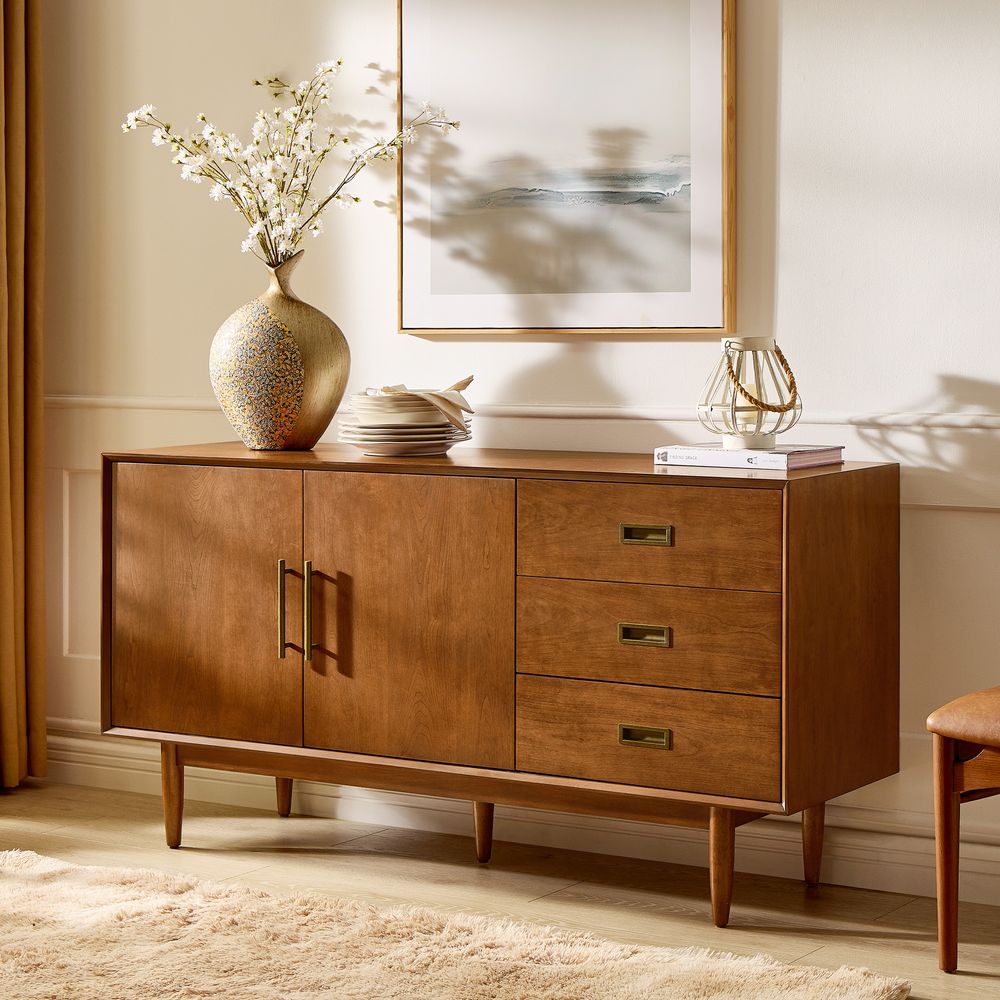
Kaden 63" Mid-Century Sideboard
View Product
Choosing a Sideboard for Different Rooms
The right sideboard depends on what you need to store. A configuration that works in a dining room may not be the best choice for an entryway or living room.
Dining Room
The dining room is the most traditional setting for a sideboard with drawers.
Use drawers for flatware, napkins, placemats, and serving utensils. Use the cabinets for larger items such as platters, serving bowls, dishes, and guest linens.
For many dining rooms, a sideboard around 60 to 70 inches wide can provide substantial storage without taking over the room. However, the right width depends on the size of the table and the available wall space.
The top can also function as a serving surface when needed. Use trivets or other appropriate protection for hot dishes, and keep enough of the surface clear for actual serving.
Living Room and Media Wall
A sideboard can also work as storage below or near a wall-mounted TV.
Drawers can hold remotes, batteries, controllers, and other small accessories. Cabinets can conceal gaming equipment, media accessories, and other larger items.
For a media wall, pay particular attention to height and cable management. A longer, lower sideboard generally works better than a tall piece beneath a wall-mounted TV.
The Vera 72" Sideboard is one example of a longer sideboard suited to a larger wall. Its 72-inch width provides substantial horizontal storage, while the drawers and cabinets create separate places for smaller and larger items.
Entryway and Bedroom
A narrow sideboard can turn an unused hallway or entryway wall into practical storage.
Use drawers for keys, mail, chargers, and other small everyday items. A tray on top can provide a designated landing spot for frequently handled belongings.
In a bedroom, drawers can hold smaller accessories, jewelry trays, linens, or other loose items, while cabinets can provide additional enclosed storage.
For narrow spaces, consider a depth of around 14 to 16 inches and check the remaining walkway before buying.
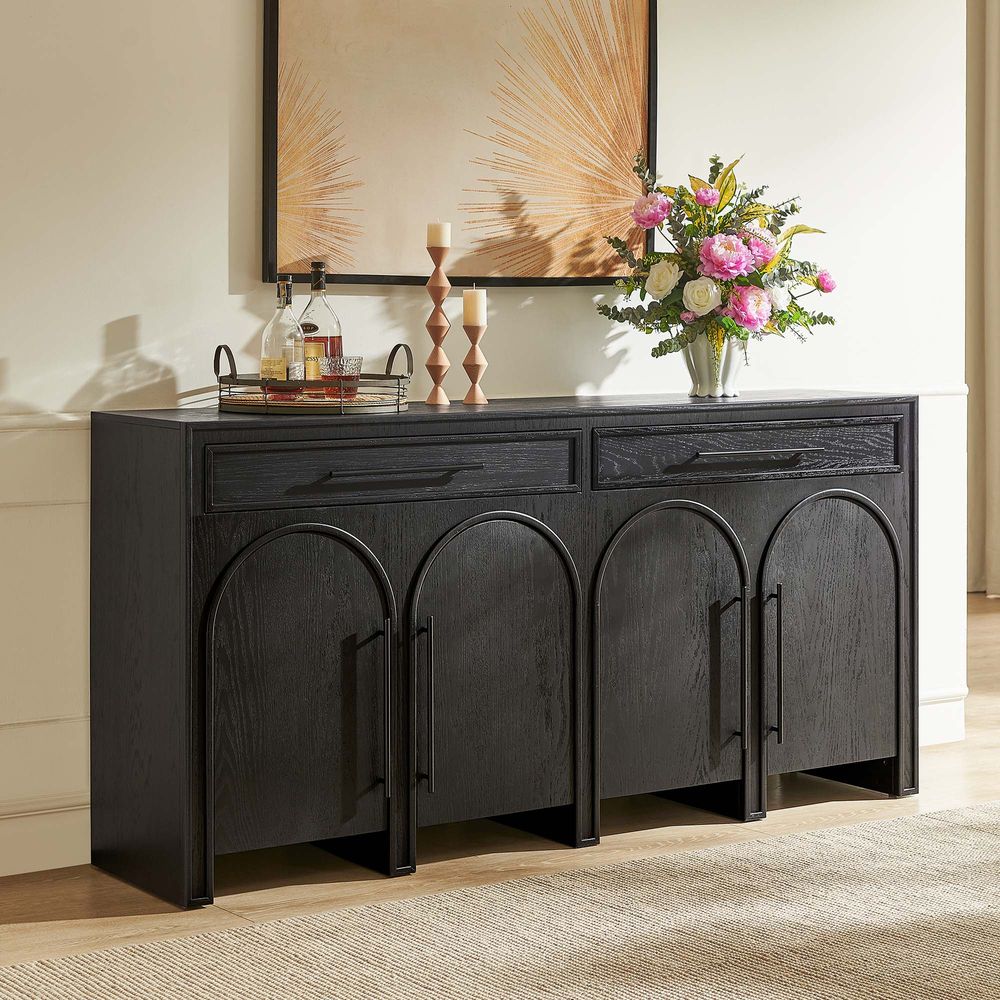
Vera 72" Sideboard
View Product
How to Organize a Sideboard With Drawers
Choosing a drawer configuration is only the first step. Organization determines whether the storage remains useful over time.
Sort by How Often You Use It
A simple access-frequency system can work well:
-
Top drawer: Items you use every day
-
Middle drawers: Items you use weekly
-
Lower drawers or cabinets: Seasonal and occasional items
In a dining room, this could mean flatware and napkins in the top drawer, candles and serving tools in the middle, and larger serving pieces in the cabinets.
The goal is to give each drawer a clear purpose rather than letting every compartment become a general catch-all.
Use Simple Dividers
You do not need a custom organizer for every drawer.
Bamboo dividers can separate flatware and utensils. Small bins can keep chargers, batteries, and cables from mixing together. Trays can also help contain smaller items inside cabinet shelves.
Avoid overloading drawers and shelves. Heavy stacks of dishes are generally better distributed across lower storage areas than concentrated in one drawer.
Styling the Top Without Creating More Clutter
A sideboard top is useful surface space, but it can quickly become a drop zone for mail, bags, cups, and miscellaneous items.
Keep the styling simple enough that the surface remains functional.
Use Height and Negative Space
A straightforward arrangement can combine one taller object, one medium-height object, and one lower object. For example, a lamp or vase can provide height while a bowl or tray keeps the other end of the surface grounded.
You do not need to fill the entire top. Leaving visible empty space helps the sideboard remain practical and keeps the arrangement from feeling crowded.
If the sideboard is used as a serving surface, choose decor that can be moved easily rather than creating a permanent collection of small objects.
Art, Mirror, and Lighting Above
A mirror or artwork that is roughly two-thirds to three-quarters the width of the sideboard can create a balanced visual relationship.
Leave enough space between the artwork and the sideboard so the two pieces feel connected without appearing crowded. A lamp can add useful evening lighting, while a tray can organize smaller decorative or functional objects.
The goal is to make the wall feel finished without turning the sideboard into another surface that needs constant clearing.
Buy a Sideboard or Build One?
A custom-built sideboard can make sense when you need an unusual size, specific wood species, or a particular storage layout. It also gives experienced woodworkers complete control over the construction.
For most shoppers, however, the decision comes down to time, tools, cost, and the complexity of the project.
When a DIY Build Makes Sense
DIY can be worthwhile if you already have woodworking tools and experience with cabinet construction and drawer joinery. It is especially useful when an existing wall requires a very specific dimension that is difficult to find commercially.
The trade-off is time and material cost. A sideboard with a solid-wood case, quality hardware, and dovetail drawers requires more than basic assembly skills.
When Buying Makes Sense
Buying a finished sideboard provides a completed product without the time commitment of building and finishing one yourself. A commercial piece may also come with a warranty, return policy, and established product specifications.
For most homes, compare the actual construction, dimensions, storage layout, and warranty rather than assuming that DIY or store-bought furniture is automatically the better option.
Care and Longevity: Keep Your Sideboard Looking Its Best
Good furniture still needs appropriate care, but the exact method depends on the finish and materials used.
Protecting the Top
Wipe spills promptly and avoid leaving standing moisture on the surface. Use coasters, trays, and trivets when appropriate, particularly for drinks, plants, and hot serving dishes.
Most importantly, follow the manufacturer's care instructions for the specific finish. Avoid abrasive cleaners or products that are not recommended for the surface.
Keep solid-wood furniture away from prolonged, intense direct sunlight when possible. Extended exposure can cause some finishes and wood species to change color over time.
Don't Overload the Drawers
Check the manufacturer's weight limits for drawers and shelves. Heavy dishes, cookware, or other dense items can place unnecessary stress on drawer slides and cabinet hardware.
Distribute heavier items across appropriate storage areas and keep frequently used items where they are easy to reach.
Final Takeaway
A sideboard with drawers can provide a useful combination of everyday organization, enclosed storage, and serving space. The right piece depends less on a single "perfect" dimension and more on how its proportions and storage layout work in your room.
Start with the space you have, then work through storage needs, construction, and appearance. A sideboard that fits the room and the way you use it will usually be more useful than one chosen for looks alone.
FAQs
How tall should a sideboard with drawers be?
Many sideboards are 30–36 inches tall, with around 32–34 inches being a practical range for many dining rooms. The right height depends on the table, intended use, and overall proportions of the room.
How deep should a dining room sideboard be?
For many rooms, 16–20 inches deep provides a useful balance between storage and floor space. Choose around 14–16 inches for a narrow dining room or hallway, and consider deeper pieces only when you have enough clearance.
What size sideboard do I need for my dining table?
As a starting point, a sideboard around two-thirds to three-quarters the length of your dining table can create a balanced proportion. A 72-inch table, for example, could pair well with a sideboard around 48–54 inches wide. Always check the wall and circulation space as well.
What should I store in sideboard drawers versus cabinets?
Use drawers for smaller, frequently used items such as flatware, napkins, placemats, keys, remotes, and accessories. Cabinets are better for larger or less frequently used items such as platters, dishes, linens, and small appliances.
How many drawers should a sideboard have?
There is no standard number. Two wide drawers can work well for linens and larger items, while three or four smaller drawers provide more separation for flatware, keys, accessories, and other small items. A combination of drawers and cabinets offers flexibility for mixed storage needs.
Can a sideboard with drawers work as a TV stand or media console?
Yes, provided the dimensions and construction are appropriate. A longer, lower sideboard can work below a wall-mounted TV, while drawers can hide remotes and accessories and cabinets can store larger media equipment. Check the sideboard's width, height, weight capacity, and cable-management options before using it for media equipment.
How do I organize a sideboard so the drawers don't become a junk drawer?
Give each drawer a specific job and organize by access frequency. Keep daily items in the top drawer, weekly items in the middle, and occasional items in lower storage or cabinets. Dividers and small bins can help keep smaller items separated.
Should a sideboard match my dining table?
It does not need to match exactly. Coordinating wood tones, finishes, or color temperatures can create a cohesive look while allowing some variation. Proportion and placement are usually more important than having identical furniture finishes.
What material is best for a sideboard, solid wood or engineered wood?
Both can work when properly constructed. Solid wood offers natural variation and can often be repaired or refinished, while quality veneer over engineered wood can provide stability and a consistent appearance. Look at the complete construction, including joinery, hardware, finish, and material quality.
How much clearance do I need in front of a sideboard?
Plan for at least 36 inches of usable clearance between the sideboard and the backs of dining chairs. If the area is a major circulation path, 42–48 inches can provide more comfortable movement. Use painter's tape to test the footprint before buying.