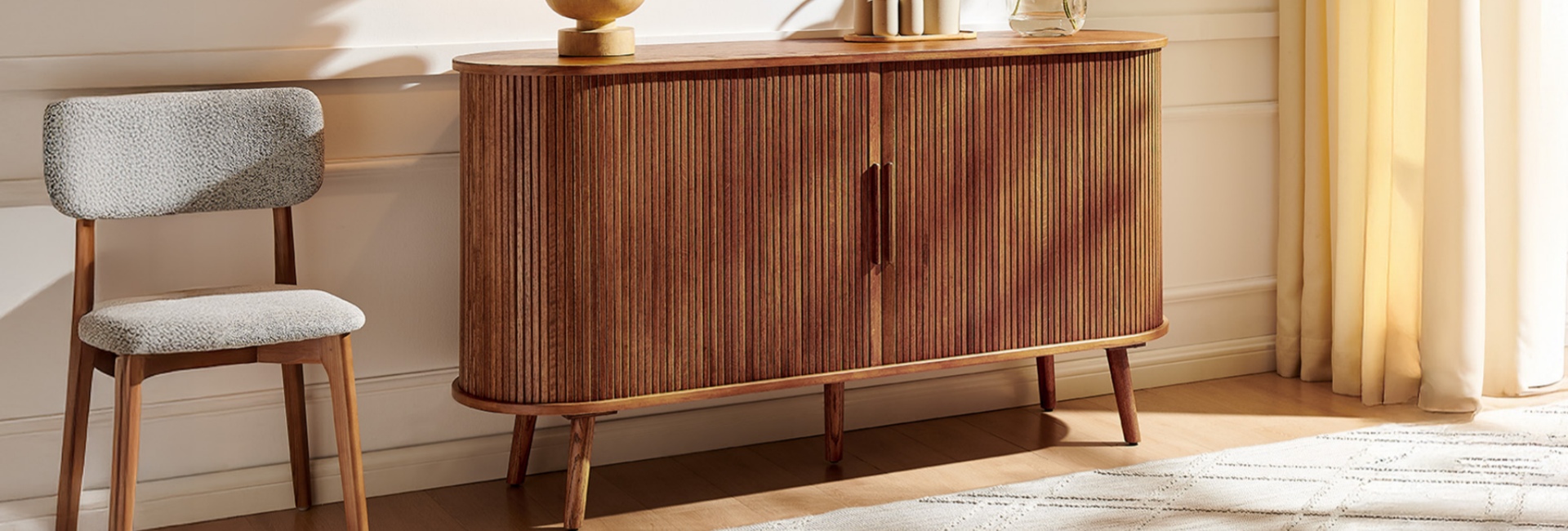
A solid wood sideboard can add storage, serving space, and a useful surface to a dining room without taking over the room. It can hold dinnerware and linens, give you somewhere to set a lamp or serving dish, and fill a long wall more effectively than a small piece of furniture.
The challenge is choosing one that works for your space now and still makes sense years from now. The important details are not complicated: wood species, dimensions, construction, storage layout, finish, and care all matter.
This guide breaks down what to look for when buying a solid wood sideboard, including how to compare wood types, measure your space, evaluate construction, and choose storage that fits the way you actually use your home.
Table of Contents
- What a Solid Wood Sideboard Actually Does in Your Home
- Sideboard, Buffet, or Credenza: Know What You're Buying
- Start With the Wall: How to Size a Solid Wood Sideboard
- Wood Species: What Type of Wood Is Best for a Sideboard?
- Reading the Build: How to Spot a Sideboard That Lasts
- Storage Layout: Match the Inside to Your Life
- Choosing a Solid Wood Storage Cabinet Instead
- Finish and Color: Make It Work With the Room
- Style Notes: From Fluted Fronts to Arched Glass
- Buying a Solid Oak Sideboard Online: What to Verify
- Caring for a Solid Oak Sideboard So It Ages Well
- Does a Solid Oak Sideboard Hold Its Value?
- Picking a Wooden Sideboard That Matches Your Room
- FAQs
- What type of wood is best for sideboards?
- What should I consider when buying a solid oak sideboard online?
- How can I tell if a sideboard is solid wood or veneer?
- Is solid wood always better than engineered wood for a sideboard?
- How do I care for a solid oak sideboard?
- Can a sideboard work as a TV stand or media console?
- Does a solid oak sideboard hold its value over time?
What a Solid Wood Sideboard Actually Does in Your Home
Before comparing materials and dimensions, think about the job you need the sideboard to do.
It stores. A sideboard can keep crockery, linens, chargers, serving pieces, board games, and other household items behind closed doors. Drawers are useful for smaller items that you reach for more often.
It provides surface space. The top can work as a serving surface during dinner or hold a lamp, framed photos, a plant, or a few decorative objects when the piece is not being used for meals.
It helps balance the room. A long, low case can give a large dining-room wall some visual weight. Instead of leaving the wall empty or filling it with several smaller pieces, one well-sized sideboard can provide both storage and structure.
If you're choosing between a sideboard and another storage piece, consider the room first. In a dining or gathering space, a sideboard can combine enclosed storage and usable surface area in a relatively compact footprint.
Sideboard, Buffet, or Credenza: Know What You're Buying
The terms sideboard, buffet, and credenza are often used interchangeably, especially in online furniture listings. There are some traditional differences, although the categories overlap.
A buffet is traditionally a little taller and is often designed around serving food and storing dining essentials. A credenza tends to be lower and longer, although modern furniture listings use the term broadly. A media console is similar in overall form but usually includes features designed for TVs and electronics.
For a general dining or living room storage piece, a standard sideboard is a practical starting point.
If you're comparing different widths and finishes, the Hernest sideboard collection offers examples of how similar storage functions can work across different room layouts.
Start With the Wall: How to Size a Solid Wood Sideboard
Sizing is one of the most important decisions to make before ordering. A sideboard can look too small against a large wall or make a narrow dining area feel crowded if it's oversized.
The easiest way to avoid either problem is to measure the wall, table, and walking space before you shop.
Width as a starting point
As a general starting point, a sideboard can work well when it occupies around two-thirds of the wall it's sitting against. This is not a fixed rule, but it gives you a useful proportion to work from.
You can also compare the sideboard with your dining table. A sideboard around 60 to 75 percent of the table's length often creates a balanced relationship.
For example:
-
A 72-inch dining table could work with a sideboard around 44 to 54 inches wide.
-
A 96-inch dining table could accommodate a sideboard around 60 to 72 inches wide.
The available wall space and room layout should always take priority over a specific ratio.
Leave enough clearance
Aim for roughly 30 to 36 inches of clear floor space between the sideboard and nearby furniture such as a dining table. This gives chairs room to move and provides a more comfortable path through the room.
If your room is tight, measure the actual chair movement rather than relying only on the distance between furniture fronts.
Height and the eye line
Most sideboards are around 30 to 36 inches tall. That range works well in many dining rooms because the surface is easy to reach while remaining visually low.
Taller pieces can work in rooms with higher ceilings or where additional storage is needed, but consider the visual weight as well as the storage capacity. A tall case can make a small room feel more enclosed.
Depth and the walkway
Depth is easy to overlook when you're focused on width.
For many dining rooms, 16 to 20 inches deep provides a useful balance between storage and floor space. Shallower pieces can work in narrow areas, while deeper cabinets may provide more interior capacity but reduce the available walkway.
Before ordering, mark the proposed footprint with painter's tape. Then open nearby doors and pull out dining chairs to see whether the furniture will interfere with movement.
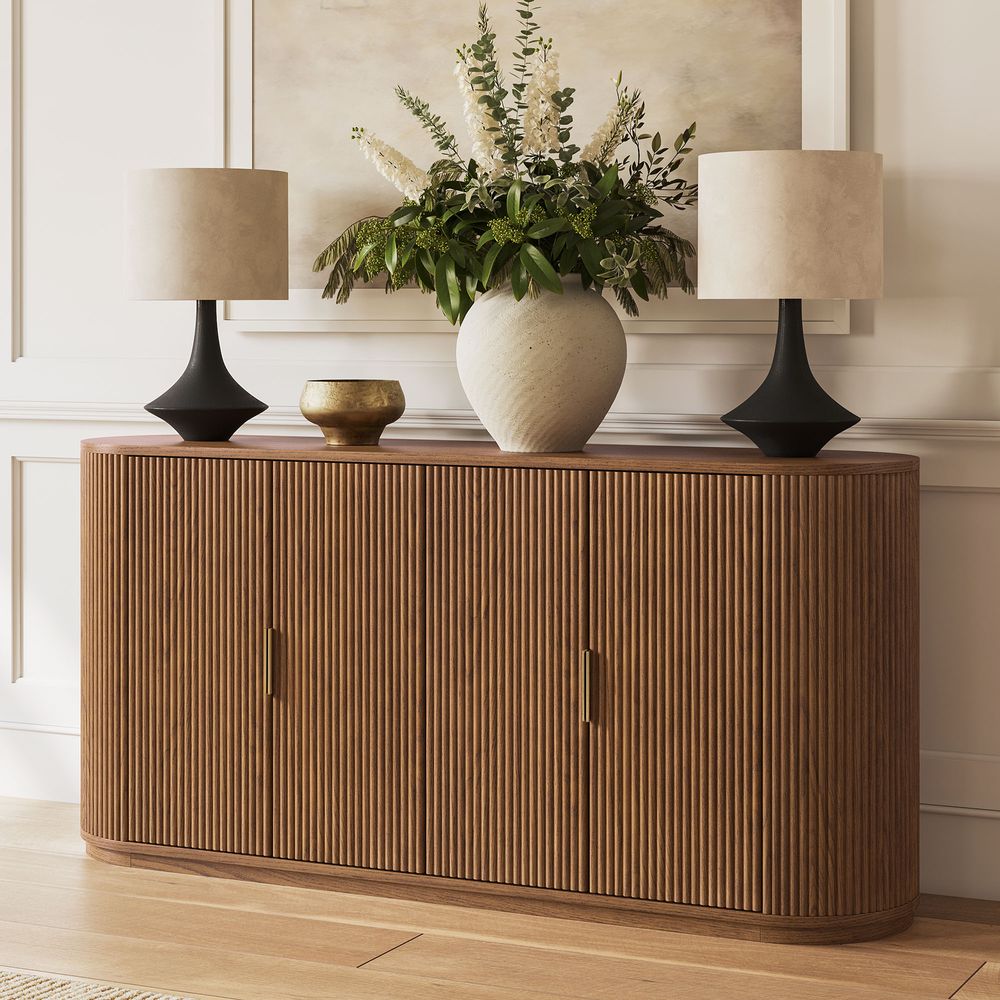
If your wall is relatively short, the Rolf 63" Oak Fluted Sideboard is one example of a more compact profile. At 63 inches wide and 15.7 inches deep, it can provide storage while keeping the footprint relatively shallow. Its 30.3-inch height also keeps the top within a comfortable range for everyday use.
Rolf 63" Oak Sideboard
View Product
Wood Species: What Type of Wood Is Best for a Sideboard?
There is no single best wood for every home. The right choice depends on how much wear the piece will receive, the look you want, and how much you're willing to spend.
Oak is one of the most practical hardwood choices for a frequently used sideboard, while ash offers similar hardness with a lighter visual character. Walnut is valued for its rich color and grain but is somewhat softer.
Why oak is a popular choice
Oak is widely used for furniture because it combines durability, distinctive grain, and a range of finish options.
White oak is commonly listed at around 1,360 lbf on the Janka hardness scale, a test used to compare the resistance of wood to indentation. That makes it a relatively hard domestic hardwood and a practical choice for furniture that will see regular use.
Oak also works with a broad range of finishes, from light natural tones to darker stains.
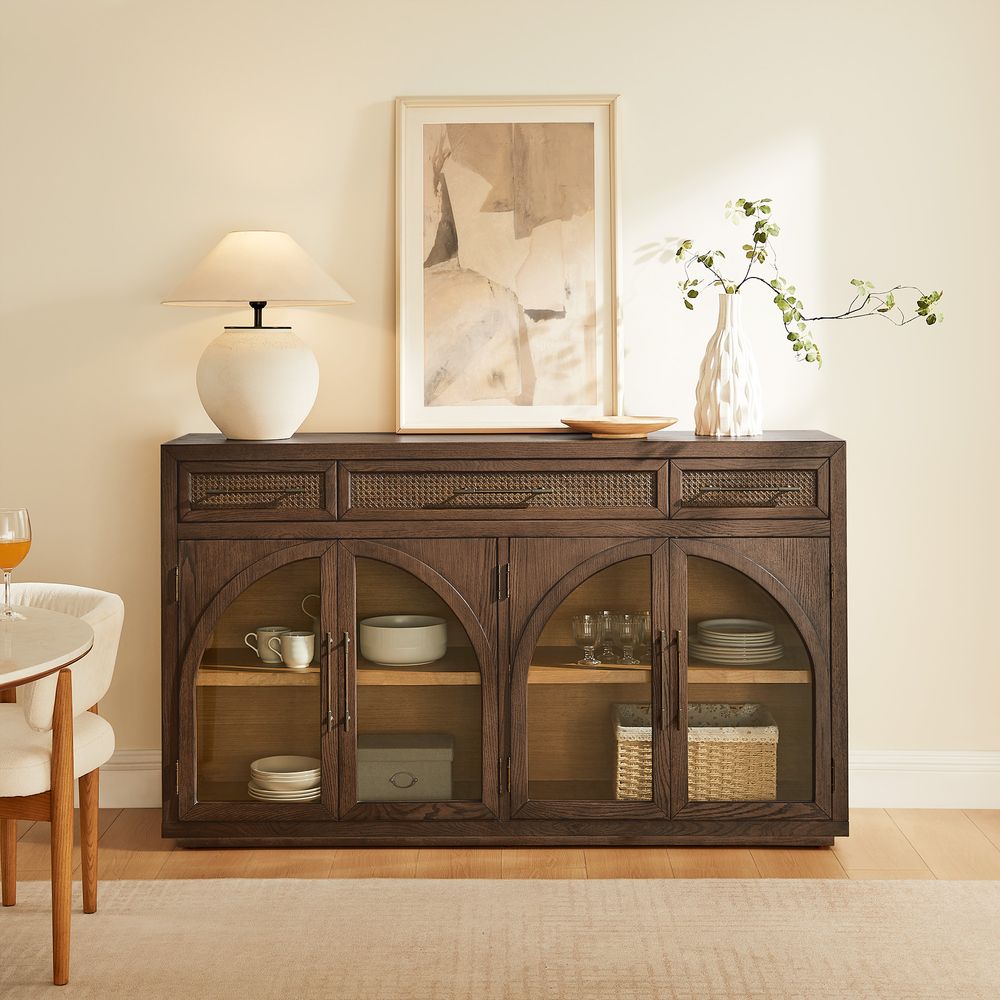
The Valborg 66" Oak Sideboard is one Hernest example that combines American solid oak with dovetail-jointed drawers, a dark brown oak finish, and arched glass doors.
Ash, walnut, and other options
Ash is another durable hardwood commonly used in furniture. It is often listed at around 1,320 lbf on the Janka hardness scale, making it close to white oak in hardness. Its grain and naturally lighter appearance give it a different look even when the construction is similar.
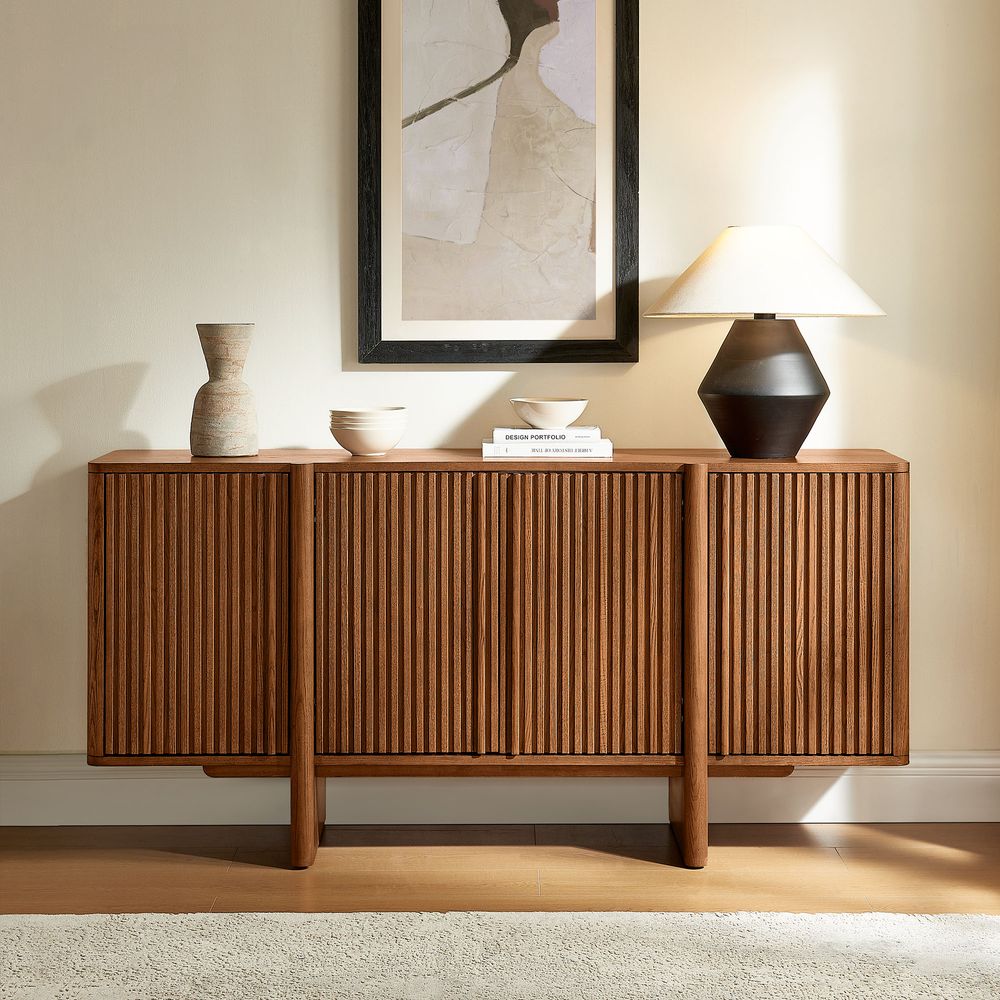
The Sabina 64" Ash Wood Sideboard uses American solid ash and combines square fluting with fluted handles.
Black walnut is softer than oak and ash, commonly listed at around 1,010 lbf, but its deeper brown color and distinctive grain make it a popular choice for furniture.
Pine and other softwoods can also be used for sideboards. They tend to dent more easily, so they may be better suited to rooms or households where a softer, more casual material is appropriate.
For comparative wood hardness information, the Wood Database is a useful reference.
Solid wood vs. veneer over a stable core
Solid wood and veneer serve different purposes, and veneer is not automatically a sign of lower-quality construction.
A well-made piece may combine solid wood structural components with wood veneer over a stable plywood or engineered core. That construction can help larger panels stay flatter as humidity changes.
The more important question is whether the product description clearly explains what is solid wood, what is veneered, and what material is used for the core.
A listing that says "solid oak" without explaining which components are solid deserves a closer look. The goal is not to avoid every veneered component; it is to understand exactly what you're buying.
Valborg 66" Oak Sideboard
View Product
Reading the Build: How to Spot a Sideboard That Lasts
A product photo can show you the finish and overall design, but it cannot tell you everything about construction. Look for details that indicate how the case and drawers are assembled.
Joinery to look for
Dovetail joints are one useful sign of well-made drawers. The interlocking pieces provide mechanical support in addition to adhesive and are commonly found in furniture designed for regular use.
Mortise-and-tenon joinery is another established woodworking technique. A projecting piece of wood fits into a corresponding opening, creating a strong connection between structural components.
Neither joinery method alone guarantees that an entire sideboard is well made. Look at the overall construction, materials, hardware, and finish together.
Check the back and case construction
The back panel contributes to the stability of the cabinet. A properly secured back can help the case resist racking, especially when the piece is moved.
If product specifications are available, check what material is used for the back rather than judging quality by weight alone. A heavy piece can indicate substantial materials, but weight by itself does not tell you how the cabinet is constructed.
Hardware: soft-close and full-extension glides
Hardware has a noticeable effect on everyday use.
Soft-close hinges can make cabinet doors quieter and reduce slamming. Full-extension drawer glides allow the drawer to open farther, making items at the back easier to reach.
If you're shopping online, look for specific hardware descriptions rather than assuming a feature is included because the product photographs look premium.
Storage Layout: Match the Inside to Your Life
The exterior determines how the sideboard looks in the room. The interior determines how useful it is.
Before buying, think about the items you actually plan to store.
Drawers vs. doors vs. open shelves
Drawers are useful for smaller items that need to be easy to access. Closed cabinets are better for larger pieces and anything you would rather keep out of sight.
Open shelves are useful when display is part of the goal, but they require more visual editing because everything remains visible.
For many households, a combination of drawers and closed cabinets offers the most flexibility.
Adjustable shelves and mixed configurations
Adjustable shelves can make a noticeable difference when you store items of different heights. They allow you to change the interior arrangement rather than working around a fixed shelf position.
The Sabina 64" Ash Wood Sideboard, for example, combines an enclosed storage layout with a textured fluted exterior. The result is a piece that can handle everyday storage while still contributing to the room's overall design.
Sabina 64" Ash Wood Sideboard
View Product
Choosing a Solid Wood Storage Cabinet Instead
Not every room needs a traditional dining sideboard. If the main goal is simply to hide household clutter, a more straightforward solid wood storage cabinet may make more sense.
The same basic principles still apply:
-
Check the material breakdown.
-
Look for stable case construction.
-
Choose hardware suited to frequent use.
-
Make sure the shelf dimensions fit what you plan to store.
-
Measure the full footprint before ordering.
A simpler cabinet can be useful in an entryway, living room, home office, or other area where serving space is less important than enclosed storage.
Finish and Color: Make It Work With the Room
Once the practical decisions are made, finish becomes more important.
Consider contrast with the floor
The sideboard does not have to match the floor or dining table exactly. Slightly different wood tones can help separate the furniture from the surrounding surfaces.
For example, a warm oak finish can stand out against a cooler floor, while a darker wood finish can create more visual weight against a lighter wall.
The goal is coordination rather than an exact match.
Matte vs. gloss, light vs. dark
Matte finishes tend to show fewer reflections and can be easier to live with in a busy room. Gloss finishes reflect more light but can also make fingerprints and smudges more noticeable.
Light finishes can help a compact room feel visually lighter. Dark finishes can create contrast and make a long wall feel more grounded.
Choose based on the room's natural light, surrounding finishes, and how much maintenance you're comfortable with rather than relying only on the color shown in a product photograph.
Style Notes: From Fluted Fronts to Arched Glass
A solid wood sideboard can be practical without looking purely utilitarian. Details such as fluting, glass doors, and leg profiles can change how the piece fits into a room.
Fluted, mid-century, and modern details
Fluted fronts add texture through repeated grooves without introducing a separate pattern. Round fluting can create a softer look, while square fluting tends to feel more structured.
Tapered legs and minimal hardware can give a sideboard a mid-century character. A low, simple silhouette can work well in more contemporary spaces.
These details are worth considering after the basics are covered: size, storage, construction, and material should come first.
Glass and rattan accents
Glass-panel doors allow stored items to remain visible while still protecting them from dust.
Arched glass can soften the shape of a rectangular cabinet, while rattan or woven details can introduce additional texture and warmth.
Choose these features based on how much of the interior you want to display. If you prefer storage to disappear visually, solid doors may be more practical.
Buying a Solid Oak Sideboard Online: What to Verify
Buying furniture online is much easier when you know which specifications to check before placing the order.
Read the materials line by line
Don't stop at the word "oak."
Look for details such as:
-
Which parts are solid oak?
-
Which parts use veneer?
-
What is the core material?
-
What materials are used for the back and drawer bottoms?
-
Is the wood described as kiln-dried?
-
What type of finish is applied?
Kiln drying can reduce moisture content before furniture is constructed and help make wood more dimensionally stable. However, wood will still respond to changes in the environment after it enters your home.
Check dimensions against your doorway
Measure the path into the room, not just the wall where the sideboard will sit.
Check:
-
Front-door clearance
-
Hallway width
-
Tight corners
-
Interior doorways
-
Elevator or stair dimensions, if relevant
-
The packaged dimensions when provided
A sideboard that fits the final location may still be difficult to bring into the house if the boxed dimensions are larger than the available route.
Warranty, lead time, and returns
Check the warranty before buying, especially for a substantial solid wood piece.
Also confirm:
-
Estimated delivery time
-
Delivery method
-
Whether threshold or room-of-choice delivery is included
-
Return period
-
Return shipping conditions
-
Any exclusions for damage or assembly
A clear return policy is particularly useful when you're buying furniture without seeing it in person.
Caring for a Solid Oak Sideboard So It Ages Well
Solid wood responds to changes in temperature and humidity, so consistent care matters more than complicated maintenance.
Daily and seasonal habits
Dust with a soft microfiber cloth and wipe with the grain. Blot spills promptly rather than allowing moisture to sit on the surface.
Use coasters under drinks and felt pads under objects that may scratch the finish. Keep the sideboard away from prolonged direct sunlight and avoid placing it directly against a heat source such as a radiator.
Keeping indoor humidity relatively stable, often around 40–60%, can help reduce excessive seasonal wood movement.
The most important point is consistency. Small amounts of regular care are easier than trying to correct a damaged finish later.
Wax vs. oil, and what to avoid
The correct maintenance product depends on the finish already applied to the furniture.
For a waxed or lacquered surface, use only products recommended for that type of finish. An oiled surface may require periodic re-oiling, but the manufacturer should specify which oil and how often it should be applied.
Always follow the manufacturer's care instructions before applying oil, wax, or polish. Using the wrong product can damage a factory-applied finish.
Avoid silicone-heavy furniture sprays if the manufacturer does not recommend them, particularly if you may need to refinish the piece later.
Does a Solid Oak Sideboard Hold Its Value?
Solid wood can have an advantage over lower-cost materials when it comes to long-term ownership because it can often be repaired, maintained, and refinished.
That does not mean every solid oak sideboard will retain a specific percentage of its original price. Resale value varies significantly based on the brand, design, condition, age, original price, and local demand.
The more useful question is whether the construction supports a long service life.
A solid wood case with sound joinery and a repairable finish can continue serving its original purpose for many years. That can make the higher initial cost easier to justify, particularly if you plan to keep the piece through multiple moves or room changes.
Picking a Wooden Sideboard That Matches Your Room
Once you've worked through the practical details, the decision becomes much easier.
Start with the space:
-
Measure the wall.
-
Measure the available walkway.
-
Compare the sideboard with the dining table.
-
Check the delivery path.
Then look at the furniture itself:
-
Confirm which components are solid wood.
-
Compare wood species.
-
Check joinery and hardware.
-
Choose drawers, cabinets, or adjustable shelves based on what you store.
-
Pick a finish that complements rather than exactly matches the room.
You do not need every piece of wood furniture in a room to come from the same collection. A sideboard can coordinate with a dining table through tone, shape, or material while still having its own character.
The short version is simple: buy the wood, not just the photo. Look past the finish and check the dimensions, materials, construction, storage, and care requirements. A well-chosen solid wood sideboard can be useful for years because it is built around how you actually live.
FAQs
What type of wood is best for sideboards?
For many households, oak is a practical choice because it combines durability, distinctive grain, and a wide range of finishes. White oak is commonly listed at around 1,360 lbf on the Janka hardness scale. Ash is similar in hardness and has a lighter visual character, while black walnut is somewhat softer but valued for its rich color and grain.
What should I consider when buying a solid oak sideboard online?
Check the material breakdown, dimensions, construction details, delivery path, warranty, return policy, and lead time. Pay particular attention to which parts are solid oak and which use veneer or engineered materials. Also compare the packaged dimensions with your doorways and hallways before ordering.
How can I tell if a sideboard is solid wood or veneer?
Look at the product specifications first and check which components are described as solid wood. Visually, solid wood often shows grain continuing around an edge, while veneer may reveal a thinner layer over another core. However, appearance alone is not always enough to identify construction accurately. Veneer over a stable plywood core can also be a legitimate construction choice, so the key is understanding the material breakdown.
Is solid wood always better than engineered wood for a sideboard?
Not necessarily. Solid wood can offer durability, repairability, and the ability to refinish certain surfaces, while engineered materials can provide dimensional stability and help control the movement of larger panels. A solid wood frame combined with veneer over a stable core can be a sensible construction. Focus on the complete material breakdown and construction rather than treating one material as automatically superior.
How do I care for a solid oak sideboard?
Dust regularly with a soft cloth, wipe spills promptly, use coasters and felt pads, and keep the piece away from prolonged direct sunlight and heat sources. Keeping indoor humidity relatively stable can also help reduce seasonal wood movement. For wax, oil, or polish, always follow the manufacturer's instructions for the specific finish on your sideboard.
Can a sideboard work as a TV stand or media console?
It can, provided the dimensions and construction are appropriate. Check the sideboard's height, width, weight capacity, cable-management options, and ventilation. Electronics stored inside closed cabinets may need adequate airflow, so a traditional sideboard is not automatically a substitute for a purpose-built media console.
Does a solid oak sideboard hold its value over time?
Solid wood can support long-term ownership because it can often be maintained, repaired, or refinished. However, resale value varies widely based on the brand, condition, design, age, original price, and local demand. There is no universal resale percentage that applies to every solid oak sideboard.