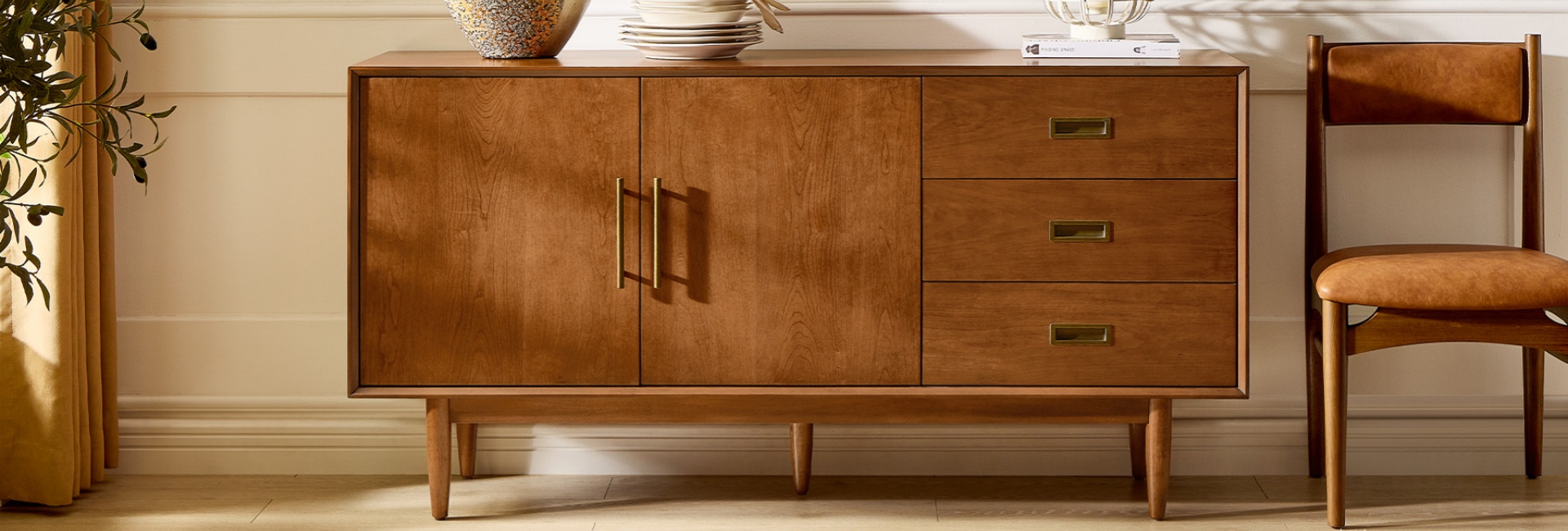
A mid-century modern sideboard can add useful storage without making a room feel bulky. In a dining room, it can hold dinnerware and linens. In a living room or entryway, it can hide everyday clutter while giving you space for lamps, artwork, or decorative objects.
The challenge is finding one that fits both the room and the way you use it.
Start with the basics: width, depth, storage layout, materials, and construction. Then look at the details that give a sideboard its mid-century modern character, such as tapered legs, warm wood tones, simple geometry, and restrained hardware.
Table of Contents
- What Is a Mid-Century Modern Sideboard?
- Why a Mid-Century Modern Sideboard Works So Well
- What Size Mid-Century Modern Sideboard Do You Need?
- Solid Wood vs. Veneer: What Should You Choose?
- Choose Doors, Drawers, or Shelves Based on What You Store
- What Makes a Sideboard Look Mid-Century Modern?
- Where to Use a Mid-Century Modern Sideboard
- Can a Sideboard Double as a Media Console or Home Bar?
- How to Style the Top of a Mid-Century Modern Sideboard
- How to Care for a Wood Sideboard
- Is Mid-Century Modern Still Popular in 2026?
- How to Choose Your Mid-Century Modern Sideboard
- FAQs
- What is a mid-century modern sideboard?
- How tall is a mid-century modern sideboard?
- What size mid-century modern sideboard should I buy?
- What wood is best for a mid-century modern sideboard?
- Is solid wood better than veneer?
- Can a mid-century modern sideboard work in an entryway?
- How should I style the top of a sideboard?
- How do I care for a wood sideboard?
What Is a Mid-Century Modern Sideboard?
A mid-century modern sideboard is generally a low, horizontal storage cabinet with clean lines, wood-forward finishes, and relatively simple detailing. Many designs draw from furniture popular in the 1950s and 1960s, while contemporary versions may use updated materials, construction methods, and storage features.
Common characteristics include:
-
Low horizontal proportions: A wider, lower silhouette is common.
-
Tapered or splayed legs: Raised legs create a lighter visual profile.
-
Warm wood tones: Oak, walnut, teak, and other wood finishes are often used.
-
Simple fronts: Hardware is usually restrained rather than highly decorative.
-
Functional storage: Drawers, doors, shelves, or a combination keep everyday items out of sight.
Not every mid-century modern sideboard has all of these features. Instead of relying only on the style label, look at the overall silhouette, proportions, materials, and details.
Why a Mid-Century Modern Sideboard Works So Well
A sideboard solves a practical storage problem while taking up less visual space than a tall cabinet.
Its low profile works particularly well in dining and living rooms because it provides enclosed storage without adding much vertical bulk. The raised base can also make the furniture feel less heavy, especially in smaller rooms.
You can use a sideboard to store:
-
Dinnerware and serving pieces
-
Table linens and napkins
-
Books and board games
-
Small electronics and accessories
-
Entryway essentials
-
Decorative objects
Because sideboards are relatively low and versatile, the same piece can often work in more than one room as your storage needs change.
What Size Mid-Century Modern Sideboard Do You Need?
There is no single correct size for a mid-century modern sideboard. The right dimensions depend on the wall, nearby furniture, available walking space, and how much storage you actually need.
As a starting point:
These ranges are planning guidelines, not strict rules. A 63-inch sideboard may work well in one dining room but feel too large in another.
Before buying, measure the entire footprint, including the space needed to open drawers and doors.
Measure the Wall Width First
Measure the usable wall rather than simply choosing a sideboard based on its listed width.
If the room allows, leaving roughly six inches of visible wall on each side can give the furniture some breathing room. Treat this as a starting point rather than a requirement.
A simple way to test the size is to use painter's tape to mark the sideboard's width and depth on the floor. This lets you see how much space the furniture will occupy before you order it.
Match the Sideboard to the Dining Table
A sideboard does not have to match your dining table exactly, but proportion matters.
Around two-thirds of the table length can be a useful starting point. For example, a 72-inch dining table might pair naturally with a 48- to 54-inch sideboard.
That is not a fixed design rule. If your room is large enough, a longer sideboard can work. In a smaller room, a shorter one may leave better circulation around the table.
Check Height and What Goes Above It
Many mid-century modern sideboards fall roughly in the 28- to 32-inch range, although actual dimensions vary considerably.
Think about what you plan to place above the sideboard. A mirror, artwork, lamp, or television will change how the overall arrangement feels.
For wall art, leaving roughly 4–6 inches between the top of the sideboard and the bottom of the artwork can be a useful starting point. Adjust the gap based on the size of the artwork and the proportions of the room.
Check Depth and Walkway Clearance
Sideboards are often around 16–20 inches deep, but always check the actual product dimensions.
For a main walkway, around 36 inches of clear passage is a useful planning target. However, local building requirements and the specific room layout should take priority.
Also account for the space needed to open cabinet doors and drawers. A sideboard that technically fits against the wall may still make the room feel cramped if its storage doors block the normal path through the space.
Solid Wood vs. Veneer: What Should You Choose?
Wood choice affects the appearance, feel, durability, and maintenance of a sideboard, but there is no single wood species that is best for every home.
Common options include:
-
Oak: Often has a lighter appearance and visible grain.
-
Walnut: Usually offers deeper brown tones and a richer appearance.
-
Teak: Known for warm color and natural durability.
-
Rubber wood: A commonly used hardwood that can be paired with engineered materials and veneers.
The more important question is not simply "Which wood is best?" but What materials are used where, and how is the piece constructed?
What to Look for in the Construction
A sideboard can combine several materials without being poorly made.
Depending on the design, useful construction details may include:
-
Kiln-dried wood
-
Solid wood components
-
Real wood veneer
-
Stable engineered-wood cores
-
Dovetail drawer joints
-
Properly constructed doors and drawer boxes
Veneer is not automatically a sign of lower quality. A well-made veneer surface can provide the appearance of natural wood while an engineered core can help provide dimensional stability.
For more background on wood products and furniture materials, resources from the USDA Forest Products Laboratory and The Wood Database can be useful starting points.
A Hernest Example: Kaden 63-Inch Mid-Century Sideboard
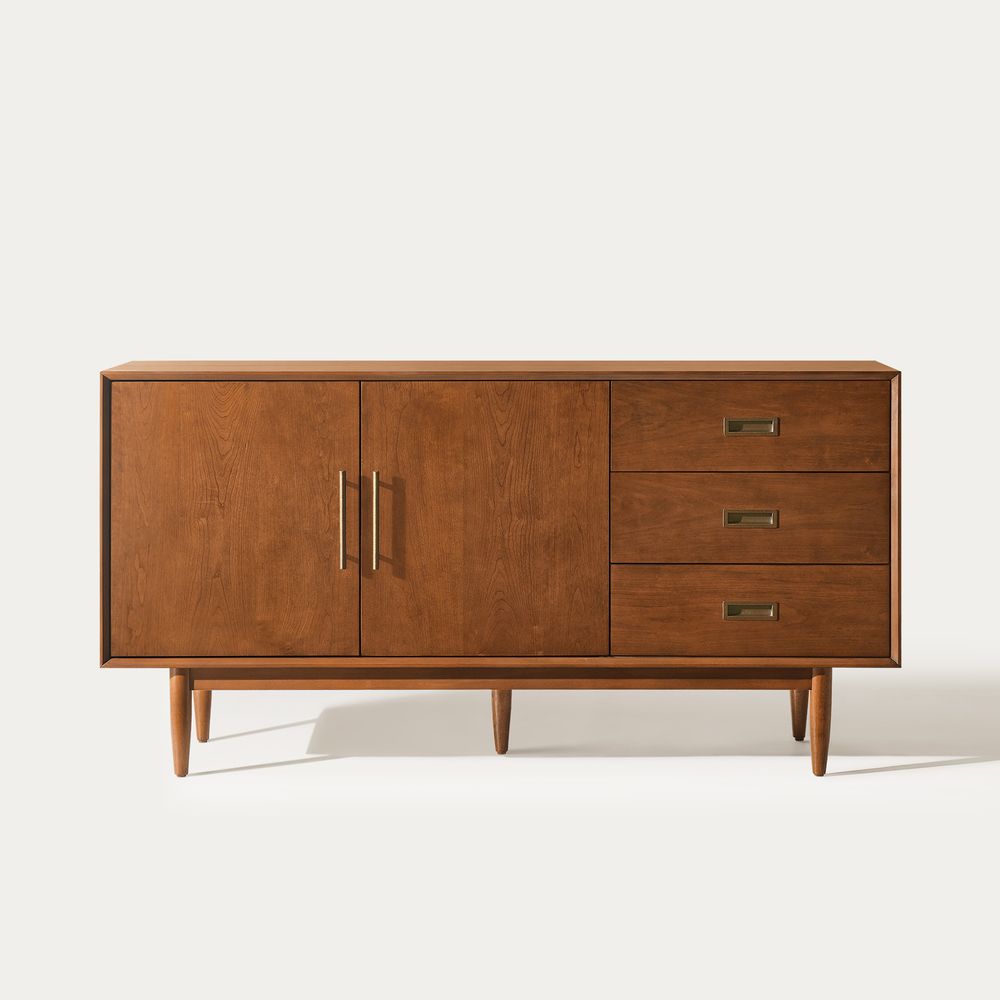
The Kaden 63-Inch Mid-Century Sideboard shows how materials and construction can work together in a practical sideboard.
It combines rubber wood, engineered wood, and cherry veneers. The boards are kiln-dried, and the drawers use precision dovetail joints.
At 63 inches wide, its proportions can work well in dining spaces where a 72-inch sideboard would feel oversized. The tapered legs and beveled front also give it the clean, understated profile commonly associated with mid-century modern furniture.
Kaden 63" Mid-Century Sideboard
View Product
Choose Doors, Drawers, or Shelves Based on What You Store
The best storage configuration depends on what you plan to keep inside the sideboard.
Drawers for Smaller Everyday Items
Drawers are useful for items that you reach for frequently but don't necessarily want sitting out in the room.
Think about:
-
Napkins and table linens
-
Serving tools
-
Mail
-
Small electronics
-
Manuals
-
Everyday household accessories
Shelves for Larger or Taller Items
Adjustable or open shelves can make it easier to organize dinnerware, bowls, books, board games, vases, and other objects that do not fit neatly into shallow drawers.
If you plan to store taller items, check the interior shelf height rather than relying only on the overall exterior dimensions.
Sliding Doors for Tighter Spaces
Sliding doors can be particularly useful when the sideboard sits close to a walkway, sofa, dining chairs, or another piece of furniture.
Unlike hinged doors, they do not require additional swing space in front of the cabinet.
A Hernest Example: Valo 63-Inch Oak Sideboard
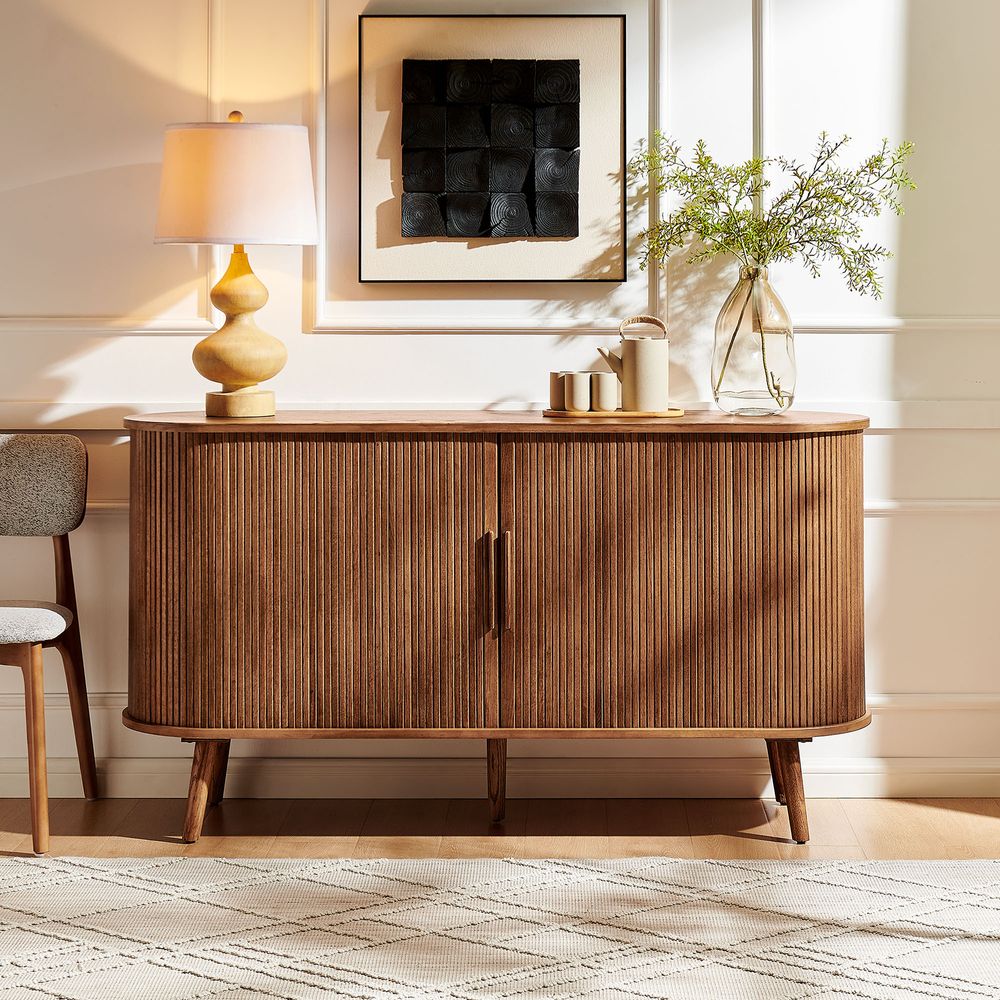
The Valo 63-Inch Oak Sideboard uses fluted tambour doors that slide across the front.
It combines American solid oak, plywood, and oak veneers, with kiln-dried construction and a wire-brushed, multi-step finish in Warm Brown Oak.
The sliding front can be useful when you want enclosed storage without a large door swing. The fluted surface also adds texture while keeping the overall form relatively simple.
Because tambour doors use tracks, keeping the track area clean can help maintain smooth operation.
Valo 63" Oak Sideboard
View Product
What Makes a Sideboard Look Mid-Century Modern?
You do not need a sideboard covered in vintage details to achieve a mid-century modern look. In many rooms, a few well-chosen design elements are enough.
Low Profile
A low, horizontal silhouette is one of the easiest ways to create the right visual proportion.
Tapered or Splayed Legs
Angled legs raise the cabinet off the floor and create a lighter appearance.
Warm Wood
Natural-looking oak, walnut, teak, and similar finishes can add warmth without relying on heavy ornamentation.
Restrained Hardware
Minimal pulls, recessed handles, or hardware that blends into the front can keep the cabinet visually clean.
Simple Geometry
Straight lines, balanced proportions, and uncluttered fronts usually fit the look better than excessive decoration.
Contemporary features such as fluted doors or updated finishes can still work with the style when the overall silhouette and proportions remain restrained.
Where to Use a Mid-Century Modern Sideboard
A sideboard does not have to stay in the dining room.
Dining Room
Use it for dinnerware, glassware, linens, serving pieces, and entertaining supplies.
Living Room
A sideboard can provide concealed storage for books, games, electronics, and other items while giving you a surface for lamps and artwork.
Entryway
A shallower sideboard can help organize bags, keys, shoes, mail, and other items that tend to collect near the front door.
Bedroom
It can provide additional clothing or accessory storage when a dresser alone is not enough.
Home Office
Use drawers and cabinets for office supplies, documents, technology accessories, and other equipment that you would rather keep out of sight.
The best room for a sideboard is often the room where you actually need the storage.
Can a Sideboard Double as a Media Console or Home Bar?
In some rooms, yes—but the product specifications matter.
Using a Sideboard as a Media Console
Before using a sideboard for a television, check:
-
Overall width
-
TV compatibility
-
Weight capacity
-
Cable-management features
-
Ventilation
-
Storage configuration
-
Viewing height
If you are using a wall-mounted TV, the sideboard can also provide a visual anchor underneath it. Just make sure the furniture's dimensions and storage features suit the equipment.
Using a Sideboard as a Home Bar
A sideboard can also work as a home bar if the interior storage is appropriate for bottles, glassware, trays, and bar accessories.
Look for shelves with enough vertical clearance and a top surface that gives you room to prepare or serve drinks.
How to Style the Top of a Mid-Century Modern Sideboard
The top of a sideboard can easily become cluttered. A simple arrangement usually works better than filling every inch.
Start with one larger anchor, such as:
-
A mirror
-
Artwork
-
A table lamp
-
A large vase
Then add one or two smaller pieces and, if you like, something organic such as a plant or branches.
Varying the height of the objects can keep the arrangement from looking flat. A simple rule of three can also help: group three objects or visual elements while leaving some open surface around them.
How to Care for a Wood Sideboard
Wood furniture generally benefits from simple, consistent care.
-
Dust regularly with a soft, dry cloth.
-
Wipe spills promptly rather than allowing moisture to sit on the surface.
-
Use coasters and trivets when placing drinks or hot serving dishes on the top.
-
Limit prolonged exposure to strong, direct sunlight.
-
Be cautious with furniture polish unless the manufacturer recommends it.
-
Follow the care instructions supplied with the specific product.
Different finishes can respond differently to cleaning products, so the manufacturer's instructions should take priority over general furniture-care advice.
Is Mid-Century Modern Still Popular in 2026?
Mid-century modern design continues to be used in contemporary interiors in 2026, partly because its basic elements—clean lines, practical proportions, natural-looking wood, and relatively simple forms—can work with several other design approaches.
You may see current sideboard designs combine traditional MCM proportions with details such as:
-
Fluted or textured fronts
-
Natural oak finishes
-
Minimal hardware
-
Updated storage layouts
-
Mixed materials
A sideboard does not need to look like a piece from the 1950s to fit a mid-century modern room. Proportion, silhouette, materials, and detailing usually have a greater effect than whether every element is historically authentic.
How to Choose Your Mid-Century Modern Sideboard
Before you buy, work through these seven steps:
1. Measure the wall.
Record the usable width, height, and depth of the area.
2. Mark the footprint.
Use painter's tape to visualize the actual dimensions on the floor.
3. Decide what needs to go inside.
Choose between drawers, cabinets, shelves, or a combination based on your storage needs.
4. Compare construction.
Look at the materials, veneer, drawer joints, wood components, and overall construction.
5. Check the proportions.
Compare the sideboard with your dining table, sofa, TV, artwork, and surrounding furniture.
6. Think beyond the current room.
A versatile sideboard may work in another room later if your storage needs change.
7. Verify the specifications.
Check the exact width, depth, height, interior dimensions, door or drawer clearance, and any weight or equipment limits before ordering.
The right sideboard is not necessarily the largest one or the one with the most storage. It is the one that fits the room, holds what you actually need, and continues to work with the space over time.
FAQs
What is a mid-century modern sideboard?
A mid-century modern sideboard is generally a low, horizontal storage cabinet with clean lines, warm wood finishes, restrained hardware, and features such as tapered legs. Modern versions may combine these characteristics with contemporary materials and storage features.
How tall is a mid-century modern sideboard?
Many mid-century modern sideboards are roughly 28–32 inches tall, although the actual height can vary. Always check the product dimensions before deciding what you will place above the sideboard.
What size mid-century modern sideboard should I buy?
Start by measuring the available wall and considering the furniture around it. Sideboards around 48–60 inches can work in smaller spaces, while 60–72 inches or more may suit larger dining or living rooms.
What wood is best for a mid-century modern sideboard?
There is no single best wood for every room. Oak, walnut, teak, and rubber wood can all be used in furniture. Consider the appearance, construction, finish, durability, and maintenance requirements rather than choosing based only on species.
Is solid wood better than veneer?
Not necessarily. Solid wood has its own characteristics, while real wood veneer can provide a natural wood surface over a more dimensionally stable core. Construction quality and how the materials are used are often more important than the label alone.
Can a mid-century modern sideboard work in an entryway?
Yes. A shallower sideboard can provide useful entryway storage for bags, mail, keys, and other everyday items. Measure the walkway carefully so the cabinet does not interfere with movement or door clearance.
How should I style the top of a sideboard?
Start with one larger anchor, such as artwork, a mirror, lamp, or vase. Add a few smaller pieces at different heights and leave some empty surface so the arrangement does not feel crowded.
How do I care for a wood sideboard?
Dust regularly, wipe spills promptly, use coasters and trivets, avoid prolonged direct sunlight, and follow the manufacturer's care instructions. Avoid using cleaning or polishing products unless they are suitable for the specific finish.