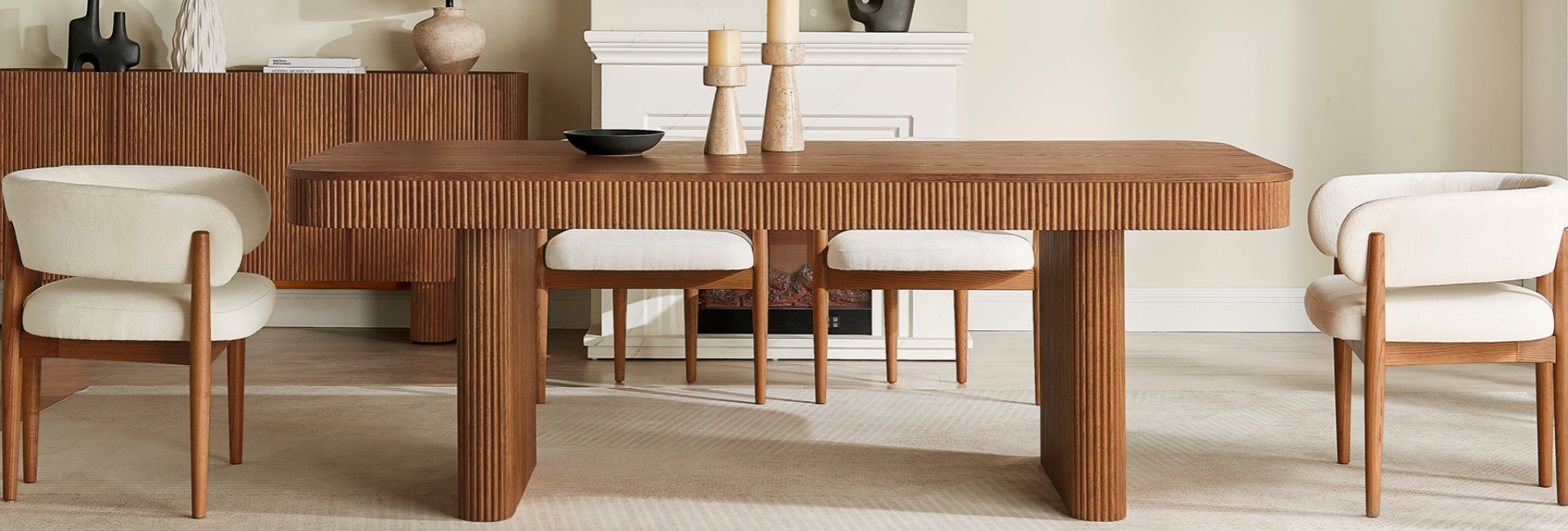
Choosing a dining room table for 6 can be tricky when manufacturers use different dimensions and seating capacities. A table may technically fit six chairs but leave little room for serving dishes, pulling out chairs, or moving around the dining area.
Start with the tabletop dimensions, then check whether six chairs fit comfortably and whether people can move around the table without blocking nearby furniture. A 60-inch rectangular table may work in a compact dining area, while a 72-inch table provides more room for three diners along each long side. Round tables create a different seating arrangement, and extendable designs offer flexibility when guests visit.
This guide covers 6 person dining table dimensions, common sizes for different table shapes, room-planning calculations, and practical buying considerations to help you choose a table that fits your home.
Table of Contents
- How Big Should a Dining Room Table for 6 Be?
- What Dining Table Shapes Are Recommended for Seating Six People?
- Round Dining Table for 6 Size Guide
- Rectangular Dining Room Table for 6 Dimensions
- How to Measure Your Dining Room Correctly
- Choosing the Right Table Material
- Choosing the Right Chairs for a Six-Person Table
- Extendable Dining Tables for Flexible Seating
- Dining Table Height, Legroom, and Lighting
- What to Check Before Buying a Dining Room Table for 6
- Conclusion: Finding the Right Dining Room Table for 6
- FAQs
- What dining table shapes are recommended for seating six people?
- How big should a 6 person dining table be?
- What's the standard size for a 6-seater?
- What size round table fits 6 people?
- Can you fit 6 people at a 48 inch round table?
- How much space should be between a dining table and the wall?
- Is a round or rectangular table better for a small dining room?
- Are extendable dining tables worth it for families?
- What dining table material lasts the longest?
- What size dining room is needed for a table that seats six?
- How tall is a standard dining room table?
How Big Should a Dining Room Table for 6 Be?
The right size depends on the table shape, chair dimensions, and how much room you want for place settings and serving dishes. The following measurements are practical starting points rather than universal industry standards.
Standard Size of Dining Table for 6
These ranges are planning guidelines, not fixed standards. Table leg placement, chair width, tabletop shape, and available floor space all affect how comfortably six people can sit.
For a rectangular dining room table for 6, 72 × 36 inches is a useful reference size. It provides approximately 24 inches of table-edge space for each of three diners along a long side. However, the available room for serving dishes depends on the tabletop width and place settings.
A 60 × 36-inch table can also accommodate six in a compact arrangement, typically with two people along each long side and one at each end. Whether this arrangement works comfortably depends on the table's legs, the amount of usable tabletop space, and the width of the chairs.
How Much Space Does Each Person Need?
A common furniture-planning guideline is to allow approximately 24 inches of table-edge space per diner. This provides a useful starting point when estimating seating capacity.
For example, three people sitting along one side of a rectangular table need approximately:
24 inches × 3 people = 72 inches
That is one reason a 72-inch table works well for three place settings along each long side.
This calculation describes the space along the table edge, not the total room each person needs. Diners also need space for their chairs, legs, and movement. Wide upholstered chairs or armchairs may require more room than compact side chairs.
Table width matters, too. A 36-inch-wide tabletop generally provides room for place settings and some shared dishes. A 40-inch-wide or larger table offers more flexibility for serving platters and centerpieces, provided the surrounding space can accommodate it.
Dining Room Table Size Chart for Six People
Use this comparison to narrow down your options.
The best dining room table size is not necessarily the largest one that fits on the floor. It should provide enough room for six diners without blocking doors, walkways, or access to nearby furniture.
What Dining Table Shapes Are Recommended for Seating Six People?
Rectangular, round, and oval tables are versatile options for six diners. Square tables can work, too, but their footprint may make them less practical in some homes.
Rectangular Dining Tables
Rectangular tables are a practical choice for long or narrow dining rooms and open-plan spaces. Their shape makes it easy to arrange three chairs along each long side, although the final layout depends on the table's dimensions and support structure.
A 60-inch table can work when space is limited. A 72-inch table provides more room for six diners, while an 84-inch table offers additional surface space for serving dishes or occasional extra guests.
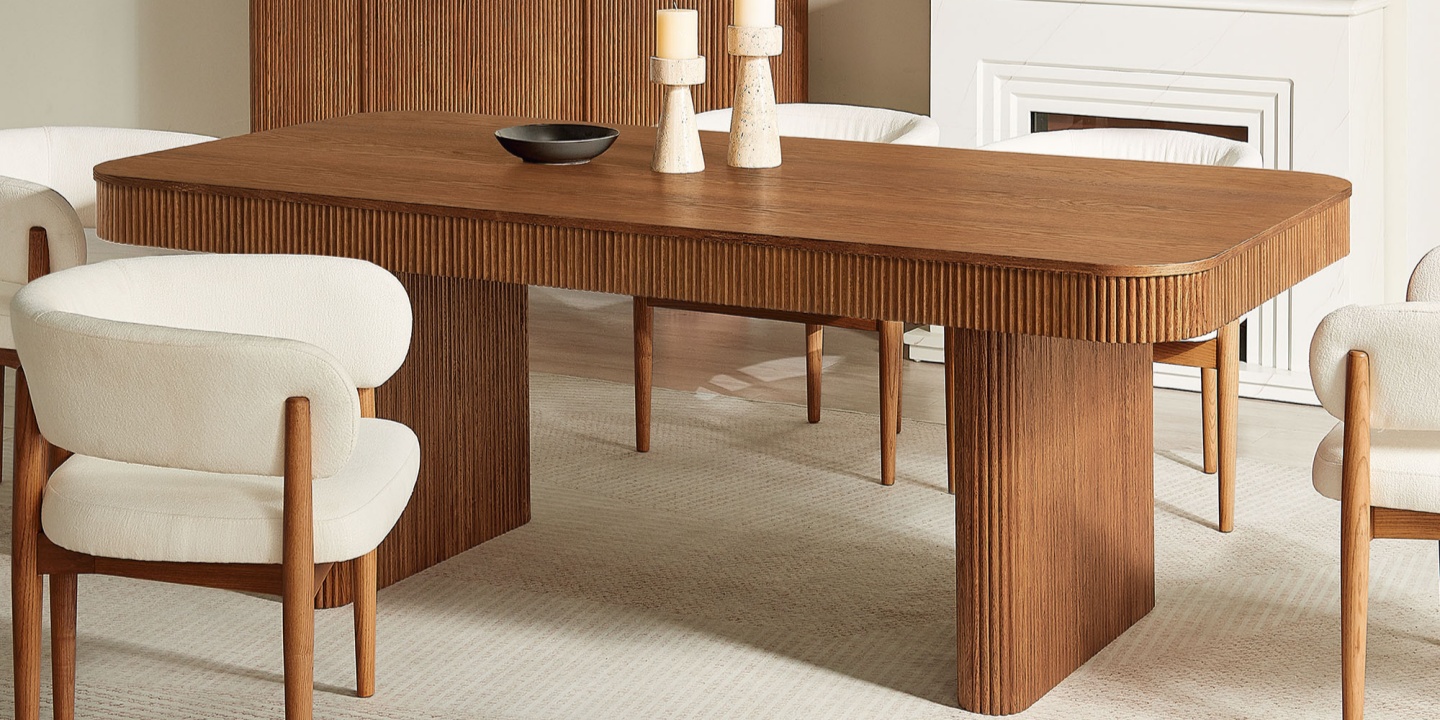
For a larger dining room, the Marisol 84-Inch Oak Dining Table is worth considering. It measures 84 × 40 × 30 inches and has a listed seating capacity of six to eight people. Its rounded corners soften the rectangular shape, while the oak fluting adds texture to the base.
Because the Marisol is larger than a compact six-person table, measure the full dining area before choosing it. Its dimensions are better suited to homes that can accommodate a more substantial dining surface.
Round Dining Tables
Round tables work well in square dining areas and spaces where people want to face one another more directly. Without corners, they can make it easier to move around the table in some layouts.
However, a round table is not automatically the most space-efficient choice. A larger diameter can take up more floor space than a compact rectangular table, and the chairs still need room to pull out. Compare the complete footprint, including the chairs.
When comparing a round dining table for 6 size, consider both the diameter and the table base. A pedestal base may provide more flexibility for chair placement, while a four-leg design can restrict where diners sit.
Oval Dining Tables
Oval tables combine a longer seating arrangement with rounded ends. They can work well when you want the capacity of a rectangular table but prefer softer edges.
An oval table around 60–72 inches long may suit six diners, depending on its width and base design. Check the usable length of the tabletop rather than relying on the overall shape alone, because curved ends can affect how much room is available for place settings.
Square Dining Tables
Square tables can create a balanced arrangement in a square room. A table measuring approximately 54–60 inches on each side may accommodate six, depending on the seating plan.
The main consideration is floor space. A 60-inch square table occupies 60 inches in both directions, so it may be harder to fit into a narrow dining area than a rectangular table with a similar seating capacity.
For many households, rectangular tables offer the greatest flexibility. Round and oval designs are worth comparing when the room layout or preferred dining experience makes them a better fit.
Round Dining Table for 6 Size Guide
What Size Round Table Fits 6 People?
For six people, a round table measuring 54–60 inches in diameter is a useful range to consider for everyday dining. A 48-inch round table may accommodate six in a compact arrangement, but it offers less room for each diner and for shared dishes.
These measurements are planning guidelines, not guarantees of comfort. Six compact chairs around a 54-inch table may fit differently from six wide upholstered chairs around a table of the same diameter.
Measure the chairs as well as the tabletop, and check whether the base interferes with anyone's knees or feet.
Can You Fit 6 People at a 48-Inch Round Table?
Yes, six people can fit around a 48-inch round dining table, but the seating arrangement will usually feel snug.
A 48-inch circle has a circumference of approximately 151 inches. Dividing that by six gives about 25 inches of circumference per person. This is a simplified geometric estimate rather than a direct measurement of usable dining space, but it helps explain why six diners can fit around a compact table.
The practical limitations become more noticeable when you add wide chairs, full place settings, drinks, and shared serving dishes. A central pedestal may improve chair placement, while a bulky base or widely spaced legs may reduce it.
A 48-inch round table can work when:
The chairs are relatively compact.
Meals are casual and the tabletop does not need to hold many serving dishes.
The dining area cannot accommodate a larger table.
Six-person seating is occasional rather than a daily requirement.
For regular meals with six adults, compare 54- and 60-inch tables before deciding. They provide more tabletop area and may feel less crowded, although they also require more floor space.
54-Inch vs. 60-Inch Round Dining Tables
The difference between these two sizes is more noticeable than the six-inch increase might suggest. A 60-inch circle has about 23% more tabletop area than a 54-inch circle.
A 54-inch round table is a practical middle ground when you need six seats but want to limit the table's footprint. It may suit a moderately sized dining area, particularly when the chairs have a relatively narrow profile.
A 60-inch round table provides more room for plates, glasses, and shared dishes. It may be a better choice for households that regularly host guests, provided there is enough clearance around it.
Neither size is automatically right for every home. Consider how you serve meals, the width of your chairs, and the space available around the table.
Pedestal Base vs. Four-Leg Base
The table base affects how easily you can position six chairs.
A central pedestal can leave more open space around the perimeter and reduce the chance of chair legs colliding with table legs. A four-leg design may offer a familiar look and stable support, but its legs can restrict chair placement near the edges.
Before buying, check the position of the supports and the amount of knee and foot room available. The usable space underneath the tabletop matters just as much as its diameter.
Rectangular Dining Room Table for 6 Dimensions
Is a 60-Inch Dining Table Big Enough for Six?
A 60 × 36-inch rectangular table can seat six, but the arrangement is usually more compact than it would be around a 72-inch table.
One common layout places two diners on each long side and one at each end. The end seats depend on the position of the table legs, the amount of overhang, and the width of the chairs.
This size may work well in apartments, smaller dining rooms, or kitchen dining areas where a longer table would restrict movement. If you often serve large dishes in the center, test the layout with actual place settings before committing.
Why Consider a 72-Inch Dining Table?
A 72 × 36-inch rectangular table is a useful reference size for six people because it provides approximately 24 inches of table-edge space for each of three diners along a long side.
A 72 × 40-inch table offers more width for shared dishes and serving platters, but it also takes up more room. Consider the extra width only if the surrounding clearance remains comfortable.
When comparing 6 person dining table dimensions, pay attention to the entire product specification. The tabletop, legs, apron, and chair arrangement can all affect the usable seating space.
When Does an 84-Inch Table Make Sense?
An 84-inch table can be useful if you want generous surface space or occasionally seat more than six people. It is not necessary for every household of six, and its larger footprint can be a drawback in a compact dining area.
Before choosing it, measure the room with chairs pulled out. A table that fits between four walls on paper may still obstruct a walkway or prevent a nearby cabinet from opening.
How to Measure Your Dining Room Correctly
The 36-Inch Clearance Rule
A commonly used furniture-planning guideline is to leave approximately 36 inches between the table edge and a wall or other obstruction. This provides room to pull out chairs and move around the dining area.
The exact space needed depends on how the room is used. A route where people regularly walk behind seated diners may require more room, while a constrained layout may need a different seating arrangement.
Calculate the Maximum Table Size
To estimate how much tabletop space may fit, subtract the desired clearance from both sides of the room.
Maximum table length = room length − twice the planned clearance
Maximum table width = room width − twice the planned clearance
For example, consider a dining area measuring 14 × 11 feet:
Room length: 168 inches
Room width: 132 inches
Planned clearance: 36 inches on each side
The initial calculation gives:
Length: 168 − 72 = 96 inches
Width: 132 − 72 = 60 inches
The resulting 96 × 60-inch area is a theoretical limit based on that clearance assumption, not a recommendation to purchase a table of that size. The calculation estimates the tabletop footprint only. It does not automatically account for chair dimensions, the space needed to pull chairs out, door swings, sideboards, or whether people can pass behind seated diners.
For a six-person table, compare smaller options first and check the layout with the chairs in place. If one side of the room is a major walkway, you may need to allow more clearance there and choose a narrower or shorter table.
Test the Layout Before You Buy
A simple floor test can help you spot space problems before ordering a table.
Measure the proposed tabletop length and width.
Use painter's tape to mark the outline on the floor.
Position your existing chairs around the outline, allowing for their actual width.
Pull the chairs back as you would when sitting down or standing up.
Walk around the arrangement and check nearby doors, cabinets, and walkways.
This test is especially useful when comparing a 60-inch table with a 72-inch or 84-inch model. It also helps reveal whether a larger table would interfere with the rest of the room.
Layout Tips for Different Dining Areas
Small dining rooms: Consider a compact rectangular table, a round pedestal table, or an extendable design. Prioritize clear access to doors and nearby furniture over maximizing the number of seats.
Open-plan homes: A rectangular table can help define the dining area. Make sure it does not interrupt the main route between the kitchen, living room, and exterior doors.
Dedicated dining rooms: A 72-inch or larger rectangular table may be suitable when the room provides enough clearance. Measure any sideboards or cabinets as part of the layout.
Kitchen dining areas: Compact tables and flexible seating may work best. Avoid placing chairs where they obstruct cabinet doors, appliances, or the normal path through the kitchen.
The goal is to make the dining area work for everyday use, not simply to fit the largest possible table.
Choosing the Right Table Material
Material affects appearance, maintenance, weight, and how a table fits into your household's routine. It does not determine seating capacity by itself.
Wood Dining Tables
Wood offers a familiar, warm appearance and comes in a range of grain patterns and finishes. Solid wood, veneers, and engineered wood have different construction characteristics, so check the product specifications rather than assuming all wood tables are made entirely from solid hardwood.
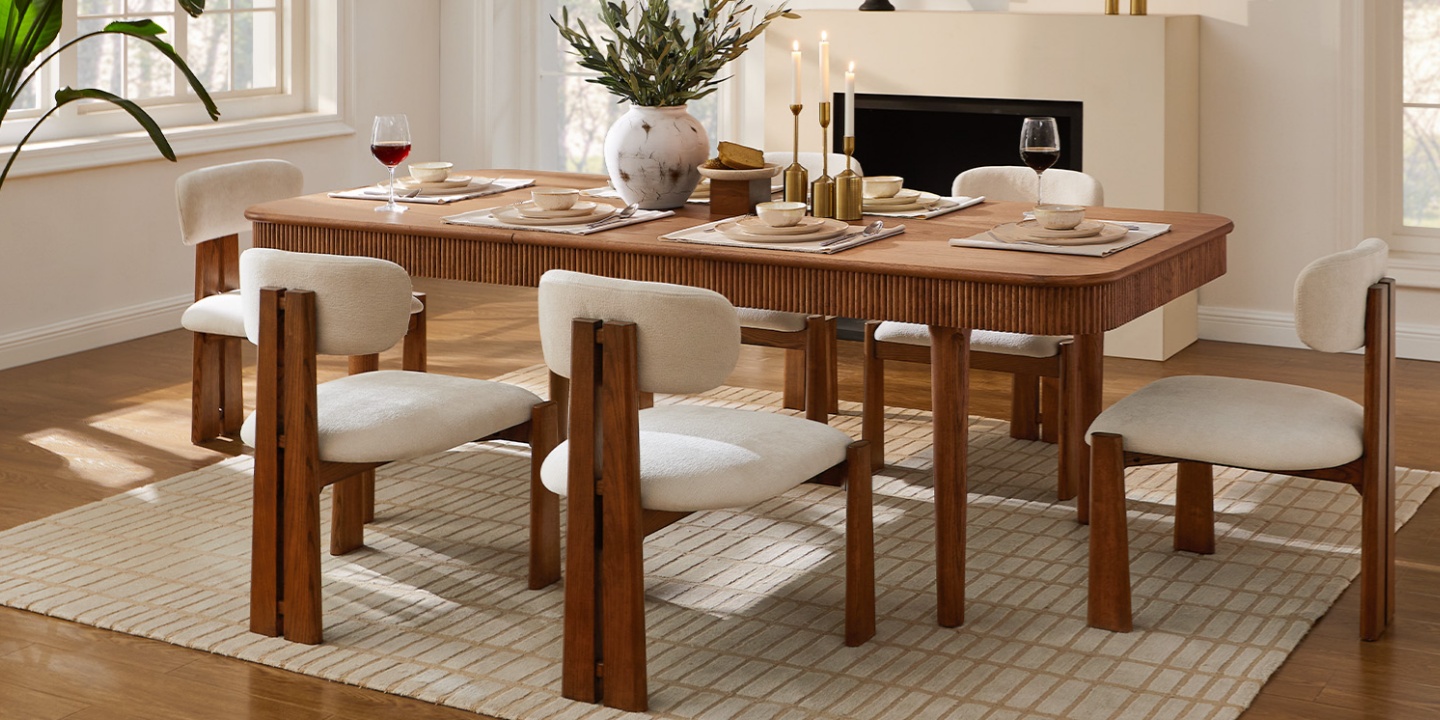
For example, the Valo 72"–92" Extendable Dining Table has a listed seating capacity of six to eight people. Its crafted of American solid oak and plywood with oak veneers, and two self-storing extension leaves.
The extension feature lets you keep the table more compact for everyday meals and expand it when additional space is needed. Check both the compact and extended dimensions against your dining room before purchasing.
Glass Dining Tables
Glass tabletops can make a room feel visually lighter because the surface does not block as much of the view through the space. They can suit smaller rooms, although the actual footprint and chair clearance remain the same as with other table materials.
Glass may show fingerprints and smudges readily, so regular cleaning is part of everyday maintenance.
Stone and Sintered-Stone Tables
Stone and sintered-stone tabletops offer a different look and may provide resistance to certain types of heat, stains, or scratches, depending on the specific material and finish.
Care instructions vary, so check the manufacturer's guidance for cleaning products, hot cookware, and spill removal. Do not assume every stone surface has the same maintenance requirements.
Engineered Wood and Veneers
Engineered wood and veneer construction can offer consistent finishes and a range of price points. Durability depends on the core material, surface finish, joinery, and overall construction quality.
When comparing products, review the listed materials and care instructions. A clear understanding of the construction is more useful than relying on broad labels such as "premium" or "durable."
Choosing the Right Chairs for a Six-Person Table
Check Chair Width and Placement
Chair dimensions are a major part of the seating equation. A table that accommodates six compact side chairs may feel crowded with six wide upholstered chairs.
Before buying, check:
The width of each chair, including armrests.
The position of the table legs and supports.
The space between adjacent chairs.
Whether the chairs can be pulled out without hitting a wall or nearby furniture.
If you already own dining chairs, measure them before choosing the table. If you are buying a complete set, evaluate the table and chairs together rather than relying on the advertised seat count alone.
Armchairs vs. Side Chairs
Side chairs generally take up less space and are easier to position along the long sides of a rectangular table. Armchairs can add comfort at the ends, but their extra width may affect the available space.
A combination of four side chairs and two end chairs can work well with a rectangular table, provided the end chairs fit between the table supports and nearby furniture.
Bench Seating
A bench can be useful when you need flexible seating or want to tuck the seats underneath the table when they are not in use. It may also suit a compact layout where moving individual chairs is inconvenient.
However, a bench does not automatically make a table more comfortable or increase its usable capacity. Measure the bench length, leg placement, and space required to get in and out. Individual chairs may be more comfortable for long meals.
Extendable Dining Tables for Flexible Seating
An extendable table can be a practical solution if six people use the table most days but larger groups visit occasionally. Rather than keeping a large table in place all year, you can use a more compact configuration and extend it when needed.
What to Check Before Buying an Extendable Table
First, confirm the table's dimensions in both configurations. Also check whether the extension leaves are stored inside the table or need to be stored separately.
A self-storing mechanism can be convenient because you do not need a separate place to keep the leaves. Removable leaves can offer flexibility, too, but you need enough storage space and should account for the additional setup.
Second, measure the room with the table fully extended. The extended tabletop may fit, but the chairs and people using them still need adequate clearance.
Third, verify the manufacturer's stated seating capacity. The number of people a table can accommodate depends on the extension length, chair dimensions, and seating arrangement.
When Is an Extendable Table Worth It?
An extendable table is worth considering if your usual seating needs are smaller than your occasional gatherings. It may not be necessary if you regularly seat six or more people and already have enough space for a larger fixed table.
Consider how often you host guests, how much floor space you want to preserve, and how easy the extension mechanism is to operate.
Dining Table Height, Legroom, and Lighting
Standard Dining Table Height
Many standard dining tables measure approximately 28–30 inches high. This range works with many dining chairs, but you should compare the tabletop height with the chair's seat height and the clearance underneath the table.
A comfortable fit depends on more than the overall table height. An apron or support frame underneath the tabletop can reduce legroom, even when the table's listed height seems appropriate.
Check Knee and Foot Clearance
Before purchasing, look at the space beneath the tabletop. Check whether the apron, pedestal, or legs will interfere with knees or feet.
If possible, try the chairs with the table or compare their dimensions carefully. The height of the seat, the underside of the tabletop, and the position of the supports all affect comfort.
Lighting Above the Table
A pendant light or chandelier should illuminate the tabletop without blocking people's view across it. The appropriate fixture size and hanging height depend on the room, ceiling height, and table dimensions.
As a starting point, many dining areas use a fixture centered over the table and hung approximately 30–36 inches above the tabletop. Treat this as a design guideline rather than a universal requirement, and check the fixture manufacturer's installation instructions.
What to Check Before Buying a Dining Room Table for 6
Before making a final decision, work through these practical checks.
Measure the Room
Measure the length and width of the usable dining area, accounting for doors, windows, sideboards, kitchen islands, and other furniture. Do not assume the entire floor area is available for the table.
Confirm the Seating Arrangement
Decide whether you want three chairs along each long side, two chairs on each side with one at each end, or another configuration. Then check the table's legs and supports to make sure the arrangement is practical.
Think About Everyday Use
Consider whether the table will mainly be used for meals, homework, remote work, or entertaining. The amount of tabletop space you need may differ depending on how you use it.
Compare the Materials and Care Requirements
Read the product specifications to understand the tabletop materials, finish, construction, and cleaning instructions. This helps you choose a table that suits your routine and expectations.
Check Delivery and Assembly Details
Before ordering, review the package dimensions, delivery requirements, and assembly instructions. A table can fit the room but still be difficult to move through a hallway, staircase, or doorway.
Conclusion: Finding the Right Dining Room Table for 6
Choosing a dining room table for 6 comes down to balancing seating comfort, tabletop dimensions, and room clearance. A 60 × 36-inch rectangular table can work in a compact dining area, while a 72 × 36-inch table offers a useful reference size for six people. Round tables measuring 54–60 inches in diameter may provide a more comfortable arrangement than a compact 48-inch model, depending on the chairs and base design.
Before ordering, mark the proposed table dimensions on the floor and test the layout with chairs in place. This simple step can help you spot clearance problems before delivery. If your seating needs change throughout the year, an extendable design such as the Valo 72"–92" Extendable Dining Table may provide useful flexibility.
FAQs
What dining table shapes are recommended for seating six people?
Rectangular, round, and oval tables are all practical options for six people. Rectangular tables work well in longer rooms and make it easy to arrange three chairs along each long side. Round tables encourage conversation, while oval tables combine a long seating area with rounded ends. The best shape depends on your room layout and chair dimensions.
How big should a 6 person dining table be?
A rectangular dining table measuring approximately 60–72 inches long and 36–40 inches wide is a useful starting point for six people. A round table measuring 54–60 inches in diameter may provide a more spacious arrangement for everyday dining. Actual seating capacity depends on chair width, table supports, and the space needed for serving dishes.
What's the standard size for a 6-seater?
A 72 × 36-inch rectangular table is a common reference size for six people, with three diners along each long side. It is not a universal standard, and a 60-inch table may work in a more compact arrangement. Check chair dimensions and available room clearance before choosing a table.
What size round table fits 6 people?
A 54–60-inch round table is a useful range to consider for six people. A 54-inch table offers a balance between tabletop space and floor space, while a 60-inch table provides more room for serving dishes. The right diameter depends on chair width, the table base, and the space available around the table.
Can you fit 6 people at a 48 inch round table?
Yes, six people can fit around a 48-inch round table, but the arrangement is usually tight. Compact chairs and simple place settings can make it more workable, while wide chairs and shared serving dishes reduce the available space. For regular meals with six adults, consider a 54- or 60-inch table if your room can accommodate it.
How much space should be between a dining table and the wall?
About 36 inches between the table edge and a wall or nearby obstruction is a commonly used planning guideline. More space may be needed where people regularly walk behind seated diners or where the table sits near a doorway or cabinet. Test the layout with the chairs pulled out rather than measuring only the tabletop.
Is a round or rectangular table better for a small dining room?
Neither shape is always better. A round table can make movement around a compact space feel easier because it has no corners, but its diameter still needs to fit the room. A narrow rectangular table may work better in a long, tight dining area. Compare the complete footprint, including chairs and walkways.
Are extendable dining tables worth it for families?
An extendable table can be useful when your household typically needs six seats but occasionally hosts more guests. It allows you to keep the table compact for everyday meals and expand it when necessary. Check both the closed and extended dimensions, the extension mechanism, and the manufacturer's seating-capacity guidance before buying.
What dining table material lasts the longest?
Longevity depends on the material, construction, finish, maintenance, and how the table is used. Solid wood can often be repaired or refinished, while engineered wood and veneers vary by construction quality. Stone and sintered-stone surfaces have different care requirements. Compare the manufacturer's specifications rather than relying on the material name alone.
What size dining room is needed for a table that seats six?
There is no single room size that works for every six-person table. The room must accommodate the tabletop, chairs, and enough clearance for people to sit down and move around. As an initial planning step, subtract your intended clearance from the room dimensions, then check door swings, nearby furniture, and the fully pulled-out chair positions.
How tall is a standard dining room table?
Many standard dining tables are approximately 28–30 inches high. Check the chair seat height and the clearance beneath the tabletop to ensure that diners have enough room for their legs. Aprons, pedestals, and other supports can affect comfort even when the overall table height falls within this range.