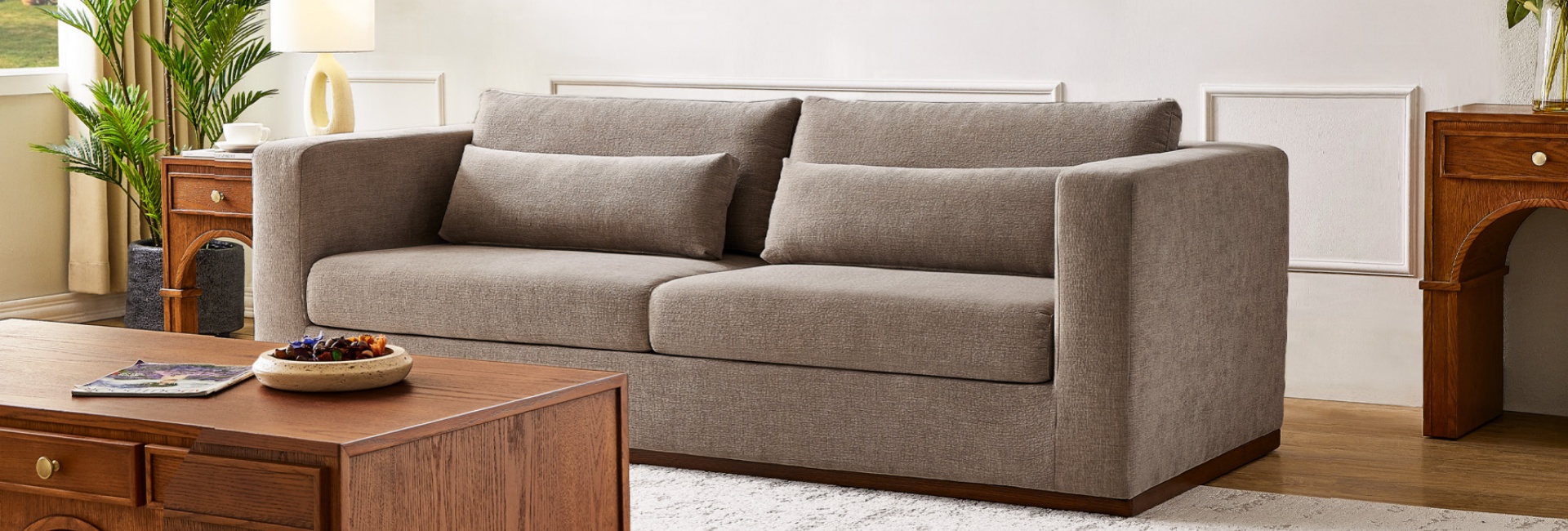
A deep couch is a sofa with more usable seat depth than a typical sofa, often around 24 inches or more from the front of the seat to the backrest. The extra room lets you stretch out, tuck your legs up, or lean back instead of sitting upright.
If you spend your evenings watching TV, reading, or napping in the living room, a deep seat couch can make the space feel much more relaxed. But deeper is not automatically better. The right depth depends on your body, how you sit, and how much floor space the sofa will take up.
Table of Contents
- What Exactly Is a Deep Couch?
- Deep Sofa Depth: The Numbers That Actually Matter
- Why Deep Sofas Feel So Comfortable
- The Honest Downsides of a Deep Seat Couch
- Is a Deep Couch Right for You?
- How to Make a Deep Sofa More Comfortable
- Deep Seat Couch Styles for a Modern Home
- Matching a Deep Couch to Your Room Size
- What to Look for in a Deep Sofa
- Final Takeaway
- FAQs
- What is a deep couch called?
- What seat depth is considered deep?
- What is the standard couch seat depth?
- Are deep couches comfortable?
- Are deep sofas comfortable for short people?
- Are deep sofas better for tall people?
- How do I know if a couch is too deep for me?
- How can I make a deep sofa more comfortable?
- Do deep couches take up more floor space?
What Exactly Is a Deep Couch?
When people describe a sofa as "deep," they are talking about seat depth, not the sofa's width or height.
That distinction matters because two sofas can have similar overall dimensions but feel very different when you sit in them.
Seat Depth vs. Overall Depth
Seat depth is the distance from the front edge of the seat cushion to the backrest. It is the part of the sofa that supports your body and determines how far back you can sit.
Overall depth is the sofa's complete front-to-back measurement, including the back frame and cushions. It tells you how much floor space the sofa occupies.
A sofa can have a generous overall depth without having an especially deep seat. Thick back cushions, for example, can take up several inches of that space.
When comparing sofas, look for the actual seat depth rather than relying only on overall dimensions.
What Seat Depth Is Considered Deep?
There is no industry-wide cutoff for what officially counts as a deep sofa. In practice, many furniture brands describe seats around 24 inches or more as deep, while sofas around 20 to 22 inches tend to fall into the standard range.
Once you get closer to 28 or 30 inches, the sofa generally shifts further toward lounging rather than upright sitting. At that point, the extra space is useful for stretching out but can make upright sitting less comfortable for shorter users.
The simplest way to think about it is this: a deep sofa gives you enough seat space to lean back, curl up, or put your legs on the cushion without feeling confined.
Deep Sofa Depth: The Numbers That Actually Matter
Seat depth is one of the most useful measurements to check before buying a sofa. A few extra inches can noticeably change how the sofa feels.
Standard, Deep, and Extra-Deep
The ranges below are useful buying guidelines rather than strict industry standards:
There is some overlap between these categories. A sofa's seat height, cushion firmness, and back cushion thickness can make the same seat depth feel very different.
Why a Few Inches Can Change the Feel
Moving from a 22-inch seat to a 26-inch seat may not sound dramatic on paper, but you gain several inches of usable space under your thighs and behind your hips.
That extra room is useful if you like to stretch out, cross your legs, or sit with your feet tucked onto the cushion. It can also make a noticeable difference for taller users who find standard sofas leave part of their thighs unsupported.
The trade-off is just as important. If the seat is deeper than your seated leg length, you may have to slide forward to keep your feet on the floor or add a pillow behind your back.
Why Deep Sofas Feel So Comfortable
The appeal of a deep sofa is fairly simple: it gives you more room to change position.
You can stretch out with a blanket, curl up for a movie, or lie across the cushion for a quick nap without feeling like you are balancing on the edge of the seat.
That extra depth can also help taller users. A standard sofa may leave more of the thighs unsupported, while a deeper seat gives the legs more room to rest. Height is only part of the equation, though. Your seated leg length and preferred posture matter just as much.
There is a social benefit, too. A larger seating surface gives family members more room during movie night and leaves space for a pet without everyone competing for the same few inches.
Visually, deep sofas often create a relaxed, inviting feel. Lower profiles, soft upholstery, and rounded shapes work particularly well in casual, modern living rooms.
The Honest Downsides of a Deep Seat Couch
A deep couch works well when its dimensions match the people and the room using it. When they do not, the extra depth can become a daily annoyance.
When It's Too Deep for Shorter Users
Shorter users are more likely to struggle with a very deep seat, particularly when the seat depth is greater than their seated leg length.
Sit all the way back and your feet may not reach the floor. Move forward to put your feet down and you may lose the back support you need.
Instead of choosing a sofa based on height alone, compare your seated leg length with the actual seat depth. A firm lumbar pillow can also bring the effective backrest forward by several inches.
Getting Up From a Deep, Soft Seat
Deep sofas with soft cushions can be harder to stand up from because your body sits lower and farther back into the seat.
That can matter for older adults or anyone who has difficulty standing from a low, soft surface. If several people in the household use the sofa, think about who needs to get in and out of it most often.
A slightly shallower seat with firmer cushions may be a better everyday choice than an extra-deep, sink-in design.
More Floor Space, Less Clearance
A deep couch also takes up more room.
A standard sofa may have an overall depth around 34 to 40 inches, while a deeper model can reach 40 to 45 inches or more. In a compact living room, those extra inches can reduce walking space or leave less room for a coffee table.
The solution is not necessarily to avoid deep seating. It is to check the sofa's full dimensions before buying and make sure the room can accommodate them comfortably.
Is a Deep Couch Right for You?
Instead of choosing by appearance alone, test the sofa against your body, habits, and room.
The Knee-Bend Test
Sit all the way back against the cushions and check where the front edge of the seat meets the backs of your knees.
As a practical starting point:
Your knees should clear the front edge by a small gap, roughly 2 to 4 inches.
Your feet should rest flat on the floor or come close to doing so.
The front edge should not press into the backs of your thighs.
You should be able to stand without excessive effort.
If your feet dangle when you sit back, the seat may be too deep for comfortable upright sitting. If you have to perch on the front edge to reach the floor, the sofa is probably not the right fit for your body.
Measure Your Seated Leg Length
Height alone does not tell you whether a sofa will fit.
Sit on a firm chair with your back against the backrest and measure from the back of your hip to the back of your knee. Compare that measurement with the sofa's seat depth.
It is not an exact furniture-fit formula because cushion shape and posture also matter, but it gives you a much better starting point than using your standing height alone.
In other words, use your seated leg length as a better reference point than height alone when comparing deep sofas.
Tape the Sofa's Footprint on the Floor
Online dimensions can be surprisingly difficult to visualize.
Before ordering, use painter's tape to mark the sofa's exact overall dimensions on your living room floor. Include its full depth, width, and any space needed around it.
Walk around the taped outline for a day. Put a chair or temporary box where your coffee table will sit and check whether the main walking paths still feel comfortable.
As a general planning guideline, allow around 30 to 36 inches between the sofa and coffee table and about 24 to 36 inches for a main walkway, depending on how the room is used.
A Quick Self-Assessment
Ask yourself:
Do you mostly lounge, nap, or watch TV on the sofa?
Do you prefer leaning back or sitting upright?
Is the sofa being used by taller adults?
Does your room have enough space for a deeper footprint?
Does anyone in the household need an easier-to-stand-from seat?
Do you regularly read, work, or eat while sitting on the sofa?
If lounging is the priority and the room has enough space, a deep couch can be an excellent fit. If the sofa needs to work for a wide range of body types and activities, standard depth may be the safer choice.
How to Make a Deep Sofa More Comfortable
Already bought a deep sofa that feels a little too deep? You can often improve the fit without replacing it.
A firm lumbar pillow is one of the simplest fixes. Place it behind your lower back to move the effective backrest forward. That reduces the usable seat depth and can help your feet reach the floor.
An ottoman or low footrest works in the opposite direction. Instead of trying to sit upright in a deep seat, use the extra depth as a lounge position and give your legs somewhere to rest.
Higher back cushions can also make a difference. If the cushions support your shoulders rather than stopping around your lower back, you can sit more upright without needing to perch near the front edge.
For shorter users, a combination of a firm lumbar pillow and a supportive footrest is often more useful than simply adding several soft decorative pillows.
Deep Seat Couch Styles for a Modern Home
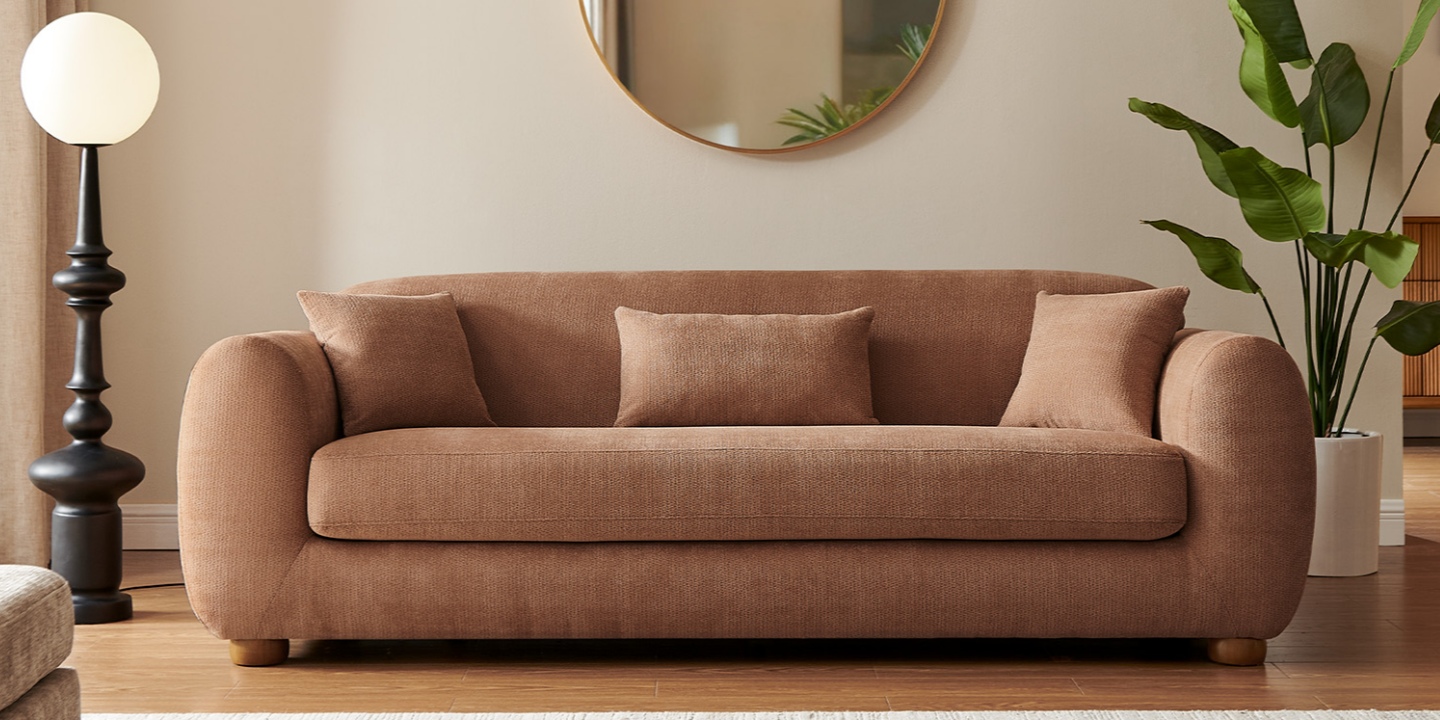
Deep seating does not have to look bulky. The sofa's silhouette, arms, base, and upholstery all affect how it looks in the room.
Curved and rounded profiles can soften a room with lots of straight lines. The Frosta 91" Chenille Loveseat is one example, with rounded armrests and a layered backrest that create a softer, more enveloping profile. Its 91-inch width makes it a substantial piece without relying on a formal, traditional silhouette.
Track-arm and low-profile sofas create a cleaner, more architectural look. They work particularly well in open-concept rooms where the sofa needs to anchor the seating area without making the space feel visually heavy.
Color also changes the effect. A neutral deep sofa in oatmeal, gray, or soft green can blend into the room, while a saturated color can make the sofa the focal point.
Matching a Deep Couch to Your Room Size
A sofa that looks perfectly proportioned in a showroom can feel oversized once it is inside a smaller living room. Check the room measurements before you start shopping.
Clearance Rules
For a typical living room layout, leave around 30 to 36 inches between the sofa and coffee table and approximately 24 to 36 inches for a walkway, depending on traffic and furniture placement.
Consider the sofa's overall depth rather than its seat depth when planning.
For example, if a deep sofa is 45 inches deep and you want 36 inches of clearance in front of it, you need about 81 inches from the wall behind the sofa to the edge of the walking area.
That simple calculation can prevent an expensive sizing mistake.
Small-Space Workarounds
A smaller room does not automatically rule out deep seating.
Consider a loveseat or apartment-size sofa instead of a full sectional. Small side tables can replace a large coffee table, and a low-profile frame can help preserve an open visual feel.
If the room is especially tight, a standard-depth sofa paired with an ottoman can provide much of the same lounging flexibility without taking up as much floor space.
What to Look for in a Deep Sofa
Once the depth works for your body and room, look beyond the dimensions. The frame, suspension, cushions, and upholstery all affect how the sofa performs over time.
Frame, Fill, and Fabric
The frame provides the basic structure. Solid wood and quality plywood components, combined with sound joinery, can help the sofa maintain its shape through everyday use.
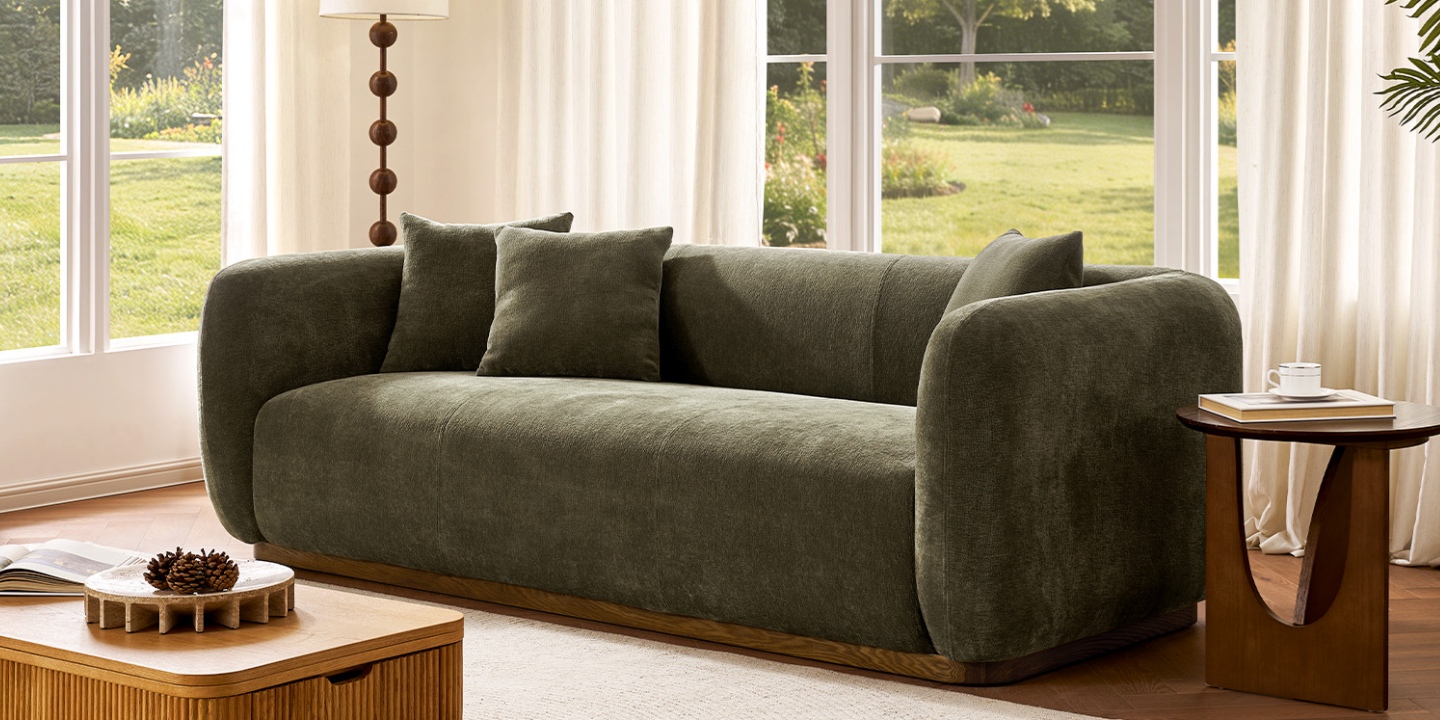
The Jade 90" Deep Seat Sofa, for example, uses an American solid oak and plywood frame. Its low profile and deep seating are designed around relaxed lounging, while the green chenille upholstery and recessed wood base give it a grounded modern look.
For cushions, look for a supportive foam core with a fiber wrap rather than relying on low-density foam alone. Foam provides the underlying support, while the fiber layer creates a softer surface feel.
Suspension matters as well. Sinuous springs and reinforced webbing can provide support beneath the cushions and help distribute everyday seating pressure.
When choosing fabric, think about how the sofa will actually be used. Chenille has a soft, casual texture and can work well in relaxed living rooms. If spills are a concern, look for a spill-resistant treatment or performance fabric. Removable cushion covers can also make routine cleaning easier.
At the time of writing, the featured Hernest deep-seat sofas are priced around $1,600–$1,800 before promotions.. Prices can change, so check the current product listing before making a purchase.
Finally, read the warranty terms, not just the number of years. Pay attention to what is covered, particularly the frame, suspension, and cushions. Coverage details matter more than the headline warranty period alone.
You can explore the full Hernest sofa collection to compare sofa sizes, styles, and construction details.
Final Takeaway
A deep couch is not automatically more comfortable than a standard sofa. Its extra seat depth is valuable when you like to lounge, stretch out, or sit with your legs up, but the same depth can be awkward if you prefer upright sitting or have a shorter seated leg length.
Before buying, check three things: the sofa's seat depth, how your body fits that depth, and how the sofa's overall footprint works in your room.
If those three measurements line up with the way you actually use your living room, a deep seat sofa can be a great fit.
FAQs
What is a deep couch called?
A deep couch is commonly called a deep seat sofa or deep seated couch. You may also see terms such as "lounge sofa" used for models designed around relaxed, reclined sitting. The defining feature is the seat depth, not the sofa's overall width or height.
What seat depth is considered deep?
There is no universal industry cutoff, but many furniture brands consider around 24 inches or more to be deep. Standard sofa seats are often around 20 to 22 inches, while seats approaching 28 to 30 inches provide more room for lounging.
What is the standard couch seat depth?
A standard sofa seat is generally around 20 to 22 inches deep, measured from the front of the seat to the backrest. Overall sofa depth is greater because it includes the back frame and cushions.
Are deep couches comfortable?
They can be very comfortable if the depth matches your body and how you sit. Deep sofas work particularly well for lounging, watching TV, stretching out, and napping. They can feel less comfortable if you prefer upright sitting or if the seat is deeper than your seated leg length.
Are deep sofas comfortable for short people?
They can be, but shorter users are more likely to need additional support. If your feet do not reach the floor when you sit against the backrest, try a firm lumbar pillow or consider a shallower seat.
Are deep sofas better for tall people?
Often, yes. Taller adults may appreciate the additional thigh support of a deeper seat, but height alone should not determine the choice. Your seated leg length, seat height, cushion firmness, and preferred posture all matter.
How do I know if a couch is too deep for me?
Sit all the way back and check the relationship between your knees, feet, and the front edge of the seat. A small gap behind your knees is a useful starting point, while feet that dangle or an edge that presses into your thighs are signs the seat may be too deep.
How can I make a deep sofa more comfortable?
Try a firm lumbar pillow to reduce the effective seat depth, an ottoman or footrest for your legs, and supportive back cushions for more upright sitting. These changes can make a deep sofa easier to use without replacing it.
Do deep couches take up more floor space?
Usually, yes. Deep sofas often have an overall depth of around 40 to 45 inches or more, compared with roughly 34 to 40 inches for many standard sofas. Measure the sofa's full footprint and leave enough room for the coffee table and main walking paths.