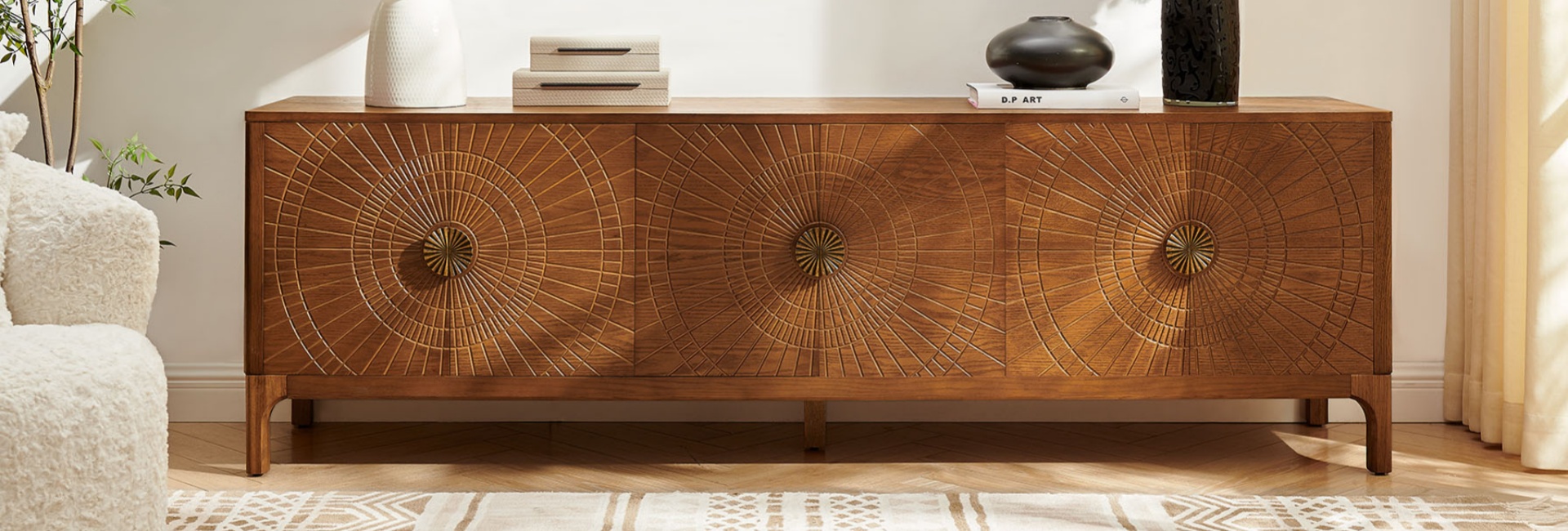
If you’re buying a TV stand you expect to keep for years, “solid wood” is a good place to start—but it shouldn’t be the end of your research.
For most buyers, solid hardwood is one of the best choices for a durable TV stand, while plywood can provide excellent structural support and MDF can work well in the right application. The best-performing TV stands often combine different materials rather than relying on one material throughout.
That matters even more when you’re furnishing a living room around a 75-, 80-, or 85-inch TV. A large console has to support a substantial load, resist sagging across long spans, handle everyday wear, accommodate electronics, and remain stable as indoor conditions change.
If you’re comparing solid wood, plywood, and MDF, start with the material—but don’t stop there. The way a console is supported, joined, finished, and rated for weight will tell you far more about its long-term performance.
Table of Contents
- What Is the Best Material for a Durable TV Stand?
- What Makes a TV Stand Durable?
- TV Stand Materials Compared: Solid Wood vs. Plywood vs. MDF vs. Particleboard
- Which Wood Is Best for a Durable TV Stand?
- Is Solid Wood Better Than Engineered Wood for a TV Stand?
- How to Choose the Right TV Stand Material for Your Home
- What to Look for When Buying a Durable TV Stand
- How HERNEST TV Stands Apply These Material and Construction Principles
- MDF, Composite Wood, and U.S. Furniture Standards
- Common Mistakes That Can Make a TV Stand Less Durable
- How to Make Your TV Stand Last Longer
- Final Verdict: The Best TV Stand Material Depends on More Than the Material
- FAQs
- What Is the Best Material for a TV Stand?
- What to Look for When Buying a TV Stand?
- Is MDF Good for a TV Stand?
- Are Wood TV Stands Durable?
- Is Solid Wood Better Than MDF for a TV Stand?
- Is Plywood Better Than MDF for a TV Stand?
- What Is the Most Durable Wood for a TV Stand?
- What Is the Best Material for a Large TV Stand?
- Does Humidity Affect a Wooden TV Stand?
- Is Engineered Wood Good for a TV Stand?
- How Long Should a Durable TV Stand Last?
What Is the Best Material for a Durable TV Stand?
There is no single material that is automatically best for every TV stand. For long-term ownership, however, solid hardwood—particularly oak or ash—is one of the strongest all-around options.
The right choice ultimately depends on what the stand needs to support, how it will be used, and the conditions in your home.
Solid Hardwood Is One of the Best Choices for Long-Term Durability
Solid hardwood has a reason to remain popular in quality furniture: it offers strength, a natural appearance, and the ability to age gracefully.
Oak, ash, maple, and walnut are all used in furniture because they combine useful mechanical properties with distinctive grain patterns. Hardwood can also be repaired or refinished when normal wear eventually shows.
For a TV stand, that can make a real difference. The top may support a television and soundbar for years, while doors, drawers, and shelves are handled repeatedly.
White oak, for example, has a Janka hardness rating of approximately 1,350 lbf, while white ash measures about 1,320 lbf. Janka hardness measures resistance to indentation, though—not the load capacity of an entire TV stand. A hard wood can still be used in a poorly supported console.
That distinction is important: wood species tell you something about the material, but construction tells you how the finished furniture will perform.
Plywood Offers Strong Structural Support
Plywood consists of multiple layers of wood veneer bonded together, with the grain direction typically alternating between layers.
That layered structure makes plywood useful for furniture components that need strength and dimensional consistency. It can work particularly well for cabinet bodies, shelves, and other structural panels.
It also tends to provide good screw-holding performance when properly specified and assembled.
Plywood and solid wood tend to shine in different parts of a piece of furniture. Solid wood brings natural grain and a substantial feel, while plywood is often chosen for stable structural panels.
MDF Can Be a Good Choice for the Right Application
MDF, or medium-density fiberboard, is made from refined wood fibers bonded into a dense, uniform panel.
Its biggest advantage is consistency. Unlike solid lumber, MDF has no natural grain variations, making it particularly useful for painted furniture, routed details, and smooth contemporary surfaces.
Its main weakness is moisture. Standard MDF should not be treated as waterproof, and prolonged exposure to water can cause swelling and deterioration. Large MDF panels also need appropriate support when carrying significant loads.
So, is MDF a bad choice for a TV stand?
Not at all. A well-designed MDF component can perform very well when used in the right environment and supported appropriately.
Why There Is No Single Best Material for Every TV Stand
Consider two living rooms.
One has a 55-inch TV, a streaming device, and little else. Another has an 85-inch TV, soundbar, gaming consoles, a receiver, speakers, and several accessories.
They put very different demands on a TV stand.
Your decision should account for:
TV and equipment weight
Console width and shelf span
Storage requirements
Indoor humidity
Daily use
Children or pets
Desired finish
Expected ownership period
The best material is the one that fits the job.
Quick Ranking: Best TV Stand Materials
Solid hardwood — Best overall for long-term durability
Plywood — Best for structural support
Wood veneer + engineered wood — Best balance of appearance and stability
MDF — Best for smooth painted finishes
Particleboard — Best for budget furniture
This ranking is based on typical furniture applications rather than material alone. Construction quality, panel thickness, joinery, support, finish, and weight capacity can change how a finished TV stand performs.
What Makes a TV Stand Durable?
A durable TV stand isn't simply one made from an expensive material. Look inside the cabinets, under the top, and at the points where components connect. That's where much of the real engineering becomes visible.
Weight Capacity and Load Support
Start with the manufacturer's stated weight capacity.
Your total load may include the television, soundbar, gaming console, receiver, speakers, streaming devices, and anything else sitting on the furniture.
For a large TV, don't choose a console that is barely rated for your current setup. Give yourself some margin for additional equipment.
And don't try to test capacity yourself by pressing down on the top. Use the manufacturer's specifications.
Shelf Span and Structural Reinforcement
Long shelves deserve particular attention.
An 84-inch console may look substantial, but a long unsupported span can still be vulnerable to deflection. Shelf thickness, material, internal dividers, support points, and the distance between supports all affect performance.
This is one reason a simple statement such as “solid wood” isn't enough.
A properly supported shelf made from an engineered panel can outperform a poorly supported shelf made from a premium hardwood.
Joinery, Hardware, and Overall Construction
The strongest material can't compensate for weak construction.
Look at how the top, legs, shelves, doors, and cabinet sections are connected. Properly selected hardware, secure joints, reinforced connection points, and stable legs all contribute to long-term performance.
When possible, pay attention to how the furniture feels in use. Excessive wobbling, movement, or flexing is not something to dismiss simply because the finish looks beautiful.
Moisture Resistance and Dimensional Stability
Wood naturally exchanges moisture with the surrounding air. Changes in moisture content can cause wood to expand or contract, which is why proper drying and environmental control matter.
The USDA Forest Products Laboratory has long documented the relationship between wood moisture content and dimensional changes in service.
For everyday furniture use, you don't need to obsess over humidity readings. The bigger concerns are standing water, repeated spills, condensation, and prolonged exposure to excessive moisture.
Finish Quality and Everyday Wear Resistance
Durability also means surviving ordinary life.
Coffee gets spilled. Remotes get tossed onto the top. Kids put toys on the console. Pets brush against the corners. Electronics are moved when cables need attention.
A good finish helps protect the underlying material and makes routine maintenance easier.
With natural hardwood, minor scratches may blend into the grain or be repairable later. A deeply damaged thin surface can be much harder to restore.
Ventilation and Heat Management for Electronics
Once a TV stand houses a console, receiver, soundbar, or other electronics, ventilation becomes part of the furniture's job.
Gaming consoles, receivers, and other devices generate heat. If they're placed inside a completely sealed compartment with little airflow, heat has fewer ways to escape.
Look for purposeful ventilation and cable openings. They're not just convenience features—they help the furniture work properly as an entertainment center.
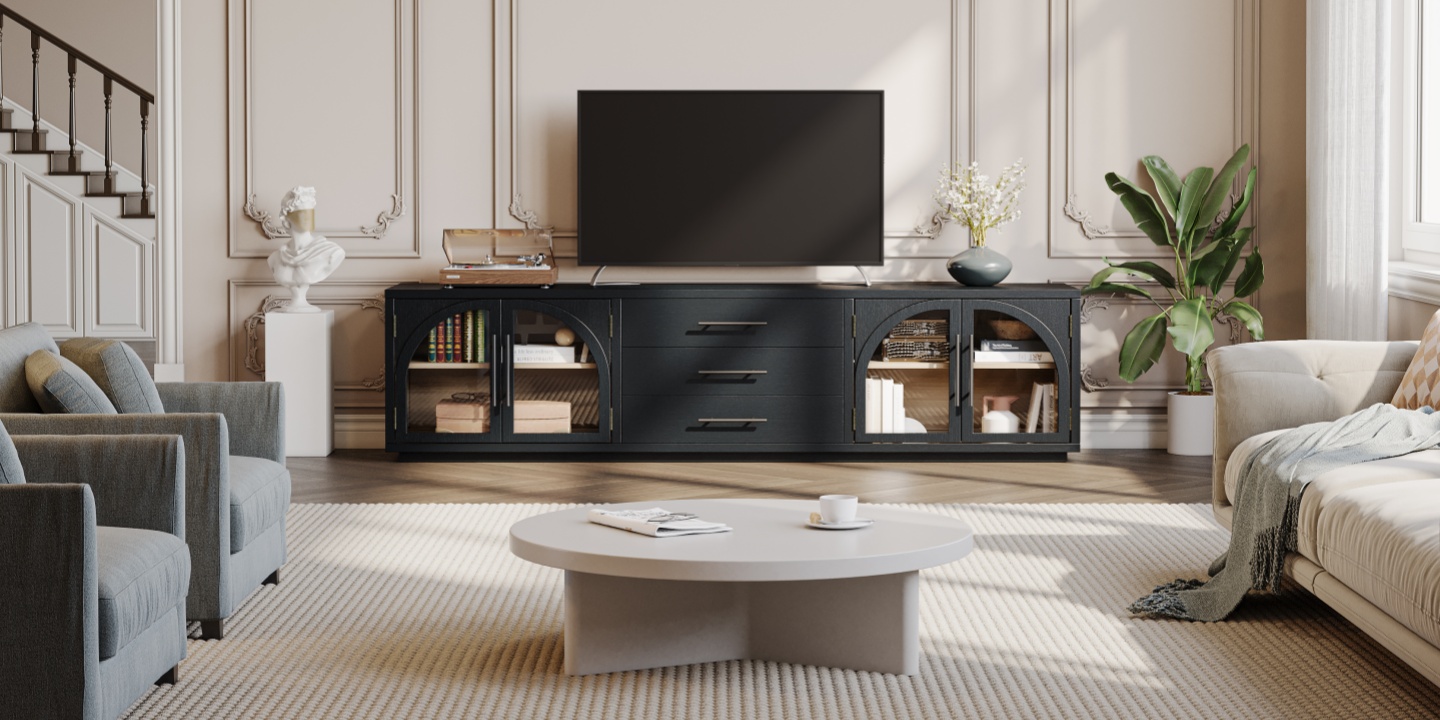
TV Stand Materials Compared: Solid Wood vs. Plywood vs. MDF vs. Particleboard
Solid Wood TV Stands
Solid wood is an excellent choice when longevity, natural appearance, repairability, and substantial construction are priorities.
Its trade-offs are cost, weight, and natural movement as environmental conditions change.
For buyers who plan to keep their furniture for many years, those trade-offs can be worthwhile.
Plywood TV Stands
Plywood is particularly useful for structural panels.
Its layered construction provides a stable engineered panel that can work well for shelves and cabinet components. The specific plywood grade, thickness, edge treatment, and construction method still matter, so “plywood” alone isn't a complete quality specification.
MDF TV Stands
MDF is smooth, consistent, and easy to machine.
It's particularly well suited to painted surfaces and furniture with clean, detailed profiles. Its main limitations are moisture sensitivity and the need for appropriate support across large spans.
If you want a painted TV stand with a uniform surface, MDF can make practical sense.
Particleboard TV Stands
Particleboard is made from wood particles bonded into panels and is common in budget furniture.
It isn't automatically unsuitable for a TV stand. However, when you're buying a large console intended to support a heavy television and multiple electronics, construction quality deserves closer attention.
Check the panel thickness, edge treatment, hardware, shelf support, and stated weight capacity.
Wood Veneer and Engineered Wood Combinations
This is where a material comparison can become misleading.
A well-designed TV stand doesn't need to be made entirely from one material. Solid wood, plywood, engineered panels, and natural veneer can each perform different jobs.
Natural wood veneer provides the appearance and grain of real wood while allowing an engineered substrate to provide a consistent panel underneath.
The smarter question isn't “Is every part solid wood?” It's “Why was each material used where it was?”
Which Wood Is Best for a Durable TV Stand?
Oak: A Durable All-Around Choice
If someone asks for one practical hardwood recommendation, oak is an easy answer.
It offers good hardness, recognizable grain, broad design versatility, and a natural appearance that works with everything from traditional interiors to contemporary and mid-century modern rooms.
White oak's Janka hardness is approximately 1,350 lbf. Again, that number describes resistance to indentation—not the structural capacity of a finished TV stand.
For a busy living room where furniture needs to look good for years, oak is a particularly well-rounded option.
Ash: Strong, Light, and Well-Suited to Modern Interiors
Ash is another excellent furniture wood.
White ash has a Janka hardness of approximately 1,320 lbf and typically features a prominent, relatively straight grain.
Visually, ash tends to feel lighter and brighter than walnut, which makes it especially attractive for contemporary and mid-century modern interiors.
If you want natural wood character without a darker overall look, ash deserves a serious look.
Walnut and Other Hardwood Options
Walnut is prized for its rich color and distinctive grain.
Black walnut has a Janka hardness of approximately 1,010 lbf, which is lower than white oak and white ash. That doesn't make it a poor furniture material. It simply shows why “most durable” and “most beautiful” aren't necessarily the same thing.
Choose walnut because you like its appearance and overall furniture characteristics—not because it wins every hardness test.
Why Wood Drying and Moisture Control Matter
Even the best hardwood needs to be properly dried before becoming furniture.
Wood moisture content naturally moves toward equilibrium with its surrounding environment. If material is not properly prepared, dimensional changes can create problems after the furniture enters a home.
That's why wood species, drying, construction, finish, and indoor conditions should be considered together.
Is Solid Wood Better Than Engineered Wood for a TV Stand?
When Solid Wood Makes the Most Sense
Solid wood makes particular sense when you want:
Natural grain
A substantial furniture feel
Long-term ownership
Potential repair or refinishing
Visible hardwood components
It's especially attractive for tops, legs, frames, doors, and decorative details.
When Plywood or Other Engineered Wood Makes Sense
Engineered wood can be the better choice when consistency and panel stability are important.
Plywood is useful for structural applications. MDF works particularly well for smooth painted surfaces and detailed machining.
The goal isn't to eliminate engineered wood.
The goal is to use the right material for the right component.
Why High-Quality TV Stands Often Combine Multiple Materials
This is often the most practical approach.
A furniture maker can use solid hardwood for visible elements, plywood for structural panels, and veneer for a consistent natural-wood surface.
That isn't necessarily cutting corners. It can be deliberate engineering.
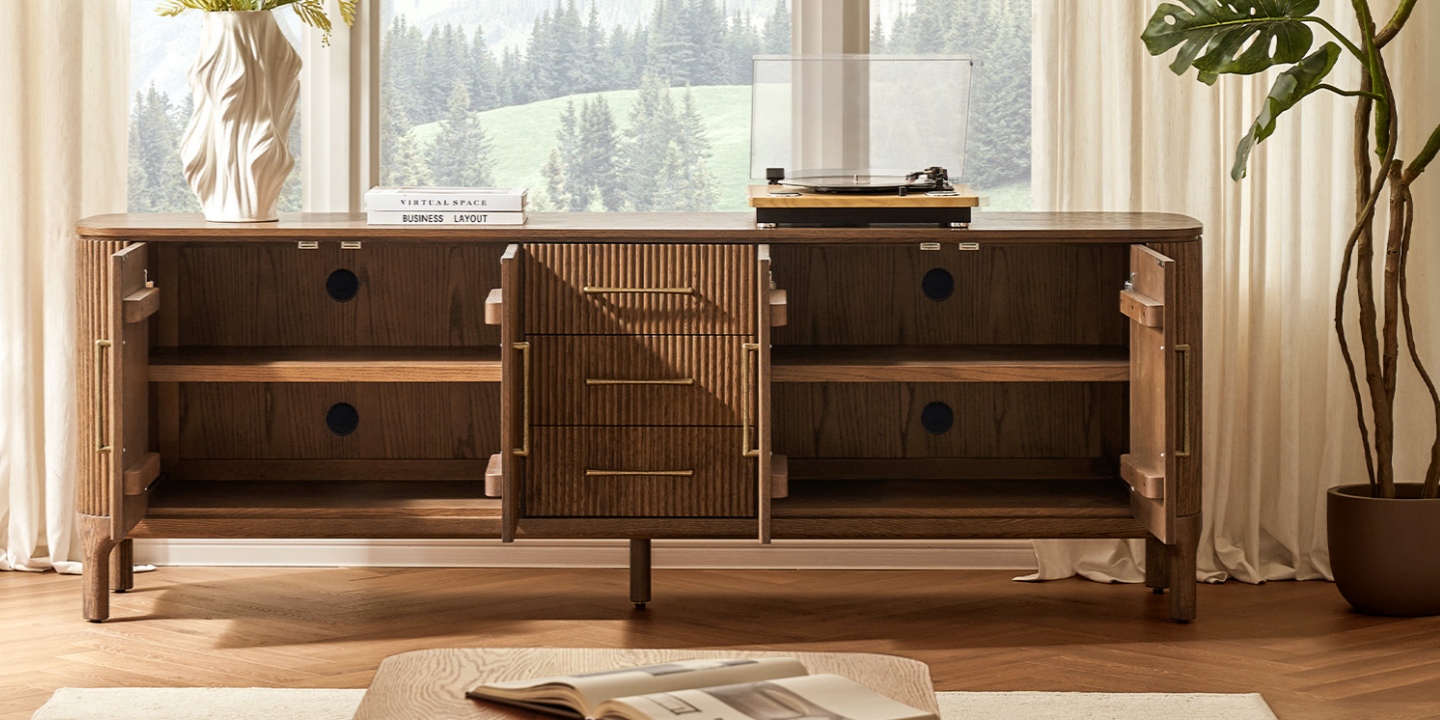
How to Choose the Right TV Stand Material for Your Home
Best Material for Large 75-, 80-, and 85-Inch TVs
For a large TV, prioritize structural support over the material label.
Look for:
A clearly stated weight capacity
Adequate top support
Supported shelves
Strong cabinet construction
Limited unsupported spans
Appropriate width and depth
A long console should feel structurally substantial, not simply look large in product photography.
Best Material for Gaming and Entertainment Setups
Gaming setups add another consideration: heat.
If your console houses a gaming system, receiver, speakers, or several media devices, look for ventilation, cable management, accessible storage, and enough internal space.
Measure your electronics before buying. A cabinet that technically fits a console but leaves no room for airflow is not a good long-term solution.
Best Material for Homes With Kids and Pets
Solid hardwood can be attractive for busy households because it offers substantial construction and can often be repaired or refinished when minor surface damage occurs.
But don't confuse durability with safety.
A family-friendly TV stand should also be stable, appropriately sized, and properly secured where necessary. For homes with young children, follow the manufacturer's anti-tip and anchoring recommendations.
Best Material for Humid and Coastal U.S. Homes
If you live in a humid area such as Florida or another coastal region, focus on moisture management rather than looking for a magically “humidity-proof” wood.
A suitable finish, properly dried material, stable indoor conditions, and quick cleanup of spills all help.
In homes that rely heavily on air conditioning, maintaining reasonably stable indoor conditions can also reduce dramatic swings in wood moisture content.
Best Material for Mid-Century Modern Interiors
Oak and ash are particularly natural fits for mid-century modern interiors.
Their visible grain and warm tones pair well with tapered legs, clean lines, restrained profiles, and minimal ornamentation.
But don't let the wood species make the entire decision. Proportion matters just as much. An oversized, visually heavy console can overwhelm an MCM room even if it's made from beautiful oak.
What to Look for When Buying a Durable TV Stand
Check the TV Stand's Weight Capacity
Compare the manufacturer's stated capacity with the combined weight of your TV and equipment.
Don't buy a console rated right at your current load if you expect to add speakers, a soundbar, or other equipment later.
Choose the Right Width and Depth for Your TV
The “75-inch” label only tells you the diagonal screen measurement.
Measure the actual television, including the width and depth of its feet or base. Then compare those measurements with the console.
A little extra surface area around the TV can also create a more balanced appearance.
Look for Supported Shelves and Strong Cabinet Construction
Pay attention to internal dividers and shelf support.
A long shelf with no intermediate support has to carry more load across a wider span. A well-designed cabinet distributes that load more effectively.
This is one area where product specifications and construction diagrams can tell you more than lifestyle photography.
Check Cable Management and Ventilation
Look for rear cable cutouts and ventilation openings where electronics are stored.
You want cables to have a clear route without forcing equipment against the back wall or leaving cabinet doors permanently open.
Evaluate the Finish and Surface Protection
Ask what finish is used and how the manufacturer recommends cleaning it.
For a high-use family room, easy maintenance matters. A beautiful surface that requires overly delicate treatment may not be the best fit for your household.
Review Material Specifications, Warranty, and Care Instructions
A trustworthy furniture listing should give you enough information to make an informed decision.
Look for:
Exact material specifications
Dimensions
Weight capacity
Shelf information
Care instructions
Warranty details
Assembly requirements
If the product page only says “premium wood” without telling you what that actually means, keep looking.
How HERNEST TV Stands Apply These Material and Construction Principles
Valo 84" Oak Media Console: Solid Oak, Plywood, and Oak Veneer
The Valo 84" Oak Media Console shows why looking at the complete material specification is more useful than simply asking whether a TV stand is “solid wood.”
The console combines solid oak, plywood, and oak veneer. It is designed for TVs up to 85 inches and lists a recommended weight capacity of 230 pounds, along with adjustable shelving and rear cable cutouts.
Those specifications address several practical concerns at once: natural wood character, structural support, storage flexibility, and electronics organization.
The important takeaway isn't simply that the console uses oak. It's that the materials are being used for different functions within the same piece of furniture.
Sabina 84" Ash Wood Media Console: Solid Ash, Engineered Wood, and Ash Veneer
The Sabina 84" Ash Wood Media Console follows a similar construction philosophy, combining solid ash, engineered wood, and ash veneer.
Solid ash contributes natural grain and visible wood character, while engineered components can provide consistency for larger panels.
So when you compare TV stands, don't get stuck on the solid-wood-versus-engineered-wood debate. Look at where each material is actually used.
A better question is:
Does the construction use each material where it performs best?
What HERNEST's Material Specifications Tell Buyers About Construction Quality
Detailed specifications are valuable because they allow buyers to connect materials with actual furniture performance.
When a product page identifies the wood species, engineered components, dimensions, weight capacity, shelving, and cable management, you're able to evaluate the furniture instead of simply judging a finish.
That's the level of transparency worth looking for when comparing TV stands.
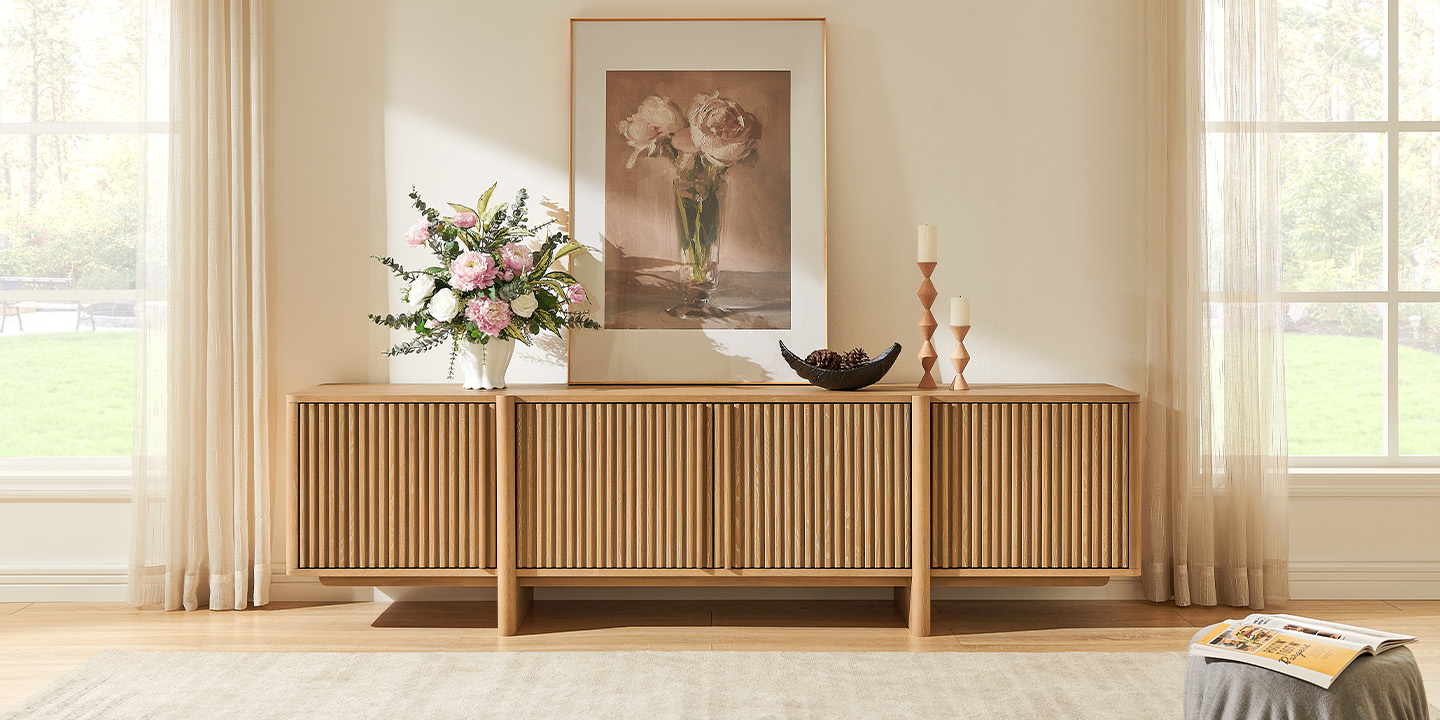
MDF, Composite Wood, and U.S. Furniture Standards
Is MDF Safe for Furniture?
MDF is widely used in furniture and is not inherently unsafe simply because it is an engineered wood product.
For U.S. buyers, the more useful question is whether regulated composite wood products meet applicable formaldehyde emission requirements.
It's also important to separate safety from durability. A compliant MDF panel is not automatically stronger than solid wood, just as solid wood doesn't automatically answer every indoor-air-quality concern.
What U.S. Buyers Should Know About TSCA Title VI
TSCA Title VI establishes formaldehyde emission standards for regulated composite wood products sold in the United States, including hardwood plywood, MDF, and particleboard.
EPA materials identify emission limits of 0.05 ppm for hardwood plywood, 0.11 ppm for MDF, and 0.09 ppm for particleboard, along with testing and certification requirements.
For shoppers, this means composite wood should not be dismissed simply because it isn't solid wood. Instead, look for clear compliance information from the manufacturer.
What California Buyers Should Know About Composite Wood Standards
California buyers may also encounter references to CARB requirements.
Federal TSCA Title VI standards were developed to align with California's formaldehyde emission standards for regulated composite wood products.
These standards address emissions and compliance—not whether a TV stand will last 10 years or 20 years.
Keeping those issues separate helps you make a better purchase:
Durability asks how the furniture performs. Compliance asks whether the material meets applicable regulatory requirements.
Common Mistakes That Can Make a TV Stand Less Durable
Choosing a TV Stand Based Only on Appearance
A beautiful finish tells you very little about structural performance.
Before you decide, check the specifications and construction.
Assuming "Solid Wood" Means Every Component Is Solid Wood
A TV stand described as solid wood may still contain plywood, engineered wood, veneer, or other materials in specific components.
That's not automatically a problem.
What matters is whether the manufacturer clearly explains what materials are used and why.
Ignoring Weight Capacity and Unsupported Shelf Spans
This is one of the easiest mistakes to prevent.
Check the rated load and look at how long shelves are supported. A large TV deserves more than a quick glance at product photography.
Overlooking Ventilation for Gaming Consoles and Other Electronics
Electronics produce heat.
If equipment is stored in a closed compartment, make sure the design provides appropriate ventilation and cable access.
Exposing Wood or Engineered Wood to Prolonged Moisture
A spilled drink that gets wiped up quickly is very different from repeated exposure to moisture.
Keep wood furniture away from persistent dampness, condensation, and standing water, and follow the manufacturer's care instructions.
How to Make Your TV Stand Last Longer
Stay Within the Manufacturer's Weight Limit
Treat the manufacturer's weight rating as a real limit.
Include the television and every component that will sit on the top or shelves.
Protect the Surface From Spills and Excess Moisture
Wipe spills promptly.
Avoid leaving wet glasses, planters, or other moisture sources sitting directly on the furniture for extended periods.
Follow the Manufacturer's Cleaning and Care Instructions
Don't assume every wood finish should be cleaned the same way.
Use the manufacturer's recommended method and avoid abrasive cleaners unless they are specifically approved.
Keep Electronics Properly Ventilated
Give heat-producing equipment enough breathing room.
If a cabinet consistently becomes hot, reconsider how the equipment is positioned rather than assuming the furniture can handle unlimited heat.
Maintain Stable Indoor Conditions
Wood naturally responds to changes in temperature and relative humidity.
You don't need to turn your living room into a controlled laboratory. Reasonably stable indoor conditions, combined with protection from excessive moisture, are usually sufficient for normal furniture use.
Final Verdict: The Best TV Stand Material Depends on More Than the Material
So, what are the best materials for a durable TV stand?
For most buyers, solid hardwood—especially oak or ash—is one of the best choices for long-term durability. Plywood is an excellent structural material, while MDF can be a smart option for smooth painted surfaces and other applications where its uniformity is useful. Particleboard is generally more appropriate when affordability is the primary concern.
But don't stop at the material name.
For a durable TV stand, check the weight capacity, shelf support, joinery, cabinet construction, finish, ventilation, and moisture management. These factors determine how well the material performs once it becomes a piece of furniture.
If you're buying for a 75-, 80-, or 85-inch TV, start with dimensions and load capacity. If you have gaming equipment, prioritize airflow and cable management. If you live in a humid or coastal area, pay closer attention to moisture and finish. And if you're investing in furniture for the long haul, look for transparent material and construction specifications.
In other words, the best TV stand isn't necessarily the one made from the most expensive material. It's the one whose materials and construction are appropriate for the job.
FAQs
What Is the Best Material for a TV Stand?
For long-term durability, solid hardwood such as oak or ash is one of the best choices. Plywood can be excellent for structural components, while MDF works well for certain applications such as painted finishes. A combination of materials can often provide better overall performance than using one material throughout.
What to Look for When Buying a TV Stand?
Check the material specifications, weight capacity, dimensions, shelf support, cabinet construction, cable management, ventilation, finish, warranty, and care instructions. For large TVs, prioritize structural support and load capacity before choosing based on color or style.
Is MDF Good for a TV Stand?
Yes, MDF can be a good material for a TV stand, especially for painted furniture. Its smooth, uniform surface makes it easy to finish, but standard MDF is more vulnerable to prolonged moisture and needs adequate support across wide spans.
Are Wood TV Stands Durable?
Yes. Well-constructed wood TV stands can be highly durable. Oak and ash offer good resistance to everyday wear, while proper joinery, shelf support, finish, and weight capacity determine how well the finished furniture performs over time.
Is Solid Wood Better Than MDF for a TV Stand?
Not automatically. Solid wood is generally preferable for natural appearance, long-term ownership, and repairability. MDF can be more practical for smooth painted surfaces and certain detailed designs. The best choice depends on the component, construction, environment, and intended use.
Is Plywood Better Than MDF for a TV Stand?
Plywood is often a better choice for structural panels because its layered construction provides useful strength and stability. MDF offers advantages for smooth surfaces and painted finishes. Neither material is universally better; panel thickness, support, joinery, and overall construction also matter.
What Is the Most Durable Wood for a TV Stand?
Oak is one of the best all-around choices for a durable TV stand because it combines good hardness, strength, availability, and design versatility. White oak has a Janka hardness of approximately 1,350 lbf, although hardness alone does not determine the structural durability of a finished console.
What Is the Best Material for a Large TV Stand?
For a large TV stand, prioritize a structurally sound solid-hardwood or engineered-wood construction with adequate reinforcement and a clearly stated weight capacity. Shelf support is especially important because long spans can increase the risk of deflection.
Does Humidity Affect a Wooden TV Stand?
Yes. Wood naturally exchanges moisture with the surrounding air, and changes in moisture content can cause dimensional changes. Normal indoor fluctuations are generally manageable, but prolonged exposure to excessive humidity, standing water, condensation, or repeated spills can cause problems over time.
Is Engineered Wood Good for a TV Stand?
Yes. Engineered wood includes different materials, such as plywood and MDF, and their performance varies. Quality engineered panels can provide consistency and structural performance when properly selected and supported. The important questions are which material is used, where it is used, and how the furniture is constructed.
How Long Should a Durable TV Stand Last?
There is no universal lifespan because durability depends on material, construction, load, environment, finish, and maintenance. A well-built TV stand that stays within its weight rating and receives appropriate care can serve as a long-term piece of furniture.