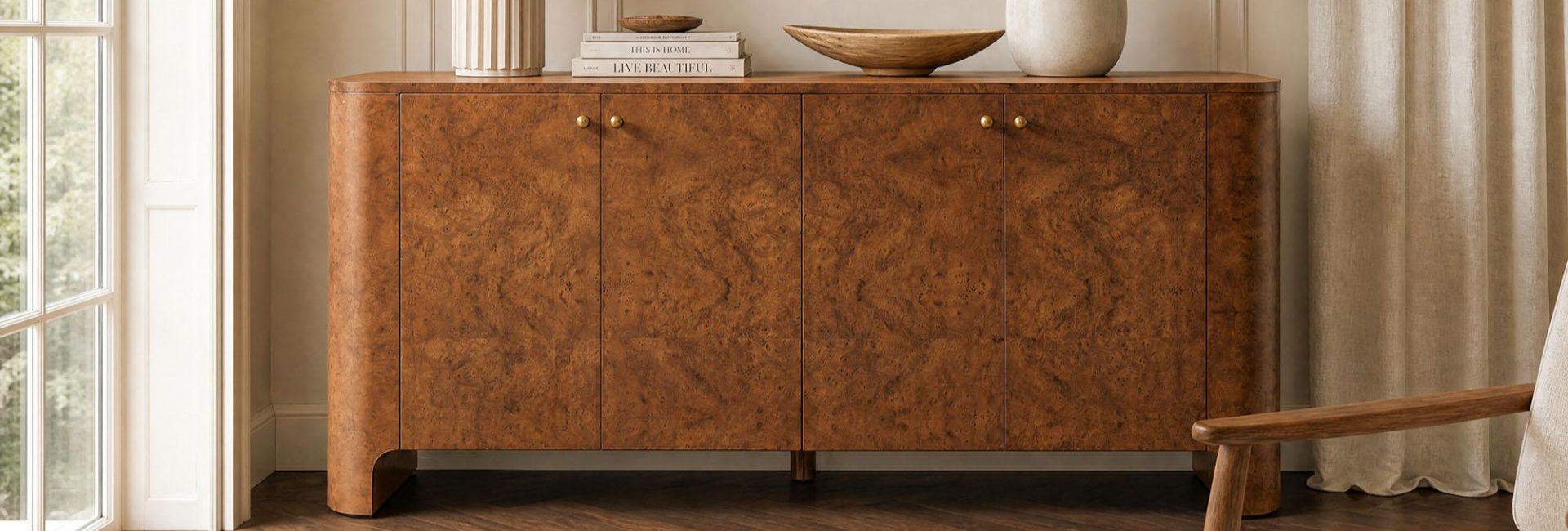
A burl wood sideboard is a sideboard faced in burl, a wood cut from a rounded growth on a tree where the grain loops around dormant buds instead of running straight. The surface ends up looking closer to marble than timber: tight swirls, small dark eyes, patches that seem to sit an inch below the finish. No two doors match, because no two burls do.
That rarity is why the look has bounced between luxury and nostalgia for a century, and why it's suddenly everywhere again. It's also why buying one takes more care than buying a plain oak cabinet. Some pieces are faced in genuine burl veneer over a stable core. Others are printed to imitate it, and the listing won't always tell you which. This guide covers how burl forms, how to read a spec sheet, what the pattern does to a room, and how to keep the figure sharp for twenty years instead of two.
We've handled enough of these pieces to have opinions. Here's all of it.
Table of Contents
- What a Burl Wood Sideboard Actually Is
- Solid Burl, Burl Veneer, or Burl-Look: Read the Label
- Why Burl Wood Furniture Costs More Than Other Wood Furniture?
- What a Burl Wood Sideboard Does for a Room
- How to Choose the Right Burl Wood Sideboard for Your Space
- How to Style a Burl Wood Sideboard With Different Materials and Colors
- Burl Wood Sideboard Styling Ideas: What to Display on Top
- How to Care for a Burl Wood Sideboard: Cleaning, Sunlight, and Humidity
- 3 Practical Ways to Use a Burl Wood Sideboard at Home
- What to Look for Before Buying a Burl Wood Sideboard
- FAQs
What a Burl Wood Sideboard Actually Is
Burl is a growth, not a species. A tree develops a rounded bulge on its trunk, a branch, or a root, and the wood inside that bulge has grain running in every direction. Foresters still can't fully explain why some trees produce them; the University of New Hampshire Extension calls burl formation a bit of a mystery, with injury, insects, fungus, and plain stress all plausible triggers and none of them covering every case.
What happens inside is better understood. The cells divide in many directions at once rather than stacking into neat vertical fibers, which is why burl wood comes out dense and stubbornly hard to split. Ask anyone who's tried to run a burl through a planer without tear-out.
Why the Grain Never Repeats
Those swirls you see are grain wrapping around hundreds of sleeping buds. Slice a burl one way and you get curls. Slice it two inches over and the pattern changes completely. Two consecutive veneer leaves cut from the same block won't match each other either, which is why cabinetmakers bookmatch them: open two leaves like a book and the mirrored halves form a symmetrical pattern down a pair of doors.
This is the single most useful thing to understand before you shop. A genuine burl surface cannot repeat. A printed one usually does, and it repeats exactly, door after door, unit after unit.
Burl Is Not Birdseye, and It's Not a "Burl Tree"
Two things get muddled constantly. Birdseye maple has small round markings but straight grain underneath; burl has chaotic grain throughout. And there's no such thing as a burl tree. Sellers write walnut burl, maple burl, or mappa burl because the species sets the color and the burl sets the figure. A light, golden surface is usually a lighter species. A deep chocolate one points to walnut.
Solid Burl, Burl Veneer, or Burl-Look: Read the Label
This is the part most trend pieces skip, and it's the part that decides whether you'll be happy with what arrives.
Solid burl exists, but rarely at sideboard scale. Burls come out of the forest in irregular lumps, so solid burl shows up in bowls, turned pieces, small slabs, and tabletops. A full cabinet built from solid burl would be museum-grade, enormously heavy, and priced accordingly. Almost nothing on the retail floor is built this way.
Genuine burl veneer is how nearly every burl sideboard is actually made, vintage or new. A thin slice of real burl is glued over a stable panel. That's not a shortcut or a cost trick. Veneer has been standard cabinetmaking practice for centuries because it lets a rare, wild figure cover a wide door without that door twisting. A cross-laminated core moves less across 72 inches than a solid plank ever would.
Burl-look finishes are printed or laminated to imitate the pattern, with no burl inside. These can look good in a photograph and fine at three feet. They're also a legitimate budget choice. You just need to know which one you're paying for.
One more habit worth building: check the back panel and the inside of a door. Real veneer has a visible edge somewhere, usually where the face meets the banding. A printed surface runs pattern straight to a hard seam with nothing underneath.
Why Burl Wood Furniture Costs More Than Other Wood Furniture?
The price gap between a burl sideboard and a plain one isn't marketing. It's yield.
Walk a stand of mature hardwoods and you'll find a handful of saleable burls across dozens of trees, and only some of those survive opening up. Many look promising from outside and turn out to be riddled with bark pockets, rot, or voids that wreck the usable sheets. Mills build in heavy waste factors, often budgeting 20 to 30 percent extra material just to cover layout and defects.
Then there's the bench time. Someone has to sort leaves, flip them, decide which eyes and swirls become focal points, and cut the rest away. That's skilled labor, and it doesn't scale.
There's an ethical dimension too, and it's not decorative. Burl sells for real money, so people steal it. The National Park Service has prosecuted burl poaching from old-growth redwoods, with cuts measured in feet. Taking a burl off a living tree opens a wound that insects and disease move into. Better sources exist: salvaged stock, wood from private land, and vintage pieces already in circulation.
What a Burl Wood Sideboard Does for a Room
Burl is visually loud in a quiet way. It doesn't shout color; it pulls the eye with movement. Put one in a room and everything else has to decide whether to support it or fight it.
The rule that works: let one piece lead. A burl sideboard on a dining wall, with plain walls, linen or wool textiles, and matte ceramics around it, reads expensive and calm. Add a second figured wood, a busy wallpaper, or a heavily patterned rug in the same sightline and the effect collapses. The eye has nowhere to rest, and the piece starts looking like clutter with a good finish.
Where it earns its keep fastest is the dining room, especially in open-concept homes where the dining zone is visible from the sofa. Burl gives that wall a focal point without needing art, a hutch, or a gallery arrangement. It also works in an entry, where a console-sized piece sets the tone in the first three seconds.
Where it struggles: small, dark rooms with a lot of brown already, and rooms with strong warm-toned walls. Burl's warmth needs contrast or distance to read as luxury rather than heavy.
The Three-Foot Test
Burl behaves differently depending on how far you stand from it. Up close, the eyes and swirls read as individual details: you can trace a bud, see where the figure changes direction, notice the depth under the finish. From twelve feet, none of that survives. The whole surface flattens into a warm, mottled field that most people read as stone or even fabric.
That's worth planning around. A burl sideboard in a dining room you walk past daily gives you the close-up experience, and the details keep rewarding you for years. The same piece at the far end of a long great room reads as a rich brown mass with texture, which is a good outcome for a focal wall and a bad one if you bought it for the swirls. If the piece will mostly be seen from across a room, favor a larger figure with stronger contrast and a lighter tone, because fine detail disappears at distance. If it's in arm's reach of the table, a tight, dark, high-contrast burl will hold up better to years of looking.
Light matters as much as distance. Burl looks best under a warm lamp at an angle that skims the surface and casts small shadows across the figure. Flat overhead light does the opposite and makes a glossy finish look like plastic. That's one reason a table lamp on the piece does so much for it.
How to Choose the Right Burl Wood Sideboard for Your Space
Style gets the attention, but fit decides whether you love the thing in year three. Three measurements matter most.
Width and Wall
A dining sideboard runs 60 to 72 inches for most rooms. On a wall under 8 feet, a 72-inch piece leaves room for a lamp or a plant at one end and still lets doors open fully. Go wider than 80 inches on a short wall and the piece starts to look like built-in millwork that stopped early.
Leave at least 12 inches between the cabinet edge and any doorway, and more if a chair backs up to it. You want the doors to swing without clipping anything.
Height and Depth
Sideboards sit lower than kitchen counters, usually 30 to 34 inches. That's comfortable for serving, reaching into the top shelf, and setting a lamp on. Depth is where buyers get surprised: 15 to 18 inches is typical, and 16 is enough for tableware but tight for a stack of oversized platters. Measure what you actually store before you commit.
What's Behind the Doors
Adjustable shelves beat fixed ones every time, because a sideboard that holds plates this year might hold board games next year. Check whether the interior has ventilation if you plan to put media components inside, and look at the door hardware: push-to-open fronts look cleanest but need a quality mechanism, while visible pulls are easier to grip with full hands.
A piece that gets all three right is the Briar 72-Inch Burl Sideboard. The richly figured veneer flows seamlessly from the tabletop down to the arched legs, creating a cohesive look with distinctive natural grain patterns. The softly rounded corners help reduce bumps and sharp edges in everyday use while giving the cabinet a smoother silhouette. Multiple adjustable shelves behind the doors adapt to different storage needs, making room for platters, glassware, and everyday essentials.
If your room runs mid-century, its arched silhouette does more work than a straight-legged cabinet would. If your room is quieter and more architectural, keep reading.

Briar 72-Inch Burl Sideboard
View Product
How to Style a Burl Wood Sideboard With Different Materials and Colors
Burl is a warm, high-sheen material by nature, so the supporting cast should cool it down or ground it. A few pairings that reliably work:
Metals. Brushed brass, aged bronze, and matte black balance the gloss. Polished chrome and nickel can work, especially in a mid-century room, but they double the shine and get loud fast.
Neutrals. Cream, greige, cocoa, caramel, and warm gray all flatter burl's amber tones. Cool blue-grays can work as contrast if you keep them well away from the piece and use them in textiles rather than paint.
Textiles. Linen, boucle, wool, and leather all give the eye a place to land. Avoid anything with a strong repeat pattern in the same sightline.
Other woods. Pair burl with straight-grain walnut, oak, or ash and the contrast does the work. Pair it with another figured wood and you get competition. A matched pair of burl pieces counts as one gesture and can look intentional. Three unrelated burl pieces in one room rarely do.
For rooms that already carry some pattern (a rug, a wallpaper, a gallery wall), the smarter move is a burl piece with a calmer front. That's where the Bodil 72-Inch Burl Sideboard fits: four push-to-open doors with no visible hardware, a beveled frame that gives the front architectural definition, and a glazed burl finish laid out almost like a tile collage, so the pattern has structure instead of pure chaos. Crafted from rubberwood and engineered wood with burl veneers, it also features multiple adjustable shelves inside for flexible storage. In a room with a patterned rug, this is the version that won't argue.

Bodil 72-Inch Burl Sideboard
View Product
Burl Wood Sideboard Styling Ideas: What to Display on Top
The most common styling mistake with a burl sideboard is treating the top like a display shelf. Burl is the display. Everything you add is either supporting it or fighting it.
Work with a rough two-thirds empty rule. One tall element (a lamp with a simple shade, a single large vase, a branch in a heavy vessel), one low element (a stack of two books, a shallow bowl), and one textural element (a stone tray, a linen runner). That's a finished top. Five objects of similar size look like a collection of objects; three of different heights look like a decision.
Skip anything mirrored or high-gloss on top. The surface already carries sheen, and chrome-and-glass accessories will make it read like a hotel lobby.
Above the piece, go bigger and quieter than you think. One large piece of art or a plain plaster-finish wall beats a cluster of small frames, which fragments the wall and competes with the figure below. If your ceiling is low, skip art entirely and let the sideboard hold the wall.
How to Care for a Burl Wood Sideboard: Cleaning, Sunlight, and Humidity
Burl veneer is durable when it's finished properly, but it's less forgiving of neglect than a plain oak top. Nearly all the damage we see comes down to three things: water sitting in a seam, dry heat, and the wrong cleaner.
The Daily Routine
Dust with a soft, dry cloth, following the grain rather than scrubbing across it. Conservators at North Carolina Historic Sites warn that cloth can catch on a loose veneer edge, and that dusting alone can lift a weak one. So go gently near seams and corners, and stop pressing if you feel a lip.
Blot spills immediately. Don't wipe, don't drag: dragging carries liquid into a joint, and water in a joint is what eventually loosens veneer. Use coasters under everything cold and everything hot. Skip silicone polish, scouring pads, and solvent cleaners entirely; they cloud finishes permanently.
What Actually Damages Veneer
Dry heat is the quiet killer. A sideboard sitting against a radiator or in direct afternoon sun will shrink and swell across seasons, and a veneered panel under that stress can cup or lift at an edge. Keep the piece out of direct sun, or use a UV-filtering shade if the room gets a lot of light.
Humidity swings do similar work over longer periods. Aim for a stable indoor range (most furniture guidance lands around 30 to 50 percent relative humidity) and don't park the piece next to a forced-air vent. Felt pads under lamps and ceramics prevent the small scratches that show up most on glossy burl finishes.
3 Practical Ways to Use a Burl Wood Sideboard at Home
A sideboard is one of the most flexible pieces in a house, and burl doesn't change that. Three uses that work especially well:
Dining buffet. The classic. Tableware, linens, and serving pieces inside; a lamp, a bowl, and one vase on top. It holds the wall, and it works for holiday serving without a single addition.
Media console. Check the depth first (a receiver or console needs 16 inches and airflow), then plan cord routing before the piece arrives. Media consoles are built for this, but a sideboard can do the job if you're willing to drill a grommet or run cables down a back leg. Soundbars sit fine on top; just leave clearance at the front for the remote sensor.
Entry console. A 60-inch piece in an entry gives you a landing zone, hidden storage for gloves and bags, and an immediate style statement. Add a tray for keys and one lamp, and stop there.
Avoid putting a burl sideboard in a steamy zone (next to a shower, over a heating vent, in an unvented laundry). The finish will survive; the seams are what you're protecting.
What to Look for Before Buying a Burl Wood Sideboard
If you take nothing else from this guide, take this list into the store or onto the product page:
-
Is the burl real veneer, solid, or printed? The material line answers it. "Burl finish" and "burl effect" are printed.
-
What's the core? Engineered wood with cross-lamination is normal and stable. Solid-core construction is heavier and pricier.
-
Are the doors bookmatched? Mirrored pairs are a sign of care in layout and a better-looking front.
-
Are the shelves adjustable? Fixed shelves lock you into one storage plan.
-
What's the depth? Under 16 inches, check your largest platter and your media gear.
-
How is it finished? Lacquer, polyurethane, and wax each need different care. Ask what yours is.
-
Is there a chain-of-custody claim? A certificate code on the SKU, not a brand statement.
-
What's the return window? Natural variation means the piece won't match the photo exactly. Make sure you can live with that, and that you can send it back if you can't.
That last point matters more with burl than with any other finish. The pattern on your door is not the pattern in the photo, and no retailer can promise otherwise. Buy the tone and the silhouette you love, and let the figure be a surprise.
FAQs
Is burl wood real wood?
Yes, when it's described as burl veneer or solid burl. Burl is a growth pattern, not a manufactured finish, so the wood is genuine. Watch for "burl finish," "burl effect," or "burl pattern" in the material line, which usually indicates a printed or laminated surface.
Why is burl wood furniture so expensive?
Yield. Only a fraction of trees carry a saleable burl, and many burls turn out to be full of bark pockets and rot once opened. Mills budget 20 to 30 percent extra material to cover defects and layout, and matching wild figure across a run of doors takes skilled handwork. You're paying for scarcity plus bench time.
Is burl wood durable enough for daily use?
Yes, with a proper finish and reasonable care. Burl is dense and resistant to splitting, and a well-sealed veneered panel handles everyday dining room use without trouble. The vulnerabilities are water in seams, dry heat, and abrasive cleaners, not normal wear.
How can I tell real burl veneer from a printed burl finish?
Look for repetition. Real burl never repeats, and paired doors are usually bookmatched, meaning mirrored rather than identical. Check the edge band and the back panel for a visible wood layer over the core, and read the material line separately from the product title.
Does burl wood sideboard scratch easily?
The finish is what scratches, not the burl itself. Glossy finishes show fine scratches more than matte or glazed ones. Use felt pads under lamps and ceramics, coasters under drinks, and dust with a soft dry cloth rather than a paper towel.
How do I clean a burl wood sideboard?
Dust with a soft, dry cloth following the grain, and blot spills immediately instead of wiping them across the surface. Skip silicone polish, scouring pads, and solvents. Then follow the maker's guidance for your specific finish, since lacquer, polyurethane, and wax all want different treatment.
What should I put on top of a burl sideboard?
Three objects of different heights, roughly: one tall lamp or vase, one low stack of books or a shallow bowl, and one textural tray or runner. Leave about two-thirds of the surface empty, and avoid mirrored or high-gloss accessories that compete with the finish.