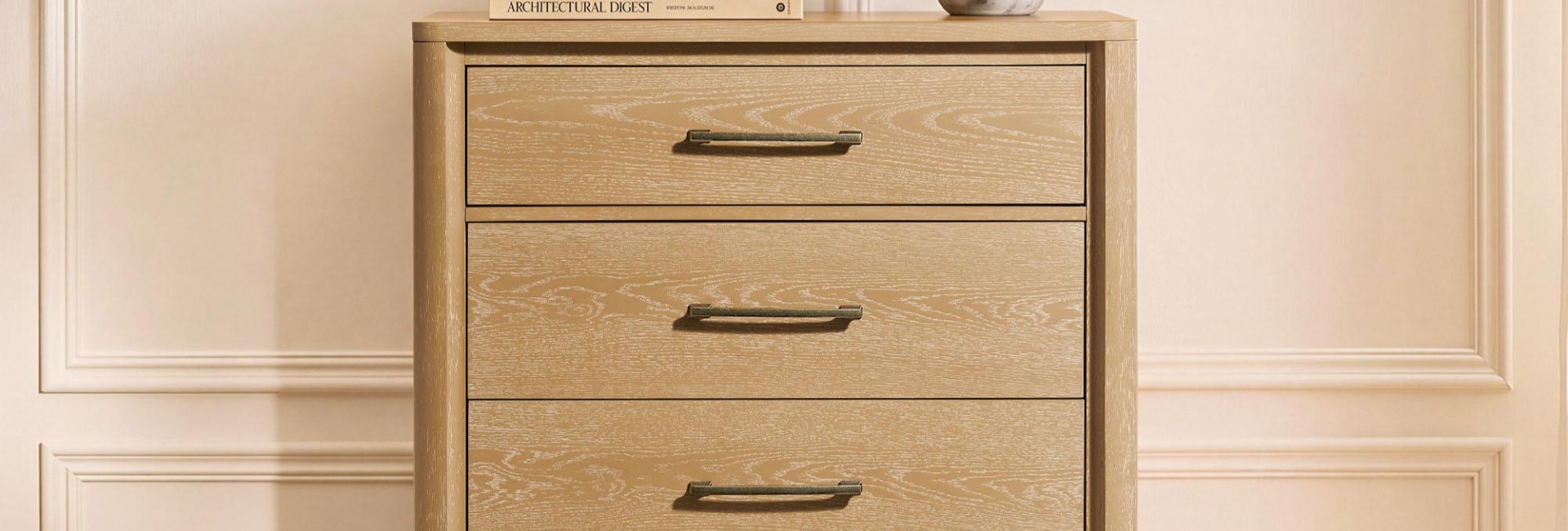
A chest of drawers is a freestanding storage piece with multiple sliding drawers, usually arranged vertically to hold clothing and household essentials. Designs range from tall, narrow cabinets to wider units with multiple drawer columns or specialized compartments. Some prioritize everyday clothing storage, while others are built for accessories, hanging garments, or entertainment equipment. Understanding the different types of chests of drawers helps you compare their proportions, storage layouts, and intended uses before choosing one for your home.
Table of Contents
- What Is a Chest of Drawers?
- What Are the Different Types of Chests of Drawers?
- Types of Chests of Drawers by Drawer Configuration
- How Drawer Dimensions Affect Storage
- What Can You Store in Different Types of Chests of Drawers?
- Where Do Different Types of Chests of Drawers Work Best?
- How to Choose the Right Type of Chest of Drawers
- Final Thoughts
- FAQs
What Is a Chest of Drawers?
A chest of drawers is a cabinet-style furniture piece with multiple horizontal drawers that slide in and out of an enclosed frame. It is commonly used for folded clothing, underwear, accessories, and linens, although some designs are suited to living rooms, dressing areas, and guest rooms.
Most chests share a few structural features:
-
Cabinet frame: The main structure supports the drawers and determines the furniture's overall width, depth, and height.
-
Sliding drawers: Individual compartments vary in size and may be arranged in one or more columns.
-
Drawer fronts and hardware: Front panels, handles, knobs, and slides affect both appearance and everyday operation.
-
Top surface: The flat top can hold a lamp, jewelry tray, framed photograph, or other frequently used items.
-
Enclosed storage: Drawer fronts keep belongings out of sight and separate them into individual compartments.
The materials and construction vary by product. Some chests use solid wood, while others combine engineered wood with real wood veneers or other finishes. These differences affect the furniture's appearance, weight, maintenance requirements, and price.
Chest of Drawers vs. Dresser
The terms chest of drawers and dresser are sometimes used interchangeably in modern furniture listings. Traditionally, however, they describe different proportions.
A chest of drawers generally has a taller, narrower profile, with drawers stacked vertically. A dresser is usually wider and lower, often with two or more columns of drawers. Some dressers also include a matching mirror.
This distinction can help when planning a room. A vertical chest may fit beside a closet or along a narrow bedroom wall, while a wide dresser needs more horizontal space. Since retailers do not always use these terms consistently, compare the actual dimensions and drawer arrangement rather than relying on the product category alone.
What Are the Different Types of Chests of Drawers?
The main types of chests of drawers differ in their proportions, construction, and intended storage. Some make better use of vertical space, while others provide wider compartments or combine drawers with additional storage features.
1. Standard Chest of Drawers
A standard chest of drawers is a straightforward storage cabinet with several drawers stacked vertically. It is designed for general-purpose storage and commonly holds folded clothing such as T-shirts, jeans, sweaters, and sleepwear.
A typical design may have three to six drawers, although there is no fixed drawer-count requirement. Some models use full-width drawers throughout, while others include smaller upper compartments for accessories and larger drawers below for clothing.
The main advantage of this layout is its flexibility. It can serve as the primary clothing storage in a smaller bedroom or provide additional capacity alongside a wardrobe. When comparing models, pay attention to the interior width, depth, and height of the drawers. Two standard chests with the same number of compartments may offer quite different storage capacity.
A practical example is Kaden 26-Inch Mid-Century 5-Drawer Chest. It has five vertically arranged drawers in a 26.8-inch-wide frame, making it a compact option for everyday clothing storage. Each drawer measures 23.22 inches wide, 12.2 inches deep, and 5.31 inches high internally. Its dimensions illustrate how a standard chest can provide several separate storage compartments without requiring a wide dresser footprint.
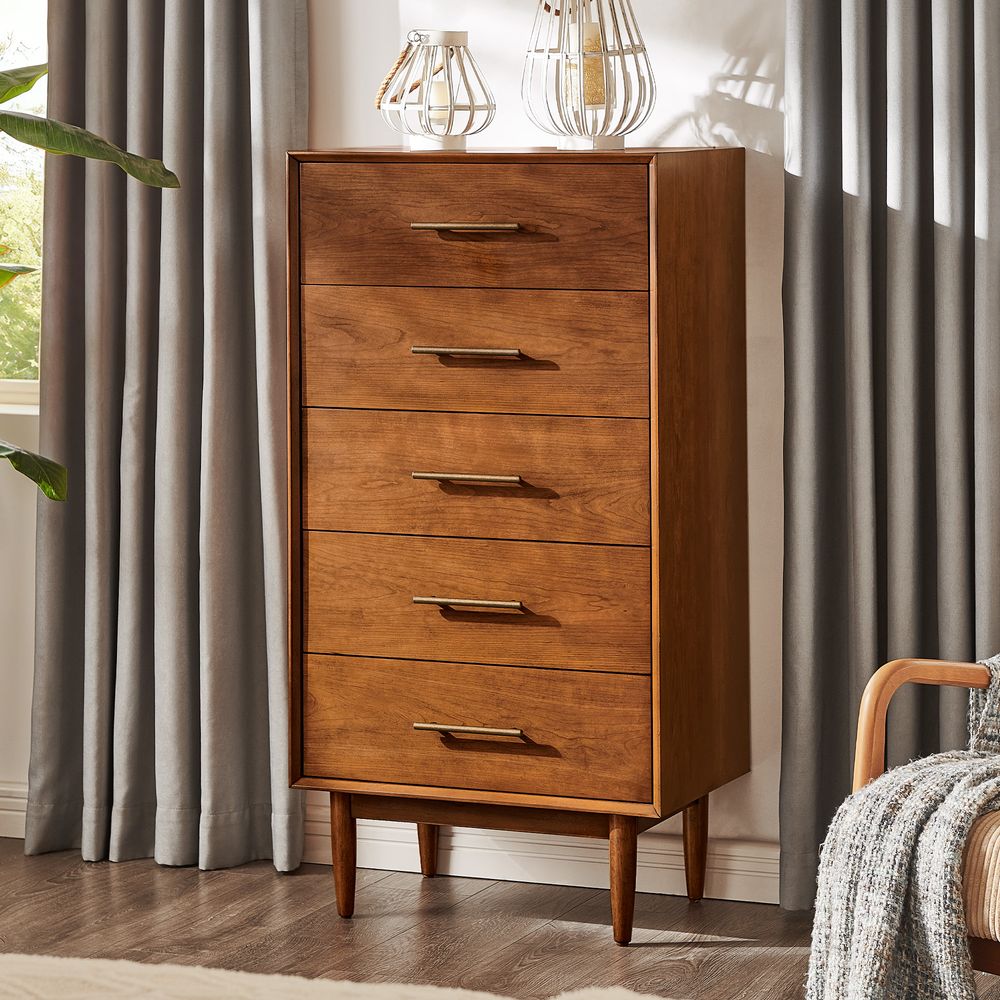
Kaden 26-Inch Mid-Century 5-Drawer Chest
View Product
2. Tallboy Chest of Drawers
A tallboy chest of drawers has a tall, relatively narrow profile, with multiple drawers arranged vertically. Its proportions allow it to provide enclosed storage without taking up as much floor width as a conventional dresser.
Tallboys are often considered for smaller bedrooms, narrow wall sections, and dressing areas where horizontal space is limited. They can also complement a wider dresser by providing separate storage for clothing or accessories.
The term tallboy is commonly used for modern tall, narrow chests, while the historical American highboy refers to a more specific furniture form, often constructed with an upper chest mounted on a raised base. The Cleveland Museum of Art's highboy collection entry illustrates this traditional construction.
When choosing a modern tallboy, consider more than its overall height. The upper drawers may be less convenient for items you reach for every day, and a taller cabinet requires appropriate stability measures. Check the available wall space, drawer-opening clearance, and included anti-tip hardware before deciding.
3. Narrow Chest of Drawers
A narrow chest of drawers has a slim cabinet frame designed for spaces where a wider storage unit would be difficult to accommodate. Its drawers are usually stacked vertically, making it suitable for a bedroom corner, a narrow wall, or a dressing area.
This design is often used for smaller folded garments, socks, accessories, and personal belongings. It can also serve as supplementary storage when a bedroom already has a full-size dresser.
However, a narrow exterior does not automatically make a chest suitable for every small room. A cabinet may fit against the wall but still have limited interior width or require more clearance than expected when its drawers are open. Check both the external dimensions and the usable drawer measurements, particularly if you plan to store jeans, sweaters, or other wider garments.
4. Wide Chest or Lowboy
A wide chest has a broader frame and generally uses wider drawers than a tall, narrow model. Its lower profile can provide convenient access to the drawers and a larger surface for lamps, mirrors, or decorative objects.
The term lowboy has a more specific historical meaning. It traditionally describes a low chest or dressing-table-like piece, often raised on legs. It should not be used as a general synonym for every contemporary wide chest.
For modern furniture, compare the actual proportions and storage layout. A wide, low chest may suit a room with limited vertical clearance, provided there is enough wall width for its larger footprint. Wider drawers can also accommodate larger folded garments, although their usefulness depends on the interior depth and construction.
5. Chest-on-Chest
A chest-on-chest traditionally consists of two stacked drawer sections, with an upper case mounted on a lower chest. The two sections create a tall storage unit with a layered appearance.
This construction provides multiple levels of drawer storage and is closely related to traditional tall furniture forms. The terms chest-on-chest and highboy are sometimes associated with one another, but they are not interchangeable in every historical context. The U.S. Government Publishing Office's furniture terminology describes a chest-on-chest as a tall chest made up of two or more sections.
When considering this style, check whether the upper and lower sections are separate components and how they are secured. Its overall height, weight, and construction also matter when planning placement in a bedroom. Make sure the furniture has adequate clearance and follows the manufacturer's stability instructions.
6. Gentleman's Chest
A gentleman's chest combines conventional drawers with a separate vertical cabinet compartment, usually positioned on one side of the furniture. Depending on the design, this section may contain a hanging rod, shelves, or both.
The combination makes it possible to store folded and hanging clothing in one piece. Drawers can hold shirts, underwear, and accessories, while the enclosed compartment accommodates garments that are better kept on hangers.
This design can be useful in a bedroom without a separate wardrobe or in a room where closet space is limited. Before choosing one, check the width and hanging height of the cabinet section. A compartment that looks spacious from the outside may not provide enough clearance for longer garments. Also review the shelf arrangement if you plan to use that area for shoes, bags, or folded clothing.
7. Lingerie Chest
A lingerie chest is a tall, narrow chest with several relatively small drawers. It was traditionally designed for lingerie and delicate clothing, but its compartments can also organize socks, scarves, jewelry, and other personal accessories.
The smaller drawer format provides separate spaces for belongings that might otherwise become mixed together in a large dresser drawer. This can be especially helpful for items that are used frequently or need to be sorted into individual categories.
Some traditional lingerie chests resemble chiffoniers, another term associated with tall, narrow drawer storage. Furniture terminology varies across retailers and historical descriptions, so compare the actual drawer dimensions and arrangement rather than assuming every lingerie chest follows the same design.
8. Bachelor's Chest
A bachelor's chest is a traditional furniture form associated with a relatively compact, shallow chest of drawers. Some historical examples feature a hinged top that opens into a writing or dressing surface.
Modern product descriptions do not always follow this historical construction. A contemporary piece labeled as a bachelor's chest may simply be a compact chest with a relatively shallow frame, without a hinged top.
If you are considering this style, review the product photographs and specifications to understand what is actually included. Its smaller proportions may suit a bedroom or dressing area with limited space, but the drawer dimensions should still match the belongings you intend to store.
9. Media Chest
A media chest combines drawer storage with features intended for television and entertainment equipment. It often has a broad top surface, enclosed drawers, and openings or compartments for cable management and electronic components.
Unlike a conventional clothing chest, a media chest is planned around the placement and use of electronics. The top must be suitable for the intended television, and cable openings should provide a practical route for connecting devices. Some designs also include open compartments for equipment that requires ventilation or remote-control access.
This type can work in a bedroom where a separate TV stand would take up additional floor space. However, do not assume that an ordinary chest of drawers can serve the same purpose. Check the product's stated top weight capacity, cable openings, and equipment storage features before placing a television or electronic devices on it.
Types of Chests of Drawers by Drawer Configuration
The number and arrangement of drawers affect how a chest organizes belongings. Two pieces with five drawers may have different storage capacities if one uses narrow compartments and the other has wider or deeper interiors.
Single-Column Drawer Layouts
A single-column layout places drawers vertically in one stack. Each drawer usually spans most of the cabinet's interior width, creating a straightforward arrangement for folded clothing.
This configuration works well when you prefer to organize belongings by category, with separate drawers for shirts, pants, sleepwear, or accessories. It is also common in tall and narrow chests, where stacking the compartments keeps the overall frame relatively slim.
Two-Column Drawer Layouts
A two-column arrangement divides the cabinet into two vertical sections. Depending on the design, it may have two drawers side by side in each row or combine narrower upper compartments with wider lower drawers.
This layout provides more ways to separate belongings. One column might hold everyday clothing, while the other is used for sleepwear, workout clothes, or accessories.
The main consideration is the width of each compartment. Individual drawers may be narrower than full-width drawers in a single-column chest, so check the interior measurements if you plan to store larger garments or folded bedding.
3-Drawer and 4-Drawer Configurations
Three- and four-drawer chests generally provide fewer storage levels than taller models. They can work well as supplementary bedroom storage, in guest rooms, or in dressing areas where a full-size chest would be unnecessary.
A three-drawer design may provide enough space for a smaller clothing collection or a few frequently used categories. A four-drawer chest offers another compartment while often remaining shorter than a five- or six-drawer model.
Drawer height matters as much as drawer count. Four deep drawers may accommodate bulkier clothing more comfortably than four shallow ones, even when the exterior dimensions are similar.
5-Drawer and 6-Drawer Configurations
A 5 drawer chest of drawers or a 6 drawer chest of drawers can provide multiple compartments for everyday bedroom storage. The difference is not simply the amount of storage: drawer width, depth, and height determine how each configuration works in practice.
A five-drawer chest with wide interiors may be convenient for folded jeans and sweaters, while a six-drawer design may provide more individual compartments for separating smaller clothing categories. Neither arrangement is automatically better; the interior dimensions should match what you plan to store.
Mixed Drawer Sizes and Combinations
Some chests combine smaller upper drawers with larger compartments below. This arrangement gives different belongings a more appropriate amount of space.
Small upper drawers can hold watches, belts, socks, and accessories, while larger lower drawers can accommodate sweaters, jeans, and folded shirts. The layout can also make frequently used smaller items easier to separate from bulkier clothing.
Check the usable interior height of each compartment before choosing a mixed configuration. A drawer that looks convenient from the outside may be too shallow for the items you intend to store.
How Drawer Dimensions Affect Storage
A chest's practical storage capacity depends on its interior measurements, not just its exterior size or number of drawers. Depth, width, height, and drawer extension all influence how easily you can store and retrieve belongings.
Shallow vs. Deep Drawers
Shallow drawers are suited to items that do not require much vertical space, such as socks, underwear, accessories, and lightweight tops. Their lower sides can make it easier to see and separate smaller belongings.
Deep drawers provide more room for bulkier items such as sweaters, sweatshirts, jeans, and folded bedding. They may also accommodate storage bins or dividers, provided the interior measurements allow them to fit.
However, a deeper drawer is not necessarily more convenient. Small items can become difficult to locate when placed at the bottom of a deep compartment without internal organization. Consider the size of the belongings you plan to store rather than choosing a chest based on drawer depth alone.
Wide vs. Narrow Drawers
Wide drawers provide room for larger folded garments or several categories arranged side by side. They can be useful for jeans, sweaters, and other clothing that takes up more horizontal space.
Narrow drawers offer smaller compartments for belongings that benefit from separation. They may be easier to organize for accessories or personal items, particularly in a tall chest with several vertically arranged drawers.
The internal layout also affects organization. Dividers can help keep smaller belongings from shifting around in a wide drawer, while narrower compartments may require fewer additional organizers.
Harold 38-Inch 5-Drawer Chest illustrates how wider drawers can accommodate larger folded garments. Each drawer has an interior width of 30.71 inches and a depth of 13 inches, providing more horizontal storage space than narrower drawer designs. Its five drawers are arranged vertically, while the oak-veneer finish and beveled corners give the chest a distinct appearance.
Drawer Accessibility and Extension
Drawer slides determine how far a drawer opens and how easily you can reach its contents. A partial-extension drawer leaves part of its interior inside the cabinet when open. A full-extension drawer travels farther along its slide, making the back of the compartment easier to access.
This distinction matters particularly for deep drawers. If a drawer does not open far enough, items stored at the back may be difficult to reach.
When reviewing a product, look for information about the slide type, opening range, and stated weight capacity. Do not assume that every drawer offers full extension simply because it moves smoothly.
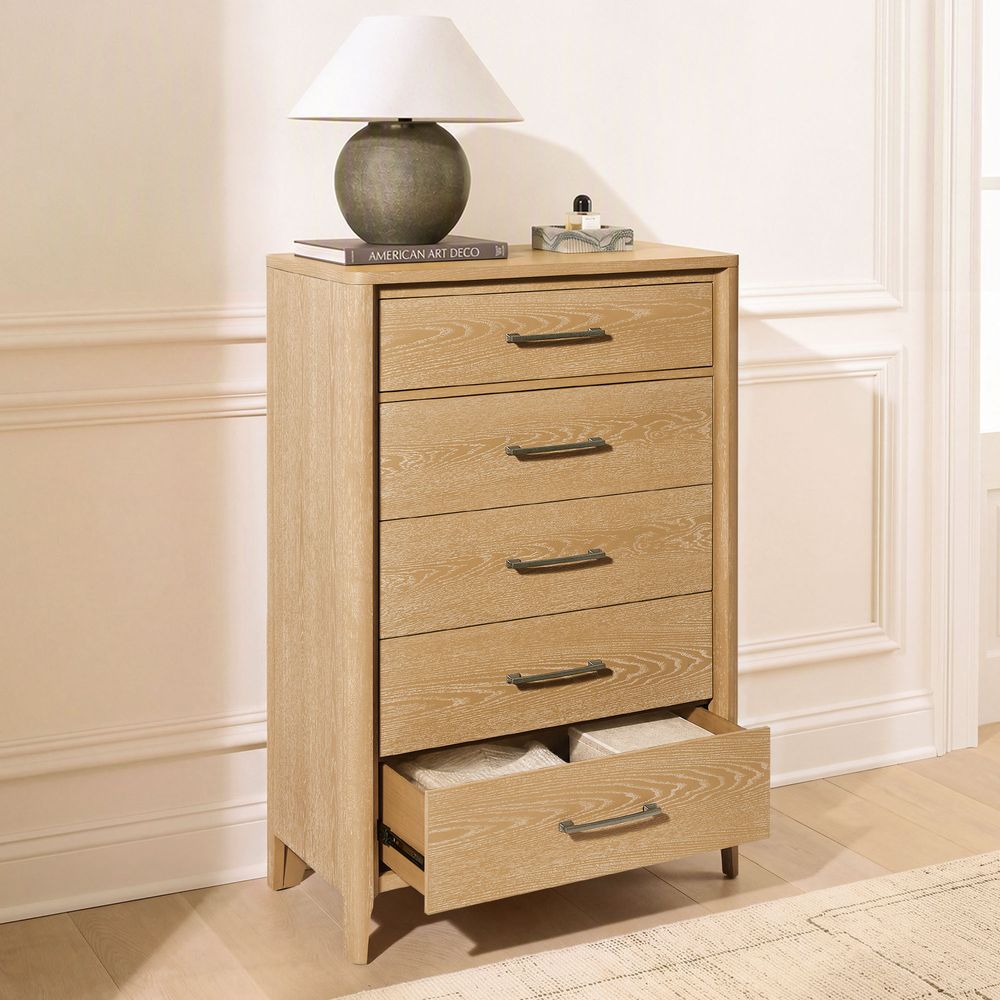
Harold 38-Inch 5-Drawer Chest
View Product
What Can You Store in Different Types of Chests of Drawers?
The most suitable chest depends partly on the belongings you want to store. Matching the drawer layout to those items helps avoid compartments that are too shallow, narrow, or difficult to access.
Everyday Clothing
Standard and tall chests are commonly used for folded clothing such as T-shirts, jeans, shorts, sweaters, and sleepwear. Wider drawers can accommodate larger folded garments, while multiple smaller compartments make it easier to separate different clothing categories.
If you plan to store heavier garments, check the product's stated drawer or weight capacity where available. A deeper drawer does not automatically support more weight.
Bedding and Linens
Some chests can accommodate folded sheets, pillowcases, lightweight blankets, and spare linens. Wider or deeper drawers are generally more suitable for these items than narrow compartments.
Compare the usable drawer dimensions with the folded size of your bedding. Thick blankets and comforters may require more space than the exterior measurements of a chest suggest.
Electronics and Household Items
A standard chest can hold smaller household belongings such as spare cables, personal devices, games, and accessories. A media chest is a more suitable option when the furniture will support a television or store entertainment equipment.
For electronic devices, consider ventilation and cable access. Equipment that generates heat should not be operated inside a closed drawer unless the furniture and equipment are specifically designed for that use. Open compartments and dedicated cable openings provide more appropriate arrangements for devices that need to remain connected.
Where Do Different Types of Chests of Drawers Work Best?
A chest of drawers can serve different rooms depending on its dimensions and storage features. The most important considerations are what you plan to keep inside, how frequently you need to access it, and whether the drawers can open without obstructing the surrounding area.
Bedroom
The bedroom is the most common location for a chest of drawers. A standard chest or tallboy can provide additional clothing storage, while a narrow model may fit beside a bed or along a smaller wall.
If you already have a dresser, a separate chest can hold accessories, sleepwear, or clothing that you want to keep apart. Check the drawer-opening clearance around beds, closets, and walking routes before deciding where to place it.
Walk-In Closet and Dressing Area
A chest can organize folded clothing in a walk-in closet or dressing area. A lingerie chest is suited to smaller personal items, while a standard chest can hold T-shirts, workout clothes, and other folded garments.
Measure the space between built-in shelves, closet doors, and clothing racks. Even if the cabinet fits, drawers may not open fully if nearby fixtures are too close.
Living Room
In a living room, a chest can provide concealed storage for spare blankets, games, remote controls, and household accessories. Its top surface may also hold a lamp or framed artwork, provided the proportions suit the room.
A media chest is a more appropriate choice when the furniture will support a television or accommodate entertainment equipment. Check the stated weight capacity, cable access, and equipment compartments before using it for that purpose.
Guest Room and Nursery
A smaller chest can give guests a place to store folded clothing and personal belongings. A three- or four-drawer design may be sufficient when the room also serves as an office or multipurpose space.
In a nursery or children's room, drawers can hold clothing, blankets, and everyday supplies. Stability is particularly important because children may pull on drawers or attempt to climb furniture. Follow the manufacturer's anchoring instructions and keep objects that could encourage climbing off the top.
How to Choose the Right Type of Chest of Drawers
Compare the furniture's external dimensions, drawer interiors, accessibility, and construction before deciding. The product name or drawer count alone cannot tell you whether a chest will work for your room and belongings.
Measure Available Space
Measure the width, depth, and height available for the chest. Account for baseboards, nearby furniture, closet doors, and other features that could affect placement.
Drawer clearance deserves separate attention. A chest may fit against the wall when closed but become difficult to use if an open drawer blocks a walkway or hits another piece of furniture.
Also consider the height of the top surface. If you plan to place a lamp, mirror, or decorative objects on it, allow enough room for those items without obstructing nearby fixtures.
Match Drawer Dimensions to Your Belongings
Look beyond the external cabinet measurements. The usable width, depth, and height of each drawer determine what you can store inside.
A chest with five wide drawers may be better suited to folded jeans and sweaters, while a configuration with smaller compartments can help organize underwear and accessories. If you intend to store folded bedding, compare the drawer dimensions with the size of those items before purchasing.
Think about the largest belongings you plan to store, not just the average item. This helps avoid choosing a chest that fits the room but cannot accommodate your actual storage needs.
Consider Height and Accessibility
A tall chest can save floor space, but its upper drawers may be less convenient for frequently used items. Keep everyday belongings in compartments that are comfortable to reach and reserve higher drawers for items you access less often.
For households with children, consider the furniture's stability and follow the manufacturer's safety instructions. Avoid placing heavy objects on top or allowing children to climb on open drawers.
Check Construction and Stability
Review the cabinet frame, drawer joints, drawer bottoms, slides, and hardware. Dovetail joints are a traditional joinery method often used in drawer construction, but they should be considered alongside the overall build quality and product specifications.
Stability is also important, particularly for tall or freestanding storage furniture. Check whether anti-tip hardware is included and follow the installation instructions.
Even when a piece falls outside that specific regulatory definition, anchoring a tall or heavy chest according to the manufacturer's instructions is a sensible precaution, especially in homes with young children.
Final Thoughts
The different types of chests of drawers offer distinct ways to organize clothing and household belongings. Tallboys and narrow chests make use of vertical space, while wide chests provide broader drawer interiors. Specialized designs, including lingerie chests, gentleman's chests, and media chests, address more specific storage needs.
Before choosing one, compare the overall dimensions, usable drawer space, construction, and intended use. A five-drawer chest with wider compartments may serve a different purpose from a narrow model with the same drawer count. The furniture's actual layout matters more than its category name alone.
FAQs
What Are the Most Common Types of Chests of Drawers?
Common types include standard chests, tallboys, narrow chests, wide chests, chest-on-chest designs, lingerie chests, and gentleman's chests. Media chests and bachelor's chests are more specialized options. They differ in proportions, drawer arrangements, or additional storage features.
What Is the Difference Between a Tallboy and a Chest of Drawers?
A tallboy is a type of chest of drawers with a particularly tall, vertical design. The broader term chest of drawers covers different proportions and configurations, including standard, narrow, wide, and specialty models.
What Is a Lingerie Chest Used For?
A lingerie chest is designed for smaller belongings that benefit from separate compartments. It commonly holds underwear, socks, scarves, jewelry, and other personal accessories. Its narrow frame and multiple smaller drawers help keep these items organized.
What Is a Gentleman's Chest?
A gentleman's chest combines conventional drawers with a separate cabinet compartment. Depending on the design, the enclosed section may include a hanging rod or shelves, allowing the furniture to store both folded and hanging clothing.
How Many Drawers Should a Chest of Drawers Have?
The right number depends on the amount and type of storage you need. Three or four drawers may be enough for supplementary storage, while five or six drawers provide more separate compartments. Compare the interior dimensions as well as the drawer count.
What Type of Chest of Drawers Is Best for a Small Bedroom?
A narrow chest or tallboy may suit a small bedroom because it uses vertical space rather than requiring a wide footprint. Check its depth, overall height, and drawer-opening clearance to make sure it fits without obstructing nearby furniture or walking paths.