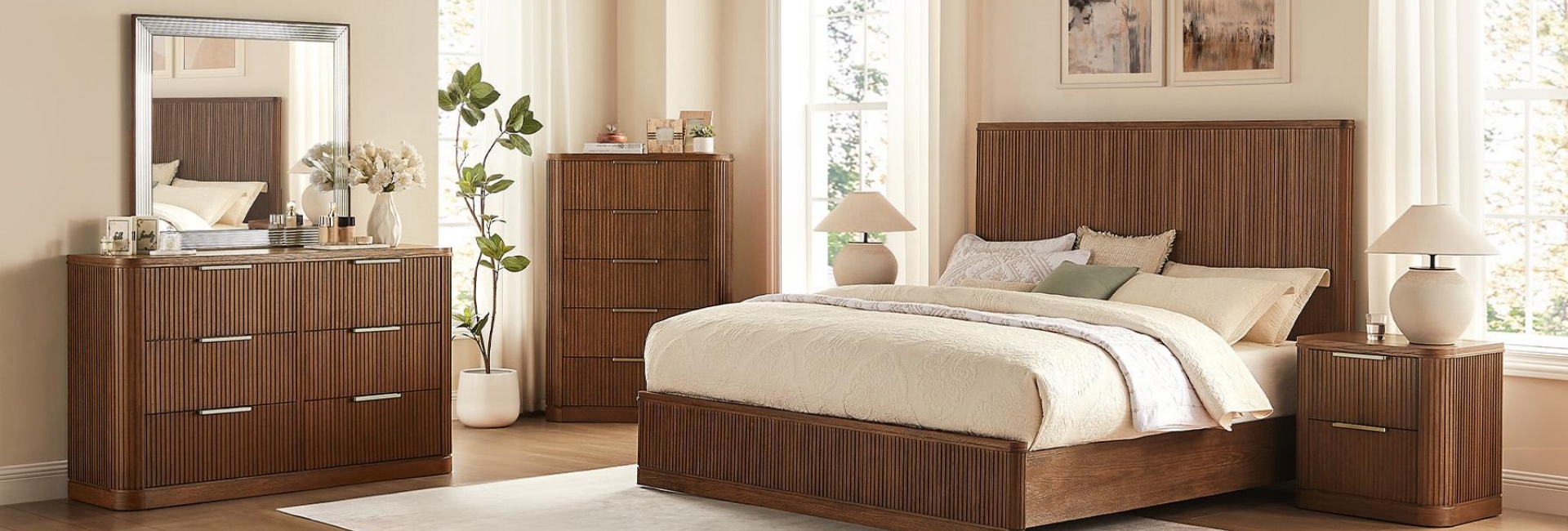
The average height of a chest of drawers generally falls within 44 to 60 inches, although compact designs may be closer to 40 inches and taller models can reach 65 inches or more. The exact measurement depends on the drawer arrangement, cabinet proportions, and base construction. A vertically stacked chest usually takes up less floor width than a wider dresser, while a shorter design may provide easier access to its top surface. Comparing these dimensions helps you find a storage piece that fits your room and everyday needs.
Table of Contents
- What Is the Average Height of a Chest of Drawers?
- Standard Chest of Drawers Height by Type
- What Affects the Height of a Chest of Drawers?
- How to Choose the Right Chest of Drawers Height
- How to Measure the Height of a Chest of Drawers
- FAQs
- How Tall Is a Chest of Drawers on Average?
- Is a 60-Inch Chest of Drawers Too Tall?
- How Tall Is a 5-Drawer Chest of Drawers?
- What Is the Difference Between Chest Height and Dresser Height?
- Should a 6-Drawer Chest of Drawers Be Taller Than a 5-Drawer Model?
- How Much Space Should I Leave in Front of a Chest of Drawers?
What Is the Average Height of a Chest of Drawers?
Many bedroom chests of drawers fall within an approximate height range of 44 to 60 inches. This is a useful shopping reference rather than a fixed industry standard. Compact models may sit closer to 40 inches, while taller designs can reach 65 inches or more.
Unlike a wide dresser, which often arranges drawers across two or more columns, a traditional chest of drawers usually stacks them vertically. This arrangement provides multiple storage compartments without requiring as much horizontal wall space. However, it also requires more vertical clearance and may place upper drawers beyond comfortable reach for some users.
The appropriate height depends on how you plan to use the furniture. If you store everyday clothing in the chest, consider whether you can comfortably reach the drawers you use most often. If floor space is limited, a taller design may provide more storage within a narrower footprint.
It is also important to distinguish between overall furniture height and usable drawer space. A chest measuring 55 inches from the floor to the top panel does not provide 55 inches of storage. The cabinet frame, drawer fronts, internal supports, top panel, and base all contribute to its external dimensions.
When comparing products, use the listed overall height rather than estimating it from the number of drawers or the appearance of the cabinet. Product specifications provide the best way to confirm whether a particular model will fit your room.
Standard Chest of Drawers Height by Type
Chest of drawers height varies with the furniture's proportions and drawer arrangement. The following ranges are general shopping references, not fixed manufacturing standards.
These categories can overlap. A narrow chest may also be classified as a tall chest because the terms describe different characteristics: narrow refers to width, while tall refers to vertical proportions. Actual dimensions vary by manufacturer, style, and construction.
Standard Chest of Drawers
A standard chest of drawers generally measures around 44 to 60 inches tall. It provides a balance between vertical storage and accessibility, making it a common option for bedrooms.
Three- and four-drawer arrangements are frequently found in this category, although the dimensions depend on the size of each compartment. A chest with deeper drawers may be taller than another model with the same number of drawers but shallower interiors.
When comparing standard models, check the overall height alongside the drawer dimensions. The exterior measurement indicates how much wall space the furniture occupies, while the interior measurements show how much usable storage it provides.
Tall Chest of Drawers
A tall chest of drawers typically measures around 50 to 65 inches high. Its defining feature is a vertically oriented structure that provides several storage compartments within a relatively compact footprint.
This design can be useful in smaller bedrooms where floor space is limited. Instead of extending across a wide wall, the furniture uses vertical space to accommodate clothing and household items.
However, additional height does not automatically make storage more convenient. Upper drawers may be harder to reach, particularly for shorter users. Consider placing less frequently used belongings in higher compartments and keeping everyday items within comfortable reach.
Also account for nearby windows, wall-mounted lighting, sloped ceilings, and other overhead features when planning placement. A ceiling height of eight feet does not guarantee that every tall chest will fit comfortably in its intended location.
Narrow Chest of Drawers
A narrow chest of drawers is designed for smaller wall spaces while maintaining vertical storage capacity. Many models measure approximately 48 to 65 inches tall, depending on their width and internal configuration.
Narrow models can fit beside a closet, in a compact bedroom corner, or along a wall where a wider dresser would obstruct movement. Their vertically arranged drawers are often used for folded tops, underwear, accessories, and other smaller belongings.
However, a narrow exterior does not necessarily provide enough room for every type of clothing. Check the interior width and depth before purchasing. A chest may accommodate smaller garments comfortably but offer limited space for bulky sweaters, jeans, or larger household items.
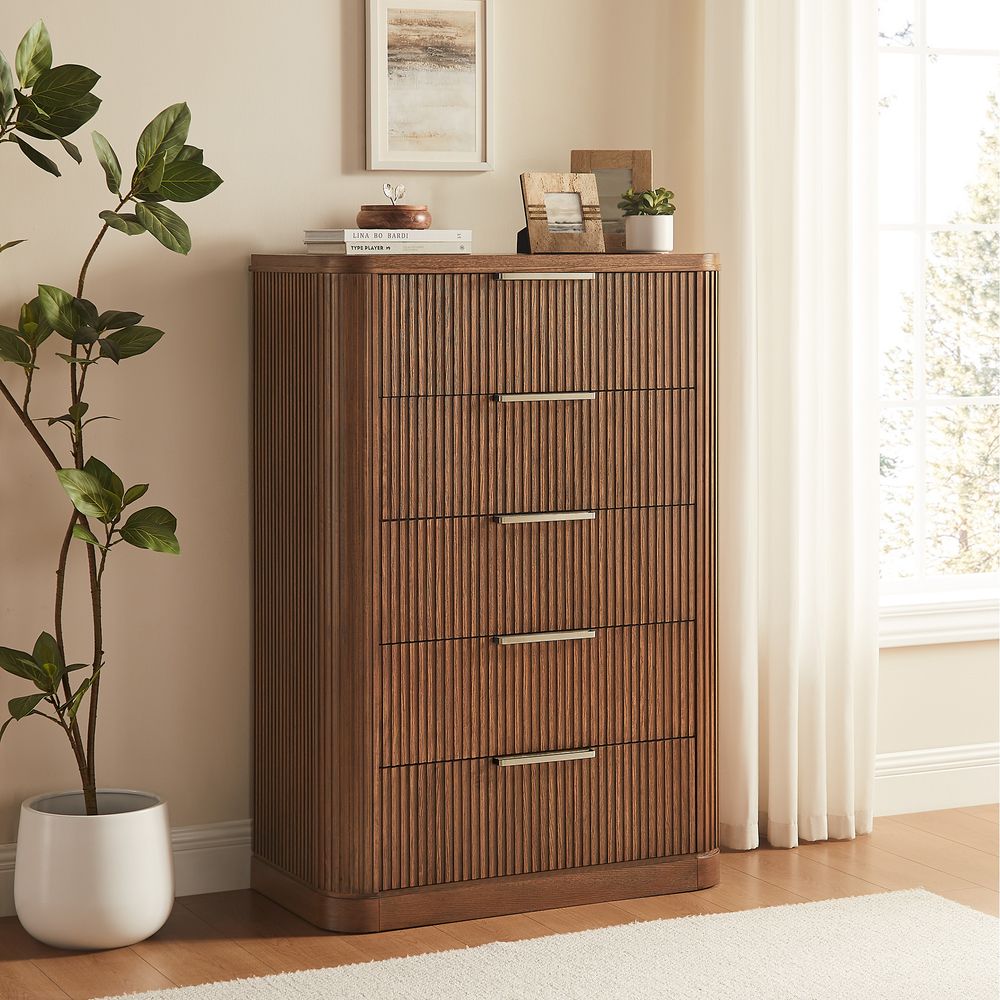
Finley 38-Inch Fluted 5-Drawer Chest
View Product
5-Drawer Chest of Drawers
A 5 drawer chest of drawers commonly measures around 52 to 60 inches tall when its compartments are arranged vertically. Five drawers provide several separate storage areas, but the overall dimensions depend on the height of each drawer and the space occupied by the cabinet structure.
The Finnley 38-Inch Fluted 5-Drawer Chest measures 38 inches wide, 18.3 inches deep, and 54.3 inches tall. Its five vertically arranged drawers provide separate storage for clothing and everyday items, while the fluted front adds texture to the cabinet's appearance. Its taller, relatively narrow profile makes it suitable for bedrooms where vertical storage is more practical than a wider dresser.
The Thursen 36-Inch Chevron 5-Drawer Chest has a slightly more compact footprint, measuring 36 inches wide, 18 inches deep, and 52 inches tall. Its five drawers offer similar vertically arranged storage, while the chevron-patterned front gives the cabinet a distinct look. Compared with the Finnley, it is 2 inches narrower and 2.3 inches shorter, which may make a difference when fitting furniture into a smaller bedroom.
6-Drawer Chest of Drawers
A six-drawer chest can have different proportions depending on whether the compartments are arranged in one column or two.
A single-column design stacks all six drawers vertically. It generally requires more height and less width than a two-column arrangement, making it suitable for spaces with limited wall width but sufficient vertical clearance.
A two-column design places drawers side by side, typically creating a wider and shorter cabinet. This arrangement distributes storage horizontally rather than vertically and may provide easier access to individual compartments.
The 6 drawer chest of drawers height therefore depends heavily on its layout. Do not assume that a six-drawer model will always be taller than a five-drawer chest. Compare the overall height, width, and drawer arrangement together.
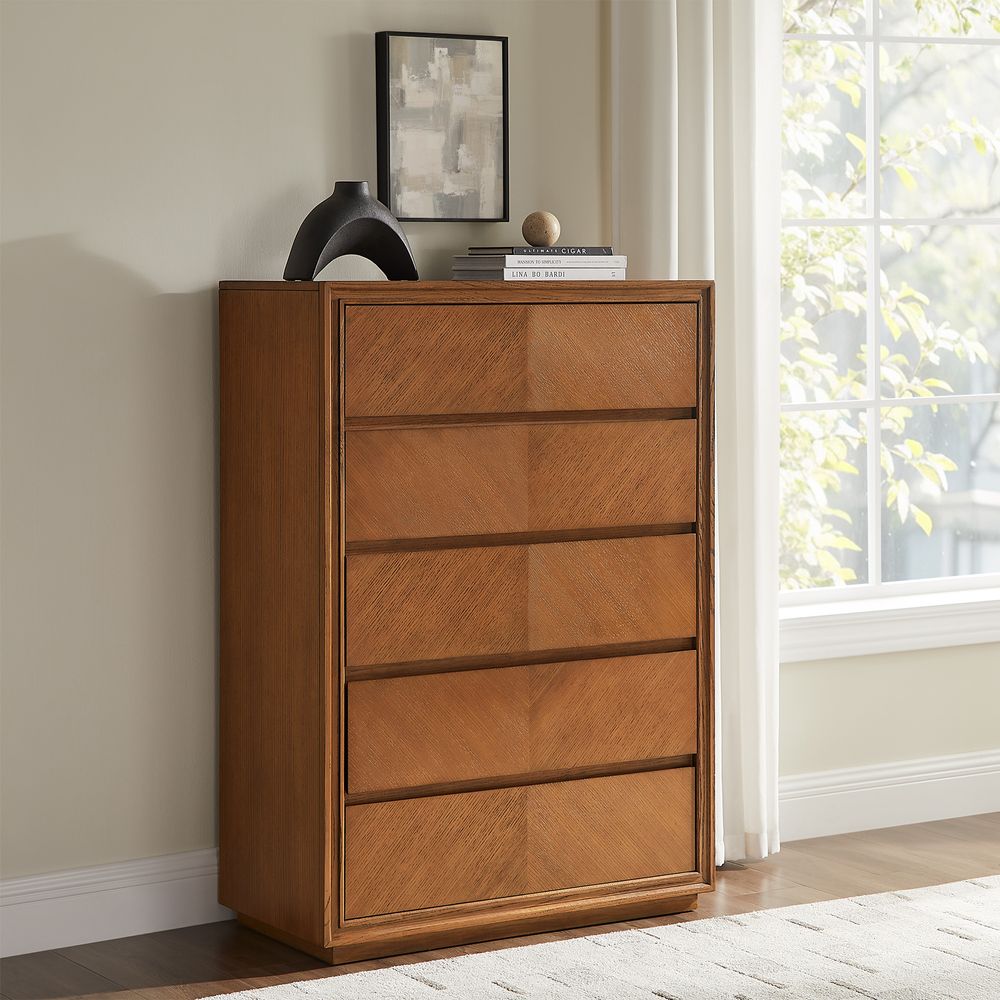
Thursen 36-Inch Chevron 5-Drawer Chest
View Product
What Affects the Height of a Chest of Drawers?
Several construction and design details contribute to the total height of a chest of drawers. Understanding them helps explain why two pieces with the same drawer count can have different external dimensions.
Number and Arrangement of Drawers
More drawers often mean a taller cabinet when the design uses a single vertical column. However, this relationship changes when drawers are arranged in multiple columns.
A three-drawer chest with unusually deep compartments may be close in height to a five-drawer model with shallower drawers. Similarly, a six-drawer cabinet arranged in two columns may be wider rather than taller.
The arrangement determines how storage is distributed across the cabinet. Single-column designs concentrate compartments vertically, while double-column designs use more horizontal space.
Individual Drawer Dimensions
The height, width, and depth of each drawer affect the overall proportions of the furniture. Some designs use shallow upper drawers for smaller belongings and deeper lower compartments for clothing that takes up more space.
Rails, internal supports, drawer bottoms, and the gaps between drawer fronts also occupy space within the cabinet. As a result, the exterior height may be greater than the combined usable interior heights of the drawers.
When shopping, look for interior drawer measurements where available. The height of a drawer front does not necessarily indicate how much usable space is inside.
Base and Leg Design
The base can contribute several inches to the overall height of a chest. Raised legs create visible space beneath the cabinet, while a recessed or plinth-style base gives the furniture a more grounded appearance.
Two chests may offer similar drawer storage but have different overall heights because of their base designs. Adjustable levelers can also affect the final installed height, particularly on uneven floors.
When comparing products, check whether the stated overall measurement includes the permanent legs, feet, and base. This ensures you are comparing the complete furniture dimensions rather than just the cabinet body.
Overall Cabinet Structure
The cabinet frame, top panel, and decorative detailing all contribute to the final measurement.
A thick top panel adds height without increasing the available drawer space. Raised edges, decorative moldings, and integrated bases can also affect the highest point of the furniture.
When two chests have similar internal storage, their external heights may still differ because of these structural choices. Reviewing the complete product dimensions helps you understand how much space each model will occupy.
How to Choose the Right Chest of Drawers Height
The right height should fit your room while allowing convenient access to the drawers. Consider your reach, storage needs, and available space before comparing individual models.
Consider Your Height and Everyday Accessibility
Choose a chest that lets you reach commonly used drawers without repeatedly stretching or bending.
For shorter users, a particularly tall chest may place the upper drawers outside a comfortable reach. Taller users may find the same arrangement easier to use. The height of the furniture relative to the person using it therefore matters alongside the room's dimensions.
Think about how frequently you access each compartment. Everyday clothing is often more convenient in middle or lower drawers, while less frequently used belongings can be stored higher up.
You can also compare the top surface height with nearby furniture. Matching every furniture height is not necessary, but the relationship between a chest, nightstand, and bed can affect the overall arrangement of a bedroom.
Match the Height to Your Storage Needs
Consider what you intend to store before deciding how tall the chest should be.
If you mainly need space for underwear, socks, and lightweight tops, a design with several smaller compartments may work well. If you store jeans, sweaters, or other bulky clothing, look for deeper drawers with sufficient interior width.
A taller cabinet may provide more vertically arranged compartments, but overall height does not tell you how spacious each drawer is. Check the usable dimensions of individual compartments, especially their interior height and depth.
Consider Your Bedroom Space
Measure the intended location before selecting a chest. Account for nearby furniture, closet doors, windows, and overhead features that may affect placement.
A tall cabinet beneath a low window may obstruct part of the window, while a chest placed beside a closet should not interfere with door movement. For rooms with sloped ceilings, measure the available height at the exact location where the furniture will stand.
Consider the visual proportions of the room as well. A tall, narrow chest concentrates storage vertically, while a shorter, wider unit occupies more wall space. You can mark the proposed footprint with painter's tape to get a better sense of how the furniture will fit.
Consider Drawer Access and Furniture Stability
The chest should have enough open space in front for the drawers to extend and for you to stand comfortably while using them.
Check the drawer extension rather than assuming every model requires the same amount of clearance. Also consider nearby beds, closet doors, bedroom entrances, and other furniture that might interfere with an open drawer.
Stability deserves particular attention with taller storage furniture. A loaded drawer changes the distribution of weight as it moves outward, so use the supplied anti-tip hardware and follow the manufacturer's installation instructions.
Even when a piece falls outside that specific regulatory definition, anchoring a tall or heavy chest according to the manufacturer's instructions is a sensible precaution, especially in homes with young children.
How to Measure the Height of a Chest of Drawers
Accurate measurements help you determine whether a chest will fit beneath windows, wall-mounted features, or other nearby obstacles. A tape measure is sufficient for checking the overall height and available clearance.
Measure from the Floor to the Top Surface
Place the end of your measuring tape on the floor and extend it vertically to the highest permanent point of the chest.
Keep the tape straight rather than following the cabinet's front or side. If the top panel has a raised edge or decorative detail, measure to the highest point.
For a new purchase, check whether the product specification lists the complete assembled height. Product images can make a chest appear taller or shorter depending on the camera angle and surrounding furniture.
Include the Base and Legs
The overall height should include the entire piece, from the floor to the top panel.
Do not measure only the main cabinet body and forget to account for legs, feet, or the base. These components form part of the furniture's actual height and can affect whether it fits beneath a window or wall-mounted feature.
For furniture with removable legs, distinguish between the assembled height and the cabinet-only measurement. Also check whether adjustable levelers are included in the stated dimensions.
Account for Uneven Floors and Other Obstacles
A floor that slopes slightly can affect how a chest sits after installation. Check whether the floor is reasonably level and whether the furniture has adjustable levelers.
Inspect the space above the furniture as well. Windowsills, wall lights, shelves, artwork, and sloped ceilings can all limit the available vertical clearance.
For a chest intended to sit below a window, measure from the floor to the bottom of the windowsill and compare that figure with the complete assembled height. Allow enough clearance to position the furniture without contact.
Finally, consider delivery access separately from everyday placement. Check stairways, hallway turns, door openings, and the product's delivery dimensions before ordering.
FAQs
How Tall Is a Chest of Drawers on Average?
Many bedroom chests of drawers measure approximately 44 to 60 inches tall. Compact designs may be closer to 40 inches, while taller models can reach 65 inches or more. The exact height depends on the drawer arrangement, cabinet proportions, and base construction.
Is a 60-Inch Chest of Drawers Too Tall?
Not necessarily. A 60-inch chest can work well in a bedroom with sufficient vertical clearance and comfortable access to its drawers. Consider your height, ceiling clearance, and the location of windows or wall-mounted fixtures before choosing one.
How Tall Is a 5-Drawer Chest of Drawers?
A vertically arranged five-drawer chest commonly measures around 52 to 60 inches tall. However, drawer depth, cabinet proportions, and base construction can change the overall measurement. Compare the listed dimensions of individual models rather than relying on drawer count alone.
What Is the Difference Between Chest Height and Dresser Height?
A traditional chest of drawers is generally taller and narrower, with drawers stacked vertically. A dresser is typically wider and shorter, often featuring two or more columns of drawers. However, furniture naming conventions vary, and some products overlap in size and configuration.
Should a 6-Drawer Chest of Drawers Be Taller Than a 5-Drawer Model?
Not necessarily. A six-drawer chest with one vertical column will generally need more height than a similar five-drawer design. However, a six-drawer unit with two columns may distribute its compartments across a wider cabinet instead. Compare the overall dimensions and drawer layout rather than relying on drawer count alone.
How Much Space Should I Leave in Front of a Chest of Drawers?
Leave enough room for the drawers to extend fully and for someone to stand comfortably while accessing their contents. The required clearance depends on drawer depth, extension mechanism, and surrounding furniture. Measure the open-drawer projection and account for the space needed to move around the room.