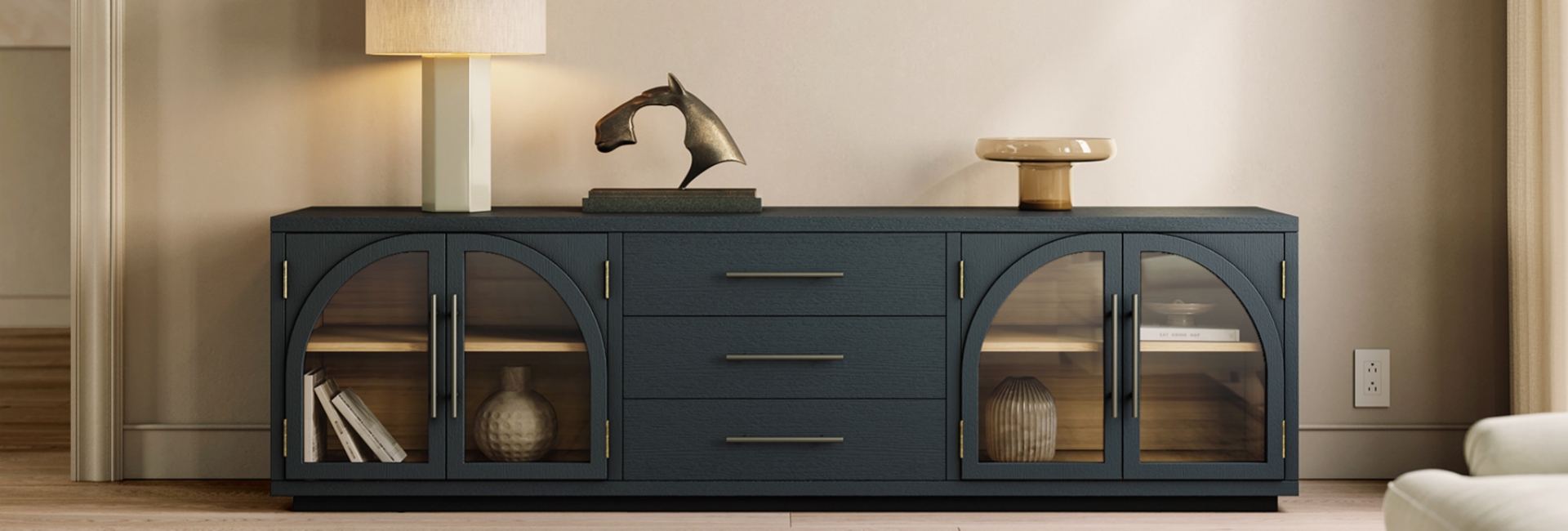
Should a coffee table match the TV stand? Not necessarily. In most living rooms, the two pieces look better when they coordinate rather than match exactly. A shared wood tone, similar proportions, or one repeated design detail can make them feel connected without making the room look like everything came from the same furniture set.
The bigger question is how the coffee table and TV stand relate to the rest of the room. Your sofa sets the scale for the coffee table, while the TV and media wall determine the scale of the console. From there, material, color, shape, and visual weight help the two pieces work together.
In this guide, we'll break down the practical rules for pairing a coffee table with a TV stand, including sizing, wood tones, MCM styles, contrasting shapes, and matching sets. You'll also see how real Hernest pieces can be combined to create a living room that feels coordinated without looking overly staged.
Table of Contents
- Should a Coffee Table Match the TV Stand?
- Matching vs. Coordinating: What's the Difference?
- Start With Scale Before Style
- Choose an Anchor Style and Build Around It
- Coordinate Materials, Then Add Contrast
- Can You Mix Different Wood Tones?
- Use Shape to Break Up Repetition
- Make the Coffee Table Work Harder
- Matching Sets: When They Help and When They Flatten
- Small Rooms and Family Homes Need Different Rules
- A Simple 8-Step Way to Coordinate Your Living Room
- FAQs
- Should a coffee table match the TV stand?
- What size coffee table goes with a TV stand?
- How do I coordinate a coffee table and TV stand that don't match?
- Can you mix different wood tones between a coffee table and TV stand?
- Should a coffee table be lower than the TV stand?
- What color coffee table works with a white TV stand?
- What color coffee table works with a black TV stand?
- Is an MCM TV stand easy to pair with a coffee table?
- Are lift-top coffee tables still in style?
- Is buying a matching coffee table and TV stand set a design mistake?
Should a Coffee Table Match the TV Stand?
Quick answer: No. A coffee table does not need to match a TV stand exactly. In most living rooms, coordination works better than an identical set. Use one or two shared details—such as a similar wood undertone, leg style, or metal finish—and let the shape or material provide some contrast.
The living rooms that feel collected rather than showroom-perfect usually follow this approach. The media console and coffee table belong to the same design story, but each piece has its own character.
When someone asks, "Should a coffee table match the TV stand?" we usually start with a different question: What do you want the room to feel like? A calm, coordinated room can use closely related finishes. A more layered space can mix materials, shapes, and wood tones with a few visual connections between the pieces.
The key is not matching every detail. It's knowing which details are worth repeating.
Matching vs. Coordinating: What's the Difference?
Exact matching and coordination are not the same thing.
A matching set has a legitimate advantage: it removes uncertainty. The finish works, the proportions are designed to go together, and you don't have to make as many decisions. That's useful when furnishing a rental, staging a home, or finishing a room quickly.
Coordination gives you more flexibility. You can combine a walnut console with an oak coffee table, for example, as long as the relationship between the pieces feels intentional.
Our general rule is simple: match the feeling, not every finish.
Start With Scale Before Style
Style gets most of the attention, but scale is what makes a living room feel comfortable.
The coffee table and TV stand don't actually need to be sized in relation to each other first. Both pieces should relate to the sofa, TV, and overall room dimensions. The sofa is the main anchor of the seating area, while the TV stand anchors the media wall.
Here are practical starting points for a typical living room:
These are starting points rather than hard requirements. A sectional, unusually deep sofa, narrow room, or open floor plan may call for different measurements.
The Clearance Numbers That Matter
People often spend more time comparing wood finishes than checking the space between the furniture.
For most rooms, about 16–18 inches between the sofa and coffee table is a comfortable starting point. You may want slightly more space with a deep sofa or in a room where people frequently walk around the seating area.
Between the coffee table and TV stand, 24–30 inches generally gives you enough room to move while keeping the media zone connected to the seating area.
If the coffee table crowds the console, the two pieces can visually merge into one heavy block. If the gap is too large, the coffee table can feel disconnected from the TV area.
And remember: a large TV does not automatically require a large coffee table. If an 85-inch TV already creates a strong focal point, a lower and visually lighter coffee table can balance the room better than another oversized piece.
Choose an Anchor Style and Build Around It
Once scale is right, look at the style of the room.
The sofa and rug are often the best clues. If they are low, angular, and streamlined, furniture with similar proportions will usually feel natural. If they are rounded and soft, a round or oval coffee table can reinforce that direction.
The TV stand and coffee table should support the room's main style rather than compete with it.
Why Mid-Century Modern TV Stands Are Easy to Pair
Mid-century modern is particularly easy to coordinate because it relies on a recognizable set of design elements: warm wood, low profiles, tapered or streamlined legs, and organic shapes.
That means an MCM TV stand and coffee table don't need identical finishes to work together. A walnut console can pair with an oak table if the proportions and overall warmth are compatible. Likewise, a rectangular media console can work with a round or oval coffee table because the contrast adds visual interest.
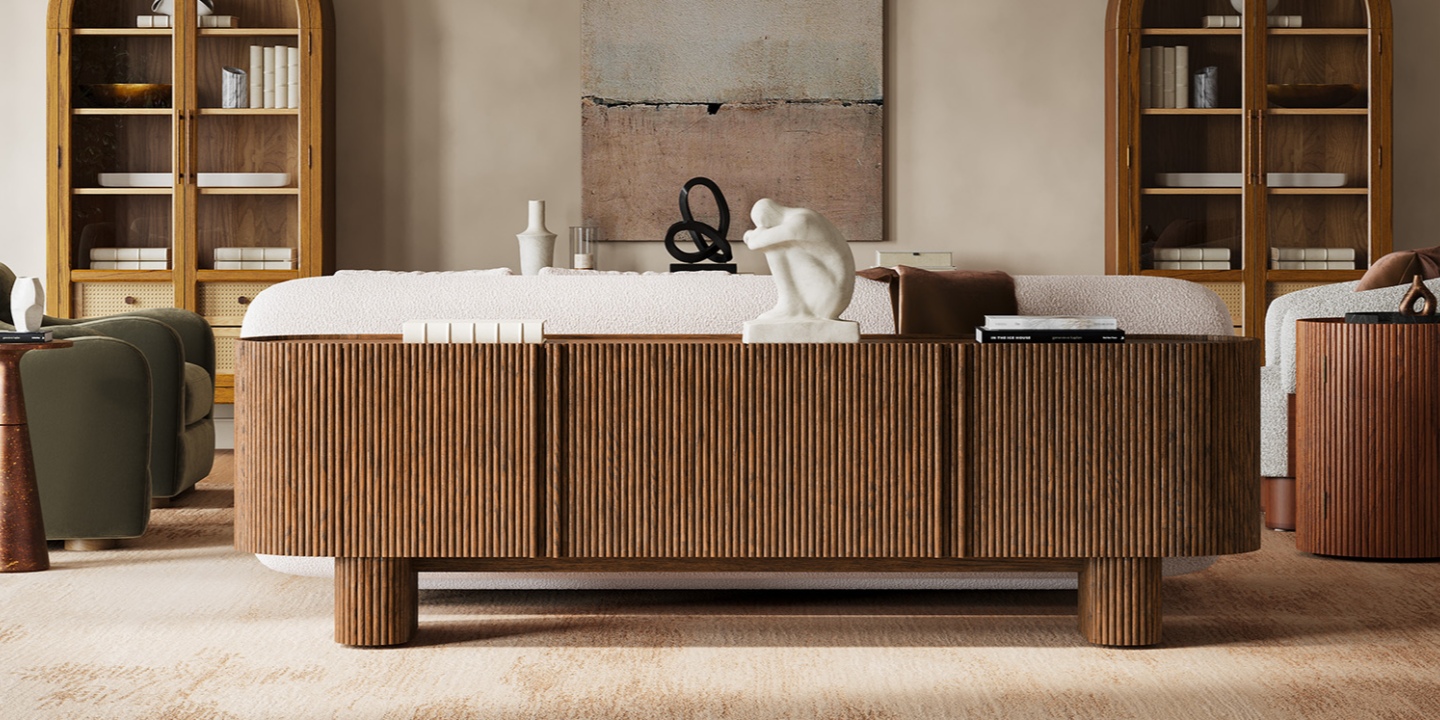
The Marisol 84" Oak Media Console from Hernest is a good example. Its warm brown-oak finish, fluted front, rounded plinth, and low-profile design give it a distinctly mid-century direction. It is 84 inches wide and designed for TVs up to 85 inches, with four rear cord cutouts for cable management.
Pairing it with a round or oval coffee table in a related warm wood tone creates a cohesive MCM look without requiring the two pieces to come from the same collection.
The fluted surface is another useful detail. Its vertical rhythm can be echoed by the lines or texture of a coffee table without requiring an identical pattern.
Coordinate Materials, Then Add Contrast
Material is where a coordinated room starts to feel more personal.
Instead of choosing the same material for every piece, think about a dominant material, a supporting material, and one point of contrast.
Wood is often the dominant material in a living room. If the TV stand is wood, the coffee table can repeat that warmth in a smaller amount or introduce a contrasting material such as glass, stone, or metal.
The goal is not to make every surface different. Too many unrelated materials can make the room feel fragmented.
Match the Hardware, Not the Entire Piece
One of the easiest ways to connect two different pieces is to repeat a small detail.
For example, if the TV console has brass hardware, a coffee table with brass-colored legs can create a visual connection even if the wood finishes are different.
This works because the repeated metal detail gives the eye something familiar to recognize. The larger surfaces can remain different.
Glass and metal are particularly useful when a wood console feels visually heavy. A glass-topped coffee table with a slim metal base allows more of the floor to remain visible, which can make a compact living room feel more open.
As a general rule, similar finishes tend to be easier to combine than competing ones. Matte and matte usually feel more natural together than a highly glossy surface paired with a raw, heavily textured finish.
Can You Mix Different Wood Tones?
Yes. Different wood tones can work together as long as the contrast looks intentional.
The safest approach is to look at undertone and contrast, rather than trying to find two finishes that are almost identical.
Two finishes that are nearly—but not quite—the same can look accidental. A clearer contrast often feels more deliberate.
For example:
Warm oak can work with another warm oak or a noticeably darker walnut.
A medium walnut can pair with lighter oak when the room has other elements that connect the tones.
Bleached or gray-washed finishes tend to read cooler and may need other cool or neutral elements nearby.
Oak and some ash finishes can read warm and golden, while walnut and cherry often bring deeper brown or reddish undertones. Bleached or gray-washed finishes tend to feel cooler.
The important point is that wood color varies by species, stain, finish, and lighting. Treat undertone as a useful guide rather than a rigid rule.
White TV Stand, Dark TV Stand: The Contrast Move
A white TV stand gives you plenty of options.
Warm wood is one of the easiest choices because it adds visual warmth without making the room feel busy. Light oak or honey-toned wood can keep the space inviting. Glass or acrylic can preserve an airy look in a small room, while black metal can create stronger contrast.
Avoid trying to find a coffee table that is an almost-identical shade of white or cream. Small differences in white can be more noticeable than a deliberate contrast.
A black TV stand works differently. Because the console already carries visual weight, a medium wood coffee table can soften the overall composition. Walnut, medium oak, stone, glass, and metallic accents can all work depending on the room.
The goal is to balance the visual weight rather than repeat it.
Use Shape to Break Up Repetition
Most living rooms already contain plenty of rectangles:
sofa
rug
TV
TV stand
windows
shelves
Adding a round or oval coffee table can soften that geometry.
A rectangular TV stand paired with a round coffee table is one of the simplest ways to make the furniture feel coordinated without looking like a matching set. The two pieces have different shapes, but they still work together because their scale and style belong to the same room.
Visual weight matters, too.
A solid console that sits close to the floor can benefit from a coffee table with visible legs and open space underneath. Conversely, a slim, raised console can handle a more substantial coffee table because the media wall already feels visually light.
In a 10-by-12-foot room, for example, placing two very chunky furniture pieces in the same visual zone can make the room feel crowded. If one piece carries more visual weight, letting the other breathe can create a better balance.
Make the Coffee Table Work Harder
The coffee table has a different job from the TV stand.
The TV stand supports the screen, hides equipment, and manages cables. The coffee table is part of the everyday seating experience. It holds drinks, books, laptops, remotes, and whatever else ends up in the middle of the room.
That means function should influence your choice just as much as appearance.
For a small living room or work-from-home setup, a lift-top coffee table can be particularly useful. It provides a comfortable surface for working or eating from the sofa while adding storage for smaller items.
A Lift-Top Coffee Table for Small-Space Living
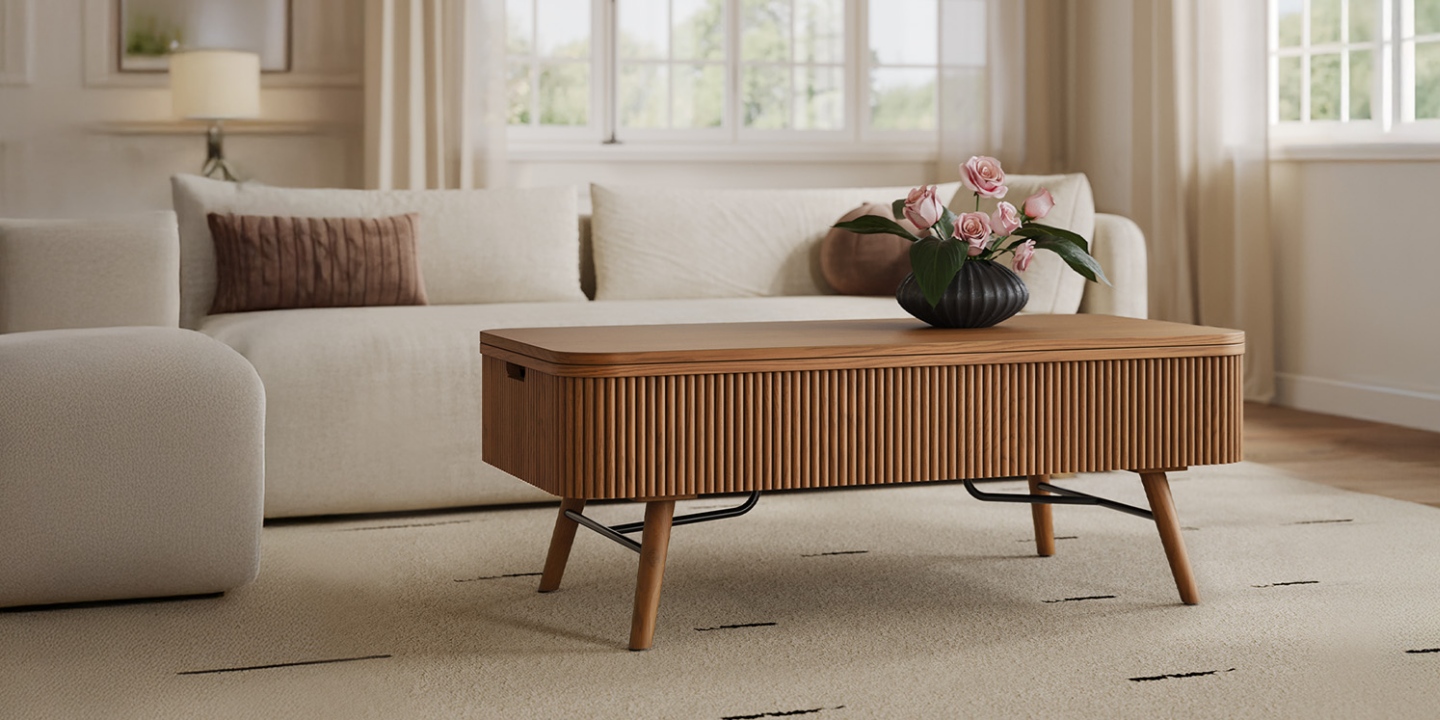
The Magnus 47" Lift-Top Oak Coffee Table is a practical example. Its brown-oak finish, fluted base, oak construction, metal frame, lift-top mechanism, and concealed storage give it a different role from a traditional coffee table.
Paired with the Marisol 84-inch oak media console, the two pieces can share the same warm, textured direction without becoming a matching set.
The console handles the media wall. The coffee table handles the seating area and everyday activities.
That distinction is important. A coordinated living room is not just about making furniture look similar. The pieces should also perform different jobs well.
Cable management is another practical detail worth considering. A console with rear cord cutouts can keep TV, soundbar, and gaming cables routed toward the wall instead of spilling into the room.
Matching Sets: When They Help and When They Flatten
Matching furniture sets are not a design mistake.
They can be particularly useful when you want:
A fast, low-risk furnishing solution
Consistent finishes
Guaranteed compatibility
A simple look for a rental
A cohesive media zone in an open-plan room
The downside is that an entire room from one collection can feel overly uniform.
If you already own a matching coffee table and TV stand, you don't need to replace either piece. Instead, introduce contrast elsewhere. A textured rug, sculptural accessory, different-colored upholstery, or artwork can give the room more personality.
The set provides the visual foundation. The surrounding pieces make the space feel lived in.
Small Rooms and Family Homes Need Different Rules
A small room changes the priorities.
Transparency and open floor space become more valuable, so a glass coffee table or slim-legged design can work well. A media console that stays relatively shallow can also preserve more walking room.
For homes with children or pets, practicality matters even more.
Rounded coffee table edges can be easier to live with than sharp corners. Closed console storage can keep electronics and cables out of reach. Durable, easy-to-clean finishes can also make more sense than delicate surfaces that require constant care.
Flexibility is useful, too. Nesting tables can separate for movie night or everyday use, then tuck together when you need more floor space.
The best coffee table and TV stand pairing is ultimately the one that works with how you actually use the room.
For more options, browse Hernest's media consoles and coffee tables.
A Simple 8-Step Way to Coordinate Your Living Room
Use this process if you're starting from scratch:
Choose the anchor style. Start with the sofa and rug, then identify the main design direction.
Measure the sofa. Record its length and seat height before choosing the coffee table.
Size the TV stand to the TV. Aim for roughly 4–6 inches of extra console width on each side.
Size the coffee table to the sofa. About two-thirds of the sofa length is a useful starting point.
Set the height. Keep the coffee table level with or about 1–2 inches below the sofa seat.
Choose one shared detail. Repeat a wood undertone, leg shape, texture, or metal finish.
Add one deliberate contrast. Change the shape, material, or visual weight so the pieces don't look copied.
Check the clearances. Aim for about 16–18 inches between sofa and coffee table and 24–30 inches between coffee table and TV stand.
If you follow these steps, the question changes from "Do these pieces match?" to a much more useful one:
"Do these pieces look like they belong in the same room?"
That's the real goal.
FAQs
Should a coffee table match the TV stand?
No. A coffee table does not need to match a TV stand exactly. In most living rooms, coordination works better than an identical set. Share one or two details, such as a wood undertone, leg style, or metal finish, and let the pieces retain some contrast.
What size coffee table goes with a TV stand?
Size the coffee table primarily according to the sofa rather than the TV stand. A useful starting point is a table about two-thirds the sofa's length and level with or 1–2 inches below the sofa seat. Leave about 16–18 inches between the sofa and table and 24–30 inches between the table and TV stand.
How do I coordinate a coffee table and TV stand that don't match?
Choose one shared detail and repeat it. You might use a similar wood undertone, related leg style, matching metal finish, or a repeated texture. Then introduce one deliberate contrast, such as a round coffee table with a rectangular TV console.
Can you mix different wood tones between a coffee table and TV stand?
Yes. Different wood tones can work when the contrast is intentional. Look at the undertones and avoid finishes that are almost—but not quite—the same. A clear difference between light oak and darker walnut can often look more deliberate than two slightly different brown finishes.
Should a coffee table be lower than the TV stand?
Usually, yes, but the coffee table's height should be determined by the sofa rather than the TV stand. Aim for a coffee table that is level with or about 1–2 inches below the sofa seat. The TV stand can be considerably taller because it sits behind the seating area.
What color coffee table works with a white TV stand?
Warm wood is one of the easiest choices because it adds warmth without overwhelming the room. Light oak, honey-toned wood, glass, and black metal can all work. Avoid an almost-white or cream finish if it is close but not identical to the TV stand.
What color coffee table works with a black TV stand?
Medium or warm wood can soften the visual weight of a black console. Walnut, medium oak, glass, stone, and metallic accents can also work. The best choice depends on the room's existing colors and materials.
Is an MCM TV stand easy to pair with a coffee table?
Yes. Mid-century modern furniture typically uses warm wood, low profiles, streamlined legs, and organic shapes, making it relatively easy to coordinate. An MCM TV stand in oak can work especially well with a round or oval coffee table in a related finish.
Are lift-top coffee tables still in style?
Yes. Modern lift-top designs can look like conventional coffee tables when closed while providing a raised work or dining surface and additional storage. They are especially practical for small living rooms and work-from-home spaces.
Is buying a matching coffee table and TV stand set a design mistake?
No. Matching sets can simplify furnishing and guarantee finish consistency. They become limiting only when every piece in the room uses the same design language. If you own a matching set, add contrast through the rug, lighting, accessories, artwork, or surrounding furniture.