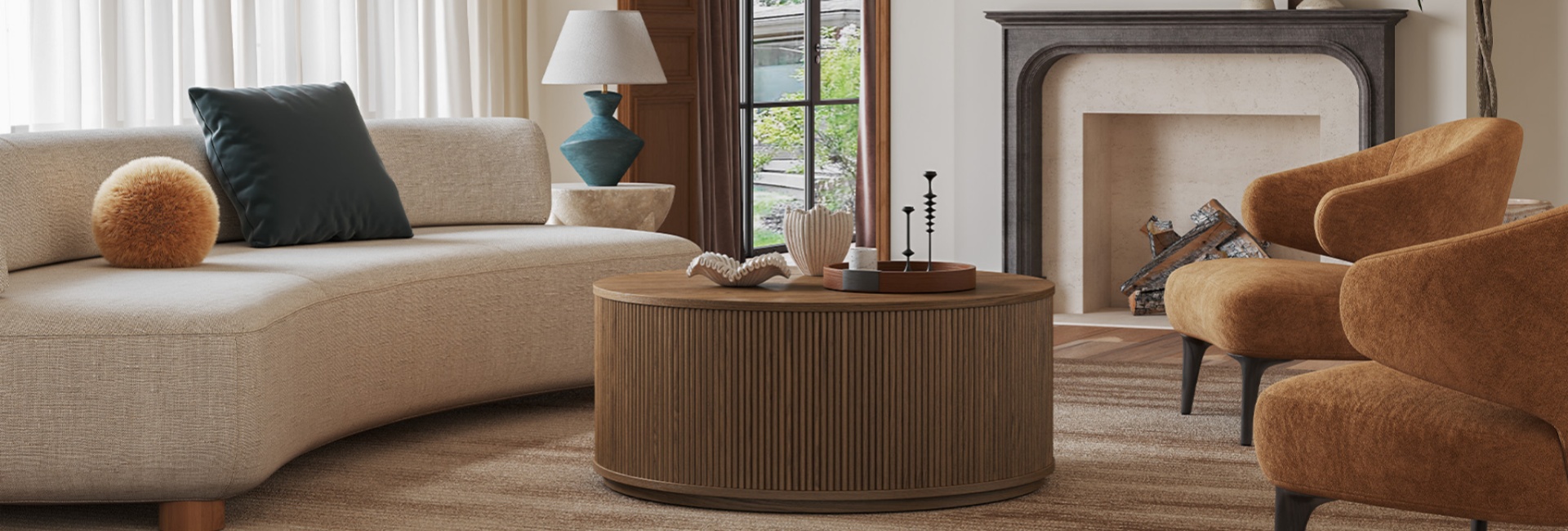
A coffee table can make a living room feel finished—or quickly turn into a landing spot for remotes, mail, and half-empty mugs. The trick is not adding more decor. It is knowing what to group, how much space to leave open, and how to make the arrangement work with the shape and size of the table.
In this guide, you’ll find practical coffee table decor ideas for real living rooms, including a simple five-layer styling formula, layouts for round and rectangular tables, ideas by table size and room style, and the common mistakes that make a table look cluttered. The goal is a coffee table that looks considered in photos but still has plenty of room for everyday life.
We’ve styled the same tables in our studio for countless shoots, and the most useful lessons are surprisingly simple: start with one anchor, vary the height, mix a few materials, add something natural or personal, and leave enough open space to actually put your coffee down.
Table of Contents
- Coffee Table Decor Ideas at a Glance
- What to Put on a Coffee Table When You're Starting From Zero
- The Five-Layer Formula That Makes Any Table Look Considered
- How to Keep a Coffee Table Both Styled and Usable
- Coffee Table Decor Ideas by Table Size
- Styling a Round Coffee Table Versus a Rectangular One
- Vary the Height and Group in Odd Numbers
- Mix Materials So the Table Doesn't Read as a Catalog
- Match the Decor to the Room You Already Have
- What to Put in the Middle of Your Coffee Table
- Common Mistakes to Avoid When Decorating a Coffee Table
- Refresh the Table Seasonally Without a Full Restyle
- The 60-Second Coffee Table Styling Checklist
- FAQs
- What can I put in the middle of my coffee table?
- How do you style a coffee table without a tray?
- How many items should go on a coffee table?
- What should I put on a round coffee table versus a rectangular one?
- How do I match coffee table decor to my living room style?
- What's the best way to style a coffee table on a budget?
- How often should I refresh my coffee table decor?
Coffee Table Decor Ideas at a Glance
If you want the short version, start here:
Use one anchor: A tray, low bowl, or stack of two or three books gives the arrangement a visual starting point.
Aim for three to five objects: A standard 40- to 48-inch coffee table usually does not need more.
Vary the height: Combine low, medium, and tall pieces so the arrangement does not read as a flat row.
Add something organic: A plant, fresh stem, dried branch, or natural stone softens harder materials.
Mix at least two materials: Try wood with ceramic, glass with stone, or woven fiber with metal.
Keep at least one-third of the surface open: The table still needs to hold a coffee mug, phone, remote, or laptop.
Let the table shape guide the layout: Round tables work well with one off-center cluster, while rectangular tables can use two or three zones.
The best coffee table decor is not the arrangement with the most objects. It is the one that looks intentional and still works when someone actually sits down.
What to Put on a Coffee Table When You're Starting From Zero
The blank top is where most people freeze. The answer to what to put on a coffee table is not a long shopping list. It is one anchor object, then everything else earns its spot next to it.
An anchor is the piece that gives the eye a place to land. It can be a tray, a stack of two or three hardcover books, a low decorative bowl, or a small catchall. Pick one and set it slightly off center. The off-center placement tends to feel more relaxed, while a dead-center cluster can look like a place setting someone forgot to clear.
Once the anchor is down, the rest of the surface has context.
A tray is the easiest anchor for most rooms because it does double duty. It groups small stuff so the table looks curated instead of scattered, and you can lift the whole thing when you need the surface clear for a puzzle, a laptop, or a pizza.
A book stack works better as an anchor when the table is small or when you want height without a tray. A low bowl anchors a table that already has a tray elsewhere, or a round table where a rectangular tray would fight the shape.
Start with the anchor and stop adding the moment the table feels full. Most first attempts put down the anchor and then keep going. The best versions we shoot have three to five objects total on a standard 40- to 48-inch table, not fifteen.
The Five-Layer Formula That Makes Any Table Look Considered
Once the anchor is set, build the rest in layers. We call this the five-layer formula because it scales from a tiny apartment table to a six-foot sectional centerpiece without changing the basic logic. Each layer has one job.
The tray goes first. For a round table, reach for a round tray so the shapes echo. On a rectangular table, a square or rectangular tray usually reads cleaner. Fill it to about one third of the surface and no more.
Books come next as the height base. Two or three hardcovers with spines that suit the room do more work than a tall stack. Turn busy dust jackets around so the cloth binding shows if you prefer a quieter look. Top the stack with a candle or a small object so it becomes a two-for-one layer.
The tall object is the one people often skip, and skipping it is why so many tables look flat. A vase with a single eucalyptus stem, a ceramic candlestick, or a small rechargeable lamp gives the arrangement a vertical line. Keep it under about 12 inches so it does not block the conversation across the table. If your table sits between two facing sofas, keep the tall piece even lower.
The organic element is one of the easiest ways to keep a coffee table from feeling overly manufactured. A small succulent, a single orchid stem, or a handful of dried branches breaks up hard surfaces. If living plants are a lost cause in your home, dried material can give you the same textural contrast without regular care. One intentional stem can do more than a cluster of artificial greenery.
The personal piece is what keeps the table from looking like a showroom. A ceramic you picked up on a trip, a framed photo, or a stone your kid brought home can work. It should mean something. That one item is often the difference between a table that photographs well and a table that feels lived in.
How to Keep a Coffee Table Both Styled and Usable
The most common failure we see is a table that looks great for the photo and falls apart the second real life shows up. Someone needs a drink, the remote is nowhere, and the whole arrangement gets shoved aside in one motion.
A styled coffee table has to stay a table.
Leave at least a third of the surface open at all times. That open area is where the mug, phone, and TV remote actually live. If you cannot set a full glass down without moving three things, the styling is working against you.
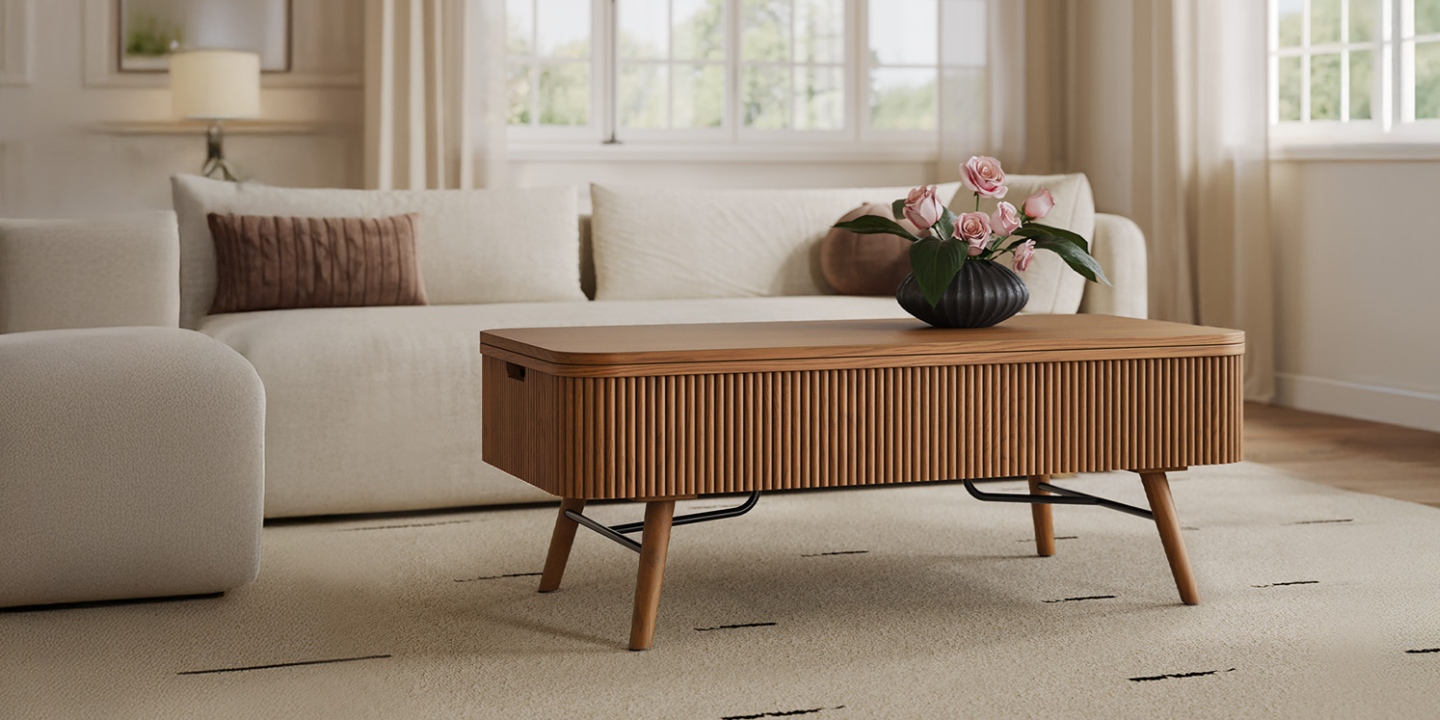
Storage is the quiet hero here, and it is one reason lift-top designs can work especially well in busy living rooms. The Magnus 47" Lift-Top Oak Coffee Table hides remotes, chargers, and magazines inside its lift-top compartment and drawer, so the top can stay clear for the styled pieces and everyday items can disappear underneath.
For a living room where the coffee table doubles as a work surface or dinner tray, hidden storage lets the decor stay put instead of getting cleared every evening.
The rule is simple: style the top, but design the table so the mess has a home. A beautiful tray helps, and built-in storage helps even more. Together, they mean you do not have to choose between a table that looks good and one that works.
Coffee Table Decor Ideas by Table Size
The amount of decor you need depends partly on the size of the surface. A small table can look crowded with the same arrangement that feels balanced on a larger one.
Small Coffee Tables
Small coffee tables need restraint. Start with three pieces: a low tray or book stack, one organic element, and one small personal or decorative object.
Avoid trying to recreate a large-table arrangement on a small surface. A tall vase, oversized tray, and multiple book stacks can quickly turn the table into an obstacle course.
The goal is not to fill the surface. It is to give the eye one interesting grouping while preserving enough room for everyday use.
Medium Coffee Tables
A 40- to 48-inch coffee table gives you enough space for three to five objects without making the arrangement feel sparse.
Start with one anchor, then add a book stack, a taller object, and one organic or personal element. If the surface still feels empty, add one low accent rather than several tiny objects.
This is the easiest size for the five-layer formula because there is enough room to create visual variety without needing multiple large groupings.
Large Coffee Tables
Large coffee tables can support more than one visual zone, but that does not mean every inch needs decoration.
Instead, think horizontally. Put a book stack or tray toward one end, a low bowl or plant closer to the middle, and a small decorative piece toward the other side. Leave gaps between the zones so the arrangement does not become one oversized cluster.
The larger the table, the more important scale becomes. A single tiny candle on a six-foot table will look lost, while several oversized objects can make the room feel heavy.
Styling a Round Coffee Table Versus a Rectangular One
Table shape decides the layout more than most people expect. The same objects placed the same way can look right on one shape and wrong on another.
Round tables want a soft, radial feel. Put the arrangement in one quadrant rather than directly in the middle so the eye can travel around the curve. A round tray echoes the shape and keeps the group from looking like it landed there by accident.
On a small round table, one stack of books, one plant, and one bowl is plenty.
Rectangular tables read best as a story across the length. Split them into two or three zones: a book stack at one end, the tray-and-decor cluster near the middle, and a low plant or candle at the other end. Each zone stands alone, and the gaps between them are part of the design.
For smaller living rooms, a round lift-top can also be practical because the curved edge is easy to walk around. The Magnus 39" Oak Round Lift-Top Coffee Table combines a 39-inch round surface with lift-top functionality and perimeter storage, making it a useful option when every inch of surface needs to work.
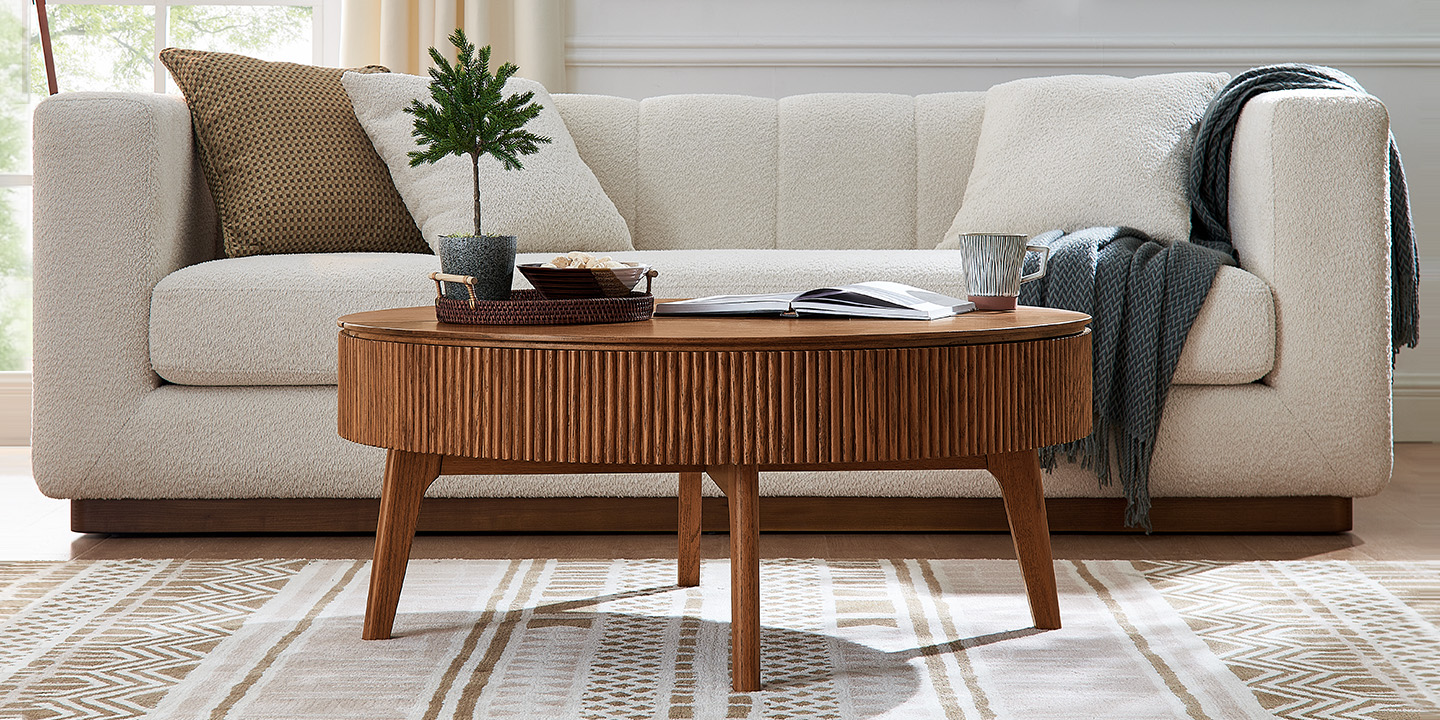
Vary the Height and Group in Odd Numbers
Three small principles fix most tables that feel "off" without anyone knowing why: height, grouping, and space.
Vary the Height
When every object sits at the same level, the table reads like inventory on a shelf. Build three distinct heights: low, medium, and tall.
The tray or bowl provides the low level. The book stack creates the middle. The vase, candlestick, or other vertical object provides the peak.
The difference does not have to be dramatic. The goal is simply to give the eye somewhere to move rather than presenting everything along one flat line.
Group in Odd Numbers
Three or five objects often feel more relaxed and less symmetrical than evenly matched pairs. That makes odd-numbered groupings an easy styling shortcut.
Inside a tray, aim for three to five elements, counting a book stack as one visual unit. The important thing is not the number itself but whether the pieces read as one intentional group.
Leave Negative Space
Negative space is not empty failure. It is the resting place for the eye and the practical space where real life happens.
Leave at least a third of the surface open, and on a small table leave closer to half. A table with breathing room looks intentional. A table packed edge to edge looks like the drawer exploded.
Step back and look at the whole arrangement. If it feels busy, remove the two smallest objects before adding anything else.
Mix Materials So the Table Doesn't Read as a Catalog
A table styled in one material can look flat even when every piece is attractive. The fix is contrast: pair smooth ceramic with rough wood, glass with woven fiber, or metal with stone.
Aim for at least two, and preferably three, different material textures in the arrangement.
Oak is a forgiving base because it sits well next to almost everything. Warm wood works with ceramic, glass, woven fiber, stone, and metal without demanding that every accessory match it.
Glass adds shine without visual weight. A clear vase or small glass object can lift the arrangement. Metal, even a small brass catchall, adds a point of reflection. Stone or ceramic grounds it. Woven fiber, such as a rattan tray or coiled bowl, warms a room that runs cool.
You do not need one of everything. You need enough contrast that the table feels collected from a real home rather than ordered as a matching set.
Match the Decor to the Room You Already Have
The objects on the table should look like they belong to the same room as the sofa, not like they were dropped in from another house. Pull color and material cues from nearby furniture and you almost cannot go wrong.
Modern and Mid-Century
Keep it spare. One or two objects, a single stem in a simple vase, and a matte tray are enough. Clean lines and a limited palette work particularly well.
The Magnus oak tables fit this direction naturally because their fluted and tapered-leg silhouettes have a mid-century feel. Add a low ceramic bowl and a small succulent and stop before the surface starts feeling busy.
Coastal and Farmhouse
Natural texture carries these looks. Try a woven tray, a linen-bound book stack, white or blue ceramics, and dried coastal grasses or eucalyptus.
Warmth usually works better than shine. A chunky pillar candle in an earthy tone can feel more at home than a highly polished brass accent.
Japandi and Minimal
Restraint is the whole point. One ceramic object, one small plant, and one smooth stone can be enough.
If you are tempted to add a fourth decorative object, step back first. The empty space is part of the style.
For other room styles, the shortcut is the same: pick one color or material from the sofa, rug, or nearby furniture and repeat it in the books, vase, tray, or another small accent. Repetition helps a mix look chosen rather than random.
What to Put in the Middle of Your Coffee Table
This is one of the most common coffee table styling questions, and the honest answer is usually: not a tall centerpiece.
For a rectangular table, resist the urge to build a pyramid directly in the middle. Center piles can look staged and may block the view across the table when you are seated.
Instead, put the main cluster slightly off center, or split the surface into zones so the true middle stays available for a drink.
If you want something in the middle, make it low: a shallow bowl with a few stones, a small tray with coasters, or a single coffee-table book lying flat with a small object on top.
For a round table, the middle can hold a low bowl or compact arrangement, but an off-center placement often leaves the curve feeling more open.
The one thing to avoid in the middle is anything tall. A tall vase or lantern can turn the table into a visual wall between two sofas. Save the height for the side of the arrangement where it frames the room instead of cutting it in half.
Common Mistakes to Avoid When Decorating a Coffee Table
We have shot enough tables to know the same few errors show up again and again. Skip these and your table will look styled instead of stuffed.
Too many small items. One candle, one tiny vase, one little bowl, and one bead garland may each be fine alone. Together, they make the eye jump. Choose fewer, more substantial pieces.
Decor that is too tall. A dramatic arrangement belongs on a dining table more often than a coffee table. Tall pieces can block conversation and make the room feel heavy. Keep the tallest object under about 12 inches, or lower if the table sits between facing seats.
No negative space. Every inch does not need decor. Leave a third to a half of the surface open. It is the fastest fix for a cluttered arrangement.
Everything matches perfectly. A full matching set from one store can read flat and predictable. Real homes gather things over time. Mix a found stone with a favorite candle and a book you actually read.
Ignoring scale. A tiny candle alone on a large square table looks lost. Oversized pieces can swamp a small table. Match the size of the decor to the size of the table.
Forgetting the table surface itself. The table is the first object in the composition, not just a shelf. A busy grain or heavily veined top wants quieter objects. A clean, uniform surface can take a bolder piece.
Fake plants done badly. One real stem or intentional dried branch often looks better than a collection of artificial greenery. If living plants are impossible, commit to dried material so the look feels deliberate.
Refresh the Table Seasonally Without a Full Restyle
You do not need to redo the whole table four times a year. The structure can stay while the accents rotate.
Keep the anchor, books, and signature vessel in place for months. Swap the organic layer more often because flowers and greenery change quickly.
Spring and summer can use lighter touches such as a small succulent, fresh stems, or a white or terracotta candle. Fall and winter can handle more visual weight with dried botanicals, amber glass, chunky candles, or deeper tones.
One small change every few weeks is enough to keep the table from fading into the background. The permanent pieces create continuity; the seasonal accents make the room feel current.
This also keeps the table from looking like a display that never changes. A coffee table should show some evidence that someone actually lives around it.
The 60-Second Coffee Table Styling Checklist
Before you call it done, sit on the sofa and run through these questions:
Is there one clear anchor set slightly off center?
Are there roughly three to five objects on a standard-size table?
Can I see three different heights?
Are at least two materials or textures represented?
Is there something organic or natural on the surface?
Is there one personal piece that means something to me?
Is at least a third of the table left open?
Can I see comfortably across the table?
Does the remote, mail, or everyday clutter have a home?
Could I set down a coffee mug without moving the decor?
If most of those answers are yes, the table is doing its job. It looks considered without becoming fragile, and it gives the room a finished feeling without taking away the reason you have a coffee table in the first place.
Browse more shapes and sizes in our coffee table collection when the surface itself is ready for an upgrade.
FAQs
What can I put in the middle of my coffee table?
Keep the center low and practical. A shallow bowl, small tray of coasters, or coffee-table book with a small object on top can work well. On a rectangular table, placing the main cluster slightly off center usually leaves more usable space. Avoid tall pieces that block the view across the room.
How do you style a coffee table without a tray?
Use a book stack or low bowl as the anchor and group the remaining pieces around it with visible gaps. Because there is no tray to visually corral smaller objects, use fewer pieces and make their placement more deliberate.
How many items should go on a coffee table?
For a standard 40- to 48-inch coffee table, three to five visual objects are a good starting point. Small tables usually need fewer, while large tables can support two or three separate zones. The surface should still have at least one-third open for everyday use.
What should I put on a round coffee table versus a rectangular one?
Round tables generally work well with one compact, off-center cluster and curved or low pieces such as a round tray or bowl. Rectangular tables can be divided into two or three zones along the length. Square tables can handle balanced corners, while oval tables suit longer, lower arrangements.
How do I match coffee table decor to my living room style?
Pull one or two colors, materials, or textures from nearby furniture and repeat them on the table. Modern and mid-century rooms tend to work best with fewer clean-lined pieces. Coastal and farmhouse rooms suit natural textures, while Japandi and minimal spaces benefit from restraint and generous negative space.
What's the best way to style a coffee table on a budget?
Shop your own home first. Two hardcover books, a bowl, a candle, and a stem from the yard can create a complete arrangement without buying anything new. Thrift stores are also useful for ceramic vessels, trays, and framed pieces. The composition matters more than the price.
How often should I refresh my coffee table decor?
Keep the main anchor and books in place for months, then rotate flowers, greenery, and smaller accents every few weeks or with the seasons. You do not need a complete restyle. Small changes are enough to keep the arrangement feeling fresh.