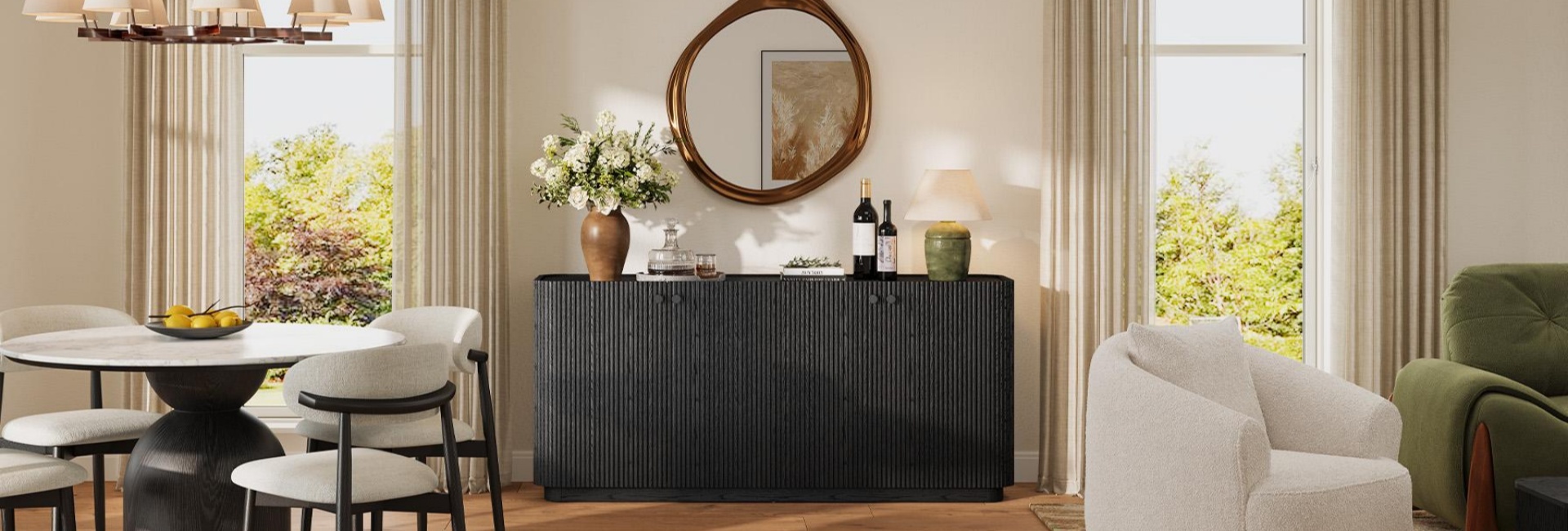
Choosing an oak sideboard involves several practical considerations: how the cabinet is constructed, whether its storage layout suits your belongings, how it fits your room, and what care its finish requires. Oak is a durable hardwood commonly used in dining room furniture, but the wood species alone does not determine how well a sideboard will hold up over time.
Furniture listings also use terms such as solid oak, oak veneer, and oak-effect to describe different materials. Understanding these labels can help you compare construction quality and choose a piece that meets your storage needs. This guide covers the main differences, along with sizing, design, placement, and maintenance.
Table of Contents
- Why Choose an Oak Sideboard?
- Solid Oak vs. Oak Veneer vs. Oak-Look
- Construction Details to Check
- How to Choose the Right Sideboard Size
- Choosing the Right Storage Layout
- Oak Sideboard Styles and Finishes
- Where to Place an Oak Sideboard
- How to Care for an Oak Sideboard
- What to Check Before Buying an Oak Sideboard
- Final Thoughts
- FAQs
- Is a solid oak sideboard worth the money?
- How can I tell if a sideboard is real solid oak or veneer?
- What size should an oak sideboard be for a dining room?
- Are drawers or cabinets better in a sideboard?
- Is oak veneer furniture cheap or bad quality?
- How do I clean and maintain an oak sideboard?
- Will an oak sideboard warp or crack over time?
- Can I use a sideboard as a TV stand?
- How long does an oak sideboard last?
Why Choose an Oak Sideboard?
Oak is a dense hardwood that holds up well to everyday use. Its strength and natural resistance to wear make it a common choice for dining tables, cabinets, and other frequently used furniture. Solid oak can also be sanded and refinished, depending on its thickness and finish, which can help extend the useful life of a piece.
Oak offers several grain patterns and color variations. White oak generally has cooler, lighter tones and a tighter-looking grain, while red oak tends to have warmer, rosier tones and more pronounced grain patterns. Quarter-sawn oak can display distinctive medullary ray patterns, which are often associated with traditional and Arts and Crafts furniture.
These differences make oak suitable for a range of interiors. A modern oak sideboard may have clean lines and a light finish, while a farmhouse design may emphasize visible grain, knots, and a more substantial shape.
One practical consideration is weight. Solid oak furniture can be heavy, especially in larger sizes. Before ordering a 72-inch sideboard or another wide cabinet, check the delivery dimensions and make sure it can pass through your doorways, hallways, and staircases.
Solid Oak vs. Oak Veneer vs. Oak-Look
Product listings use different material descriptions, and they do not always mean the same thing. Understanding the differences between solid oak, oak veneer, and oak-look finishes helps you evaluate what you are buying.
What Does Solid Oak Mean?
Solid oak refers to components made from oak lumber rather than a thin oak surface bonded to another material. However, a listing that says "solid oak construction" does not necessarily mean every part of the furniture is made from solid timber.
A sideboard may use solid oak for its frame, legs, doors, and drawer fronts while using engineered wood with oak veneer for the back panel, drawer bottoms, or large flat sections. This combination can be practical because wide solid-wood panels are more susceptible to movement as humidity changes.
When comparing products, check the material breakdown to see which components are solid oak and which use engineered wood or veneer.
When Is Oak Veneer a Good Choice?
Oak veneer is a thin layer of real oak bonded to a core material, such as plywood, MDF, or particleboard. It provides the appearance of natural oak grain while allowing manufacturers to use engineered panels for larger surfaces.
Veneer can be a practical option for side panels, shelves, and other wide sections because the core material may be less prone to movement than a solid wood panel. Its main limitation is that the oak surface is relatively thin. Deep scratches or gouges may be difficult to repair without damaging the veneer.
The quality of the core material and the way the veneer is applied both matter. Veneer over quality plywood or MDF can be a suitable furniture construction method, while poorly sealed edges may allow moisture to reach the core.
What Is Oak-Effect Furniture?
Oak-effect furniture imitates the appearance of oak using printed paper, film, or another decorative surface. Unlike solid oak or real oak veneer, it does not contain a natural oak surface.
Oak-effect finishes can provide a similar visual style at a lower price point, but they generally offer fewer repair options if the surface becomes damaged. If you specifically want real oak grain, check the product's material description rather than relying on the appearance in photographs.
How to Identify Solid Oak and Veneer
If you can inspect a sideboard in person, look at the grain and edges. On solid oak components, the grain may continue around an edge, and the end grain can reveal the wood's growth-ring structure. Veneered panels may have visible edge banding or seams where the veneer meets another surface.
Grain patterns alone are not a reliable way to identify every construction method. Veneer can be matched carefully, and some solid-wood components may have different grain patterns. The manufacturer's material breakdown is the best starting point.
Construction Details to Check
The type of wood is only one part of a sideboard's construction. Drawer joints, hardware, panel design, and finishing also affect how the cabinet performs during everyday use.
When comparing an oak sideboard, pay attention to these details:
-
Dovetail drawers. Dovetail joints have interlocking pins and tails at the drawer corners. They are commonly used in quality drawer construction. Check that the joints fit tightly and that the drawer moves smoothly on its runners.
-
Soft-close hardware. Soft-close hinges and drawer glides help doors and drawers close more gently. Test them if you can, and check that the doors sit evenly when closed.
-
Wood drying. Oak changes size as its moisture content changes. Proper drying before furniture production helps reduce moisture-related movement. Ask the manufacturer about its wood-drying process if this information is not listed.
-
Frame-and-panel doors. A floating panel within a frame allows for some natural wood movement. This construction is often used in solid-wood doors to help manage seasonal expansion and contraction.
-
Stability and weight. A sideboard should sit level without rocking. Check that the legs and frame feel stable and that drawers open without causing the cabinet to shift.
The finish also deserves attention. Brushed, glazed, and lacquered finishes create different appearances and maintenance requirements. Look for an even finish with no obvious rough patches, peeling edges, or inconsistent coverage. If possible, ask whether the manufacturer offers care instructions or a recommended product for minor touch-ups.
How to Choose the Right Sideboard Size
A sideboard should provide enough storage without making the dining room or living area difficult to move around. Before choosing a style, measure the available wall space, nearby furniture, and walking paths.
Width: Consider the Dining Table and Wall
One starting point is to choose a sideboard around half to three-quarters the length of your dining table. For example, a 72-inch dining table may pair well with a sideboard around 48 to 60 inches wide. Longer tables may have room for a wider cabinet, depending on the layout.
This is a general design guideline rather than a fixed rule. The available wall space and the proportions of the room matter just as much. Leave some space around the cabinet so it does not look crowded against adjacent furniture or walls.
Height and Depth
Many sideboards are around 30 to 36 inches tall and 14 to 18 inches deep, although dimensions vary by design. A cabinet in this height range can provide a convenient surface for serving dishes, lamps, or decorative items.
Depth is particularly important in smaller rooms. A deeper sideboard may reduce the available walkway, while a shallower cabinet may limit the size of items you can store. Compare the interior depth with your plates, serving dishes, and other belongings before ordering.
Clearance and the Tape Test
A clearance of around 36 inches in front of a sideboard is a useful planning target for walking space and access. In tighter rooms, less space may be workable, depending on how often the doors and drawers are used.
To check the layout, mark the sideboard's footprint on the floor with masking tape. Open nearby doors and drawers, pull out dining chairs, and walk through the space. Remember to account for skirting boards, radiator valves, and door swings.
Also measure the delivery route. Compare the packaged dimensions with the narrowest doorway, hallway, and staircase along the path. This is particularly important for large solid oak furniture, which can be difficult to maneuver in tight spaces.
Choosing the Right Storage Layout
Two sideboards with similar exterior dimensions can offer very different storage capacity. Before choosing a design, consider what you plan to store and how frequently you need to access it.
Adjustable shelves can make an oak sideboard more flexible, especially if you store items of different heights. Check how many shelf positions are available and whether the shelves can accommodate your larger belongings.
Interior dimensions are just as important as exterior measurements. Measure your largest regular-use items, including handles and lids, and compare them with the shelf clearance. This helps prevent situations where plates, serving platters, or bottles do not fit as expected.
For example, the Skugga 72-Inch Oak Sideboard offers multiple adjustable shelves behind its doors, making it suitable for storing tableware, glassware, and taller items. Its solid oak legs, fluted detailing, and hammered brass pulls add texture to the design. The cabinet combines American solid oak with engineered wood and oak veneers.

Skugga 72-Inch Oak Sideboard
View Product
Oak Sideboard Styles and Finishes
Oak sideboards are available in different designs, from simple flat-front cabinets to more decorative pieces. The door treatment, hardware, and finish all influence how the furniture looks in a room.
Fluted and sculpted fronts add texture through raised or recessed patterns. Vertical fluting creates a more detailed surface, while wave-inspired designs introduce curved lines. The Skimra 72-Inch Oak Sideboard features wave-inspired fluting made from solid oak, a warm brown finish, and adjustable shelves. Its textured front can work well in rooms where the sideboard also serves as a decorative focal point. Like the Skugga, it combines American solid oak with engineered wood and oak veneers.
Clean-line modern designs use flat doors, minimal hardware, and simpler silhouettes. Light oak finishes can complement open-plan spaces, neutral upholstery, glass, and metal accents. This style keeps the cabinet's grain visible without adding too much surface detail.
Farmhouse and rustic designs often feature visible grain, knots, aged finishes, and substantial shapes. These details can complement natural materials, textured fabrics, and traditional dining furniture.
Traditional designs may include frame-and-panel doors, decorative molding, and darker stains. Quarter-sawn oak, with its distinctive medullary ray patterns, is often used in furniture with a more traditional appearance.
Finish selection also affects the overall look. Natural and light finishes tend to show the grain clearly, while darker stains create a deeper color. Oak can look different under warm and cool lighting, so consider the room's flooring, wall color, and natural light before choosing a finish. If color accuracy is important, request a sample or review product photographs taken in different lighting conditions.

Skimra 72-Inch Oak Sideboard
View Product
Where to Place an Oak Sideboard
The dining room is the traditional place for a sideboard. A cabinet beside or opposite the dining table can store dishes, linens, and serving accessories, while its top provides space for serving food during gatherings. Make sure there is enough clearance for dining chairs and people moving around the table.
An oak sideboard can also work in a living room. A closed-door cabinet provides storage for accessories, books, and other household items. Some sideboards can also be used as TV stands, but check the cabinet's width, weight capacity, height, and cable access before placing a television on top. Closed storage may need ventilation if it contains electronic equipment.
In an entryway, a sideboard can hold keys, mail, bags, and other everyday items. A lamp or tray on top can make the surface more useful without taking up additional floor space.
A sideboard can also serve as storage in a home office. Choose a layout with enough shelf or drawer space for documents, office supplies, and equipment, and check that the cabinet fits comfortably behind or beside the desk.
How to Care for an Oak Sideboard
The right care routine depends on the finish, but a few basic habits can help keep an oak sideboard in good condition.
Dust the surface with a soft, dry microfiber cloth. For smudges, use a slightly damp cloth if permitted by the manufacturer's care instructions, then dry the surface promptly. Blot spills rather than scrubbing, and avoid leaving standing water on the cabinet.
Cleaning products should match the finish. Many lacquered surfaces can be cleaned with a soft cloth, while oiled finishes may need occasional reapplication of a recommended maintenance oil. Follow the manufacturer's instructions rather than using the same cleaning products on every type of finish.
Placement also matters. Prolonged direct sunlight can cause some finishes to fade or change color. Position the sideboard away from radiators and heating vents where possible, as changes in temperature and humidity can contribute to wood movement over time.
Use coasters and trivets to protect the surface from moisture and heat. Avoid abrasive pads and harsh cleaning products unless the manufacturer specifically recommends them.
What to Check Before Buying an Oak Sideboard
Before ordering, review the product specifications and compare them with your room and storage needs.
-
Construction breakdown: Check which parts are solid oak, which use oak veneer, and whether any components use oak-effect materials.
-
Wood drying: Look for information about the manufacturer's wood-drying and construction processes.
-
Drawer and door hardware: Check the drawer joints, hinges, and glides. If possible, test how smoothly the doors and drawers operate.
-
Exterior and interior dimensions: Compare the overall width, height, and depth with your available space and the items you plan to store.
-
Delivery route: Check the packaged dimensions against your narrowest doorway, hallway, and staircase.
-
Warranty and returns: Review the warranty period, what it covers, and whether return shipping or restocking fees apply.
-
Finish and color: Check product photographs, finish descriptions, or samples to understand how the oak may look in your room.
Final Thoughts
An oak sideboard can be a practical long-term furniture choice when its construction, storage layout, and dimensions suit your needs. Solid oak, oak veneer, and engineered wood each have different characteristics, so look beyond the product title and check the material breakdown. Consider the drawer and door hardware, measure the interior storage space, and choose a finish that fits your room and maintenance preferences.
FAQs
Is a solid oak sideboard worth the money?
A solid oak sideboard can be worth considering if you want durable hardwood furniture that can be maintained and refinished. However, a well-built cabinet that combines solid oak components with oak veneer over a stable core can also be a practical choice. Compare the construction details, hardware, and finish rather than judging quality by the solid oak label alone.
How can I tell if a sideboard is real solid oak or veneer?
Start with the product's material breakdown. Solid oak components are made from oak lumber, while veneer uses a thin layer of real oak bonded to a core material. Grain patterns and visible edges can offer clues, but they are not always conclusive. The manufacturer's specifications are the most reliable starting point.
What size should an oak sideboard be for a dining room?
One general guideline is to choose a sideboard around half to three-quarters the length of your dining table. Many sideboards are approximately 30 to 36 inches tall and 14 to 18 inches deep, but the right dimensions depend on your room and storage needs. Leave enough clearance for doors, drawers, and people to move around comfortably.
Are drawers or cabinets better in a sideboard?
They serve different purposes. Drawers are useful for cutlery, linens, and smaller items, while cupboards with shelves provide space for plates, serving dishes, and larger belongings. A combination of drawers and cabinets can offer more flexible storage. Check the internal dimensions before buying.
Is oak veneer furniture cheap or bad quality?
Not necessarily. Oak veneer is real oak applied as a thin surface layer over a core material such as plywood or MDF. It can be a practical option for large panels, where an engineered core may help reduce movement. Quality depends on the core material, veneer application, edge sealing, and overall construction.
How do I clean and maintain an oak sideboard?
Dust with a soft, dry cloth and wipe spills promptly. Use cleaning products suitable for the finish, and follow the manufacturer's instructions for lacquered, glazed, or oiled surfaces. Avoid abrasive pads and harsh chemicals unless they are specifically recommended. Coasters and trivets can also help protect the surface from moisture and heat.
Will an oak sideboard warp or crack over time?
Oak can expand and contract as humidity changes, so some movement is natural. Properly dried wood, suitable construction methods, and a stable indoor environment can help reduce the risk of excessive movement. Avoid placing the cabinet close to heat sources or in areas with significant humidity fluctuations.
Can I use a sideboard as a TV stand?
Yes, if its dimensions and construction are suitable for your television. Compare the cabinet's width and weight capacity with your TV's dimensions and stand placement. Also check the viewing height, cable access, and ventilation if you plan to store electronic equipment inside the cabinet.
How long does an oak sideboard last?
A well-built oak sideboard can serve a household for many years, but its lifespan depends on the materials, construction, finish, usage, and care. Solid oak components can often be sanded and refinished when the surface becomes worn, although the options depend on the finish and the amount of wood available.