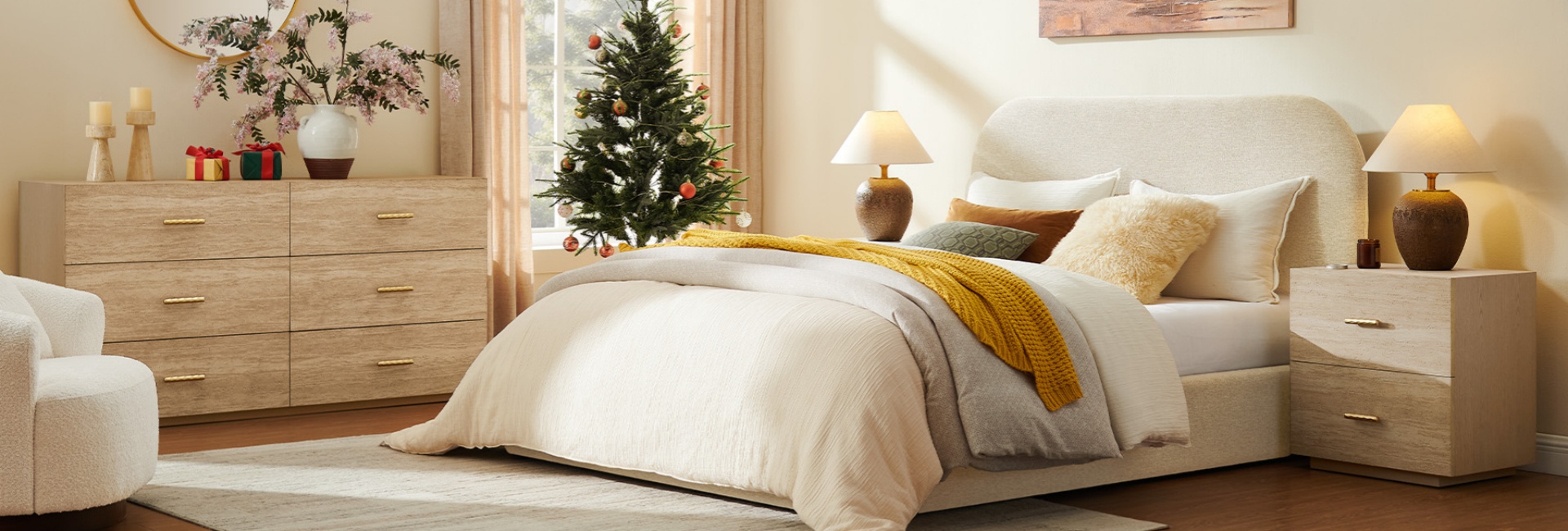
A modern dresser is a practical bedroom essential: a low, wide chest of drawers with clean lines, useful storage, and a finish that feels current. If you're choosing one for your bedroom, start with the room and your daily routine, then narrow down the style. Get the width, drawer layout, and construction right first, and the design becomes much easier to choose.
Most dresser-buying regrets come down to two things: poor fit and poor construction. A dresser can look perfect online and still overwhelm the wall, block a walkway, or leave you wishing for a different drawer layout. This guide focuses on the measurements, storage, materials, style, and safety details worth checking before you buy.
Quick answer: Choose a modern dresser by working through four things in order: available wall space, storage needs, construction quality, and style. For most bedrooms, aim for about 36 inches of clear space in front of the dresser, then choose a drawer layout that matches what you actually store.
Table of Contents
- Start With the Room, Not the Catalog
- How Many Drawers Do You Actually Need?
- Tall Chest or Wide Dresser: Matching Shape to Your Wall
- Picking a Style: Modern, Mid-Century, and Contemporary
- Wood, Veneer, and Finish: What Holds Up?
- Sizing Up: Dressers for Primary and Larger Bedrooms
- Safety, Stability, and Where to Put the Heavy Items
- A Quick Pre-Buy Checklist
- FAQs
- How do I choose a modern dresser for my bedroom?
- What size dresser is best for a bedroom?
- How many drawers should a bedroom dresser have?
- How do I keep a dresser from tipping over?
- Are engineered wood dressers bad for quality?
- What color dresser makes a small bedroom look bigger?
- Should a dresser match the bed and other bedroom furniture?
Start With the Room, Not the Catalog
The first step in choosing a modern dresser is measuring the space where it will actually live. A dresser has to fit between walls, doors, closets, beds, and walking paths, so the available space is usually smaller than it looks in a product photo.
Measure the wall and the open-drawer path
Start with three measurements.
First, measure the wall where the dresser will sit. Leave some breathing room at the sides rather than filling the entire wall from trim to trim.
Second, measure the available depth from the wall toward the bed or walkway. Remember that the dresser's closed depth is not the same as the space you'll need to use it.
Third, measure the open-drawer path. A dresser drawer extends beyond the closed cabinet when opened, so you need enough clear floor space for the drawer and for the person using it. The amount of space required varies by drawer depth and dresser design, so check the product's actual dimensions before ordering.
How much clearance does a dresser need?
A practical target is about 36 inches of clear space in front of a dresser. That gives the drawers room to open while leaving enough standing space for everyday use. A tighter bedroom may require less, while a larger room can benefit from 42 to 48 inches for a more comfortable walkway.
The exact clearance depends on the dresser's drawer depth and the room layout, so measure the open position rather than relying only on the product's closed depth.
Don't forget the doorway and delivery path
A dresser can fit perfectly against the bedroom wall and still create a delivery problem.
Measure the bedroom door, interior doorways, hallway turns, stair landings, and other narrow points along the delivery route. For a wide dresser, also consider whether the boxed piece can rotate through a corner.
Before ordering, mark the dresser's approximate footprint on the floor with painter's tape. It gives you a much better sense of how the piece will affect the room than looking at its dimensions on a product page.
How Many Drawers Do You Actually Need?
Drawer count is useful, but it shouldn't be the only number you look at. The right modern dresser depends on what you store, how much closet space you have, and whether the dresser is for one person or a shared bedroom.
As a starting point, five or six drawers can work well for one person's everyday folded clothing when most of the wardrobe stays in a closet. Seven to nine drawers provide more divided storage for couples, larger wardrobes, or bedrooms where the dresser carries a bigger share of the clothing.
Match drawers to what you wear
Don't just count drawers; count categories.
Small daily items such as socks, underwear, and accessories are easier to organize in shallower top drawers. Folded shirts and jeans generally need more usable width and depth. Sweaters, bedding, and off-season clothing can benefit from deeper lower drawers.
The goal is to give frequently used categories their own space instead of putting everything into the same large drawer.
Seven, eight, or nine drawers?
More drawers aren't automatically better. A nine-drawer dresser can be useful when several people share the storage, but it can also take up substantially more wall space.
Before choosing a larger dresser, consider whether you'll actually use the additional drawers. If your closet already handles most of your wardrobe, a seven-drawer dresser with a more compact footprint may be enough.
For shoppers comparing options, the Hernest dresser collection includes different drawer configurations, allowing you to compare storage capacity against the dimensions of your room.
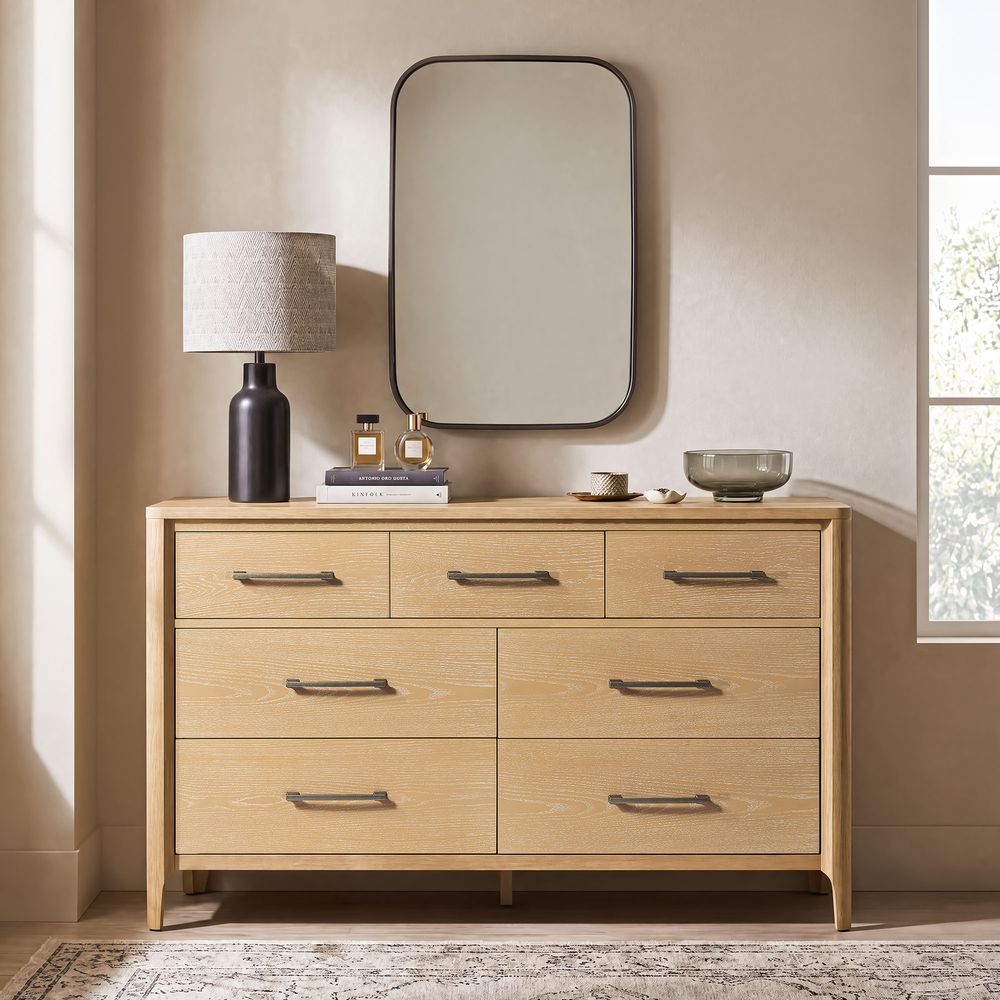
Harold 64-Inch 7-Drawer Dresser
View Product
Tall Chest or Wide Dresser: Matching Shape to Your Wall
Most bedroom dressers fall into two broad shapes: a wide, low dresser with multiple columns of drawers and a taller chest that uses vertical space.
When a vertical chest makes sense
A tall chest can be useful when floor space is limited. By stacking storage upward, it can provide substantial capacity without occupying as much wall width as a wide double dresser.
The trade-off is the smaller top surface. You may have less room for a lamp, mirror, tray, or decorative objects.
For a guest room, apartment, nursery, or compact bedroom, the vertical footprint can make a meaningful difference to the walking path.
When a wide double dresser makes sense
A wide dresser works well when you have a longer wall and need more accessible storage. Two columns of drawers can make it easier to divide clothing between people or categories, while the larger top provides useful surface space.
Many wide dressers fall somewhere around 60 to 84 inches in width, although actual dimensions vary considerably by drawer count and design. Don't choose a width simply because it looks good in a product photo. Compare the dresser's actual dimensions with your wall and the clearance around your bed.
For a more detailed look at common dresser dimensions and how to measure your space, see our guide to average dresser size.
Picking a Style: Modern, Mid-Century, and Contemporary
The word "modern" can refer to a range of clean, current furniture designs. In furniture shopping, modern, contemporary, and mid-century modern can overlap, but they usually point to different visual characteristics.
A modern dresser generally emphasizes clean geometry, restrained detailing, practical storage, and finishes that keep the overall piece visually simple.
Contemporary dressers tend to reflect current design trends. You may see fluted fronts, matte finishes, mixed materials, stone-look textures, or more distinctive hardware.
Mid-century modern dressers draw inspiration from furniture design of the 1950s and 1960s. Tapered legs, warm wood finishes, simple drawer fronts, and understated hardware are common visual cues.
The best way to compare these styles is to focus on the actual design details rather than relying on the label alone.
Mid-century cues that still feel current
Tapered legs can visually lift a dresser off the floor, which can help a smaller room feel less visually heavy. Warm wood tones also work well with neutral bedding, natural textures, and contemporary lighting.
For a bedroom that already leans toward mid-century design, the Kaden 55-Inch Mid-Century 7-Drawer Dresser is a useful example. Its tapered solid-wood legs and brown cherry finish create the characteristic warmth of the style, while seven dovetail-jointed drawers provide practical storage. Beveled edges and antique bronze pulls add detail without making the piece look overly decorative.
Contemporary finishes and hardware
Contemporary dressers are where you'll find some of the most noticeable current design details, including fluted drawer fronts, matte surfaces, stone-look finishes, and metal accents.
A good approach is to choose one strong visual feature rather than combining several competing trends. A fluted front or textured finish can provide enough visual interest on its own.
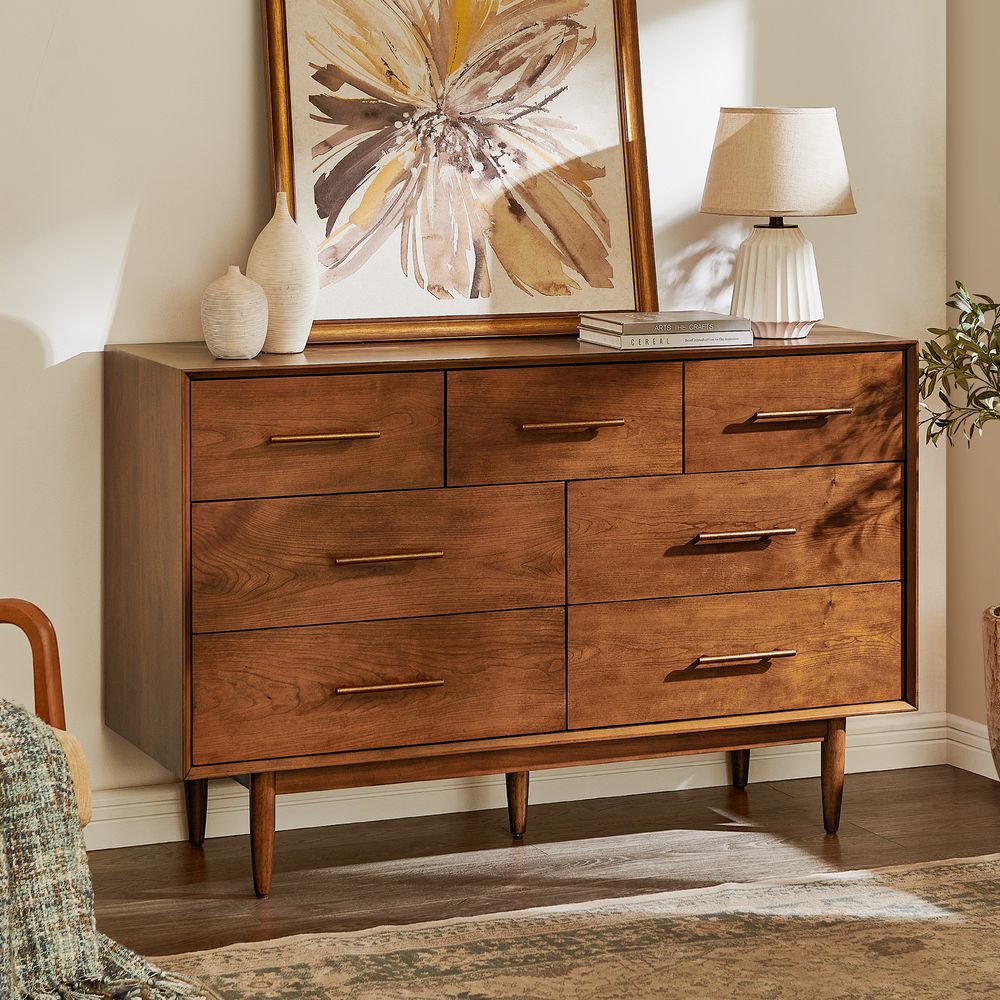
Kaden 55-Inch Mid-Century 7-Drawer Dresser
View Product
Wood, Veneer, and Finish: What Holds Up?
The word "wood" does not tell you everything about how a dresser is constructed. When comparing modern dressers, look beyond the surface and check the materials used for the frame, panels, drawer boxes, legs, and other high-use components.
Solid wood such as oak, maple, cherry, or rubberwood can provide strength and a natural appearance. Engineered wood, plywood, and MDF also have legitimate uses in furniture construction, particularly for panels and wide sections where dimensional stability matters.
Veneer is a thin layer of real wood applied over a core material. A quality wood veneer over plywood or another stable core can provide a durable surface and stable construction. Veneer over particleboard can also vary significantly in performance depending on the panel quality, edge treatment, hardware, and overall construction.
The important question is not simply whether a dresser is "solid wood." Look at what sits underneath the surface and how the components are joined together.
Why kiln-dried wood and dovetail joints matter
Two construction details are worth paying attention to: kiln-dried wood and dovetail drawer joints.
Kiln-dried wood has been intentionally dried to reduce moisture content before manufacturing. Properly dried wood can help reduce the risk of excessive movement as household humidity changes.
Dovetail joints mechanically interlock the drawer sides and front. This creates a stronger connection than a simple butt joint and can help the drawer withstand repeated opening and closing.
The Harold 64-Inch 7-Drawer Dresser illustrates this combination. It uses rubberwood and engineered wood with American oak veneers, along with kiln-dried construction and dovetail drawer joints. These are useful specifications to look for when comparing dressers intended for everyday use.
Reading a finish: cerused oak and wire-brushed grain
Finish affects more than color. A cerused or limed oak finish emphasizes the grain with a lighter treatment, while wire-brushing creates additional texture by bringing the natural grain pattern forward.
These finishes can add visual depth without relying on a glossy or heavily decorative surface. They're especially useful when you want a wood dresser to provide texture while keeping the overall bedroom relatively calm.
The Harold's light brown cerused oak finish and wire-brushed grain are examples of how texture can become part of the design rather than simply changing the color.
One additional material consideration is formaldehyde emissions from certain composite wood products. In the U.S., the EPA regulates formaldehyde emissions from hardwood plywood, medium-density fiberboard, and particleboard under its composite wood products standards. When this matters to you, check the manufacturer's compliance information and product documentation rather than relying on smell or appearance alone.
Sizing Up: Dressers for Primary and Larger Bedrooms
Once you've measured the room and determined your storage needs, you can start thinking about how large the dresser should be.
A typical horizontal dresser may be around 50 to 60 inches wide, 18 to 20 inches deep, and 30 to 36 inches tall, but there is no universal standard. Double dressers and larger storage pieces can extend to 72, 80, or 84 inches and beyond.
The right size depends on the wall, the surrounding furniture, and how much storage you actually need.
The statement piece: stone-look and travertine texture
A large dresser can become one of the main visual anchors in a primary bedroom. If you have enough wall space, a textured finish can add interest without requiring additional decorative pieces.
Stone-look and travertine-inspired finishes are one contemporary option. They bring the visual character of natural stone into the room while keeping the dresser lighter and more practical than a solid stone construction.
The Renata 80-Inch Travertine-Textured 9-Drawer Dresser is designed for this type of larger bedroom. Its 80-inch width provides substantial storage, while nine dovetail drawers and soft-close rails support everyday use. The brass-toned hammered hardware adds contrast to the textured surface.
Because of its size, a dresser like this needs a long wall and enough clearance in front of it. Measure those two things before considering the finish or hardware.
Balance a wide dresser with the rest of the room
A wide dresser carries a lot of visual weight, so balance it with the rest of the bedroom.
Repeating one element elsewhere in the room—such as the wood tone, hardware finish, or surface texture—can help the dresser feel connected to the surrounding furniture. You don't need every piece to match exactly.
Also leave some usable surface space on top. A dresser covered from edge to edge with accessories loses some of the visual simplicity that makes modern furniture appealing in the first place.
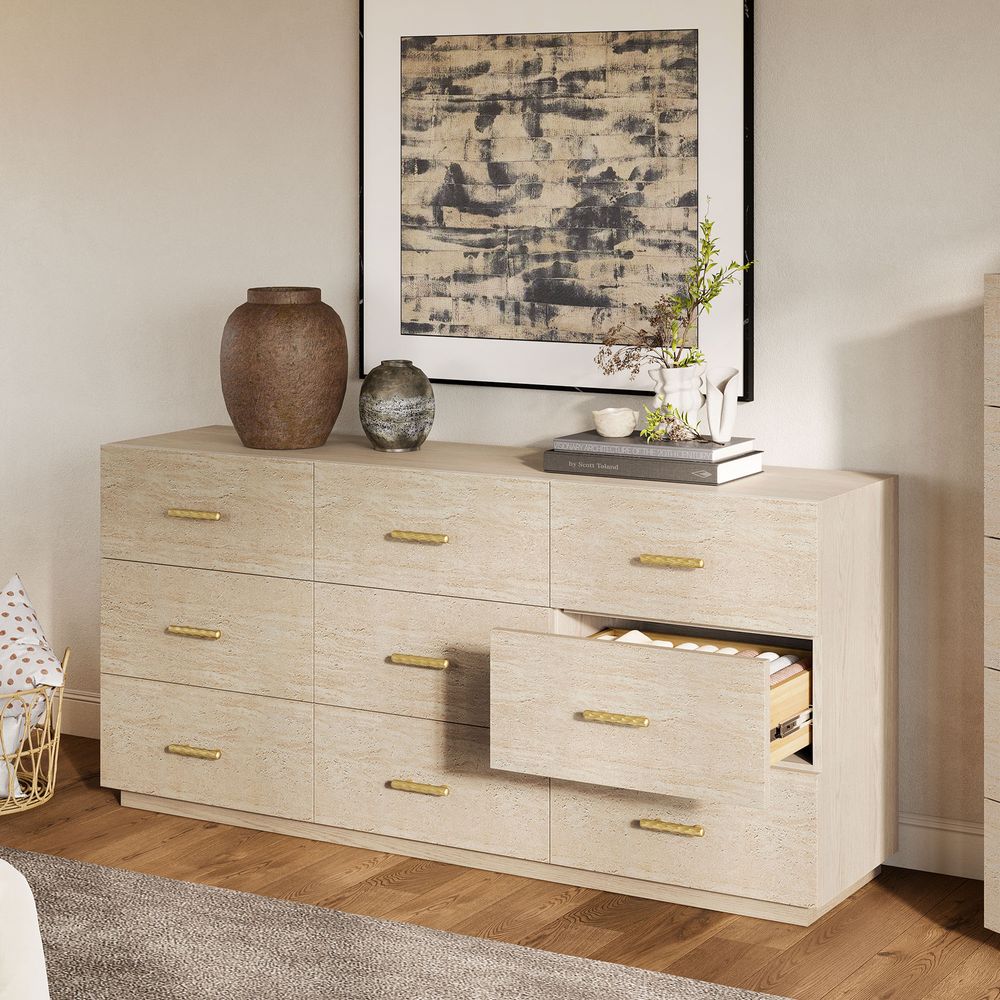
Renata 80-Inch Travertine-Textured 9-Drawer Dresser
View Product
Safety, Stability, and Where to Put the Heavy Items
A dresser is a loaded storage unit that gets opened and closed every day. Tip-over prevention should therefore be treated as a basic installation step, not an optional accessory.
In the U.S., clothing storage units are subject to federal safety requirements that address stability and tip-over hazards. The ASTM F2057 standard is also an important reference for clothing storage unit stability. When shopping, check the manufacturer's safety documentation and confirm that the product includes the required hardware and installation instructions where applicable.
Anchor it according to the instructions
If the dresser comes with an anti-tip restraint, install it according to the manufacturer's instructions. When the instructions call for wall anchoring, attach the restraint to an appropriate structural point rather than relying only on drywall.
Keep heavier items in lower drawers when practical, which helps keep the center of gravity lower. This is especially important in households with children, who may try to climb or pull on open drawers.
Safety hardware only works when it is installed correctly, so don't leave the restraint in the box after assembly.
Humidity and daily care
Wood naturally responds to changes in humidity. Keeping indoor humidity reasonably stable can help reduce excessive movement in wood furniture.
For everyday care, wipe spills promptly, keep the dresser away from direct heat, and limit prolonged exposure to strong sunlight that can change the appearance of some finishes. Use included levelers or floor protectors when provided.
Good care won't prevent every change in natural wood, but it can help the dresser maintain its appearance and function over time.
A Quick Pre-Buy Checklist
Before ordering a modern dresser, check these points:
-
Wall width: Measure the available wall and leave reasonable space around the dresser.
-
Open-drawer clearance: Aim for about 36 inches of clear space in front when the room allows.
-
Delivery path: Measure doorways, hallways, stairs, and tight turns.
-
Drawer count: Match the number of drawers to your wardrobe and closet space.
-
Shape: Choose a tall chest or wide dresser based on the wall and available floor space.
-
Construction: Check the material of the frame, panels, and drawer boxes rather than relying on the word "wood."
-
Joinery: Look for construction details such as dovetail drawer joints when listed.
-
Finish: Choose a finish that works with your room and is likely to remain appealing beyond current trends.
-
Safety hardware: Check for anti-tip hardware and installation instructions where applicable.
-
Warranty and care: Review the manufacturer's warranty, care instructions, and product specifications before purchasing.
Once those practical questions are answered, style becomes much easier to narrow down.
FAQs
How do I choose a modern dresser for my bedroom?
Start with the room rather than the style. Measure the available wall width, dresser depth, and open-drawer clearance, then choose a drawer count based on what you actually store. After that, compare materials, drawer construction, finish, and safety features before choosing the design that fits the room.
What size dresser is best for a bedroom?
There is no single best dresser size. A typical horizontal dresser may be around 50 to 60 inches wide, 18 to 20 inches deep, and 30 to 36 inches tall, while larger double dressers can reach 72 to 84 inches or more. Measure your wall and surrounding clearance first, then choose the largest size that fits comfortably.
How many drawers should a bedroom dresser have?
Five or six drawers can work well for one person's everyday clothing when most of the wardrobe stays in a closet. Seven to nine drawers can provide more divided storage for couples or larger wardrobes. Match drawer count to your storage categories rather than choosing the highest number available.
How do I keep a dresser from tipping over?
Follow the manufacturer's anti-tip instructions and install the supplied restraint when provided. If wall anchoring is required, secure it to an appropriate structural point rather than relying only on drywall. Keep heavier items in lower drawers when practical, and avoid allowing children to climb on or hang from open drawers.
Are engineered wood dressers bad for quality?
Not automatically. Engineered wood, plywood, and MDF can all be used effectively in furniture construction. Quality depends on the material grade, thickness, joinery, hardware, edge treatment, and how the different components are assembled. Instead of judging a dresser by one material label, review the complete construction specifications.
What color dresser makes a small bedroom look bigger?
Light finishes such as pale wood, white, cream, and other soft tones can reduce visual heaviness and help a small bedroom feel more open. However, size and placement matter more than color alone. A light dresser that is too large for the wall can still make the room feel crowded.
Should a dresser match the bed and other bedroom furniture?
It doesn't need to match exactly. A layered bedroom can look more intentional when pieces share one or two characteristics, such as a similar wood tone, finish sheen, or hardware color. Matching everything perfectly can be less flexible than combining complementary pieces.