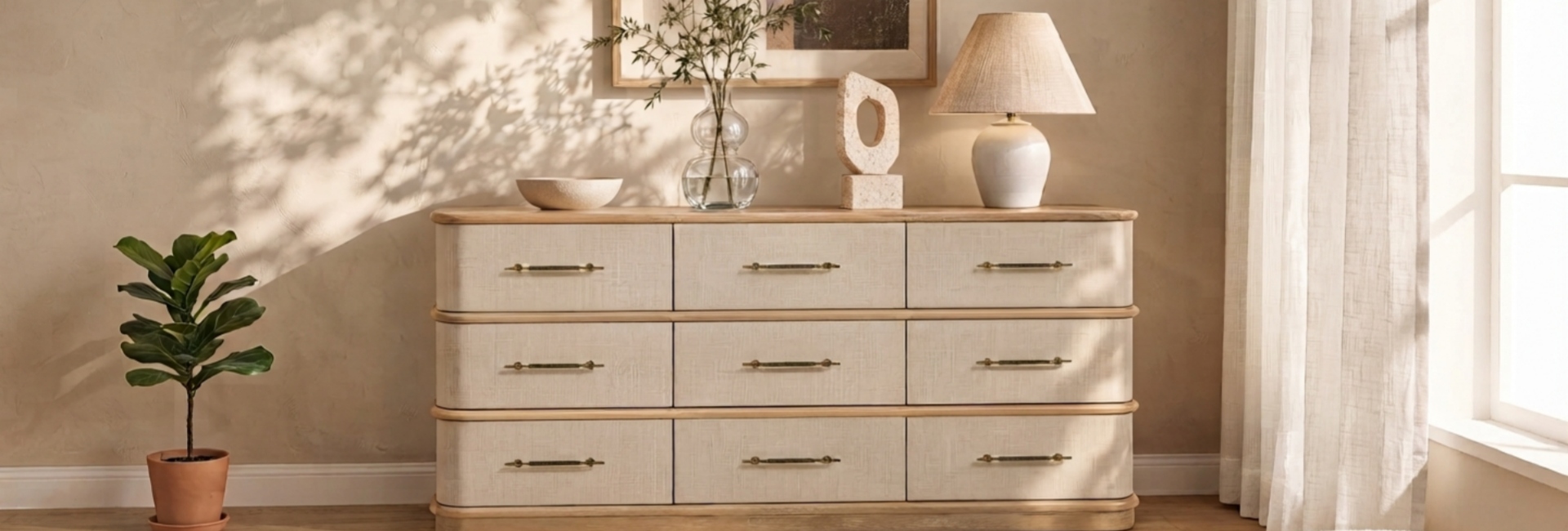
A 9 drawer dresser is a commitment, not a default. It earns its footprint when you actually need divided storage: two people sharing a primary bedroom, a room that's short on closet space, or a household that wants sweaters, jeans, linens, and smaller items each in their own home. If you're a single adult with a decent closet and a capsule wardrobe, nine drawers may sit half empty and take up a wall you'd rather use for something else.
The honest answer to "when do you need that much storage?" is simple: when organization matters to you, you have enough wall space, and you can open the drawers without fighting the bed or blocking a walkway.
Quick answer: A 9 drawer dresser is worth considering when two people share a bedroom, closet space is limited, or you want separate storage for several clothing and household categories. Before buying, check the dresser's width, drawer dimensions, drawer clearance, and the amount of usable wall space.
Table of Contents
- What Counts as a 9-Drawer Dresser?
- Standard Dimensions: How Big Is a 9-Drawer Dresser?
- How Much Storage Do Nine Drawers Really Hold?
- Who Actually Needs Nine Drawers?
- A 9-Drawer Dresser for the Bedroom: Sizing It to Your Room
- What Materials Are Best for a 9-Drawer Dresser?
- What Makes a 9-Drawer Dresser Durable?
- How to Organize a 9-Drawer Dresser
- How to Choose the Right 9-Drawer Dresser
- 9-Drawer Dresser vs. 6-Drawer Dresser
- How to Care for a 9-Drawer Dresser
- Is a 9-Drawer Dresser Worth It?
- Final Takeaway
- FAQs
- What is the average size of a 9 drawer dresser?
- How much can a 9 drawer dresser hold?
- Is a 9 drawer dresser too big for a small bedroom?
- How much clearance should I leave in front of a dresser?
- What should I look for in a durable 9 drawer dresser?
- Is a 9 drawer dresser good for couples?
- Can a 9 drawer dresser be used for things besides clothes?
- Should I choose a 9 drawer dresser or a chest of drawers?
- How do I keep a 9 drawer dresser organized?
What Counts as a 9-Drawer Dresser?
Before talking about size, it's worth settling what the name actually means. "9-drawer" describes the number of drawers, not a fixed shape.
Many wide nine-drawer dressers use three columns of drawers, often arranged in three rows. This is a common triple-dresser format: low, wide, and designed to provide substantial side-by-side storage. Other nine-drawer designs may use different drawer arrangements or stack more drawers vertically.
That's why two pieces can both be called a 9 drawer dresser while having completely different footprints.
A wide dresser may stretch roughly 60 to 80 inches across while staying around 32 to 38 inches tall. A taller design can save wall width by using more vertical space. Before buying, look at the actual width, depth, height, and drawer dimensions rather than shopping by drawer count alone.
There's another distinction worth knowing: a dresser is generally the wider, lower piece, while a chest of drawers is typically taller and narrower. Both can provide clothing storage, but they solve different space problems.
If you want to compare wide nine-drawer options designed for bedrooms, you can also browse Hernest's 9 Drawer Dressers collection.
Standard Dimensions: How Big Is a 9-Drawer Dresser?
There isn't one industry-standard size for a nine-drawer dresser because drawer configurations vary. For a wide, triple-style design, however, you will commonly see dimensions in roughly these ranges:
Treat these as planning ranges rather than hard standards. Individual products can fall outside them.
For a nine-drawer dresser, width is usually the dimension that changes the room most. Depth often stays in a fairly narrow range, while the extra drawers are created by making the piece wider or changing the vertical layout.
Height: Why Wide Nine-Drawer Dressers Sit Relatively Low
A wide nine-drawer dresser doesn't need to be especially tall. When drawers are distributed across several columns, the piece can provide substantial storage without taking up much vertical wall space.
Many wide models land around 32 to 38 inches tall. That makes them practical beneath a mirror, along a long bedroom wall, or in some cases beneath a window, provided the window height and proportions work.
If you see a nine-drawer piece around 50 inches tall, you're probably looking at a taller configuration rather than the classic low, wide dresser.
Width and the Wall Math
Width is the number that determines whether a large dresser fits your room comfortably.
A 60-inch dresser and an 80-inch dresser may have similar depths, but they create very different visual and functional demands. An 80-inch dresser needs a long, relatively uninterrupted wall and enough surrounding space that it doesn't make the room feel boxed in.
Don't measure only the furniture wall. Check:
-
Wall width available for the dresser
-
Side clearance around the piece
-
Distance from the dresser to the bed
-
Distance to the closet and bedroom doors
-
Window, outlet, radiator, and vent locations
-
The route from the entry door to the final room
A dresser that technically fits against a wall can still be the wrong size for the room.
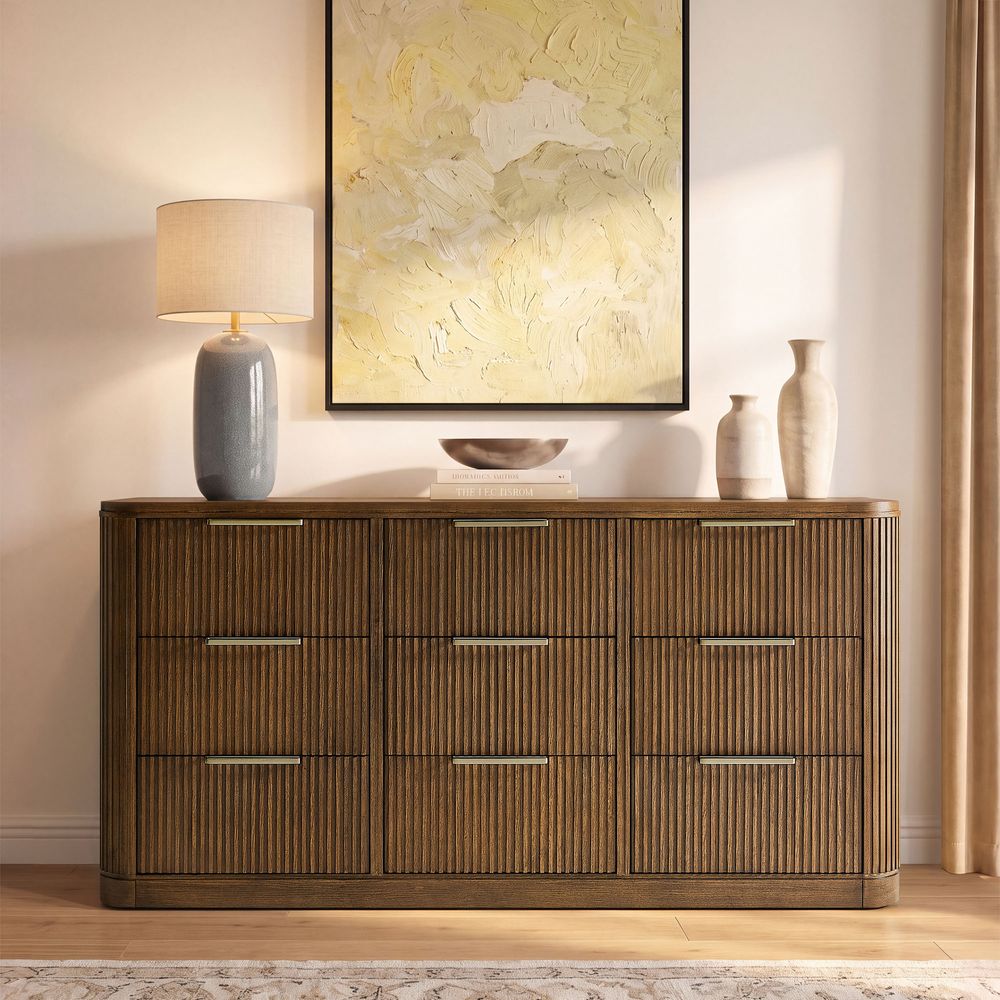
Finnley 76-Inch Fluted 9-Drawer Dresser
View Product
How Much Storage Do Nine Drawers Really Hold?
Nine drawers give you more ways to organize, but they don't automatically guarantee more usable storage volume.
There is no reliable universal number of outfits that every nine-drawer dresser can hold. Actual capacity depends on the interior width, depth, and height of each drawer, as well as what you're storing and how you fold it.
That's why drawer dimensions matter more than the number nine by itself.
The Drawer-Depth Catch
More drawers can mean smaller individual compartments. A wide nine-drawer dresser divides its storage across several drawers, while a six-drawer dresser may give you fewer but larger compartments.
If you mainly store bulky sweaters, jeans, or blankets, a smaller number of deeper drawers may sometimes be more useful. If you have lots of smaller categories—socks, underwear, workout clothes, pajamas, accessories, and seasonal items—nine separate compartments can make everyday organization much easier.
A useful rule of thumb is to count categories, not garments.
For example, nine drawers could be assigned to:
-
Socks and underwear
-
T-shirts
-
Workout clothes
-
Pajamas
-
Jeans
-
Sweaters
-
Accessories
-
Linens
-
Seasonal or miscellaneous items
The exact arrangement doesn't matter as much as having a clear reason for each drawer.
Who Actually Needs Nine Drawers?
This is the core question. A nine-drawer dresser makes the most sense in situations where separate storage solves a real problem.
Couples Sharing a Primary Bedroom
Two people can divide a wide dresser into separate zones. Each person might get a column, while the remaining drawers handle shared or seasonal items.
The advantage isn't simply having more space. It's avoiding the daily problem of clothes becoming one large shared pile.
Bedrooms With Limited Closet Space
A small reach-in closet doesn't necessarily provide enough room for an entire wardrobe. A wide dresser can take over some of the storage work that a larger closet would normally handle.
This is especially useful in older homes, guest bedrooms, apartments, and rooms with limited built-in storage.
Families and Guest Rooms
A large dresser can also hold more than everyday clothing. Guest linens, extra blankets, children's clothes, or seasonal items can each have a dedicated place.
In a guest room, that can make the furniture useful even when nobody is staying there.
Non-Clothing Storage
Nine drawers can also work for:
-
Craft supplies
-
Linens
-
Accessories
-
Hats and gloves
-
Small household items
-
Other items that benefit from being separated into categories
If your storage needs are spread across many categories, the organization can be more valuable than raw volume.
If none of these situations apply and you already have a generous closet, a six-drawer dresser may leave you with more usable floor and wall space.
A 9-Drawer Dresser for the Bedroom: Sizing It to Your Room
A 9 drawer dresser for bedroom use has to pass two tests: it fits the wall, and you can actually use it.
Many buyers pass the first test and forget the second.
Measure the Active Footprint, Not Just the Wall
A dresser has two footprints.
The first is its closed size: width, depth, and height.
The second is its active footprint when the drawers are open and someone is standing in front of them.
For example, a dresser that's about 20 inches deep may need another 24 to 36 inches or more in front of it for drawer operation and comfortable standing space. That means the usable depth of the furniture zone can be considerably larger than the depth listed on the product page.
Before ordering, place a tape measure on the floor and mark both the dresser footprint and the expected drawer extension. Then consider how that space interacts with your bed, closet, and door.
Clearance for Drawers and Walkways
Drawer clearance is one of the easiest measurements to overlook.
A dresser can fit neatly against a wall but still create a cramped bedroom if its drawers open directly into a narrow walkway. This matters even more with a nine-drawer dresser because several drawers may be opened at the same time.
As a practical planning target, aim for roughly 36 inches of clear space in front of the dresser when the room allows. You may be able to work with less in a tight bedroom, but the final decision should account for how often the drawers are used and whether another piece of furniture occupies the same zone.
Also check whether:
-
A drawer would hit the footboard of the bed
-
Open drawers would interfere with a closet door
-
A bedroom door swings into the dresser area
-
Two people can pass each other comfortably
-
Lower drawers are easy to access without crouching into another piece of furniture
This is where a floor plan or a simple tape-measure mockup can save you from an expensive return.
What Materials Are Best for a 9-Drawer Dresser?
The best material depends on what you value most: appearance, durability, weight, price, or ease of maintenance.
Solid Wood
Solid wood can offer a substantial feel and can often be repaired or refinished over time. However, wood movement is normal as temperature and humidity change, so construction quality matters as much as the material itself.
Engineered Wood and Veneers
Engineered wood can provide dimensional consistency and is widely used in modern furniture construction. Veneers add a real wood surface while allowing manufacturers to use engineered substrates for parts of the structure.
This combination can make sense when you want the appearance of natural wood without requiring every component to be made from solid lumber.
Resin and Mixed-Material Construction
Some contemporary dressers combine materials rather than relying on one material throughout the piece. For example, a dresser may use engineered wood for its main structure with a textured resin finish or wood veneer on visible surfaces.
The important thing is to look beyond the material name. Check the product specifications for the frame, drawer construction, finish, and hardware.
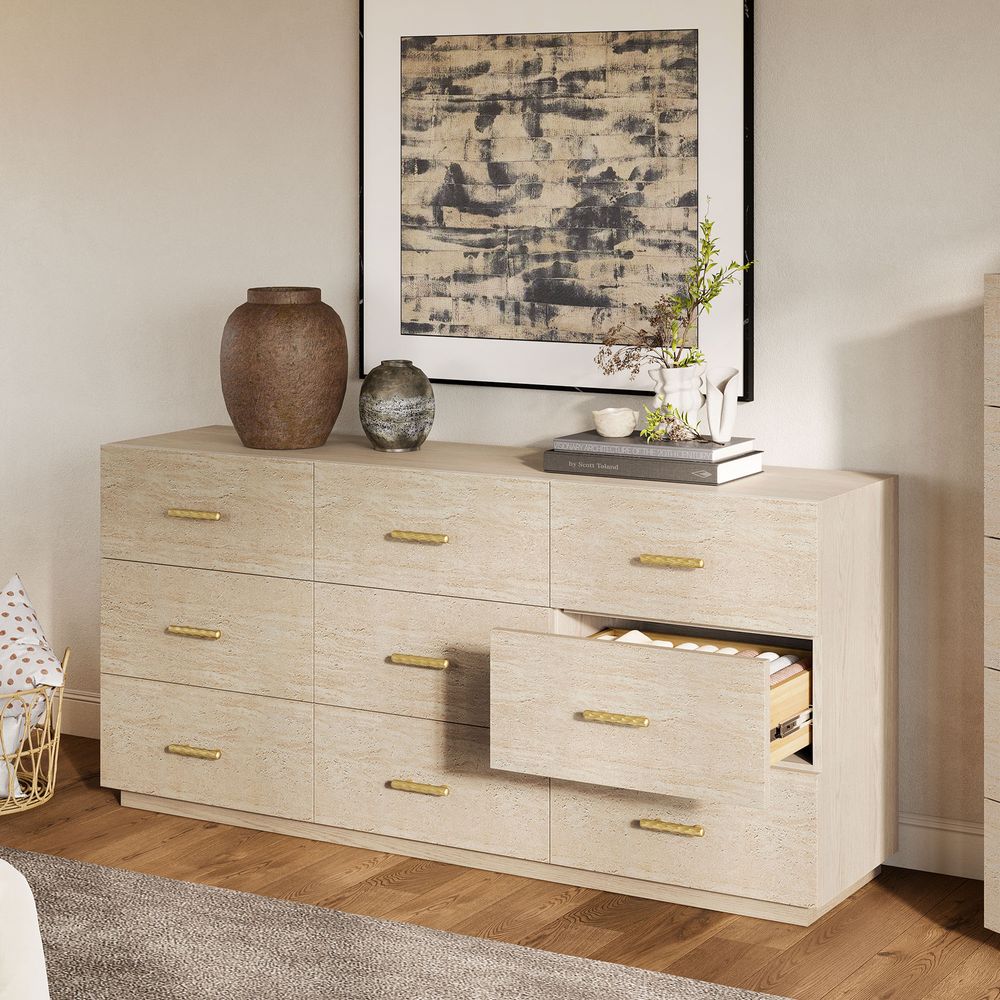
Renata 80-Inch Travertine-Textured 9-Drawer Dresser
View Product
What Makes a 9-Drawer Dresser Durable?
A nine-drawer dresser has more moving parts than a simple cabinet, so drawer construction and hardware deserve attention.
Drawer Joinery
Dovetail joints are widely regarded as a strong drawer-construction method because the interlocking shape provides mechanical resistance at the corners.
That doesn't mean a dresser without dovetail joints is automatically poorly made. Drawer slides, materials, construction tolerances, and overall assembly also affect durability.
Drawer Slides
Pay attention to how the drawers move. Smooth, consistent operation matters more than a marketing phrase such as "premium hardware."
If possible, look for information about the slide type, weight capacity, extension, and whether the drawers include soft-close features.
Frame and Construction
A large dresser needs a stable frame because the width can create more opportunity for movement or sagging if the construction is weak.
Look for clear product information about the materials used, how the case is constructed, and how the drawers are supported.
Anti-Tip Hardware
Because a nine-drawer dresser can be large and heavy, anchoring is an important safety consideration.
Look for a dresser that includes anti-tip hardware and install it according to the manufacturer's instructions. Keep heavier items in lower drawers when practical, and avoid allowing children to climb or play on the furniture.
Safety hardware is not just an accessory. It is part of setting up a large dresser responsibly.
How to Organize a 9-Drawer Dresser
The biggest advantage of nine drawers may be organization rather than capacity.
Instead of randomly filling each drawer, give each one a job. A simple system might look like this:
Drawers 1–3: Everyday clothing
Drawers 4–6: Work, workout, and sleepwear
Drawers 7–8: Underwear, socks, and accessories
Drawer 9: Seasonal items or linens
Of course, the best arrangement depends on your wardrobe.
If two people share the dresser, divide it by person rather than category. For example, one person can use the left three drawers and the other the right three, with the remaining drawers reserved for shared items.
Don't Fill Every Drawer Just Because You Have Them
Empty space is useful.
If a drawer is already packed tightly, adding more clothing makes it harder to find anything and puts more stress on the drawer hardware.
A better approach is to leave enough room to see and remove items without disturbing everything else. Folding clothes vertically or using small organizers can also make shallow drawers easier to manage.
How to Choose the Right 9-Drawer Dresser
Once you've confirmed that you have enough space, narrow your choices by looking at the details that affect everyday use.
1. Start With Width
Measure the available wall space first.
If your room comfortably accommodates only 65 inches, don't start by shopping for 80-inch dressers and hoping one will work. The width should fit the room before style or finish becomes the deciding factor.
2. Check Drawer Dimensions
Don't assume nine drawers mean nine large storage compartments.
Look at the interior width, depth, and height of the drawers. If you store bulky sweaters, deep drawers may matter more. If you organize smaller clothing categories, multiple compartments can be more useful.
3. Measure Drawer Clearance
Measure the space in front of the dresser, not just the wall behind it.
Open the drawers on your floor plan and make sure they won't collide with the bed, doors, or other furniture.
4. Consider the Finish and Style
A large dresser occupies a substantial visual area, so its finish can affect the entire bedroom.
Natural wood tones can add warmth, while darker finishes can create more contrast. Fluted, slatted, textured, or minimalist fronts can also change how visually heavy the dresser feels.
For example, Hernest's Renata 80-inch Travertine-Textured 9-Drawer Dresser uses a textured travertine-inspired finish across a wide nine-drawer layout, making the surface treatment part of the furniture's visual character.
If you prefer a more linear wood look, the Finnley 76-inch Fluted 9-Drawer Dresser uses a fluted front to give the large surface more visual definition.
5. Think About What Happens When You Move
An 80-inch dresser may work beautifully in your current bedroom but become difficult to move through a doorway, hallway, or staircase.
Before purchasing a large piece, measure the delivery route. Check door widths, stair turns, elevator dimensions, and any tight corners between the entry point and the bedroom.
This is especially important for wide, heavy dressers.
9-Drawer Dresser vs. 6-Drawer Dresser
The choice isn't simply about which dresser holds more.
A six-drawer dresser may be easier to fit into a smaller room and can provide larger individual drawers. A nine-drawer dresser gives you more compartments and can make it easier to separate clothing categories or divide storage between two people.
Choose based on how you actually organize your belongings.
A six-drawer dresser may make more sense if:
-
You have a smaller bedroom
-
Your closet already handles most of your storage
-
You prefer larger drawers
-
You don't need separate compartments for many categories
A nine-drawer dresser may make more sense if:
-
Two people share the bedroom
-
Your closet space is limited
-
You have several clothing categories
-
You want dedicated storage for linens or seasonal items
-
You have enough wall and floor space for a wider piece
Neither drawer count is automatically better. The right choice is the one that matches your room and storage habits.
How to Care for a 9-Drawer Dresser
Large dressers don't require complicated maintenance, but regular care helps protect the finish and keep the drawers working smoothly.
Keep the Surface Dry
Use a soft, slightly damp cloth for routine cleaning and wipe away moisture afterward. Avoid leaving wet glasses, spills, or damp objects sitting on the surface.
Avoid Harsh Cleaners
Unless the manufacturer specifically recommends them, avoid abrasive cleaners, bleach, or strong chemicals that may damage the finish.
Don't Overload the Drawers
Every drawer has a practical load limit. Heavy items such as books, tools, or large quantities of linens can put unnecessary stress on drawer slides and the cabinet.
Check Hardware Periodically
If handles, screws, or other hardware become loose, tighten them before the problem gets worse.
If a drawer begins rubbing, sticking, or sitting unevenly, don't force it. Check whether the drawer is overloaded or whether the slides or hardware need adjustment.
Is a 9-Drawer Dresser Worth It?
A 9 drawer dresser is worth the space when you need multiple storage categories, share a bedroom, or have limited closet capacity.
If your wardrobe is small and your closet already works well, a six-drawer dresser may be a better fit. The decision comes down to your storage needs, room dimensions, drawer configuration, and how much wall space you want the dresser to occupy.
The number of drawers is only the starting point. The better question is whether those nine compartments solve a problem you actually have.
Final Takeaway
A 9 drawer dresser isn't automatically the right choice just because it offers more storage. Its real advantage is divided, accessible storage.
For couples, bedrooms with limited closet space, or anyone managing several categories of clothing and household items, nine drawers can make everyday organization easier. For smaller rooms or lighter wardrobes, the extra width may not be worth the footprint.
Before buying, measure the wall, check the drawer dimensions, plan for open-drawer clearance, inspect the construction, and think honestly about what each drawer will hold.
If you can answer those questions before shopping, you'll have a much better idea of whether a 9 drawer dresser is actually the right size for your bedroom.
FAQs
What is the average size of a 9 drawer dresser?
A wide 9 drawer dresser is commonly around 60 to 80 inches wide, 17 to 20 inches deep, and 32 to 38 inches tall. Exact dimensions vary by drawer configuration and manufacturer.
How much can a 9 drawer dresser hold?
There is no universal clothing capacity because drawer interiors vary. Check each drawer's usable width, depth, and height rather than relying on the number of drawers alone.
Is a 9 drawer dresser too big for a small bedroom?
It can be. The key issue is not only whether the dresser fits against the wall but whether the drawers can open comfortably without blocking the bed, closet, or walkway.
How much clearance should I leave in front of a dresser?
About 36 inches of clear space is a useful planning target when the room allows. Smaller clearances may work in tight spaces, but consider drawer extension, standing space, and nearby furniture.
What should I look for in a durable 9 drawer dresser?
Pay attention to the frame, drawer materials, joinery, drawer slides, hardware, and overall construction. Dovetail drawer joints can be a useful quality indicator, but they should be considered alongside the rest of the construction.
Is a 9 drawer dresser good for couples?
Yes, if the bedroom has enough space. Nine drawers can make it easier to divide clothing by person or category and give each person dedicated storage.
Can a 9 drawer dresser be used for things besides clothes?
Yes. It can store linens, accessories, craft supplies, seasonal items, hats and gloves, and other small household belongings. The multiple drawers are particularly useful when you want to keep several categories separate.
Should I choose a 9 drawer dresser or a chest of drawers?
Choose a nine-drawer dresser when you have enough horizontal wall space and want multiple storage compartments at a lower height. A chest of drawers is generally taller and narrower, making it more useful when floor or wall width is limited.
How do I keep a 9 drawer dresser organized?
Give each drawer a specific purpose instead of filling drawers randomly. Group similar items together, avoid overloading the drawers, and leave enough space to remove clothing without disturbing the rest.