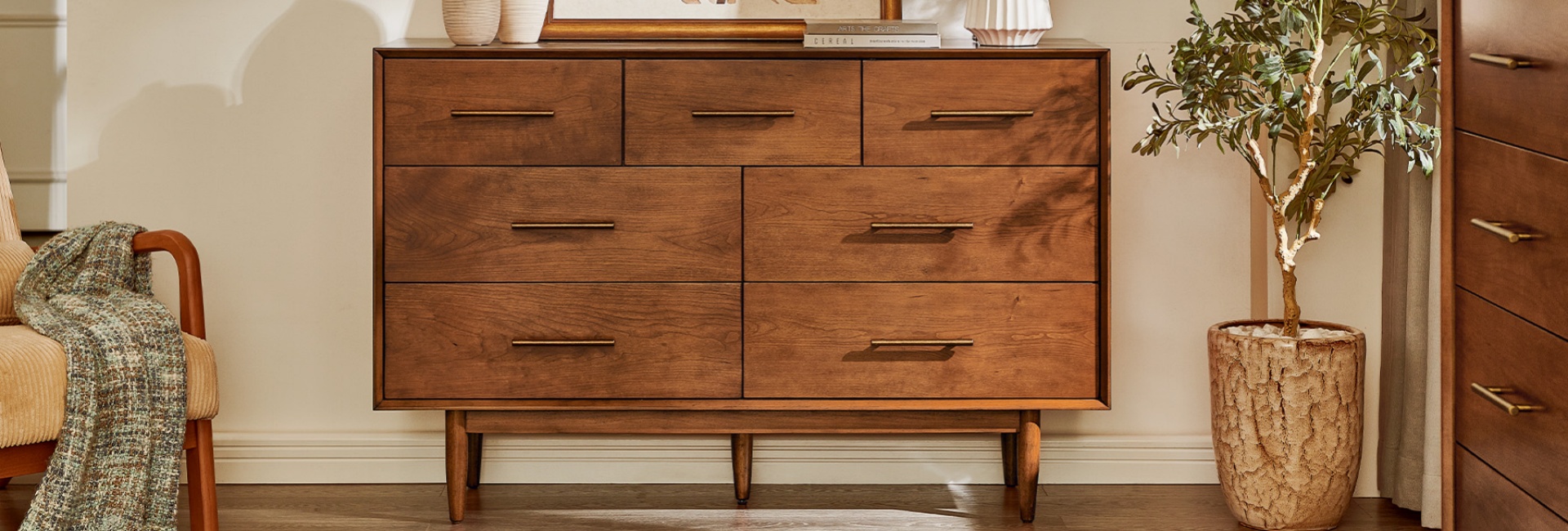
A good mid century modern dresser does more than store clothes. It fills a large part of the bedroom wall, provides everyday storage, and can influence the look of the entire room. The dressers worth comparing tend to share a few practical traits: clean proportions, quality wood or veneer, stable construction, functional drawers, tapered legs, simple hardware, and a finish that lets the material show through.
Whether you call it a mid century dresser or an MCM dresser, the buying considerations are similar. Once you know what to look for, it becomes easier to compare a new dresser with other new pieces or even with vintage furniture.
Table of Contents
- Quick Answer: What Should You Look For?
- 5 Things to Check Before Buying a Mid-Century Modern Dresser
- What Makes a Dresser Mid-Century Modern?
- Choosing the Right Wood and Materials
- Walnut, Oak, Cherry, and Other Wood Tones
- How Many Drawers Do You Actually Need?
- How to Choose the Right Dresser Size for Your Bedroom
- Dresser vs. Chest of Drawers: What's the Difference?
- Construction Details to Check Before Buying
- Finish, Care, and Keeping the Grain Looking Good
- Danish Modern vs. Mid-Century Modern
- Styling a Mid-Century Modern Dresser Without Clutter
- New vs. Vintage Mid-Century Modern Dressers
- A Real-World Example: Hernest Kaden 55" 7-Drawer Dresser
- FAQs
- What makes a dresser mid-century modern?
- What wood is best for a mid-century modern dresser?
- Are mid-century modern dressers usually solid wood?
- How many drawers should a mid-century modern dresser have?
- What's the difference between Danish modern and mid-century modern dressers?
- How do I care for a wood mid-century modern dresser?
- Can a mid-century modern dresser work as a TV stand?
- What should I check before buying a mid-century modern dresser?
Quick Answer: What Should You Look For?
A mid-century modern dresser typically has clean horizontal lines, tapered legs, minimal hardware, visible wood grain, and a simple functional silhouette.
When shopping, don't judge a dresser by its style alone. Compare the material, drawer dimensions, construction, overall size, and safety hardware. Drawer count matters, but the actual width, depth, and usable height of each drawer tell you more about how much storage you are getting.
5 Things to Check Before Buying a Mid-Century Modern Dresser
If you don't want to work through every specification, start with these five.
1. Material: Look for solid wood or quality real-wood veneer, and check what the core material actually is.
2. Drawer dimensions: Compare interior width, depth, and height rather than relying only on the number of drawers.
3. Construction: Look at drawer joinery, slides, back-panel support, and how the legs connect to the case.
4. Size: Measure the wall, the dresser depth, and the floor space needed to open the drawers comfortably.
5. Safety: Check whether anti-tip hardware is included and follow the manufacturer's anchoring instructions.
These details usually tell you more about a dresser's day-to-day usefulness than a product photo alone.
What Makes a Dresser Mid-Century Modern?
A mid-century modern dresser typically combines clean horizontal lines, tapered legs, minimal hardware, natural wood tones, and a relatively simple silhouette.
The style isn't defined by one exact shape or material. Instead, it comes from the relationship between the furniture's proportions, materials, and details.
Tapered Legs and a Lifted Look
One of the easiest details to recognize is the leg design. Mid-century dressers often sit on slim, tapered wood legs that angle slightly outward. Raising the case above the floor gives the piece a lighter visual profile and keeps the silhouette from feeling overly heavy.
That doesn't mean every MCM dresser needs angled legs. A low dresser on a substantial base can still work in a mid-century-inspired room, but tapered legs are one of the clearest visual cues associated with the style.
Clean Lines and Minimal Hardware
Look at the drawer fronts next. Mid-century dressers generally favor flat or gently curved surfaces without excessive ornamentation.
Hardware tends to be simple: slim bar pulls, recessed pulls, or integrated finger grooves are common approaches. Instead of decorative molding or elaborate knobs, the wood grain and proportions do most of the visual work.
Natural Wood Grain
Wood is another important part of the look. Walnut, teak, oak, and cherry are all associated with different examples of mid-century furniture, although the exact wood varies by designer and period.
A low- or satin-sheen finish that allows the grain to remain visible usually works more naturally with the style than a heavily glossy surface.
Choosing the Right Wood and Materials
Material affects more than appearance. It can influence durability, maintenance, dimensional stability, and how the dresser looks as it ages.
Solid Wood vs. Quality Veneer
Solid wood means the relevant components are made from real wood rather than a printed wood-look surface. Depending on the construction and finish, solid wood can often be repaired or refinished.
Quality veneer is different. It uses a thin layer of real wood over a stable core. This can be a practical approach for broad, flat surfaces because engineered cores can provide dimensional stability as humidity changes.
A well-made dresser can use both. Solid wood may be used for structural components or legs, while real wood veneer covers larger surfaces where a consistent appearance is desirable.
Engineered Cores and Laminate
Don't treat the word "engineered" as a quality rating by itself. The type of core, its density, edge treatment, joinery, and the way the components are assembled all matter.
Wood-look laminate is also different from real wood veneer. A printed surface can provide a consistent appearance at a lower price, but it does not have the same natural grain or refinishing potential as real wood veneer.
If natural wood appearance is important to you, check the actual material specification rather than relying on terms such as "wood finish" or "wood look."
If sustainability is one of your priorities, you can also look for wood certified by the Forest Stewardship Council (FSC).
Walnut, Oak, Cherry, and Other Wood Tones
Wood tone can change how a mid century modern bedroom feels even when two dressers have a similar silhouette.
Walnut
If you want a darker, classic MCM look, walnut is one of the most recognizable choices. Its medium-to-dark brown color can create a warmer, more grounded appearance and works naturally with neutral walls, textiles, and other natural materials.
Oak and Natural Tones
Oak creates a lighter appearance, particularly when the finish allows the grain to remain visible. It can work well in bedrooms with plenty of daylight or rooms that combine mid-century forms with lighter Scandinavian-inspired elements.
Natural oak is also relatively easy to combine with lighter textiles and painted furniture without making the room feel visually heavy.
Cherry and Warm Brown Finishes
Cherry offers a warmer direction. Its reddish-brown character can feel richer than natural oak without producing the same darker effect as many walnut finishes.
A real product example makes the difference easier to see. Hernest's Kaden 55-Inch Mid-Century 7-Drawer Dresser uses a Brown Cherry finish. Its warm finish can work with neutral, off-white, or muted green bedroom palettes without requiring every other piece to use the exact same wood tone.
When comparing finishes, focus on how the dresser works with your existing furniture rather than trying to create a perfectly matched bedroom set.
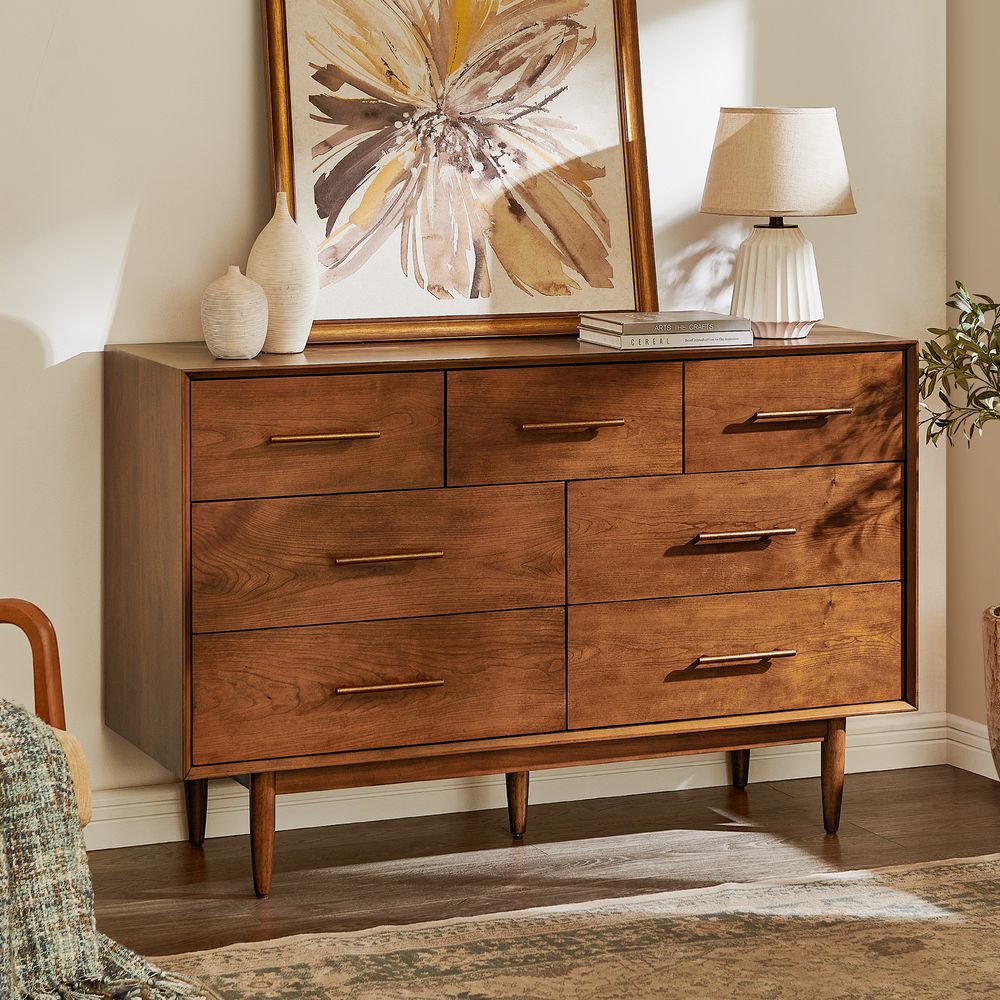
Kaden 55-Inch Mid-Century 7-Drawer Dresser
View Product
How Many Drawers Do You Actually Need?
Don't judge storage by drawer count alone.
A seven-drawer dresser with small, shallow drawers may hold less than a six-drawer dresser with wider and deeper drawers. The right configuration depends on what you store, how many people share the dresser, and how much wall space you have.
As a general starting point, five to seven drawers work well for many bedrooms, while eight- or nine-drawer designs can make sense when you need more divided storage or have limited closet space.
Think About What Goes in Each Drawer
Shallow top drawers are useful for socks, accessories, and other smaller items. Medium drawers can handle T-shirts and folded shirts, while deeper drawers are better suited to sweaters, jeans, and bulkier clothing.
For two people sharing one dresser, six or seven drawers can make it easier to divide storage without requiring multiple pieces of furniture.
Before buying, check the actual interior drawer dimensions whenever the manufacturer provides them.
How to Choose the Right Dresser Size for Your Bedroom
Measure the room before you buy. A dresser that looks compact in a product photo can take up much more physical and visual space once it is against a bedroom wall.
Width, Depth, and Height
Many mid-century dressers fall somewhere around 48 to 65 inches wide, although individual designs vary considerably.
Dresser depth often falls around 16 to 20 inches, while many standard dressers are roughly 30 to 36 inches tall. These are useful planning ranges rather than fixed standards.
A 55-inch dresser, for example, needs more than 55 inches of usable wall if you want visible space on either side. Likewise, a dresser that projects too far into a walkway can make drawers harder to use and make a smaller bedroom feel crowded.
A lower dresser can work well beneath a wall-mounted mirror or artwork. A taller chest can make better use of vertical space when floor area is limited.
Don't Forget Drawer Clearance
Measure the space in front of the dresser, not just the dresser itself.
Allow enough clear floor space to fully open the drawers and stand comfortably in front of them. Around 30 inches is a useful planning point for many bedrooms, but the actual clearance should account for the dresser, nearby furniture, doors, and the way you use the room.
Dresser vs. Chest of Drawers: What's the Difference?
The terms are sometimes used interchangeably, but there is a practical difference.
A dresser is generally wider and lower, providing more horizontal storage and a larger surface for a mirror, artwork, or everyday objects.
A chest of drawers is usually taller and narrower. It can make better use of vertical space when floor area is limited.
If you have a wide, open bedroom wall, a mid century modern dresser can provide both storage and visual balance. If floor space is tight, a taller chest may make more sense.
Construction Details to Check Before Buying
Two dressers can look almost identical in a product photo and feel very different in daily use. The difference is often hidden in the construction.
Drawer Joinery and Slides
Open a drawer and look at how the drawer box is assembled. Dovetail joints are a traditional form of joinery that interlocks the pieces rather than relying only on fasteners.
Drawer slides matter too. Quality metal slides can provide smoother operation and support repeated daily use. When comparing products, look for information about the slide type and weight capacity rather than assuming every drawer system is the same.
Back Panel and Stability
The back panel contributes to the rigidity of the case. A properly secured and reinforced back can help reduce side-to-side movement.
Pay attention to the leg-to-case connection as well. Secure hardware and substantial leg components can provide a more stable foundation than lightweight connections.
Anti-Tip Safety
For dressers and chests, anti-tip hardware is an important safety feature. Follow the manufacturer's installation instructions and anchor the furniture when required, especially in homes with children.
A loaded dresser can become unstable if multiple drawers are opened at the same time, so proper anchoring should be treated as part of the installation rather than an optional accessory.
Finish, Care, and Keeping the Grain Looking Good
A mid-century modern dresser doesn't require complicated maintenance, but a few simple habits can help protect the finish.
Dust the surface with a soft, dry cloth and wipe spills promptly rather than allowing moisture to sit on the finish.
Use coasters, felt pads, or protective mats under lamps, plants, and decorative objects that could leave marks.
Avoid aggressive cleaners or products that are not compatible with the manufacturer's finish.
Humidity and Sunlight
Wood furniture responds to changes in humidity. Keeping indoor humidity reasonably stable can help limit excessive expansion and contraction.
Direct sunlight can also gradually change the appearance of some wood finishes. If possible, position the dresser away from prolonged direct sunlight or use window coverings during the brightest part of the day.
Check drawer pulls, legs, and other hardware periodically and tighten them when necessary.
Danish Modern vs. Mid-Century Modern
Danish modern and mid-century modern overlap, but they are not identical terms.
Mid-century modern is the broader design category, generally associated with clean lines, practical forms, and functional furniture. It can include darker or lighter woods, different colors, and a range of materials.
Danish modern is associated with Scandinavian design and often emphasizes lighter woods, organic curves, craftsmanship, and understated details.
If you prefer lighter wood and softer curves, a Danish-influenced dresser may fit naturally into the room. If you prefer darker walnut, stronger horizontal lines, or more geometric details, a broader mid-century modern design offers a different visual direction.
Styling a Mid-Century Modern Dresser Without Clutter
The clean lines of an MCM dresser are easy to overwhelm with too many objects.
Instead of filling the entire top, combine a few pieces at different heights and leave some open space. A vase, a low tray, and a small decorative object can be enough.
Your nightstands also don't have to be an identical set. Similar wood tones, leg shapes, or hardware finishes can make the dresser and nightstands feel connected without making the bedroom look overly matched.
If you're creating a broader mid century modern bedroom furniture setup, repeating one or two materials throughout the room is often enough to create visual consistency.
New vs. Vintage Mid-Century Modern Dressers
Both new and vintage furniture can work in a mid-century bedroom, but they involve different considerations.
When Vintage Makes Sense
Vintage furniture can offer original period construction, unique finishes, and designs that aren't widely produced today.
Condition varies, though. Check for structural repairs, damaged veneer, loose joints, replacement hardware, drawer-slide problems, and previous refinishing before buying.
When New Makes Sense
New furniture gives you more predictable dimensions, current safety features, product specifications, and manufacturer support.
If you're buying new, compare construction details rather than choosing solely by appearance. If you're buying vintage, inspect the joints, case stability, drawer operation, finish condition, and hardware before committing.
A Real-World Example: Hernest Kaden 55" 7-Drawer Dresser
A product specification can make the buying criteria easier to understand.
Hernest's Kaden 55" Mid-Century 7-Drawer Dresser combines a 55-inch-wide format with seven drawers, rubber wood with cherry veneers, a Brown Cherry finish, tapered solid wood legs, antique bronze pulls, and dovetail drawer construction. It also includes anti-tip hardware.
Those specifications illustrate why it's useful to look beyond the product title. The "seven drawers" describe the storage layout, but the material, drawer construction, dimensions, hardware, and safety features tell you much more about what you're actually buying.
If you're comparing different drawer configurations, you can also explore Hernest's dressers collection for additional sizes and storage layouts.
FAQs
What makes a dresser mid-century modern?
A mid-century modern dresser typically combines clean lines, a relatively low and horizontal profile, tapered legs, minimal hardware, and visible wood grain. Walnut, teak, oak, and cherry are common material or finish choices.
What wood is best for a mid-century modern dresser?
There is no single best wood for every room. Walnut creates a darker appearance, oak can make a bedroom feel lighter, and cherry offers a warmer brown tone. Construction quality and finish are also important when comparing dressers.
Are mid-century modern dressers usually solid wood?
Not necessarily. Mid-century furniture can use solid wood, veneer, plywood, and other construction methods. A quality real-wood veneer over a stable core can be a practical choice, particularly for wide surfaces.
How many drawers should a mid-century modern dresser have?
Five to seven drawers work well for many bedrooms. A smaller wardrobe may need fewer, while couples or people with limited closet space may want seven or more. Compare drawer dimensions as well because drawer count alone doesn't determine storage capacity.
What's the difference between Danish modern and mid-century modern dressers?
Danish modern is often associated with Scandinavian design, lighter woods, organic curves, and understated craftsmanship. Mid-century modern is a broader category that can include darker woods, stronger geometric forms, and a wider range of materials.
How do I care for a wood mid-century modern dresser?
Dust regularly with a soft cloth, wipe spills promptly, protect the surface from moisture and heat, and avoid harsh cleaners unless the manufacturer recommends them. Keep the furniture away from prolonged direct sunlight and maintain reasonably stable indoor humidity.
Can a mid-century modern dresser work as a TV stand?
It can in some cases, but check the dresser's weight capacity, top dimensions, and stability before using it for a TV. A dresser should not be used as a MCM TV stand simply because the television fits on top. If you need dedicated TV support and cable management, a media console is designed specifically for that purpose.
What should I check before buying a mid-century modern dresser?
Start with the material, drawer dimensions, construction, overall size, and safety hardware. Also check the finish, drawer slides, leg connections, and the amount of clearance needed to use the dresser comfortably.