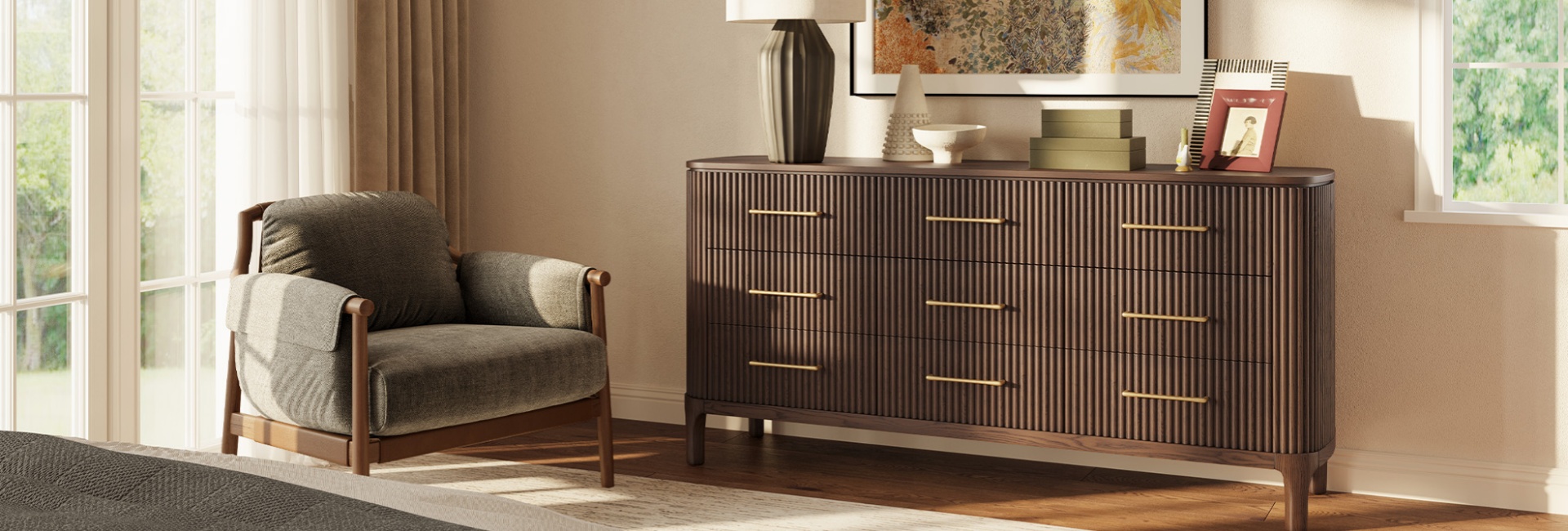
A dresser may be too small if clothes regularly pile up on top, drawers stay packed, or you have to leave some drawers partly open because they hit the bed. If you've been wondering how to know if your dresser is too small, start with three things: storage capacity, drawer clearance, and how well the piece fits your room.
Width matters, but it is only part of the equation. A dresser can have plenty of surface area and still feel cramped if the drawers are shallow. Conversely, a narrower chest can provide enough storage while taking up less floor space. The right dresser should hold what you actually use while leaving enough room to move comfortably around the bedroom.
Table of Contents
- 5 Signs Your Dresser Isn't Keeping Up
- What Counts as a Standard Dresser Size?
- How to Measure Your Room Before Buying a Dresser
- Don't Judge Storage by Drawer Count Alone
- Don't Forget Dresser Height
- Dresser vs. Chest: Which Works Better in a Small Room?
- Choose the Dresser Around Your Bedroom, Not the Other Way Around
- Where Dresser Sizing Usually Goes Wrong
- Fix It or Replace It?
- When Does a Wide Nine-Drawer Dresser Make Sense?
- A Fluted Option for Warm, Textured Bedrooms
- The Dresser Sizing Checklist
- FAQs
- How do I know if my dresser is too small?
- How do I know what size dresser I need?
- What is the ideal size for a dresser?
- What is the standard dresser size?
- How much clearance should I leave in front of a dresser?
- How deep should a dresser be?
- How wide is a typical dresser?
- How do I measure my room for a new dresser?
- What is the difference between a dresser and a chest of drawers?
- How many drawers do I actually need?
- What size dresser works best in a small bedroom?
- Can a dresser be too big even if it fits the wall?
- What dresser style works with an MCM or Organic Modern bedroom?
5 Signs Your Dresser Isn't Keeping Up
A dresser doesn't have to be completely full to be too small. Look at how you use it every day. These are some of the clearest signs that your current storage is no longer enough.
Clothes are becoming countertop storage
If folded shirts, sweaters, or underwear regularly end up on top of the dresser, your drawers may not have enough usable capacity.
The top can be useful for a lamp, mirror, tray, or a few decorative pieces. When it becomes a permanent overflow area, it is worth reconsidering the dresser's size and drawer configuration.
You can't fully open the bottom drawer
Try opening the lowest drawer all the way. If it hits the bed or another piece of furniture, part of that drawer is effectively unusable.
This is not necessarily a sign that the dresser itself is too narrow. It may be a clearance problem caused by choosing a piece that is too deep for the available space.
One person's wardrobe fills every drawer
A dresser that works for a small everyday wardrobe may struggle with a full four-season closet. Sweaters, denim, workout clothes, and bulky layers take considerably more space than lightweight tops.
If every drawer is packed before you have stored the clothes you regularly wear, the dresser may simply be undersized for your needs.
You keep avoiding certain drawers
If you consistently use two or three drawers while leaving the others mostly empty, look at the drawer dimensions rather than the total drawer count.
A shallow drawer may work well for socks and accessories but poorly for sweaters. A deeper drawer can hold bulkier clothing but may be less efficient for small items without dividers.
The storage looks larger on paper than it feels in use
A dresser can have six, eight, or nine drawers and still provide less usable storage than expected.
Drawer depth, interior height, drawer extension, and the space taken up by hardware all affect how much clothing you can comfortably store. When comparing dresser dimensions, look beyond the exterior width and consider the actual drawer space you will use.
What Counts as a Standard Dresser Size?
There is no single standard dresser size. Dimensions vary depending on whether you're looking at a compact dresser, a traditional six-drawer design, a wide double dresser, or a tall chest.
As a general reference, horizontal dressers commonly fall somewhere around 30 to 36 inches high and roughly 18 to 24 inches deep. Width varies more because dressers are designed for different rooms and storage needs.
A traditional dresser may be around 50 to 60 inches wide, while wider double dressers can extend to 70 or 80 inches or more. Tall chests generally trade width for height and may be around 24 to 40 inches wide and 44 to 60 inches tall.
These are useful planning ranges, not fixed standards. Your available wall, bed placement, door swings, and wardrobe should determine the final size.
Width, Height, and Depth at a Glance
Drawer count is another useful clue, but it should not be the deciding factor. A well-designed six-drawer dresser can be more practical than a nine-drawer piece with shallow or poorly configured drawers.
Why Standard Sizes Aren't Rules
A dresser that looks appropriately sized online can feel completely different once it is placed next to your bed.
An 8-foot ceiling, a king-size bed, a nearby closet, or a door that swings into the room can all change what works. Measure the actual space first, then compare the dresser dimensions against it.
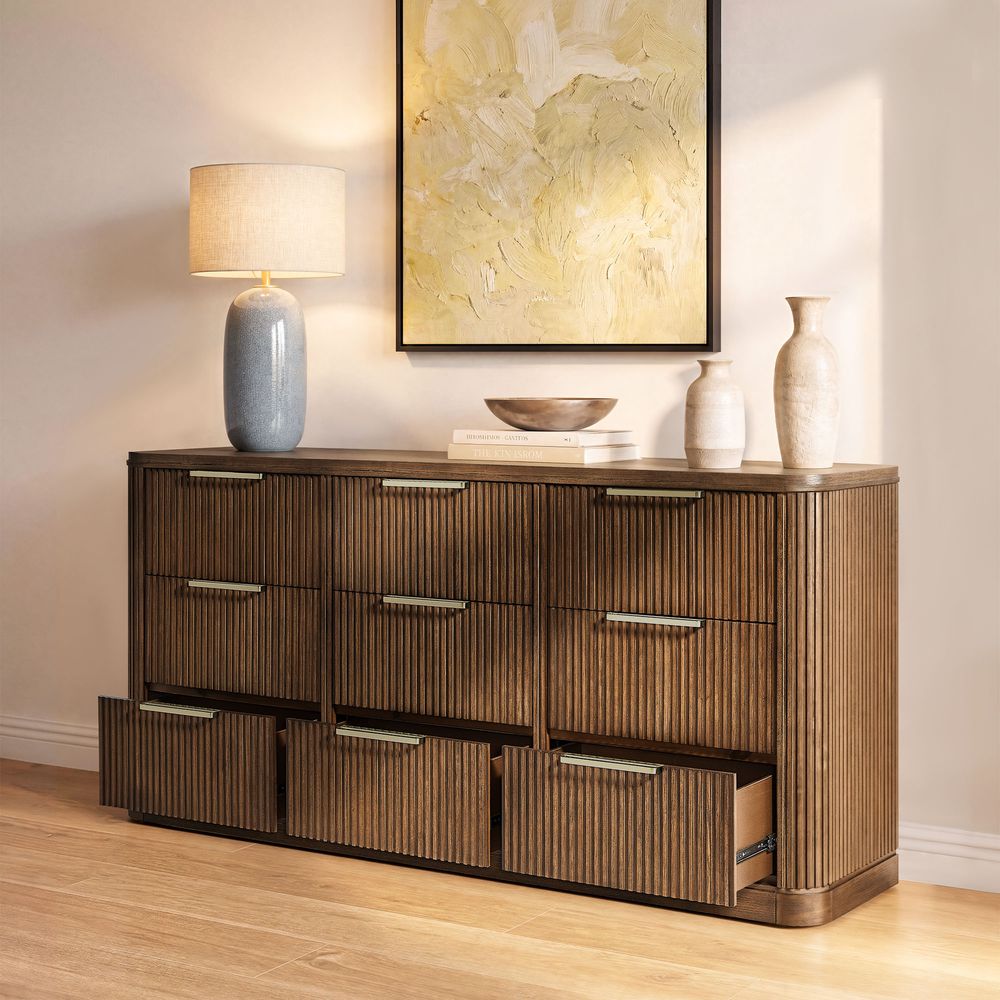
Finnley 76-Inch Fluted 9-Drawer Dresser
View Product
How to Measure Your Room Before Buying a Dresser
Before replacing a dresser, measure the room rather than just the wall. This is especially important in smaller bedrooms, where a few inches can determine whether drawers open comfortably.
Measure the Usable Wall Width
Measure the wall where the dresser will sit, then account for anything that reduces the usable width:
-
Doors and door swings
-
Closet openings
-
Window trim
-
Baseboards
-
Wall-mounted fixtures
-
Outlets and switches
You do not necessarily need a large gap on both sides, but leaving a few inches of breathing room usually makes the dresser feel more intentional rather than squeezed into the wall.
Aim for About 36 Inches of Clearance
A practical planning target is about 36 inches of clear floor space between the front of the dresser and the bed or other furniture.
This gives you room to open drawers and stand in front of them. In a particularly compact bedroom, you may have less available space, so use the actual drawer extension and your own movement pattern to determine whether the arrangement remains comfortable.
The important thing is that the dresser should not prevent its own drawers from opening or make the walkway difficult to use.
Check Depth and Drawer Extension
Many dressers are around 18 to 24 inches deep. The drawer itself extends farther when opened, so measure the full operating space rather than stopping at the front edge of the case.
For example, if a dresser is 20 inches deep and its drawers extend about 16 inches when open, you need roughly 36 inches of space just for the case and open drawer. You also need additional room for standing and moving comfortably.
That is why depth matters so much in bedrooms with a bed directly opposite the dresser.
A 12-by-12 Bedroom Example
Consider a 12-by-12-foot bedroom with a queen bed measuring 60 by 80 inches.
If you place a 60-inch dresser on the wall opposite the bed, the available wall width may be sufficient for the dresser, assuming there are no doors or other obstructions. You should then check the distance from the foot of the bed to the dresser wall.
If that distance is around 64 inches, a dresser approximately 20 inches deep can still provide comfortable drawer access, assuming the drawers extend roughly 16 inches when open. There is room for the drawers to open and for a person to stand in front of them.
In a 10-by-10-foot room, the same dresser may feel much tighter. In that situation, a narrower dresser or vertical chest may make better use of the available floor space.
Don't Judge Storage by Drawer Count Alone
Nine drawers sound like more storage than six, but drawer configuration matters just as much as the number printed on the product page.
Shallow and Deep Drawers Serve Different Purposes
Shallow drawers are useful for socks, underwear, accessories, and other small items. Deeper drawers work better for jeans, sweaters, bedding, and heavier layers.
Look at the interior dimensions, not just the exterior appearance.
A dresser with several shallow drawers may have a higher drawer count but less practical storage for bulky clothing than a six-drawer design with deeper compartments.
Drawer Construction Matters, Too
If you're comparing dressers, check whether the drawers use full-extension glides, dovetail construction, or other features that affect everyday use.
Full-extension glides allow more of the drawer to come forward, making the back easier to reach. Dovetail joints are commonly used in furniture construction and can provide a durable connection between drawer components.
Two dressers with the same width and drawer count can therefore feel very different once you start using them.
Don't Forget Dresser Height
Height affects both function and proportion. The right height depends on what you plan to place above the dresser and how the piece relates to the rest of the room.
Under a Window
If the dresser sits beneath a window, measure from the floor to the bottom of the sill.
A low-profile dresser around 24 to 30 inches tall may work well in this position, provided there is enough clearance around the window and trim.
With a Mirror Above
If you are pairing a dresser with a mirror, consider the combined height of the dresser, mirror, and any space between them.
A lower dresser can leave more visual room for a larger mirror, while a taller piece may work better with a smaller wall-mounted mirror.
With a TV
If a TV sits on the dresser, check both the dresser height and the screen height from your usual viewing position. A lower media-style piece can work better for a TV than a tall chest.
This is also where room style comes into play. A streamlined wood dresser with clean lines can complement a relaxed Modern or Mid-Century Modern (MCM) bedroom without making the TV the visual focus.
Dresser vs. Chest: Which Works Better in a Small Room?
When a bedroom feels crowded, changing the shape of the storage can be more useful than simply buying a smaller version of the same piece.
A horizontal dresser uses more wall width but gives you a larger surface and keeps storage at an easy standing height. A vertical chest uses less floor width and takes advantage of unused wall height.
If your available wall width is limited, a chest may make better use of the room. If you have a long, open wall and want a surface for a lamp, mirror, or decor, a horizontal dresser may be more practical.
For bedrooms built around a Mid-Century Modern or Organic Modern look, the choice also affects the visual balance of the room. A long, low dresser can reinforce the horizontal proportions associated with MCM furniture, while a taller chest can make better use of vertical space in a smaller room.
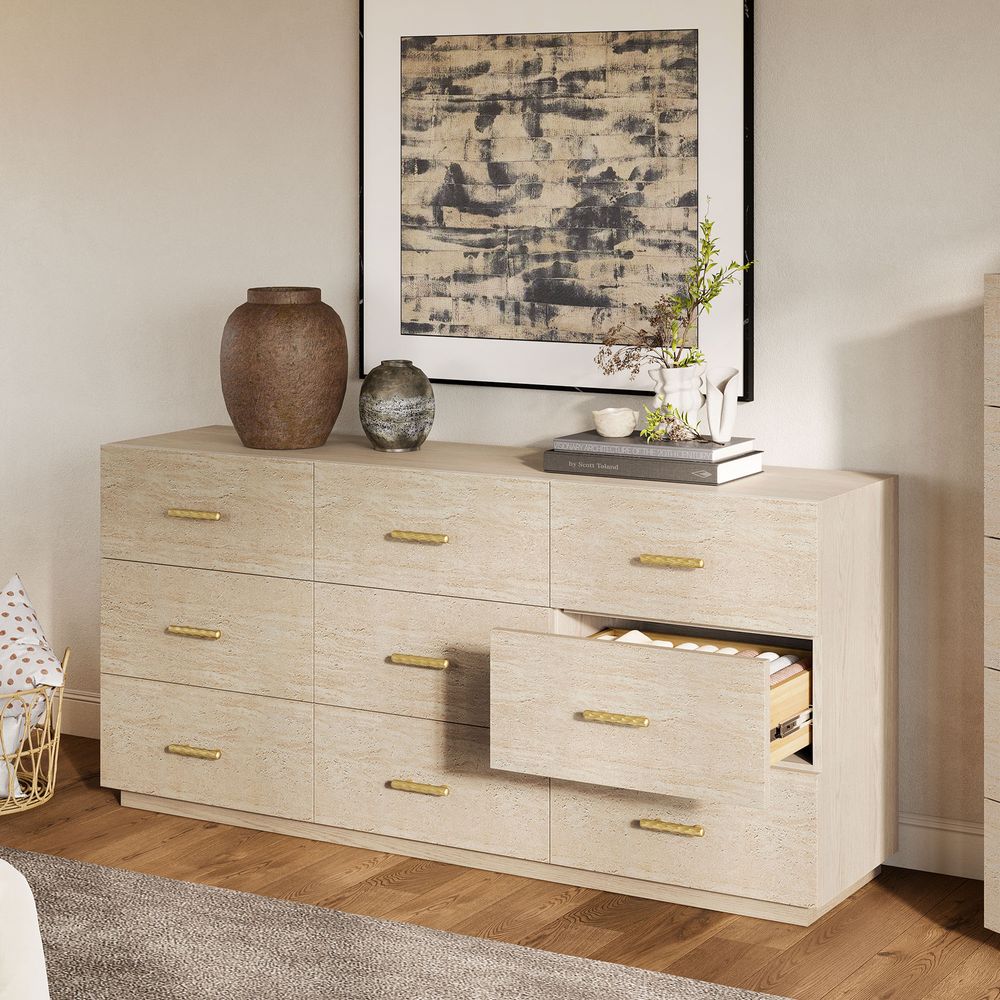
Renata 80-Inch Travertine-Textured 9-Drawer Dresser
View Product
Choose the Dresser Around Your Bedroom, Not the Other Way Around
Small Bedrooms
For a bedroom under roughly 120 square feet, start with the available wall width and clearance rather than choosing a dresser based on a target drawer count.
A narrow dresser under about 40 inches wide can work in some layouts, while a vertical chest may be a better choice when floor space is especially limited.
For a smaller room, a simple silhouette can also help the space feel less crowded. Clean-lined MCM furniture and understated Organic Modern pieces can add character without requiring a large visual footprint.
Medium Bedrooms
A room around 120 to 200 square feet can often accommodate a dresser around 50 to 60 inches wide, depending on the bed size and furniture arrangement.
This range can work particularly well with modern, MCM, and Organic Modern bedrooms because it provides useful storage while maintaining a relatively balanced wall-to-furniture proportion.
Large or Primary Bedrooms
A larger bedroom gives you more flexibility to use a wide dresser, particularly when two people share the storage.
A piece around 60 to 80 inches wide can turn a long empty wall into functional storage while providing a substantial surface for a mirror, artwork, lighting, or decor.
The broad horizontal profile also works naturally with the low, streamlined proportions often associated with Mid-Century Modern furniture, while textured wood finishes and warm neutral tones can complement an Organic Modern bedroom.
Where Dresser Sizing Usually Goes Wrong
Most sizing problems come from looking at the dresser in isolation.
Buying for the wall instead of the room. A dresser may fit perfectly between two walls and still leave too little room to open its drawers.
Ignoring door and closet clearance. Measure door swings and closet openings, not just the flat wall measurement.
Choosing width without checking depth. A wide dresser can look appropriate online but feel intrusive when it sits directly opposite a bed.
Choosing drawer count over usable storage. More drawers do not automatically mean more capacity. Compare interior drawer dimensions and configuration.
Skipping the delivery path. Measure the front door, hallway, stairways, elevators, and bedroom entrance before ordering a large dresser.
A few minutes with a tape measure can prevent an expensive return and make it easier to shop with confidence.
Fix It or Replace It?
Your dresser may not need to be replaced immediately.
Before buying another piece, try a few simple changes. Use drawer dividers for small items, move seasonal clothing into under-bed storage, and reserve shallow drawers for accessories rather than bulky clothing.
If those changes give you enough usable space, the problem may have been organization rather than dresser size.
Replacement makes more sense when the physical limitations remain. If drawers are consistently overfilled, the piece blocks its own storage, or two people are trying to share a dresser that no longer provides enough usable space, a larger or differently shaped piece may be more practical.
The goal is not to buy the biggest dresser that fits the wall. It is to find enough storage for your everyday routine without sacrificing the room around it.
When Does a Wide Nine-Drawer Dresser Make Sense?
A wide nine-drawer dresser can be useful when you have a long wall and need more organized storage without moving to a tall piece.
This is particularly relevant for shared bedrooms and full four-season wardrobes. Instead of stacking storage vertically, a wide dresser spreads the drawers across the wall and keeps the top surface easy to reach.
For shoppers drawn to MCM furniture, a long, low dresser can echo the horizontal proportions that make mid-century-inspired interiors feel balanced. In an Organic Modern bedroom, natural-looking wood tones, tactile surfaces, and restrained detailing can bring warmth without making the room feel overly decorated.
The key is proportion. A nine-drawer dresser does not solve a small-room storage problem if it leaves too little space for movement.
A Wide Option from Hernest
The Renata 80-Inch Travertine-Textured 9-Drawer Dresser is an example of a wide dresser designed for substantial horizontal storage.
At 80 inches wide, it is intended for a long bedroom wall rather than a compact space. Its nine drawers provide dedicated storage for different categories of clothing, while the broad top creates room for a mirror, lighting, artwork, or everyday pieces.
The travertine-textured surface can work particularly well in an Organic Modern setting, where tactile finishes and warm, restrained materials help create visual interest without relying on ornate decoration. Dovetail drawer construction, soft-close rails, and an anti-tip kit add practical features alongside the design.
As with any wide dresser, measure the wall, clearance, and delivery path before ordering.
A Fluted Option for Warm, Textured Bedrooms
If you prefer visible texture over a stone-inspired surface, the Finnley Fluted 9-Drawer Dresser takes a different approach.
Its vertical fluting adds rhythm to the front, while the warm brown finish brings more visual warmth to the room. The profile can work naturally with Organic Modern, MCM-inspired, and vintage-influenced interiors without requiring a heavily decorated space.
Like the Renata, it is a wide dresser intended for a long wall rather than a compact bedroom. The nine-drawer layout provides dedicated storage, while the broad top offers space for lighting, artwork, a mirror, or everyday items.
For Hernest, an Accessible approach to furniture means that design-forward pieces should still make sense in everyday homes. You should not need a professionally styled room or specialized design knowledge to create a bedroom with MCM or Organic Modern character. Practical proportions, familiar storage, approachable design, and clear sizing information make it easier to bring those looks into a real home.
Browse the Hernest dresser collection to compare different widths, finishes, drawer configurations, and silhouettes before choosing a size.
The Dresser Sizing Checklist
Before you buy, run through these measurements:
-
Measure the usable wall width and account for doors, trim, and closet openings.
-
Aim for about 36 inches of clear floor space in front when the room allows.
-
Check the dresser depth and the full drawer extension.
-
Leave enough side space for the dresser to feel comfortable in the room.
-
Decide whether you need shallow drawers, deep drawers, or a combination.
-
Consider what will sit above or on top of the dresser.
-
Measure the delivery path from the front door to the bedroom.
-
Plan to anchor the dresser to the wall using the included anti-tip hardware when applicable.
You do not need a perfect room or a complicated furniture plan. Once the dimensions work for your wardrobe, your room, and your daily routine, choosing a dresser becomes much more straightforward.
FAQs
How do I know if my dresser is too small?
Common signs include clothes piling up on top, drawers that are consistently overfilled, drawers that cannot fully open, and a storage layout that does not match the clothing you actually keep. If the dresser still feels cramped after basic organization, it may be time to size up or change the shape of the storage.
How do I know what size dresser I need?
Start with three measurements: the usable wall width, the available clearance in front of the dresser, and the amount of clothing you need to store. Then compare the dresser's width, height, depth, and interior drawer dimensions with those measurements. Choose a piece that provides enough usable storage without crowding the room.
What is the ideal size for a dresser?
There is no single ideal size. For many bedrooms, a horizontal dresser around 50 to 60 inches wide, 30 to 36 inches tall, and 18 to 24 inches deep provides a practical starting point. Larger wardrobes or shared bedrooms may call for a wider dresser.
What is the standard dresser size?
A typical horizontal dresser is often around 30 to 36 inches tall and 18 to 24 inches deep, with width varying from compact designs to wide double dressers. A common six-drawer dresser may be around 50 to 60 inches wide, while wider designs can reach 70 to 80 inches or more.
How much clearance should I leave in front of a dresser?
Aim for about 36 inches of clear space between the dresser and facing furniture when possible. The actual amount you need depends on the drawer extension, the size of the person using the dresser, and how much room is available.
How deep should a dresser be?
Many dressers are around 18 to 24 inches deep. Drawer depth varies by design, so check the interior dimensions rather than assuming that a deeper case always provides more usable storage. A very deep dresser can also make the back of the drawers harder to reach.
How wide is a typical dresser?
A traditional horizontal dresser is often around 50 to 60 inches wide, while narrower dressers may be under 40 inches and wide double dressers can reach 70 to 80 inches or more. The right width depends on your available wall and the clearance around it.
How do I measure my room for a new dresser?
Measure the wall where the dresser will go, then account for doors, closet openings, trim, and other obstructions. Check the distance to the bed or furniture opposite it, measure the dresser depth and drawer extension, and confirm that the piece can travel through your home's entry and delivery path.
What is the difference between a dresser and a chest of drawers?
A dresser is generally wider and shorter, while a chest is narrower and taller. A dresser works well along a long wall and provides a larger surface, while a chest can make better use of vertical space in a smaller room.
How many drawers do I actually need?
That depends on your wardrobe and how the drawers are configured. One person with a relatively compact wardrobe may be comfortable with five or six drawers, while a shared bedroom or full four-season wardrobe may benefit from seven to nine. Drawer depth and interior dimensions matter as much as the count.
What size dresser works best in a small bedroom?
Start with the available wall width and the clearance around the bed rather than a fixed dresser size. A narrow dresser under about 40 inches wide can work in some small rooms, while a vertical chest may provide more storage without taking as much floor space.
Can a dresser be too big even if it fits the wall?
Yes. A dresser can fit the wall and still make the room uncomfortable if it blocks a walkway, interferes with a closet or door, or leaves too little space for the drawers to open. Always measure the room in three dimensions before choosing a larger dresser.
What dresser style works with an MCM or Organic Modern bedroom?
Look for simple silhouettes, clean lines, warm wood tones, restrained hardware, and practical proportions. MCM-inspired rooms often benefit from low, horizontal profiles, while Organic Modern spaces can incorporate natural-looking wood, tactile surfaces, and softer forms. The style should support the room rather than dictate every piece.