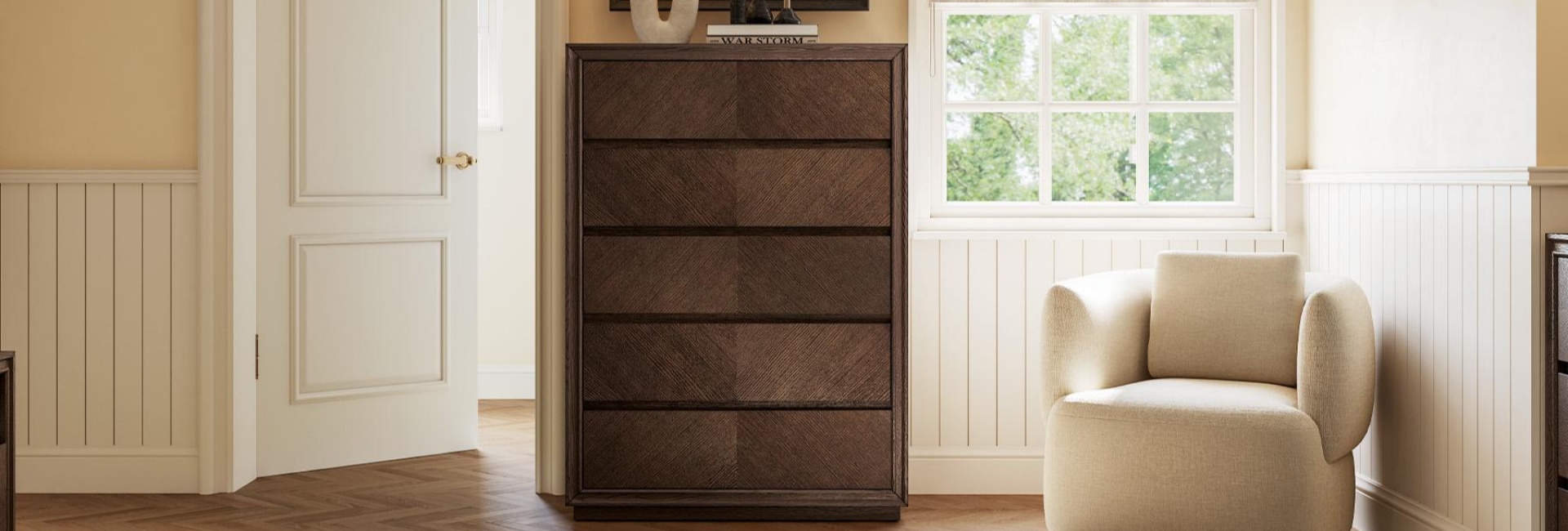
A tall chest of drawers provides vertical storage for clothing and household essentials while taking up less horizontal floor space than a wide dresser. Choosing the right one requires more than comparing height or drawer count. Overall dimensions, interior drawer capacity, materials, construction, and stability all affect how well a chest works in your bedroom. Understanding these factors can help you compare designs and find one that suits your storage needs and available space.
Table of Contents
- What Is a Tall Chest of Drawers?
- Tall Chest of Drawers vs. Wide Dresser: What's the Difference?
- How to Choose the Right Tall Chest of Drawers Dimensions
- How Many Drawers Do You Need in a Tall Chest of Drawers?
- Best Materials and Construction for a Tall Chest of Drawers
- Storage Capacity and Drawer Layout: What Should You Look For?
- How to Choose a Style for Your Bedroom
- Placement and Safety Considerations for a Tall Chest of Drawers
- FAQs
- What Is the Standard Height of a Tall Chest of Drawers?
- Is a Tall Chest of Drawers Suitable for a Small Bedroom?
- How Deep Should Drawers Be in a Bedroom Chest?
- What Materials Are Best for a Tall Wooden Chest of Drawers?
- How Do I Prevent a Tall Chest of Drawers From Tipping Over?
- Can I Put a TV on Top of a Tall Chest of Drawers?
What Is a Tall Chest of Drawers?
A tall chest of drawers is a freestanding storage unit with multiple drawers arranged vertically. Unlike a wide dresser, which spreads its storage across a broader frame, a tall chest uses vertical space to provide separate compartments within a relatively compact footprint.
Most designs feature a single column of drawers, although some wider models have two columns. Drawer configurations typically range from four to eight compartments, with different heights and depths depending on the design.
Tall chests are commonly used in bedrooms for storing folded clothing, underwear, accessories, and linens. They can also provide additional storage in guest rooms, apartments, and dressing areas where floor space is limited.
Tall Chest of Drawers vs. Wide Dresser: What's the Difference?
The main difference between a tall chest of drawers and a wide dresser is their shape and how they distribute storage space.
A tall chest has a vertical profile, with drawers stacked above one another. A wide dresser has a lower profile and a broader frame, often with multiple drawers arranged side by side.
Key Differences in Storage and Dimensions
A tall chest is useful when wall width is limited, but its height and drawer-opening clearance still need to fit the room. A wide dresser is generally more practical when you need broader drawers for bulky clothing, bedding, or shared storage.
Which Option Is Better for Your Bedroom?
Choose a tall chest if you have limited horizontal space but need several separate compartments for clothing and personal belongings. It can fit beside a wardrobe, along a narrow wall, or in an unused bedroom corner.
A wide dresser may be more suitable if you have sufficient floor space and regularly store larger folded items such as sweaters, jeans, or bedding. Its wider drawers make it easier to arrange bulky garments without stacking them too deeply.
Your storage habits should guide the decision as much as the available floor space. If you prefer organizing clothing into smaller categories, a tall chest may offer a more convenient layout. If you need larger, broader compartments, a wide dresser may be a better fit.
How to Choose the Right Tall Chest of Drawers Dimensions
The right dimensions depend on your available floor space, ceiling height, nearby furniture, and the items you plan to store. Measure the intended location before choosing a tall bedroom chest rather than relying on product photos or general size descriptions.
Measure Width, Height, and Depth
Three measurements determine whether a chest will fit comfortably:
-
Width: Measure the available wall space and account for nearby furniture, doors, and walkways.
-
Height: Check the distance between the floor and overhead features such as window trim, shelves, or sloped ceilings.
-
Depth: Measure the distance from the wall to the nearest obstruction, including the bed or other furniture.
Consider the furniture's full footprint and how much room its drawers need when extended. A chest may fit against the wall but still obstruct a walkway when its drawers are open.
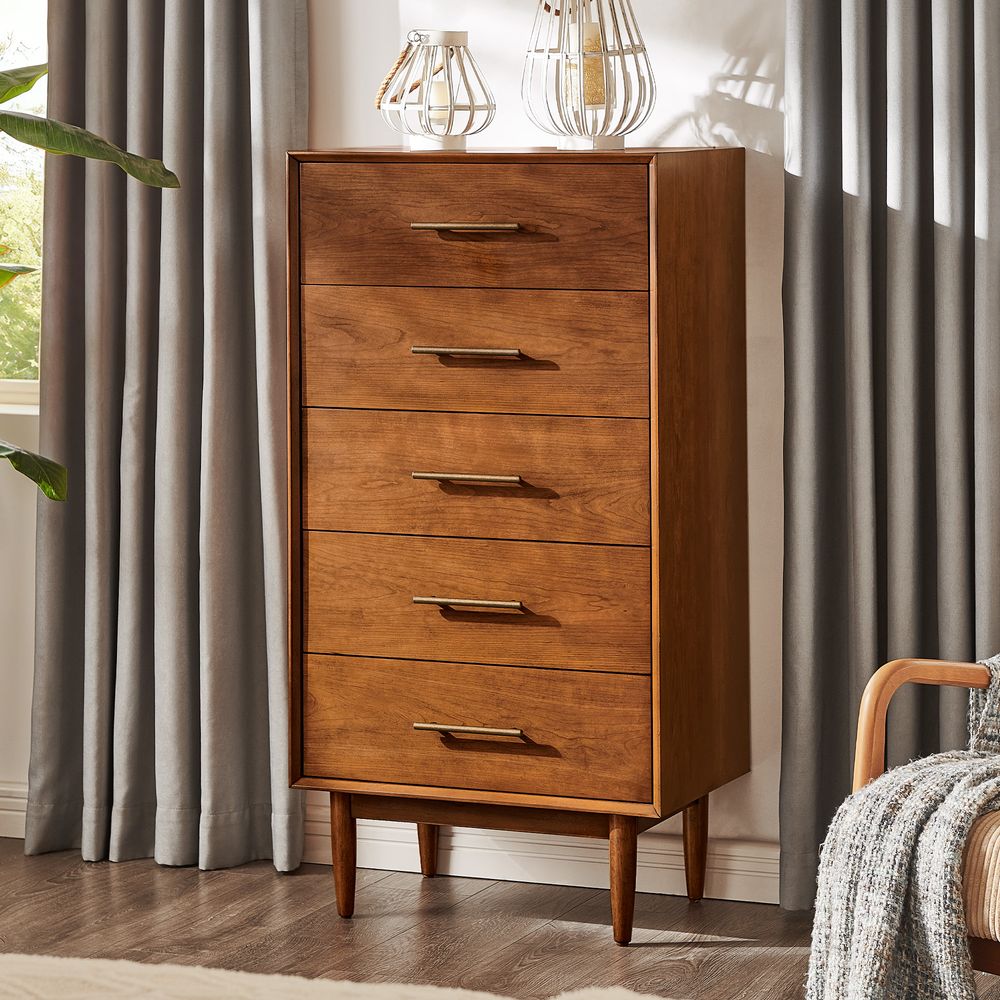
For bedrooms with limited wall width, compare models with narrower frames and vertically arranged drawers. The Kaden 26-Inch Mid-Century 5-Drawer Chest measures 26.8 inches wide, 18.1 inches deep, and 52.2 inches high. Its five-drawer configuration provides separate storage compartments without requiring the width of a larger dresser. This makes it worth considering when horizontal space is limited but additional bedroom storage is still needed.
Kaden 26-Inch Mid-Century 5-Drawer Chest
View Product
Check Drawer Opening Clearance
Measure from the front of the chest to the nearest obstruction to determine whether the drawers can open fully. Leave enough room to stand in front of the furniture and reach the contents without moving other pieces.
Also consider the accessibility of the upper drawers. A taller model may provide more vertical storage, but frequently used items should remain within comfortable reach. If the chest is intended for a child's bedroom, avoid choosing a height that makes everyday storage difficult to access safely.
Compare Overall and Interior Dimensions
Two five-drawer chests can have very different widths, depths, and interior capacities. Compare the full product dimensions rather than relying on drawer count alone.
Interior measurements are equally important. Check the usable width, depth, and height of individual drawers to determine whether they can accommodate folded clothing, accessories, or other belongings. Some designs have thick drawer sides or structural components that reduce usable interior space compared with their exterior dimensions.
How Many Drawers Do You Need in a Tall Chest of Drawers?
Tall chests commonly come with four to eight drawers, although some designs have fewer or more. The right configuration depends on how much clothing you need to store and whether you prefer separating belongings into individual categories.
Match Drawer Count to Your Storage Needs
A four-drawer chest may be sufficient for a guest room or a smaller clothing collection. A tall 5 drawer chest provides additional compartments for everyday bedroom storage, while a tall 6 drawer chest can make it easier to separate smaller items and different clothing categories.
For example, someone who stores T-shirts, underwear, socks, sleepwear, and accessories separately may prefer six drawers over four. Someone who mainly stores larger folded garments may need fewer but wider or deeper compartments.
Consider the following general differences:
-
Four drawers: Suitable for basic clothing storage or occasional-use rooms.
-
Five drawers: A practical configuration for separating everyday clothing into several categories.
-
Six drawers: Provides more compartments for smaller garments, accessories, and different clothing types.
-
Seven or eight drawers: Offers additional organization options, although individual compartments may be smaller.
These are general configuration differences rather than fixed storage rules. Actual capacity depends on each drawer's dimensions.
Consider Drawer Height and Configuration
Not all drawers in a chest need to be the same size. Some designs use shallow upper drawers for smaller items and deeper lower drawers for sweaters, jeans, or other folded garments.
A five-drawer model may offer fewer but larger compartments, while some six-drawer designs divide the available storage into smaller sections. Compare the interior measurements of each drawer to determine which arrangement better suits your clothing.
Best Materials and Construction for a Tall Chest of Drawers
When comparing tall chests, check the materials used for the frame, drawer boxes, drawer fronts, and top panel. Different components may use different materials, even within the same piece of furniture. Construction details also influence how well the drawers operate and how the furniture holds up to everyday use.
Solid Wood, Engineered Wood, and Veneer
Solid wood, engineered wood, and wood veneer are all common in bedroom furniture, but they serve different purposes.
Solid wood is made from natural timber and is often used for structural components, drawer fronts, or visible surfaces. Common furniture woods include oak, walnut, rubberwood, and mindi. Depending on the species, construction, and finish, some solid-wood surfaces can be refinished if they become worn.
Engineered wood includes materials such as MDF, particleboard, and plywood. These products are manufactured by bonding wood fibers, particles, or layers together. Their properties vary depending on the material and manufacturing process. Plywood, for instance, uses layered wood veneers, while MDF is made from compressed wood fibers.
Wood veneer is a thin layer of real wood applied to a core material, often engineered wood. It provides the visible grain and appearance of a particular wood species without requiring the entire panel to be made from solid lumber.
When comparing materials, check the specifications for each component instead of assuming the entire chest has the same composition. For veneered furniture, pay attention to the core material and how the veneer is applied, particularly around edges and frequently touched surfaces.
Drawer Joinery and Slides
Drawer construction affects how well the components hold together and how smoothly the drawers operate.
Dovetail joints are commonly used to connect drawer sides to the front or back. Their interlocking shape helps resist the forces created by repeated opening and closing. Mortise-and-tenon joints are more commonly used to connect structural furniture components, such as rails and legs.
When checking drawer construction, also inspect the thickness of the drawer panels, the fit of the joints, and how securely the drawer bottom is supported.
Drawer slides influence both movement and accessibility. Side-mounted slides are attached along the drawer sides, while undermounted slides sit beneath the drawer. Full-extension slides allow the drawer to open far enough to reach items at the back, whereas partial-extension slides leave part of the drawer inside the cabinet. Soft-close mechanisms reduce the impact when drawers close, but they do not automatically indicate better overall construction.
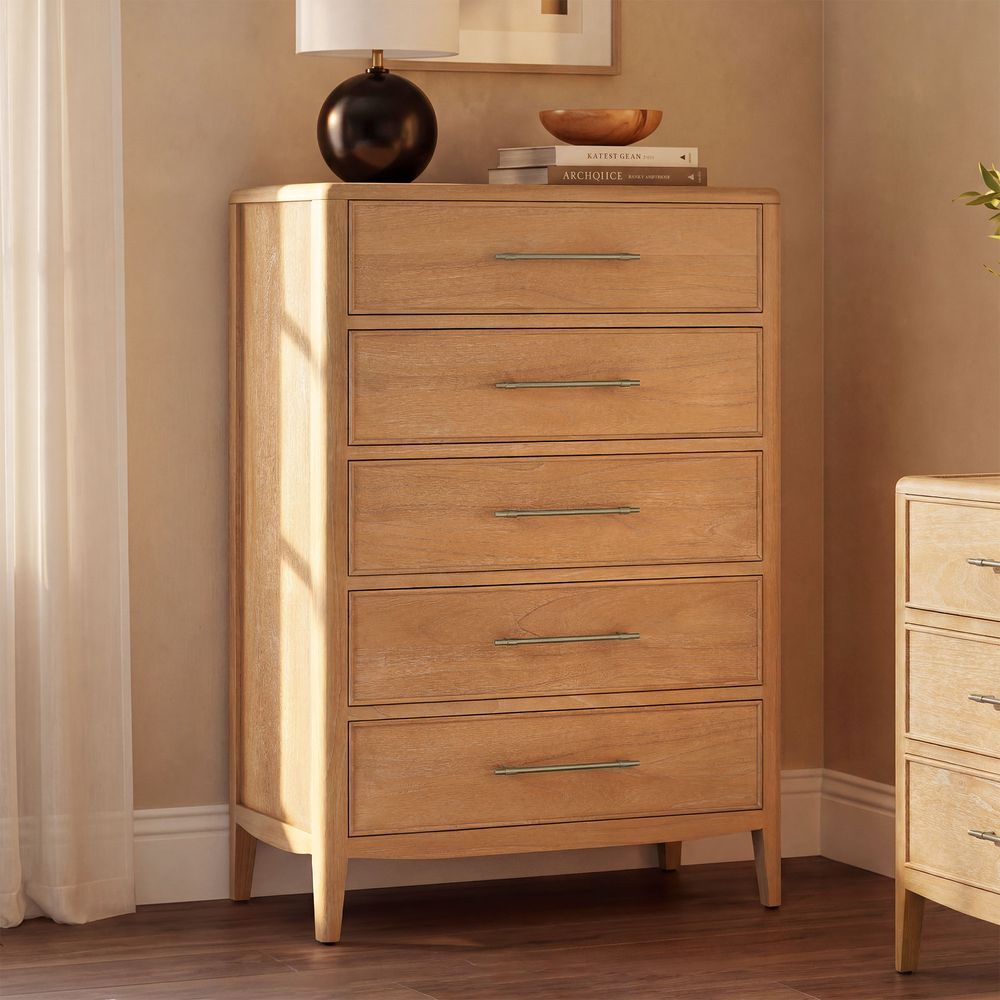
The Harrison 38-Inch 5-Drawer Chest provides an example of mixed-material construction, combining mindi wood and engineered wood with mindi veneers. Its drawers feature mortise-and-tenon joinery and undermounted soft-close glides. These specifications illustrate how material combinations, drawer connections, and slide mechanisms can vary between furniture designs.
Harrison 38-Inch 5-Drawer Chest
View Product
Hardware and Structural Stability
Drawer pulls, knobs, and handles should feel secure and provide enough grip for comfortable everyday use. Metal hardware is common, while some designs use integrated pulls or recessed handles for a simpler appearance.
Check that the drawer fronts sit evenly within the frame and that the hardware does not feel loose. The base should also provide stable support, with levelers available on some models to compensate for uneven flooring.
For taller furniture, check whether the manufacturer includes an anti-tip kit and provides installation instructions. The presence of an anti-tip device is an important safety consideration, particularly in homes with young children.
Storage Capacity and Drawer Layout: What Should You Look For?
The interior dimensions and layout determine how much a chest can actually hold. Two models with similar exterior dimensions may offer different usable storage because of variations in drawer depth, panel thickness, and internal construction.
Measure the Interior Drawer Dimensions
Check the usable width, depth, and height rather than relying only on the overall furniture dimensions. These measurements help determine whether drawers can hold folded clothing without excessive stacking or compression.
Use the following as a general guide when evaluating drawer space:
Actual storage needs depend on the size and quantity of your belongings, as well as how you fold and arrange them. If possible, compare the interior measurements with the dimensions of items you already own.
Choose a Layout That Matches Your Routine
A chest with evenly sized drawers provides a consistent layout for folded clothing. A design with different drawer heights offers more flexibility, allowing smaller items to stay separate from bulkier garments.
You can also use drawer dividers or removable organizers to create smaller compartments for socks, underwear, belts, and accessories. Before buying, check whether the drawer interiors have enough usable width to accommodate these accessories without reducing the space available for clothing.
Check Drawer Movement and Weight Capacity
Drawers should slide smoothly without excessive resistance, wobbling, or uneven movement. Full-extension slides can make it easier to reach items stored at the back, particularly in deeper drawers.
Check the manufacturer's stated drawer weight capacity if you plan to store heavier items. Overloading drawers can strain the slides, affect alignment, and make them harder to open. Keep heavier belongings within the manufacturer's recommended limits.
How to Choose a Style for Your Bedroom
Because a tall chest draws the eye upward, its height, finish, and leg design should work with the proportions of the bed, nightstands, and other bedroom furniture.
Match the Design to Your Bedroom Style
For a modern bedroom, look for clean lines, simple drawer fronts, and understated hardware. Mid-century designs often feature tapered legs, warm wood finishes, and subtle geometric details.
Traditional styles may include framed drawer fronts, decorative pulls, and more detailed woodwork. Rustic or vintage-inspired chests often use textured finishes, visible grain, or distressed details.
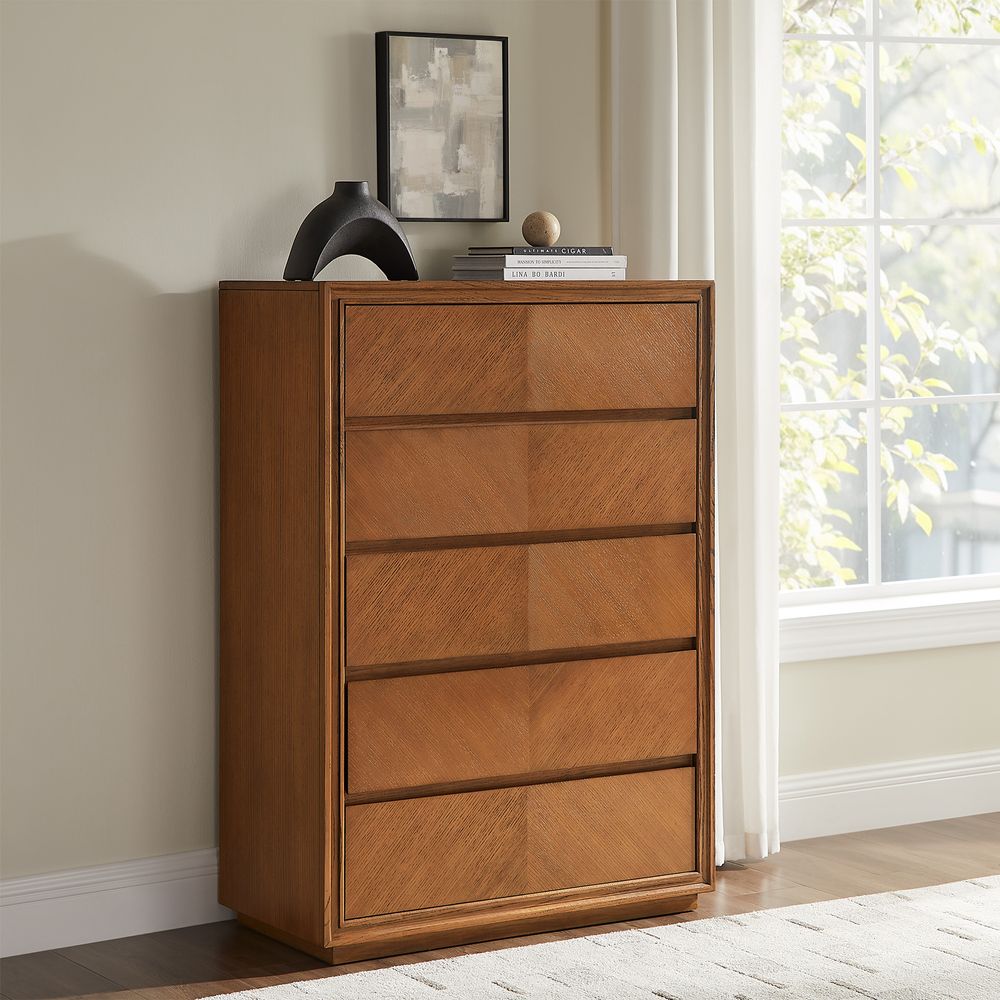
For a more decorative look, consider a chest with a patterned drawer front. The Thursen 36-Inch Chevron 5-Drawer Chest features a geometric chevron pattern, crafted of American solid oak and engineered wood with oak veneer. Its warm brown finish and parquet-inspired drawer design provide a more distinctive alternative to plain drawer fronts while retaining a vertical five-drawer configuration.
Thursen 36-Inch Chevron 5-Drawer Chest
View Product
Coordinate Colors and Finishes
The chest does not need to match every other wooden piece in the room. A light oak chest can work alongside darker furniture when the finishes share similar undertones or are connected through other elements in the space.
Consider the bed frame, nightstands, flooring, and wall color when choosing a finish. Repeating a warm or cool wood tone through smaller details can create visual continuity without making every furniture piece identical.
Also consider how the finish affects the room's overall appearance. Dark finishes can create a stronger visual contrast, while lighter wood tones may blend more easily into a smaller or brighter bedroom.
Placement and Safety Considerations for a Tall Chest of Drawers
A tall chest needs a stable position and proper wall anchoring to reduce the risk of tipping. These considerations are especially important in bedrooms where children may have access to the furniture.
Position the Chest on a Stable Surface
Place the chest on a level floor and adjust its levelers if the model includes them. Avoid positioning it where doors, heating equipment, or other household fixtures could interfere with its use.
If the floor is uneven, make sure the chest does not rock or tilt after installation. Follow the manufacturer's instructions for positioning and assembly, particularly when the furniture includes adjustable feet or a separate base.
Secure the Chest to the Wall
Tall chests can tip forward when multiple drawers are open or when someone pulls or climbs on them. Use the anti-tip hardware supplied with the furniture and follow the manufacturer's installation instructions.
Attach the furniture to an appropriate wall structure using suitable hardware. The correct fastener depends on the wall construction, so do not assume that the supplied screws are suitable for every wall type. An included anti-tip kit does not mean the chest is already secured.
Distribute Weight Carefully
Place heavier belongings in lower drawers and lighter items in the upper compartments. This helps keep the center of gravity lower and reduces the amount of weight concentrated near the top.
Open one drawer at a time and avoid using drawer fronts as steps or handles for climbing. In homes with young children, keep tempting objects off the top of the chest and use appropriate child-safety measures to discourage climbing.
FAQs
What Is the Standard Height of a Tall Chest of Drawers?
There is no single standard height for a tall chest of drawers. Many models are around 48 to 60 inches tall, although dimensions vary by design. Check the product specifications to make sure the height works with your room and furniture layout.
Is a Tall Chest of Drawers Suitable for a Small Bedroom?
Yes. Its vertical design can provide several storage compartments without requiring as much horizontal wall space as a wide dresser. However, you still need enough room for the drawers to open fully and for people to move around the furniture.
How Deep Should Drawers Be in a Bedroom Chest?
Drawer depth depends on what you plan to store. Shallow drawers work for smaller items such as socks and accessories, while deeper drawers are generally more practical for sweaters, jeans, and other bulky clothing. Always check the usable interior measurements rather than relying on the overall depth of the chest.
What Materials Are Best for a Tall Wooden Chest of Drawers?
Solid wood, engineered wood, and wood veneer are all used in bedroom furniture. The right choice depends on your budget, preferred appearance, and construction requirements. Check the specifications for the frame, drawer boxes, fronts, and top panel to understand how each component is made.
How Do I Prevent a Tall Chest of Drawers From Tipping Over?
Secure the chest to the wall using the supplied anti-tip hardware and follow the manufacturer's installation instructions. Keep heavier belongings in lower drawers, open one drawer at a time, and do not allow children to climb on the furniture.
Can I Put a TV on Top of a Tall Chest of Drawers?
It depends on the chest's top dimensions, weight capacity, and the TV's size and weight. Check the manufacturer's specifications before placing a television on top. A dedicated TV stand is generally preferable because its dimensions and load capacity are designed for television placement.