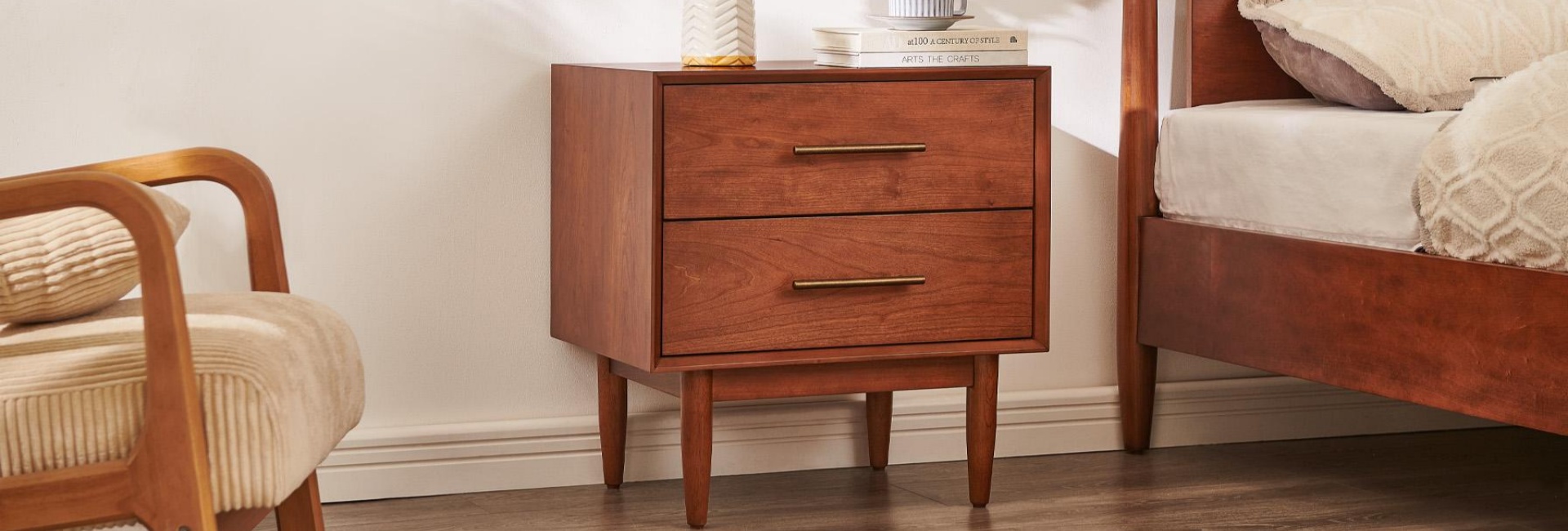
Mid-century modern nightstand combine clean lines, warm wood finishes, and practical storage in a compact design. The right nightstand should complement your bedroom, fit comfortably beside your bed, and provide convenient storage for everyday essentials. Before choosing a style, consider your mattress height, available floor space, preferred materials, and storage needs. This guide covers the design features, dimensions, construction details, and care considerations that can help you find a nightstand that suits your room.
Table of Contents
- What Makes a Nightstand Mid-Century Modern?
- Different Types of Mid-Century Modern Nightstands
- How to Choose the Right Nightstand Size
- What Materials and Construction Should You Look For?
- How to Match a Mid-Century Modern Nightstand with Your Bedroom
- How to Care for Your Mid-Century Modern Nightstand
- What to Check Before Buying a Mid-Century Modern Nightstand
- FAQs
- What Height Should a Mid-Century Modern Nightstand Be?
- Do Nightstands Need to Match the Bed?
- Are Solid Wood Nightstands Better Than Veneer?
- How Wide Should a Nightstand Be?
- Can You Use a Side Table as a Nightstand?
- How Much Storage Should a Nightstand Have?
- What Is the Difference Between a Mid-Century Modern Nightstand and a Traditional Bedside Table?
- How Do You Clean a Mid-Century Modern Wood Nightstand?
- Should I Buy One Nightstand or a Set of Two?
What Makes a Nightstand Mid-Century Modern?
Mid-century modern nightstands draw inspiration from furniture design popularized during the middle of the 20th century, particularly the 1940s through the 1960s. The style emphasizes clean geometry, understated decoration, natural materials, and functional design.
Rather than relying on elaborate carvings or heavy ornamentation, these bedside tables use simple shapes and carefully considered proportions. Several recurring details help distinguish a mid-century modern nightstand from other bedroom furniture styles.
Clean Lines and Minimalist Silhouettes
A straightforward silhouette is one of the defining features of mid-century modern furniture. Rectangular cabinet bodies, gently rounded corners, and uncluttered drawer fronts create a balanced appearance without unnecessary decoration.
These designs can work in different bedroom settings. A walnut nightstand, for example, can complement neutral bedding and an upholstered bed, while a darker wood finish can add contrast to a lighter room.
Look for balanced proportions, simple drawer fronts, and details that contribute to the overall design rather than competing for attention.
Tapered Legs and Raised Bases
Tapered legs are among the most recognizable features of mid-century modern furniture. They gradually narrow toward the floor, giving a cabinet a lighter appearance than traditional furniture with a solid base.
Some designs use slightly angled legs, while others feature straight, tapered supports. Both styles create a sense of openness beneath the cabinet.
A tapered leg nightstand can also make a compact bedroom feel less crowded by leaving more of the floor visible. Check the actual clearance underneath if you plan to clean beneath the furniture or place a small storage basket there.
Warm Wood Tones and Natural Materials
Wood plays an important role in the mid-century modern aesthetic. Walnut, oak, teak, and beech are commonly associated with this style, each offering a different grain pattern and color.
Walnut has rich brown tones and varied grain, making it a natural choice for warm or neutral bedroom palettes. Oak generally has a lighter appearance with visible grain, while teak is known for its warm golden-brown color and association with classic mid-century furniture.
A mid-century modern wood nightstand does not necessarily need to be made entirely from solid lumber. Wood veneer can also provide a natural wood surface over a supporting structure made from plywood or other engineered materials.
Simple Hardware and Functional Details
Mid-century modern furniture generally favors understated hardware. Small metal pulls, recessed handles, and simple knobs keep attention on the cabinet's shape and wood finish.
Antique bronze and brass-toned hardware can add warmth, while darker metal accents create a more subtle contrast.
For a closer look at these design features, consider the Kaden 23-Inch Mid-Century Nightstand from Hernest. Its tapered wood legs give the cabinet a raised, airy profile, while the beveled drawer fronts and antique bronze hardware add subtle detail without making the design feel overly decorative. The Brown Cherry finish brings out the warm wood tones often associated with mid-century furniture. Two dovetail-jointed drawers offer convenient storage for bedside essentials, combining the clean look of mid-century design with everyday functionality.

Kaden 23-Inch Mid-Century Nightstand
View Product
Different Types of Mid-Century Modern Nightstands
Mid-century modern nightstands come in several configurations. Although they may share similar wood finishes and tapered legs, their storage arrangements can make a noticeable difference in everyday use.
Think about what you usually keep beside your bed before choosing a design. Someone who only needs space for a phone and reading glasses may not need the same storage capacity as someone who keeps books, chargers, and personal accessories nearby.
One-Drawer Nightstands
A single drawer is usually enough for smaller bedside essentials, such as glasses, charging cables, tissues, and personal accessories. The open tabletop leaves room for a lamp or book without taking up too much floor space.
This compact configuration is a practical choice for smaller bedrooms or bedside areas with limited clearance.
Two-Drawer Nightstands
A mid-century modern nightstand with drawers provides more concealed storage without necessarily requiring a much larger footprint.
The upper drawer can hold smaller everyday essentials, while the lower drawer offers space for books, accessories, or other bedside belongings. This arrangement helps keep the tabletop organized while keeping frequently used items within reach.
Before choosing a two-drawer design, compare the interior width, depth, and height. Two nightstands with the same number of drawers can offer very different amounts of usable storage.
Open-Shelf Nightstands
Open-shelf nightstands use an exposed compartment instead of, or alongside, traditional drawers.
An open shelf keeps books, magazines, and frequently used items within easy reach. It also makes it easier to see what is stored without opening a drawer.
The main trade-off is visibility. If you prefer a tidy bedside area, a combination of open shelving and concealed storage may be a better fit than a fully open design.
Cabinet-Style and Floating Nightstands
Cabinet-style nightstands use enclosed storage, often with a hinged door instead of traditional drawers. Depending on the interior dimensions, they can accommodate items that do not fit comfortably in shallow drawers.
Floating nightstands attach to the wall rather than resting on floor-standing legs. They are useful in compact bedrooms where keeping the floor clear is a priority.
Wall-mounted furniture requires suitable wall support and secure installation. Follow the manufacturer's mounting instructions and confirm that the wall construction can support the intended load.
How to Choose the Right Nightstand Size
When comparing mid-century modern nightstand dimensions, consider mattress height, available floor space, and drawer clearance. A nightstand that looks proportionate in a product photograph may feel inconvenient if it is too tall, too deep, or difficult to access beside your bed.
Match Nightstand Height to Mattress Height
The tabletop should generally sit close to the top of your mattress. This makes it easier to reach a phone, glass of water, or bedside lamp without stretching too far up or down.
Measure from the floor to the top of your mattress, including any topper you regularly use. Compare that measurement with the listed overall height of the nightstand.
A surface slightly above or below mattress height can still work, but avoid choosing one that requires you to stretch or lean down to reach frequently used items.
For example, a low platform bed may work better with a shorter nightstand, while a taller upholstered bed may need a higher piece. Your preferred sleeping position and the height of items you keep nearby also affect comfort.
Choose Width Based on Your Bed and Available Space
Nightstand width affects both visual balance and tabletop space.
A narrow bedside table may look proportionate beside a twin or full bed, while a wider piece can provide a better balance next to a queen or king bed. However, bed size alone should not determine the final dimensions. The distance between the bed frame, wall, and nearby furniture matters just as much.
Consider these general guidelines:
-
Twin and full beds: Slimmer nightstands can preserve walking space in smaller rooms.
-
Queen beds: Medium-width designs often offer a practical balance between storage and tabletop space.
-
King beds: Wider nightstands may look more proportionate and provide additional room for lamps and personal belongings.
These are starting points, not fixed sizing rules. Measure the available space on each side of your bed before ordering.
Consider Depth and Available Floor Space
Depth determines how far the nightstand extends into the bedroom.
A deeper table provides more room for a lamp, books, and other essentials, but it can also obstruct walking paths or nearby furniture. Measure the distance between the wall and the outer edge of your bed frame to determine how much room remains.
Check the position of curtains, closet doors, bedroom doors, and other furniture as well. A nightstand that fits against the wall may still obstruct the walking path.
For narrow bedrooms, a shallower design may be more practical than a large cabinet with additional storage.
Check Drawer Clearance and Walking Space
The overall footprint is only part of the measurement process. You also need enough room to open drawers and access stored belongings comfortably.
Before ordering, check:
-
Can the drawers open fully without hitting the bed frame?
-
Is there enough room to stand comfortably while using the drawers?
-
Will the nightstand interfere with nearby doors or curtains?
-
Can you walk around the bedside area without turning sideways?
A simple way to test the layout is to mark the proposed width and depth on the floor using painter's tape. You can then check the available walking space and estimate how far the drawers will extend.
What Materials and Construction Should You Look For?
The material description tells you what goes into a nightstand, but it does not automatically determine its quality. Solid wood, wood veneer, and engineered wood each have different characteristics.
Understanding how these materials are used can help you compare furniture construction more accurately.
Solid Wood vs. Wood Veneer vs. MDF
Solid wood is made from natural lumber rather than a manufactured wood panel. Walnut, oak, and teak are common choices in furniture construction. Its natural grain and material character are part of its appeal. Depending on the species and finish, solid wood may also be suitable for refinishing or repair.
However, solid wood can expand or contract as temperature and humidity change. It may also develop surface marks through everyday use, so construction quality and proper care remain important.
Wood veneer consists of a thin layer of real wood applied to a supporting material, such as engineered wood or plywood. This construction allows furniture to display natural wood grain without requiring the entire cabinet to be made from solid lumber.
A properly applied veneer provides a real wood surface while allowing manufacturers to use different materials for the underlying structure. When comparing products, pay attention to edge finishing, surface consistency, and how exposed corners are protected.
Medium-density fiberboard (MDF) is manufactured from wood fibers combined with resin under heat and pressure. It provides a relatively uniform surface and is often used in furniture panels and painted finishes. Other engineered wood products may also be used in cabinet construction.
Engineered wood is not automatically a sign of poor quality. The way the material is used, how the components are joined, and whether the finished product suits its intended use are more useful factors to evaluate.
Understand Popular Wood Choices
Different wood species create different visual effects. The following comparison can help you identify a finish that works with your bedroom furniture.
Remember that a product's finish name does not necessarily identify its underlying wood species. A Walnut Brown finish, for example, may describe the color rather than indicate solid walnut construction.
Always check the actual material description before purchasing.
Examine Drawer Construction and Hardware
Drawers are among the most frequently used parts of a nightstand, so their construction deserves attention.
Check the following details:
-
Drawer joints: Look for well-fitted connections between the drawer sides and front or back.
-
Drawer bottoms: Check whether the bottom panel appears securely supported.
-
Drawer movement: Drawers should open and close smoothly without excessive resistance or noticeable wobbling.
-
Hardware: Handles and pulls should feel securely attached.
-
Interior dimensions: Confirm that the drawer can accommodate the items you plan to store.
Dovetail joints are a traditional woodworking method used to connect drawer components. Their interlocking shape helps provide a secure connection between the drawer sides and front or back.
Check Leg Stability and Finish Quality
Tapered legs contribute to the mid-century look, but their appearance should not be the only consideration.
Check how the legs connect to the cabinet and whether the supporting structure feels stable. The legs should sit evenly on the floor without noticeable rocking during normal use. Adjustable levelers can help compensate for uneven flooring.
The finish deserves similar attention. Look for consistent color, smooth edges, and even coverage across visible surfaces. Pay particular attention to corners and areas around drawer fronts, where wear may become more noticeable.
How to Match a Mid-Century Modern Nightstand with Your Bedroom
A mid-century modern nightstand should complement the bed and surrounding furniture without making the bedroom feel overly coordinated.
You do not need every piece to have the same finish, material, or shape. Repeating a few visual details throughout the room can create a more cohesive appearance.
Match Nightstands with Different Bed Frames
Mid-century modern nightstands can work with several types of bed frames.
A wooden bed frame creates a natural pairing, especially when the wood tones have similar warmth. However, the finishes do not need to match exactly. A walnut nightstand can complement a lighter oak bed when the contrast looks intentional.
With an upholstered bed, a wooden nightstand can introduce texture and contrast. Warm wood often works particularly well with cream, beige, gray, and muted green fabrics.
For metal bed frames, consider the nightstand's hardware and leg details. Repeating a restrained metal accent in the bedside lighting or other bedroom accessories can connect the pieces visually.
Coordinate Wood Tones and Finishes
When combining different wood finishes, consider their undertones as well as their overall darkness.
For example, a warm cherry finish can work with other brown wood furniture, while a lighter or cooler finish may create a more noticeable contrast.
A few approaches can help:
-
Keep wood tones within a similar warm or cool color family.
-
Use a lighter nightstand to contrast with a darker bed frame.
-
Repeat one metal finish across drawer hardware, lighting, or other bedroom accents.
-
Use bedding and rugs to soften differences between furniture finishes.
If your bedroom already contains several wood tones, a simple nightstand design can help keep the space visually balanced.
Choose One Nightstand or a Matching Pair
A matching pair creates symmetry and works particularly well when the bed is centered against a wall with similar space on both sides.
However, two matching nightstands are not essential. A single nightstand may be more practical when the bed is positioned against a wall or one side has limited clearance.
You can also use two different nightstands while maintaining a coordinated appearance. Choose pieces with similar heights, comparable visual weight, or complementary wood tones.
Before purchasing a set of two, measure both sides of the bed separately. Uneven wall space, outlets, windows, or other furniture may make two identical pieces difficult to accommodate.
Style the Nightstand with Practical Accessories
The tabletop should remain functional after you add decorative accessories.
Start with the items you use most frequently, such as a lamp, phone, glasses, or a book. Arrange these first, then introduce a few decorative pieces if space allows.
A simple arrangement might include:
-
A table lamp positioned toward one side.
-
A small tray for jewelry, glasses, or other accessories.
-
A short stack of books.
-
One decorative object, such as a small vase.
Pay attention to the lamp's base and shade dimensions. A lamp may fit on the tabletop but still extend too far beyond its edges or interfere with other bedside items.
How to Care for Your Mid-Century Modern Nightstand
Routine cleaning and careful use help maintain a nightstand's finish and hardware. The right care routine depends on the materials and surface treatment used in its construction.
Clean Wood Surfaces Carefully
For everyday cleaning, use a soft, dry or slightly damp cloth, following the manufacturer's care instructions.
Avoid leaving excess moisture on the surface, particularly around veneer edges and panel joints. Dry the furniture after wiping it down.
Strong solvents, abrasive pads, and harsh household cleaners may damage certain coatings. When using a new cleaning product, check the manufacturer's recommendations first.
Prevent Scratches and Water Damage
Nightstands are frequently exposed to glasses, drinks, electronic devices, and decorative accessories. A few simple habits can help reduce surface damage:
-
Use coasters under drinks to prevent water rings.
-
Place trays beneath small accessories.
-
Avoid dragging heavy objects across the tabletop.
-
Wipe up spills promptly.
-
Keep furniture away from prolonged direct sunlight where possible.
-
Avoid placing hot objects directly on finished wood surfaces.
If you use a lamp or electronic device, keep cables organized and avoid allowing them to pull against the furniture.
Maintain Hardware and Drawer Components
Handles, drawer slides, and other moving components can loosen through regular use.
Check the hardware periodically and tighten loose screws when necessary. If a drawer becomes difficult to operate, inspect it for obstructions or uneven positioning before applying lubricant or making adjustments.
Avoid forcing a drawer that does not move smoothly, as this may damage its components.
Follow Care Instructions for Different Finishes
Different surface treatments require different cleaning methods.
For veneer furniture, avoid excessive moisture, particularly near exposed edges. For painted or glazed surfaces, use cleaning methods approved for the specific finish.
If the product includes a care guide, follow those instructions rather than relying on general advice for all wooden furniture.
What to Check Before Buying a Mid-Century Modern Nightstand
Before making a final decision, compare the product's appearance with its actual specifications and construction details.
Use this checklist to narrow down your options:
-
Materials: Does the product clearly identify its wood and engineered materials?
-
Construction: Are the drawer joints, legs, and hardware adequately described?
-
Storage: Do the drawers or shelves accommodate your everyday belongings?
-
Finish: Does the color work with your existing bedroom furniture?
-
Assembly: Does the product require full assembly or only partial installation?
-
Delivery: Will the packaged furniture fit through your doors, hallways, and stairways?
-
Weight capacity: Is the recommended capacity suitable for the items you plan to place on the nightstand?
-
Quantity: Do you need one nightstand or a matching pair?
It is also worth checking the product's listed weight and assembly instructions. These details can help you plan for delivery, setup, and placement before the furniture arrives.
A good buying decision comes down to how well the nightstand fits your room, supports your daily routine, and complements the furniture you already own.
FAQs
What Height Should a Mid-Century Modern Nightstand Be?
A mid-century modern nightstand should generally sit close to the top of your mattress. Measure from the floor to the mattress surface, including any topper, and compare that measurement with the nightstand's listed height. A surface slightly higher or lower may still work, provided everyday items remain comfortable to reach.
Do Nightstands Need to Match the Bed?
No. Nightstands do not need to match the bed's exact wood species or finish. You can create a coordinated bedroom by choosing complementary wood tones, repeating similar design details, or using consistent hardware finishes. A wooden nightstand can also provide contrast beside an upholstered or metal bed frame.
Are Solid Wood Nightstands Better Than Veneer?
Not necessarily. Solid wood offers natural grain and may be suitable for refinishing, while wood veneer provides a real wood surface over a supporting material. The quality of the construction, veneer application, joints, and finish all influence how well a nightstand performs over time. Compare the complete material description rather than judging by one material alone.
How Wide Should a Nightstand Be?
The ideal width depends on your bed size, available bedside space, and storage requirements. A narrower design may suit a twin bed or compact bedroom, while a wider piece can provide better visual balance beside a king bed. Measure the available space before choosing a specific width.
Can You Use a Side Table as a Nightstand?
Yes. A side table can work as a nightstand if its height, tabletop area, and stability suit your bedside needs. However, many accent tables do not include drawers or enclosed storage. Consider where you will keep smaller essentials before choosing one as a replacement for a traditional bedside table.
How Much Storage Should a Nightstand Have?
Choose storage based on the items you regularly keep beside your bed. One drawer may be sufficient for glasses, chargers, and small personal belongings, while two drawers or a cabinet may be better if you keep books, accessories, and other items nearby. Check interior drawer dimensions rather than relying on drawer count alone.
What Is the Difference Between a Mid-Century Modern Nightstand and a Traditional Bedside Table?
A mid-century modern nightstand typically features clean lines, tapered legs, understated hardware, and warm wood tones. Traditional bedside tables may use heavier cabinet bases, more decorative details, or ornate finishes. Both can provide practical storage, but their silhouettes and overall design language are different.
How Do You Clean a Mid-Century Modern Wood Nightstand?
Use a soft cloth and follow the manufacturer's cleaning instructions for the specific finish. Avoid excessive moisture, abrasive cleaning materials, and unapproved solvents. Use coasters to prevent water rings and wipe up spills promptly. Veneer, solid wood, and painted finishes may require different care methods.
Should I Buy One Nightstand or a Set of Two?
Choose based on your bedroom layout and how you use each side of the bed. A matching pair creates a symmetrical appearance and provides equal storage on both sides. A single nightstand may be more practical when the bed is against a wall or one side has limited space. Measure both bedside areas before purchasing a set.