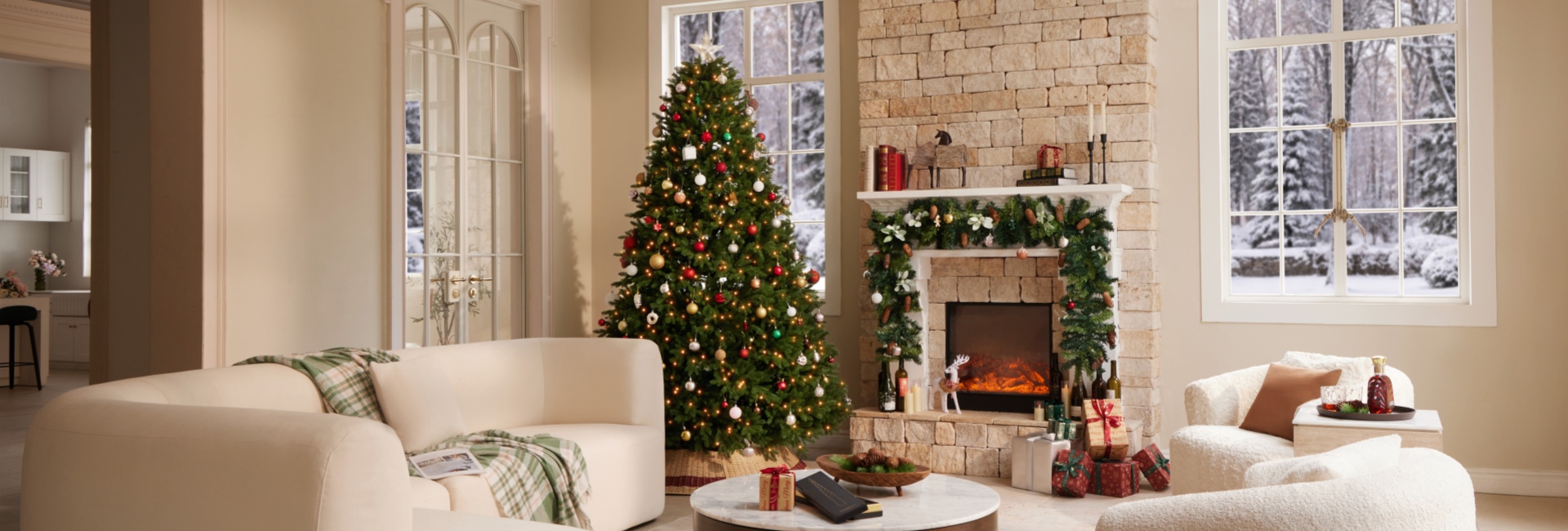
How to choose an artificial Christmas tree is easier when you start with a tape measure instead of the showroom floor. A tree can look perfect in a store and still be too tall for your ceiling, too wide for your living room, or too dense for the way you decorate.
The basic order is simple: measure your ceiling, measure your floor space, choose the shape, compare needle materials, then decide on lighting and budget. Once those basics are right, details such as flocking, tip count, and storage become much easier to judge.
For most shoppers, the goal isn't simply to find the biggest or fullest tree. It's to find one that fits the room, looks convincing up close, is easy to set up, and still makes sense after several holiday seasons.
Table of Contents
- Quick Answer: How Do You Choose an Artificial Christmas Tree?
- Start With Your Ceiling Height
- Measure Your Floor Space, Not Just the Height
- Choose PE, PVC, or a Blend
- Decide Between Pre-Lit and Unlit
- Consider an Interactive Christmas Tree
- Understand Tip Count and Branch Density
- Choose Green, Flocked, or Frosted
- Choose the Right Tree for a Small Space
- Think About Assembly and Storage
- How Long Should an Artificial Christmas Tree Last?
- How Much Should You Spend on an Artificial Christmas Tree?
- Real vs. Artificial: What About the Environment?
- What to Know Before Buying an Artificial Christmas Tree
- FAQs
- What size artificial Christmas tree should I get for an 8-foot ceiling?
- How do I choose between a full, slim, and pencil Christmas tree?
- Is PE or PVC better for an artificial Christmas tree?
- How many tips should an artificial Christmas tree have?
- Is a pre-lit artificial Christmas tree worth it?
- How long does an artificial Christmas tree last?
- Are artificial Christmas trees fireproof?
- Is a real or artificial Christmas tree better for the environment?
Quick Answer: How Do You Choose an Artificial Christmas Tree?
Start with these six decisions:
-
Measure ceiling height and account for your tree topper.
-
Measure floor space and check the tree's maximum base diameter.
-
Choose the profile: full, slim, or pencil.
-
Compare needle materials: PE generally looks more realistic than PVC.
-
Choose pre-lit or unlit based on how much lighting flexibility you want.
-
Check construction, tip count, warranty, and storage requirements before buying.
A useful height formula is:
Maximum tree height = ceiling height − topper height − desired clearance
Start With Your Ceiling Height
Height is the first measurement to make because an artificial tree cannot be trimmed down once it arrives.
Measure from the floor to the ceiling, then subtract the height of your topper and a little clearance. Remember that the listed tree height usually includes the stand and the topmost branch, so don't assume a 7.5-foot tree leaves 6 inches of usable space under an 8-foot ceiling.
What Size Artificial Christmas Tree Fits Your Ceiling?
These are starting points rather than strict rules. Your topper, ceiling fixture, and the exact listed tree height can change the calculation.
Leave Room for the Topper
A topper can add anywhere from a few inches to more than a foot.
If your ceiling is 8 feet high, for example, a 7-foot tree leaves 12 inches of total space above the tree. A 9-inch star would leave only about 3 inches, which may work depending on the shape of the topper and the exact tree height, but gives you little room for adjustment.
If you don't use a topper, you can use more of the available vertical space.
Before buying, measure both:
-
the ceiling height
-
the height of the topper you plan to use
That two-minute measurement can prevent a surprisingly expensive December return.
Measure Your Floor Space, Not Just the Height
A tree can fit vertically and still overwhelm the room.
Check the maximum base diameter in the product specifications and compare it with the area where you plan to place the tree. Remember to account for nearby furniture, walkways, doors, and the distance needed to reach electrical outlets.
A 7.5-foot full tree can take up significantly more floor space than a 7.5-foot slim tree.
If your tree will sit beside a sofa, media console, staircase, or entry path, that difference matters.
Full vs. Slim vs. Pencil Christmas Trees
Full trees have the broadest traditional silhouette. They make sense when you have enough open floor space and want the tree to serve as the room's main holiday focal point.
Slim trees keep much of the height while reducing the footprint. They work especially well in apartments, corners, bedrooms, foyers, and living rooms where a full tree would interfere with circulation.
Pencil trees are narrower still. They're useful for very tight spaces, small entryways, flanking a console, or adding a second tree without taking over the room.
If you're deciding between two trees at the same height, compare their base diameters before comparing anything else.
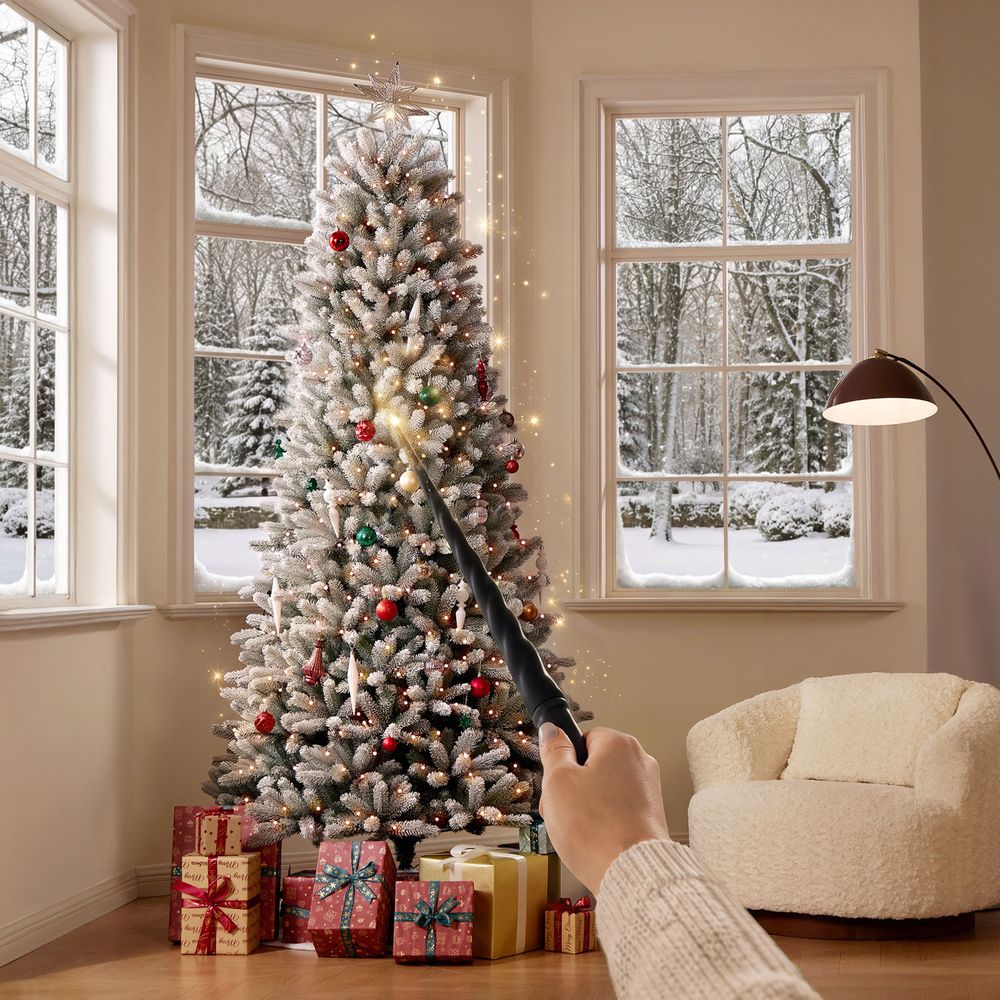
For shoppers who want a tall tree without the footprint of a traditional full profile, the CastGlow 7.5′ Artificial Christmas Tree Slim Flocked is designed around that use case.
CastGlow 7.5′ Artificial Christmas Tree Slim Flocked
View Product
Choose PE, PVC, or a Blend
Once the dimensions are right, needle material becomes one of the biggest differences you'll notice.
Artificial Christmas trees commonly use polyethylene (PE), polyvinyl chloride (PVC), or a combination of both.
Why PE Looks More Realistic
PE needles are injection-molded into three-dimensional shapes, often using molds based on real evergreen branches. That gives individual tips more depth and variation than flat-cut PVC needles.
The result is usually more convincing from across the room and up close.
PE also tends to have a more substantial feel when you run your hand through the branches. If realism is one of the main reasons you're choosing an artificial tree, molded PE is worth prioritizing.
The CastGlow collection from Hernest uses 100% PE needles, giving the line a clear focus on realistic branch construction.
What PVC Still Does Well
PVC is widely used because it is economical and can create dense coverage, particularly closer to the center of the tree.
Some artificial trees combine PE tips on the outside with PVC foliage deeper inside. This approach can balance a more realistic appearance with additional interior fullness.
The useful question isn't simply "Is PVC bad?"
It's:
"Where is the PVC used, and what does the outside of the tree look like?"
If realistic outer branches are your priority, look for PE tips where you'll see and touch them most.
Decide Between Pre-Lit and Unlit
The choice between pre-lit and unlit comes down to how you want to decorate each year.
Pre-lit trees have their lights installed before the tree reaches your home. Setup is generally faster because you assemble the sections, connect the plugs, fluff the branches, and turn the lights on.
Unlit trees give you a blank canvas. You choose the light color, strand type, density, and arrangement yourself.
Pre-Lit vs. Unlit at a Glance
If you use roughly the same lighting design every year, pre-lit can save a lot of setup time.
If changing the lights is part of your decorating ritual, an unlit tree gives you more freedom.
LED vs. Incandescent
Most newer pre-lit artificial Christmas trees use LED lights because they consume less electricity and generally produce less heat than traditional incandescent bulbs.
Incandescent lights can still appeal to shoppers who prefer their warmer, familiar glow, but LEDs are generally the more practical choice for a tree you'll use repeatedly over many seasons.
Consider an Interactive Christmas Tree
Pre-lit doesn't necessarily mean basic.
Some artificial Christmas trees simply provide steady white or multicolor lighting. Others add multiple lighting effects, color options, dimming controls, remotes, or interactive controls.
If you want the lighting itself to become part of the holiday experience, an interactive Christmas tree is worth considering.
Hernest's CastGlow pre-lit trees combine RGB lighting with multiple light shows, dimming controls, an IR remote, and a Magic Wand control option. Instead of simply plugging in a fixed strand, you can actively change the tree's lighting effects.
The Magic Wand is particularly useful for families because it turns lighting control into something physical and shared. Children can participate without needing a phone or app, while adults still have the remote when they want straightforward control.
If interactive lighting is important to you, compare the actual control method—not just whether a product says "pre-lit."
Understand Tip Count and Branch Density
Tip count refers to the number of individual branch ends on an artificial tree.
More tips can contribute to a fuller appearance, but tip count should not be treated as a universal quality score.
A 7.5-foot full tree and a 7.5-foot slim tree can have very different tip counts and still be appropriately designed for their respective profiles. Needle material, branch depth, tip length, and how the branches are distributed also affect how full a tree looks.
That's why it's better to compare tip counts between trees with similar:
-
height
-
profile
-
needle material
-
branch structure
Rather than simply choosing the tree with the largest number.
What About Christmas Tree Light Count?
You may also see recommendations of around 100 lights per foot of tree height. Treat that as a starting point rather than a minimum requirement.
A 7.5-foot tree might look great with fewer or more lights depending on:
-
bulb size
-
branch density
-
light brightness
-
color
-
how deeply the lights sit in the branches
-
whether you prefer a subtle glow or a brighter display
For pre-lit trees, compare the manufacturer's actual light count and lighting modes instead of assuming every tree should meet one universal number.
Choose Green, Flocked, or Frosted
Once the functional decisions are made, you can choose the finish.
Green Artificial Christmas Trees
Green is the most versatile option if you want one tree that can work with different decorating styles for years.
It pairs easily with traditional ornaments, metallic decorations, colorful lights, minimalist schemes, and family ornaments collected over time.
If you're buying one artificial tree and expect to keep it for many seasons, green is the safest style choice.
Flocked Christmas Trees
Flocked trees have a snow-covered appearance that creates a softer, winter-focused look.
They're especially effective if your holiday decor uses neutral colors, warm lighting, wood tones, or a more rustic aesthetic.
The trade-off is that flocking becomes part of the tree's visual identity. If you frequently change your decorating style, a plain green tree gives you more flexibility.
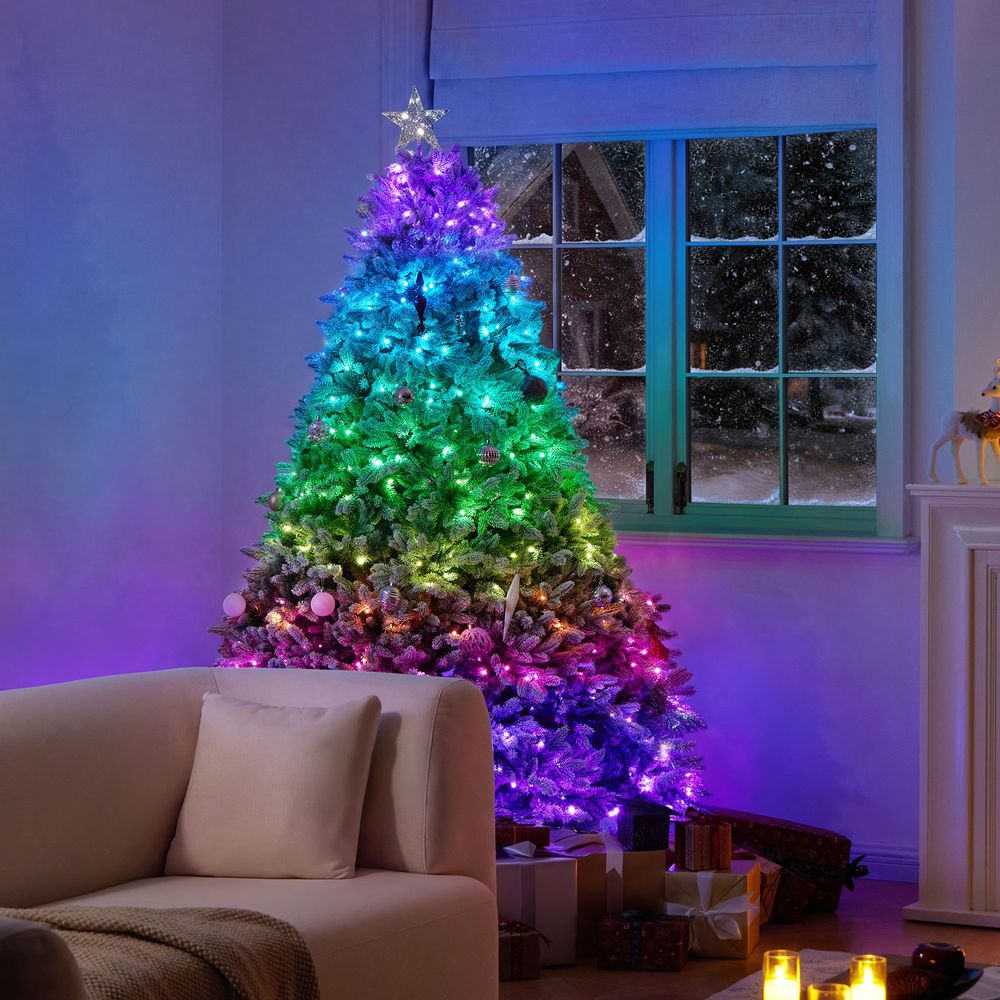
For a lower ceiling where you still want a snowy appearance, the CastGlow 6.5′ Artificial Christmas Tree Full Flocked combines a shorter height with a full profile and flocked finish.
Frosted Christmas Trees
Frosted trees generally use a lighter coating or tipped-branch effect rather than the heavier snowy appearance associated with flocking.
They're a middle ground if you want some winter character without making the entire tree look snow-covered.
CastGlow 6.5′ Artificial Christmas Tree Full Flocked
View Product
Choose the Right Tree for a Small Space
Small-space decorating requires more than simply buying a shorter tree.
A 6.5-foot tree can still be too wide for a compact apartment if it has a full profile.
For smaller rooms, look at the combination of:
height + base diameter + profile
rather than height alone.
A slim 7.5-foot tree can sometimes make better use of vertical space than a short, wide tree.
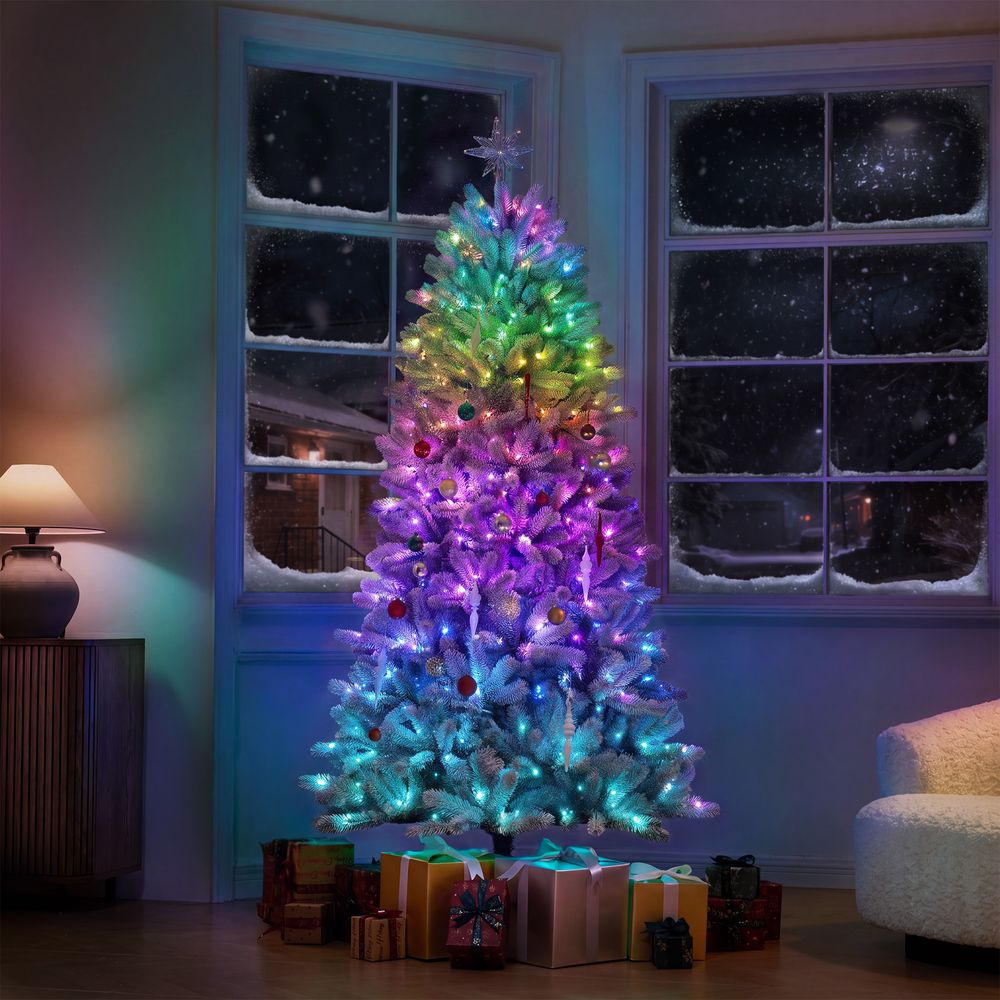
The CastGlow 6.5′ Artificial Christmas Tree Slim Flocked is another option for apartments, bedrooms, home offices, and secondary holiday displays where floor space is limited.
Measure the Walking Path
Before ordering, mark the tree's approximate diameter on the floor with painter's tape or a few pieces of paper.
Then walk around it.
Can you still open nearby doors? Can you reach the window? Does it block the TV or media console? Can people walk past without brushing the branches?
This simple test is often more useful than judging a product photo.
CastGlow 6.5′ Artificial Christmas Tree Slim Flocked
View Product
Think About Assembly and Storage
A Christmas tree has two important moments: when you put it up and when you put it away.
For annual use, hinged branches are generally easier to assemble than designs that require individual branches to be attached to the center pole.
Section-based construction also matters. A tree that separates into manageable sections is easier to move between storage and the living room.
CastGlow trees use section-based assembly designed to be completed without tools. Depending on the model, the tree is divided into multiple sections that connect during setup.
Before buying, check:
-
number of tree sections
-
whether branches are hinged
-
whether tools are required
-
storage bag availability
-
packed dimensions
-
shipping carton count
For larger trees, also check how many cartons the order contains and make sure all cartons arrive before starting assembly.
Store Your Tree Somewhere Cool and Dry
Storage conditions affect how long an artificial tree stays in good shape.
Avoid leaving it in direct sunlight or a hot, damp area for extended periods. Heat can accelerate material aging, while moisture can create problems when the tree is packed away.
A cool, dry storage area is preferable to a damp garage or an extremely hot attic.
When packing the tree away, avoid crushing the branch tips more than necessary. A little care in January can make setup much easier the following December.
How Long Should an Artificial Christmas Tree Last?
A well-made artificial Christmas tree can last for many years. Around 10 years of use is a useful benchmark, while a well-maintained higher-quality tree can last considerably longer.
The American Christmas Tree Association has cited an average artificial tree lifespan of around 10 years, with careful use potentially extending well beyond that.
Lifespan depends on more than needle material.
The construction of the stand, pole, branch hinges, electrical components, and storage conditions all matter.
What Shortens a Tree's Lifespan?
Three problems show up repeatedly:
Heat and sunlight: Prolonged exposure can fade foliage and affect some finishes.
Rough handling: Pulling, twisting, or forcing branches can damage branch wires and connections.
Poor storage: Moisture, excessive heat, and tightly compressed branches can make the next setup harder and shorten the useful life of the tree.
When Should You Replace an Artificial Christmas Tree?
Consider replacing it when:
-
branches have become brittle
-
foliage has noticeably faded
-
the structure no longer holds its shape
-
the stand or pole becomes unstable
-
electrical components are damaged and cannot be safely repaired
If the foliage still looks good but the lighting has failed, check whether the lighting system can be safely repaired or whether the manufacturer provides replacement components before replacing the entire tree.
How Much Should You Spend on an Artificial Christmas Tree?
Price varies significantly with height, profile, needle material, lighting, construction, and included features.
As a general shopping range, basic artificial trees may cost a few hundred dollars, while larger PE trees with pre-lit lighting and more elaborate construction can cost substantially more.
Instead of asking only "What's the cheapest tree?", consider the expected cost per season.
For example, a $900 tree used for 10 years works out to about $90 per year before electricity and other costs.
That doesn't automatically make the more expensive tree the better purchase. A cheaper tree can be the smarter choice if it fits your needs and holds up well. The point is to compare the purchase price with the number of seasons you realistically expect to use it.
What Features Are Worth Paying More For?
If your budget is limited, prioritize the features you'll notice every year:
-
Correct height and footprint
-
Durable construction
-
Realistic outer foliage
-
Lighting quality if buying pre-lit
-
Easy assembly
-
Warranty and after-sales support
A feature that looks impressive on the product page but has no impact on how you decorate may be less valuable than a sturdy stand or better branch construction.
Real vs. Artificial: What About the Environment?
The environmental comparison between real and artificial Christmas trees isn't as simple as saying one is always better.
Artificial trees have a larger manufacturing impact upfront because they are produced from materials and shipped to consumers. Their environmental case improves as they are reused for more years.
The American Christmas Tree Association has cited a life-cycle assessment indicating that an artificial tree needs to be reused for around five years to reach the study's break-even point compared with purchasing a fresh tree every year.
That makes longevity important.
If you already own an artificial tree, using it for as many seasons as possible is generally more meaningful than replacing it simply because a newer style is available.
For either type of tree, transportation and disposal also matter. A real tree can often be composted or chipped after the holidays, while an artificial tree is generally best kept in use for as long as possible.
What to Know Before Buying an Artificial Christmas Tree
Before you place your order, run through this checklist:
-
Measure the ceiling. Subtract the topper height and leave some clearance.
-
Measure the floor space. Check the tree's maximum base diameter.
-
Choose the profile. Full for open rooms, slim or pencil for tighter spaces.
-
Check the needle material. PE is generally the better choice for realistic outer foliage.
-
Decide on lighting. Pre-lit saves setup time; unlit gives you more control.
-
Look beyond tip count. Compare density, branch structure, and profile together.
-
Check the controls. If buying an interactive tree, see whether it uses a remote, app, wand, or another controller.
-
Review the warranty. Know what is covered before you buy.
-
Check the assembly. Look at the number of sections and whether tools are required.
-
Plan storage. Make sure you have a cool, dry place large enough for the packed tree.
The best artificial Christmas tree isn't necessarily the tallest, fullest, or most expensive one. It's the tree whose dimensions, construction, appearance, lighting, and setup fit the way you actually use your home.
FAQs
What size artificial Christmas tree should I get for an 8-foot ceiling?
For an 8-foot ceiling, a 6.5- to 7-foot tree is generally the most comfortable choice if you plan to use a topper. A 7.5-foot tree leaves very little vertical room once you account for the topper and clearance. Always check the manufacturer's listed tree height and measure your topper before buying.
How do I choose between a full, slim, and pencil Christmas tree?
Choose a full tree when you have plenty of floor space and want a traditional, substantial silhouette. Choose slim when you want to preserve height while reducing the footprint. Pencil trees are best for very narrow spaces, entryways, corners, or secondary displays.
Is PE or PVC better for an artificial Christmas tree?
PE generally looks more realistic because its needles are molded into three-dimensional shapes. PVC is less expensive and can add density, especially inside the tree. If realism is your priority, look for PE foliage on the visible outer branches.
How many tips should an artificial Christmas tree have?
There is no universal tip count that defines a good artificial tree. More tips can create a fuller appearance, but profile, branch structure, needle material, and tip arrangement also matter. Compare tip counts between trees of similar height and shape rather than choosing the highest number.
Is a pre-lit artificial Christmas tree worth it?
Pre-lit is worth considering if you want faster annual setup and don't plan to change your lighting design frequently. Unlit trees are better if you enjoy choosing different colors, strands, and lighting patterns each year.
How long does an artificial Christmas tree last?
A good artificial Christmas tree can last around 10 years or longer with proper care. Higher-quality trees may remain usable for 15 years or more. Keep the tree away from prolonged heat and sunlight, handle branches carefully, and store it in a cool, dry location.
Are artificial Christmas trees fireproof?
No. Artificial Christmas trees are not fireproof. If you buy a pre-lit tree, check the lighting certification and follow the manufacturer's safety instructions. Keep the tree away from fireplaces, heaters, candles, and other heat sources, inspect cords before use, and turn the lights off when leaving home or going to bed.
Is a real or artificial Christmas tree better for the environment?
It depends on how long the artificial tree is used and how each tree is transported and disposed of. The American Christmas Tree Association has cited a life-cycle assessment with a break-even point of around five years for an artificial tree. Keeping an artificial tree in use for many seasons is therefore an important part of its environmental value.