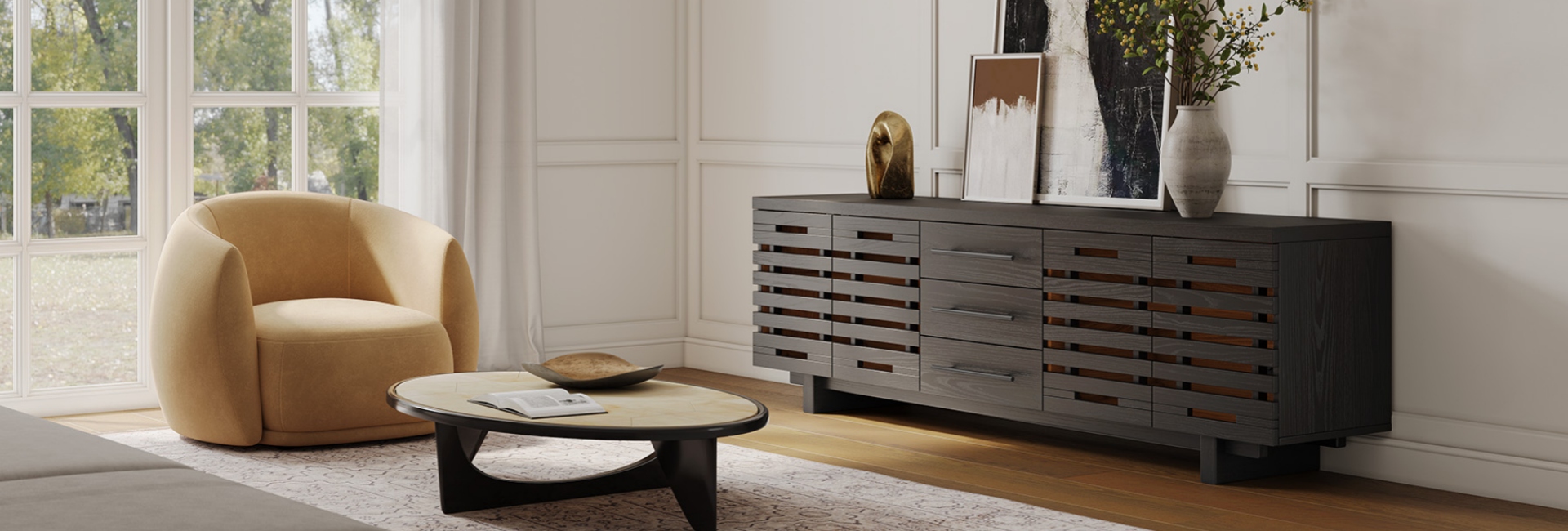
A slatted TV stand can do more than hold your television. The vertical or horizontal slats add visual texture, break up a large piece of furniture, and give a living room a warmer, more finished look.
But the design is only part of the decision. The stand still needs to fit your TV, hold your equipment, provide enough storage, and give cables somewhere to go.
This guide covers what to look for before buying, from materials and dimensions to ventilation, remote signals, and everyday cleaning.
Table of Contents
- What Is a Slatted TV Stand?
- Why Slatted TV Stands Work in Modern and Mid-Century Rooms
- What Materials Are Best for a Slatted TV Stand?
- How Wide Should a Slatted TV Stand Be?
- How Much Storage Does a Slatted TV Stand Need?
- Cable Management: Check This Before You Buy
- Do Slatted Doors Help With Ventilation?
- Will Slatted Doors Block Remote or Wi-Fi Signals?
- How Do You Keep Slatted Doors Clean?
- How to Match a Slatted TV Stand to Your Room
- Slatted TV Stand vs. a Plain TV Console
- How We'd Choose a Slatted TV Stand
- FAQs
- What is a slatted TV stand?
- Are slatted TV stands good for electronics?
- Will a slatted TV stand block my remote or Wi-Fi signal?
- How wide should a slatted TV stand be for a TV?
- What height should a slatted media console be?
- What material is best for a slatted TV stand?
- Are slatted TV stands difficult to clean?
- Can I use a slatted TV stand with a wall-mounted TV?
- How much storage do I need in a slatted TV stand?
What Is a Slatted TV Stand?
A slatted TV stand is a media console that uses evenly spaced wood or wood-look slats as part of its doors, drawer fronts, or exterior panels. The slats create a repeated linear pattern that adds depth without relying on heavy decoration.
You may also see this style called a slatted media console or slatted TV console. These terms generally refer to the same type of furniture: a TV or media console that incorporates slatted detailing into its design.
Some slatted TV stands use the slats across the entire front, while others combine slatted doors with open shelving or solid panels. That difference matters because it affects both the appearance and how easily you can access your equipment.
For a living room, the best design is usually the one that balances the look you want with the storage and equipment you actually need.
Why Slatted TV Stands Work in Modern and Mid-Century Rooms
Slatted detailing fits naturally into modern interiors because it adds texture without making the furniture look overly busy.
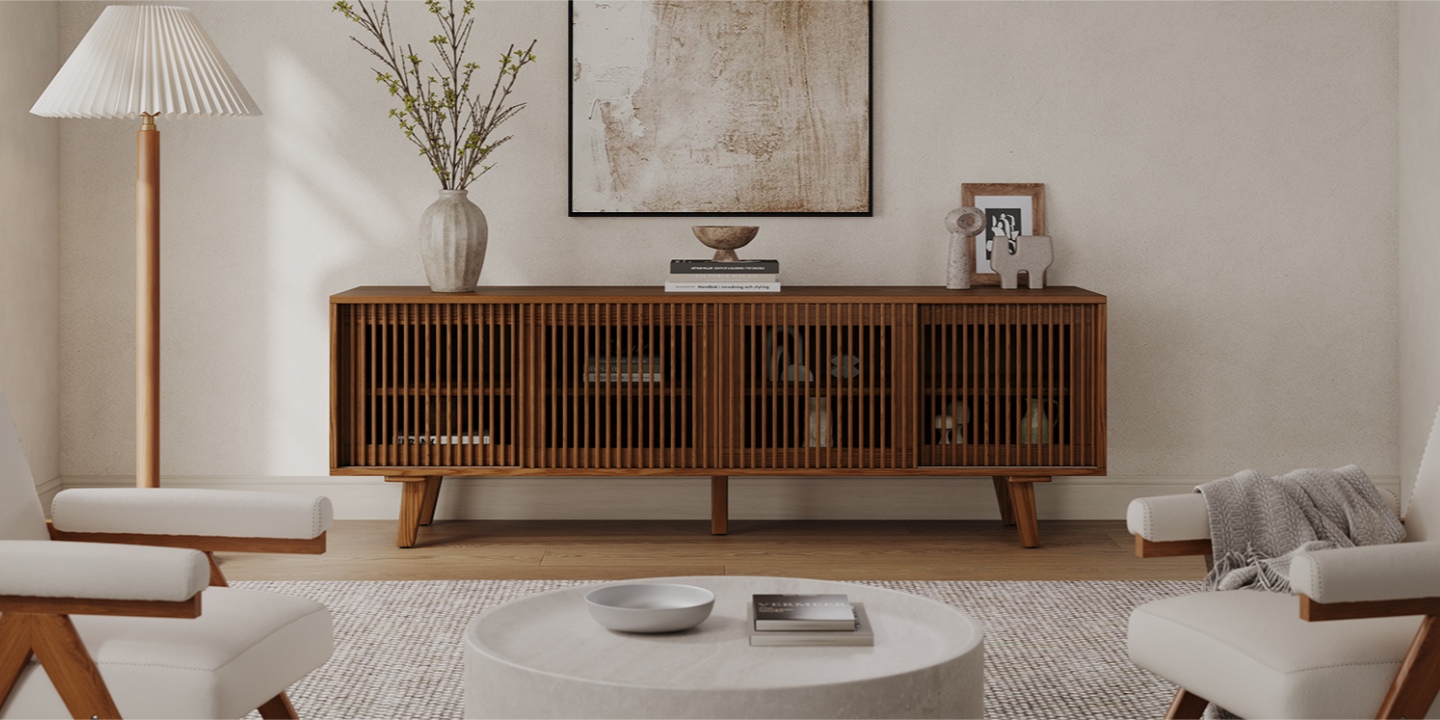
It also works particularly well with mid-century modern furniture. Wood tones, tapered or clean-lined legs, simple silhouettes, and repeated vertical lines are all common elements of the style.
A slatted front can also make a wide console feel visually lighter. Instead of one large uninterrupted cabinet face, the repeated lines give the surface more detail and rhythm.
That makes a slatted TV stand a good choice if your room already includes:
Natural wood furniture
Neutral upholstery
Warm-toned flooring
Mid-century modern pieces
Minimalist or contemporary decor
Black, brass, or other simple metal accents
The key is consistency. If the rest of the room is very traditional or heavily ornate, a strongly slatted console may feel out of place. In a modern or MCM setting, however, the pattern usually feels intentional rather than decorative for decoration's sake.
What Materials Are Best for a Slatted TV Stand?
The material affects how the console looks, how it handles everyday use, and how much maintenance it needs. There is no single material that is automatically best for every room.
Solid Wood
Solid oak is a popular choice when you want the grain and feel of real wood to remain visible.
It is durable and can generally be repaired or refinished more easily than many manufactured wood surfaces. Like other natural wood products, however, it responds to changes in temperature and humidity.
For a slatted console, solid wood can be especially useful for visible areas such as door frames, legs, and drawer fronts where the material is part of the overall design.
Engineered Wood and Veneer
Engineered wood can provide a more stable option for larger panels and interior components.
When paired with a real-wood veneer, it can still deliver the appearance of natural wood while reducing some of the movement associated with a large solid-wood panel.
Just keep in mind that veneer is a thin layer of real wood over a core material. It should not be treated exactly like a solid-wood surface when it comes to sanding, refinishing, or repairing damage.
Painted MDF
MDF is commonly used for painted furniture because it provides a smooth, consistent surface.
It can work well for painted slatted doors or components where the grain of natural wood is not the main visual feature. The downside is that MDF is sensitive to prolonged moisture exposure, so spills should be wiped up rather than left sitting on the surface.
How Wide Should a Slatted TV Stand Be?
Start by measuring your TV's actual width, rather than choosing a console based only on the TV's advertised screen size.
TV sizes are measured diagonally from one corner of the screen to the opposite corner. A 65-inch TV, for example, is not 65 inches wide.
As a general starting point:
Approximate width for a typical 16:9 TV. Always check your specific TV's dimensions.
These ranges are starting points rather than hard rules. Your wall width, TV legs, soundbar, viewing distance, and other equipment can change what works best.
Going Wider Isn't Always Better
A very wide console can overwhelm a small wall, while a narrow console may leave a large TV looking visually unsupported.
For most rooms, having the console extend beyond the TV on both sides creates a more balanced composition. It also gives you space for small speakers, decor, or other accessories.
If you're working with a large screen, measure the wall as well as the TV. A console that technically fits the television may still be too large for the room.
How Much Storage Does a Slatted TV Stand Need?
Think about what you actually want to store before deciding how many cabinets or drawers you need.
Common items include:
Game consoles
Controllers
Streaming devices
Blu-ray players
Remotes
Headphones
Board games
Cables and chargers
DVDs or other media
Closed storage is useful for items you don't want visible. Drawers work well for smaller accessories, while cabinets with adjustable shelves can handle larger electronics and media equipment.
Open shelving has a different advantage: it gives you easier access to devices and can make the console look less visually heavy.
Look Beyond the Number of Compartments
A console can have plenty of doors and drawers but still have limited usable storage.
Check the internal dimensions, shelf spacing, door opening, and weight capacity where available. If you plan to place a game console, sound system, or other larger device inside, make sure there is enough clearance around it.
This is particularly important when buying furniture online. Exterior dimensions tell you whether the console fits your room; internal dimensions tell you whether your equipment fits inside the console.
Cable Management: Check This Before You Buy
Cable management is one of those details that is easy to overlook until the TV is already installed.
Before buying a slatted TV stand, check whether it has:
Rear cable openings
Openings between compartments
Enough space behind the shelves
Room for power strips
Access for HDMI and other cables
A sensible route from the TV to your equipment
If a TV stand has no rear cable opening, you may end up drilling or modifying the back yourself to route cables cleanly.
A good setup should let you connect your TV, streaming devices, game consoles, and power supply without creating a bundle of cables that is visible from the front.
If you're wall-mounting the TV, also think about where the cables will exit the wall and how they will reach the console.
Do Slatted Doors Help With Ventilation?
They can, but the slats are only one part of the ventilation setup.
Electronics generate heat while they are running. A slatted door can provide more openings than a completely solid front, but actual airflow also depends on the rear of the cabinet, the amount of internal clearance, and where the equipment is positioned.
For devices that produce noticeable heat, check for:
Rear ventilation openings
Clearance around the equipment
Space between the device and the cabinet walls
An unobstructed path for warm air to escape
Don't assume that a slatted front automatically makes a cabinet suitable for every electronic device.
If you plan to keep a game console, receiver, amplifier, or other heat-producing equipment inside, follow the equipment manufacturer's clearance and ventilation requirements.
Will Slatted Doors Block Remote or Wi-Fi Signals?
Usually, slatted doors are not a major obstacle for everyday remote use, but the exact result depends on the device and cabinet design.
Infrared remotes generally work best when the remote has a clear line of sight to the receiver. The openings between slats may help compared with a completely solid door, but they don't guarantee that every remote will work through the cabinet.
Wi-Fi is different. Wi-Fi performance depends on factors such as your router, distance, interference, antenna placement, and the materials around the device. A slatted door should not be treated as a guarantee of better Wi-Fi reception.
If a device relies heavily on wireless connectivity, placing it where it has a reasonable connection to your router is more important than choosing a slatted front.
How Do You Keep Slatted Doors Clean?
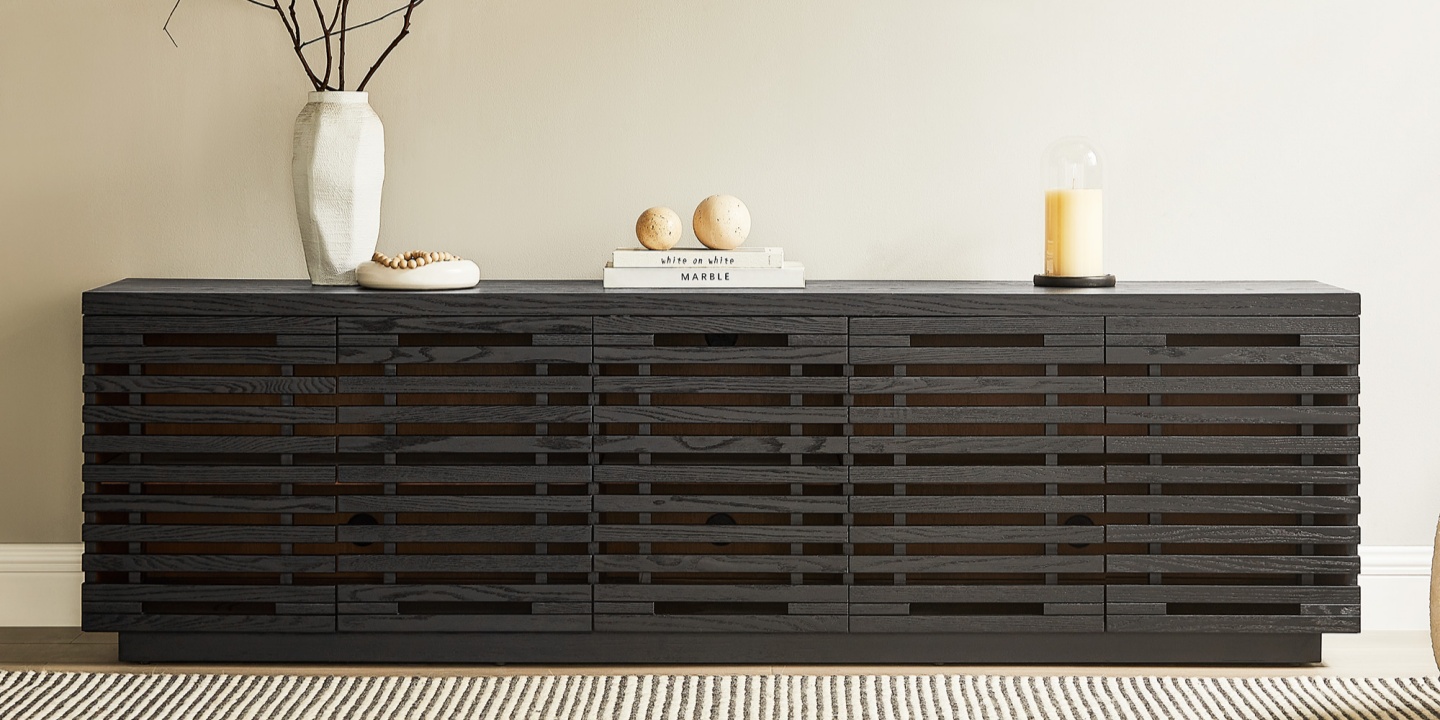
The biggest advantage of slatted furniture is also one of its maintenance considerations: all those narrow surfaces can collect dust.
Fortunately, routine cleaning is simple.
Start with a soft, dry microfiber cloth or a vacuum with a soft brush attachment. Move along the direction of the slats rather than pressing dust deeper into the gaps.
For fingerprints or small spills, use a slightly damp cloth and wipe the surface dry afterward.
Avoid soaking the wood or using harsh cleaners unless the furniture manufacturer specifically recommends them. Too much moisture can be especially problematic around unfinished edges, joints, and MDF components.
A quick dusting every week or two is usually easier than waiting until the grooves have accumulated a visible layer of dust.
How to Match a Slatted TV Stand to Your Room
Once the measurements and storage needs are settled, look at the design details.
Match the Wood Tone
A warm oak finish can work well with beige, cream, brown, and other warm neutrals.
If your room already contains several different wood tones, you don't necessarily need an exact match. Keeping the undertones relatively consistent is often enough to make the furniture feel coordinated.
Consider the Leg Style
Legs have a surprisingly large effect on the overall look.
Tapered wooden legs tend to reinforce a mid-century modern feel, while low or block-style bases can create a more contemporary appearance.
Don't Ignore the Wall
The TV stand doesn't exist in isolation. Consider the width of the wall, the height of the TV, nearby windows, artwork, and other furniture.
A large slatted console can become a visual anchor in a spacious living room. In a smaller apartment, a more compact console with well-planned storage may make more sense.
Slatted TV Stand vs. a Plain TV Console
Both styles can work. The better choice depends on the room and how much visual detail you want.
A plain console has a simpler surface and can blend easily into minimalist interiors. A slatted TV stand adds texture and gives the front of the furniture more visual character.
Choose a slatted design if you want:
More texture on a large furniture piece
A warmer wood-focused look
Mid-century modern styling
A more distinctive alternative to a plain cabinet
Choose a plain console if you prefer:
A cleaner, quieter appearance
Minimal visual texture
A simple backdrop for artwork or decor
Neither is inherently better. The right choice is the one that fits the rest of the room rather than competing with it.
How We'd Choose a Slatted TV Stand
If we were choosing one for a living room, we'd start with the practical details rather than the finish.
First, measure the TV and the available wall space. Then check the internal storage dimensions and cable routing. If electronics will sit behind the doors, look at ventilation and equipment clearance.
Only after those basics are covered would we compare wood tones, leg styles, and slat patterns.
For example, our current 84-inch slatted consoles are designed for larger TV setups where the console itself can become a substantial part of the room's visual composition.
The Astrid Mid-Century Modern Slatted TV Stand uses slatted detailing to bring texture to a clean-lined silhouette, while the Ingrid 84-Inch Slatted Oak Media Console takes the same general idea into a wider format for larger living rooms.
The important thing is not simply choosing the console that looks best in a product photo. Measure your space, check what you need to store, and make sure the furniture works with the equipment you already own.
FAQs
What is a slatted TV stand?
A slatted TV stand is a media console that incorporates evenly spaced slats into its doors, drawer fronts, or exterior panels. The design adds texture while keeping the overall silhouette relatively clean.
Are slatted TV stands good for electronics?
They can be, but ventilation depends on the entire cabinet design rather than the slatted front alone. Check rear openings, internal clearance, and the ventilation requirements of your equipment.
Will a slatted TV stand block my remote or Wi-Fi signal?
Slatted doors may allow some infrared remote signals to pass through the gaps, but performance depends on the device and cabinet design. Wi-Fi is affected by router placement, distance, interference, and surrounding materials, so slats do not guarantee better Wi-Fi performance.
How wide should a slatted TV stand be for a TV?
As a general starting point, the console should be wider than the TV. However, the ideal width depends on the TV's actual dimensions, wall space, TV legs, equipment, and the visual proportions of the room.
What height should a slatted media console be?
There is no single correct height. The best height depends on whether the TV sits on the console or is wall-mounted, as well as your seating position. For a TV placed directly on the stand, aim for a comfortable viewing angle from your main seating area.
What material is best for a slatted TV stand?
Solid oak is a strong choice for visible, high-use components, while engineered wood with veneer can provide stability for larger panels. Painted MDF is useful for smooth painted surfaces. The best combination depends on the design and how the console will be used.
Are slatted TV stands difficult to clean?
Not particularly. Dust can collect between the slats, so a microfiber cloth or soft brush attachment works well for routine cleaning. Avoid excessive moisture and harsh cleaners.
Can I use a slatted TV stand with a wall-mounted TV?
Yes. A slatted TV stand can sit below a wall-mounted TV and provide storage for media equipment, game consoles, remotes, and decor. Just make sure the console is positioned at a comfortable height and leaves enough space for your wall-mounted setup.
How much storage do I need in a slatted TV stand?
Start with the equipment and accessories you actually own. Measure larger devices and check the internal dimensions of the compartments before buying. Drawers are useful for smaller items, while cabinets with adjustable shelves are better for larger equipment.