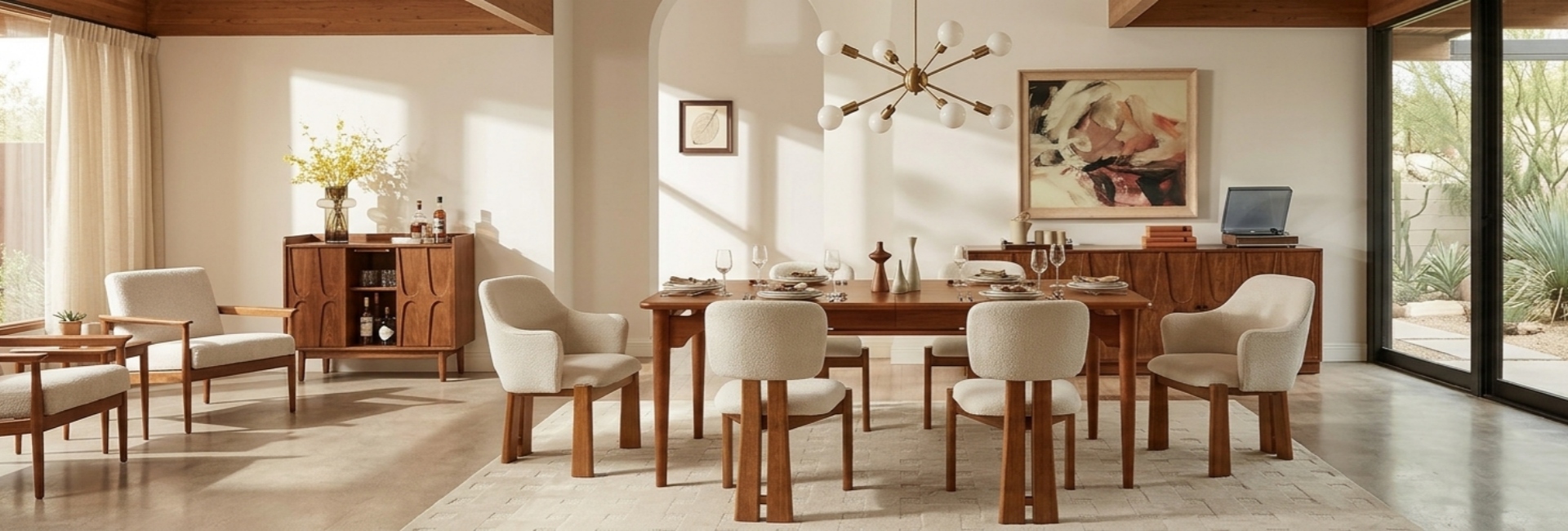
Yes—for most small homes, apartments, and households that host occasionally, an extendable dining table is worth it. It gives you a smaller everyday footprint and extra seating when you need it, without keeping a large table in the room year-round.
The trade-off is that an extendable table costs more than a comparable fixed table and has more moving parts to maintain. If you have plenty of dining space, always seat the same number of people, and rarely host, a fixed table may be the simpler choice.
The right question isn't whether extendable dining tables are good in general. It's whether the flexibility matches the way you actually use your dining space.
Table of Contents
- Are Extendable Dining Tables Worth It? A Quick Decision Guide
- What Is an Extendable Dining Table?
- Types of Extendable Dining Tables
- Pros and Cons of Extendable Dining Tables
- How Does an Extendable Dining Table Work?
- Are Extendable Dining Tables Sturdy, or Do They Wobble?
- How Much Space Does an Extendable Dining Table Need?
- How Many People Can an Extendable Dining Table Seat?
- Best Materials for an Extendable Dining Table
- Hernest Extendable Dining Tables: Two Examples
- Rectangle vs. Round vs. Oval Extendable Dining Tables
- How Much Does an Extendable Dining Table Cost?
- How to Choose the Right Extendable Dining Table
- 1. What size do you need every day?
- 2. How often will you extend it?
- 3. Where will the table be extended?
- 4. Where will the leaves go?
- 5. How stable is it when extended?
- 6. What is the tabletop made from?
- 7. Does the style work in both configurations?
- 8. Does the price match how often you'll use the feature?
- Care and Maintenance for an Extendable Dining Table
- Are Extendable Dining Tables Worth It? The Final Verdict
- FAQs
- Are extendable dining tables worth it?
- What is the difference between an extendable and an expandable dining table?
- How does an extendable dining table work?
- Are extendable dining tables sturdy?
- How much does an extendable dining table cost?
- How many people can an extendable dining table seat?
- What is a butterfly leaf?
- Are extendable dining tables good for small spaces?
- Do extendable dining tables require more maintenance?
Are Extendable Dining Tables Worth It? A Quick Decision Guide
An extendable dining table usually makes the most sense when your dining area needs to serve more than one purpose or your guest count changes from day to day.
Bottom line: If you need a table that changes size with the occasion, the flexibility usually justifies the extra cost. If you never need that flexibility, a fixed table can give you a simpler and potentially more economical setup.
What Is an Extendable Dining Table?
An extendable dining table is a dining table designed to increase its length when you need additional seating. When closed, it takes up less floor space for everyday meals. When extended, one or more leaves create additional tabletop space.
You may also see the terms expandable dining table and expandable dining room table used for the same basic concept. They generally describe a table that changes from a smaller everyday configuration to a larger entertaining configuration.
A rectangle extendable table is the most common version. Its straight sides make it easy to position against a wall or within a narrow dining area, while the longer footprint provides predictable seating when extended.
Round and oval extendable tables are also available. These can be useful when you want softer edges or a more conversational layout, especially in compact dining areas.
Types of Extendable Dining Tables
The extension mechanism has a bigger effect on everyday usability than the word "extendable" itself. Here are the main types you'll encounter.
Butterfly Leaf
A butterfly leaf is a hinged extension panel that folds and opens into position. Because the leaf stays attached to the table, you don't need a separate storage location.
It's convenient for households that extend the table regularly, although the additional hinges and hardware mean the mechanism needs to be well made.
Self-Storing Leaf
A self-storing leaf remains inside the table when the table is closed. This is one of the most convenient designs for smaller homes because the extension pieces don't take up closet or garage space.
It also keeps the leaves close to the main tabletop rather than leaving them in a separate part of the home.
Center Leaf
With a center-leaf design, the two halves of the tabletop move apart and a separate panel fills the opening.
The design is relatively straightforward and can be easier to service than a more complex mechanism. The downside is that removable leaves need their own storage space unless the table is designed to store them internally.
Drop-Leaf
Drop-leaf tables use hinged sections that fold down when you need a smaller footprint. They're particularly useful in kitchens, breakfast nooks, apartments, and other spaces where every inch matters.
The compromise is that the usable surface and seating configuration can be more limited than with a full-length extension table.
Pros and Cons of Extendable Dining Tables
Before buying one, it's worth looking at the trade-offs clearly.
Pros
Saves everyday floor space: Keep the table compact when you don't have guests.
Adds seating on demand: One table can handle both everyday meals and larger gatherings.
Works well in small homes: Apartments and multipurpose rooms benefit from the smaller closed footprint.
Can eliminate the need for a second table: You don't need to store a folding table for occasional guests.
Offers design flexibility: Rectangle, round, oval, modern, and mid-century styles are all available.
Self-storing options reduce clutter: The leaves stay with the table instead of occupying a closet or garage.
Cons
Usually costs more than a fixed table: You're paying for the extension hardware and additional construction.
More moving parts: Hinges, slides, latches, and support systems can eventually need adjustment.
Potential for instability: Poorly designed mechanisms can create movement or looseness when extended.
Visible seams: Some extension systems leave a noticeable line across the tabletop.
Separate leaves can be inconvenient: Removable leaves require appropriate storage and care.
For most buyers, the key question is whether the advantages are used often enough to justify those trade-offs.
How Does an Extendable Dining Table Work?
Most extendable dining tables use a sliding or hinged mechanism that allows the tabletop to separate or open. The extension leaf then fills the newly created space.
A well-designed table should not require a complicated setup. Depending on the mechanism, you typically release the locking hardware, separate or open the tabletop, position the leaf, and secure it.
The exact process varies by design, but convenience is one of the main reasons to choose a self-storing or butterfly-leaf model.
What Should You Look for in the Mechanism?
Pay attention to four things:
Smooth movement: The tabletop should slide or open without excessive force.
Secure locking: The two halves should remain aligned after the table is extended.
Adequate support: The extension leaf should be supported rather than relying entirely on the outer edges.
Minimal play: When the table is locked in place, there should not be excessive side-to-side movement.
If you're shopping in person, extend the table yourself rather than judging the mechanism from the closed position alone.
If you're shopping online, look for product videos or detailed specifications that show how the table opens and how the leaves are stored.
Are Extendable Dining Tables Sturdy, or Do They Wobble?
A well-built extendable dining table can be sturdy enough for everyday use. The extension mechanism itself isn't automatically a weakness; the quality of the construction, support system, hardware, and tabletop all matter.
What Makes an Extendable Table Stable?
Three factors deserve particular attention:
1. Support under the extended section
The extension leaf should have adequate support when the table is open. A supported leaf is less likely to flex or create a weak point in the middle of the tabletop.
2. A substantial tabletop and frame
A substantial tabletop can feel more stable than an extremely lightweight construction. However, solid wood isn't the only route to a durable table. A well-made engineered-wood core with quality veneer can also provide good dimensional stability.
3. A well-fitted mechanism
The sliding tracks, hinges, locks, and connecting hardware should fit together cleanly. Excessive movement when the table is open can indicate poor construction or hardware that needs adjustment.
When comparing tables, don't judge stability only from the closed configuration. The extended position is the one that matters most.
How Much Space Does an Extendable Dining Table Need?
This is where an extendable table can either solve a space problem or create one.
Don't measure only the table's closed length. You need to account for both configurations and enough room behind the chairs for people to sit down, stand up, and move around.
As a practical starting point, allow about 36 inches of clearance behind occupied chairs. You may need more in a main walkway and less in a secondary area, depending on the room layout.
Example: 72" to 92" Extendable Table
A table that changes from 72 inches to 92 inches gains 20 inches of tabletop length. But your room needs to accommodate that additional length while maintaining usable chair and walkway clearance.
The important measurement is not simply:
Table length + 36 inches
Instead, consider the entire footprint:
Table + chairs + clearance + walkways
If the table sits against a wall when closed, also check whether it needs to move away from the wall before it can be extended.
How Many People Can an Extendable Dining Table Seat?
Seating capacity depends on the table's length and width, chair dimensions, leg placement, and whether the end seats are being used.
As a general planning guide:
For comfortable dining, plan around 24 inches of table edge per adult along the sides. End seating can add capacity, but the table's width and leg placement can affect how comfortable those seats are.
A product page that says "seats 8" is only a starting point. Check the actual open dimensions and compare them with your chair width before assuming eight people will fit comfortably.
Best Materials for an Extendable Dining Table
The material matters, but construction matters just as much. A well-made table can combine different wood products and still provide excellent everyday performance.
Solid Wood
Solid wood offers a substantial feel, natural grain, and the ability to be refinished depending on the finish and construction.
Oak is especially popular for dining tables because it combines a strong visual grain with a durable, furniture-friendly surface.
Engineered Wood With Veneer
Engineered wood with a quality veneer can be a practical alternative to an all-solid-wood table. It can provide dimensional stability while allowing manufacturers to use a real-wood surface for the visible areas.
This doesn't automatically make it inferior to solid wood. The quality of the core, veneer, joinery, finish, and extension mechanism all matter.
Kiln-Dried Wood
Kiln drying removes moisture from lumber in a controlled environment and helps bring the wood to a more stable moisture level before construction.
For a wooden dining table, this can be an important quality detail because wood naturally responds to changes in moisture in the surrounding environment.
The practical takeaway is simple: don't judge an extendable table only by whether the description says "solid wood." Look at the complete construction.
Hernest Extendable Dining Tables: Two Examples
If you're comparing materials and construction, Hernest's current extendable dining tables provide two useful examples.
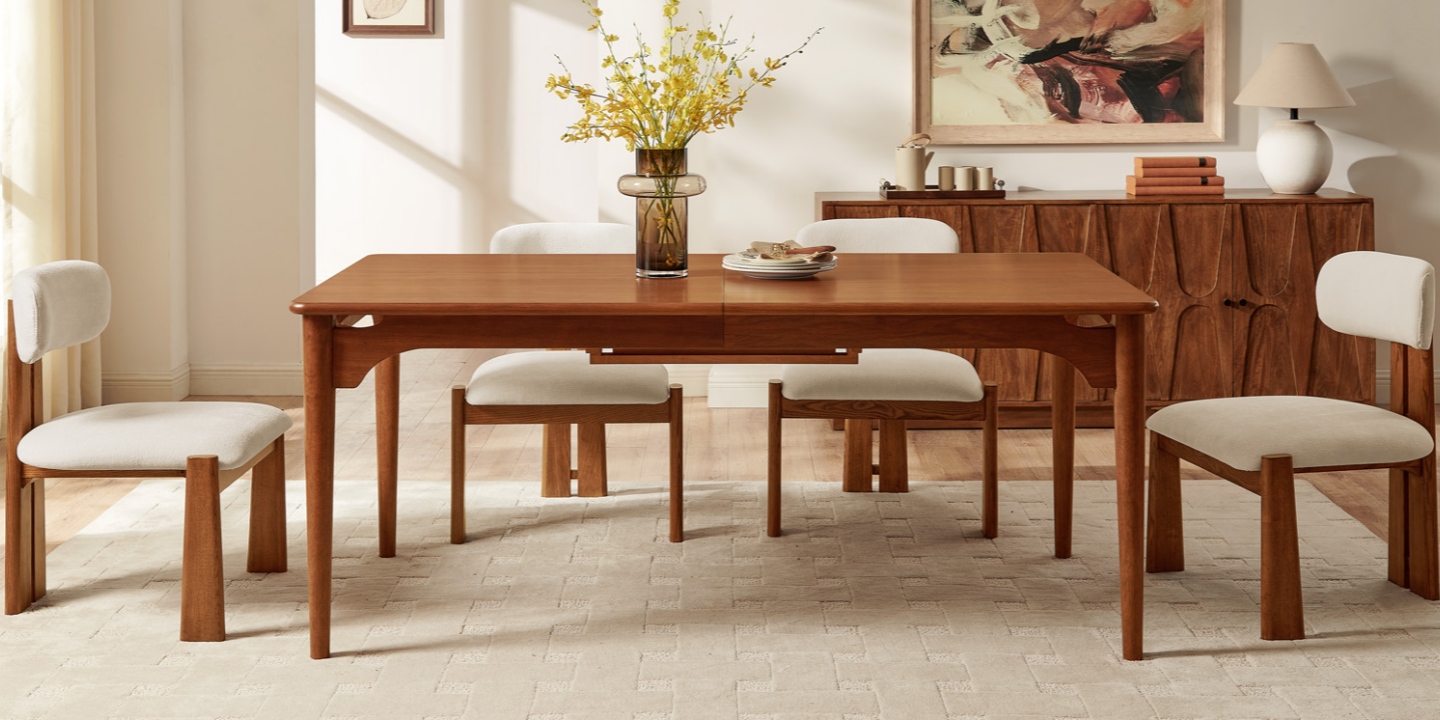
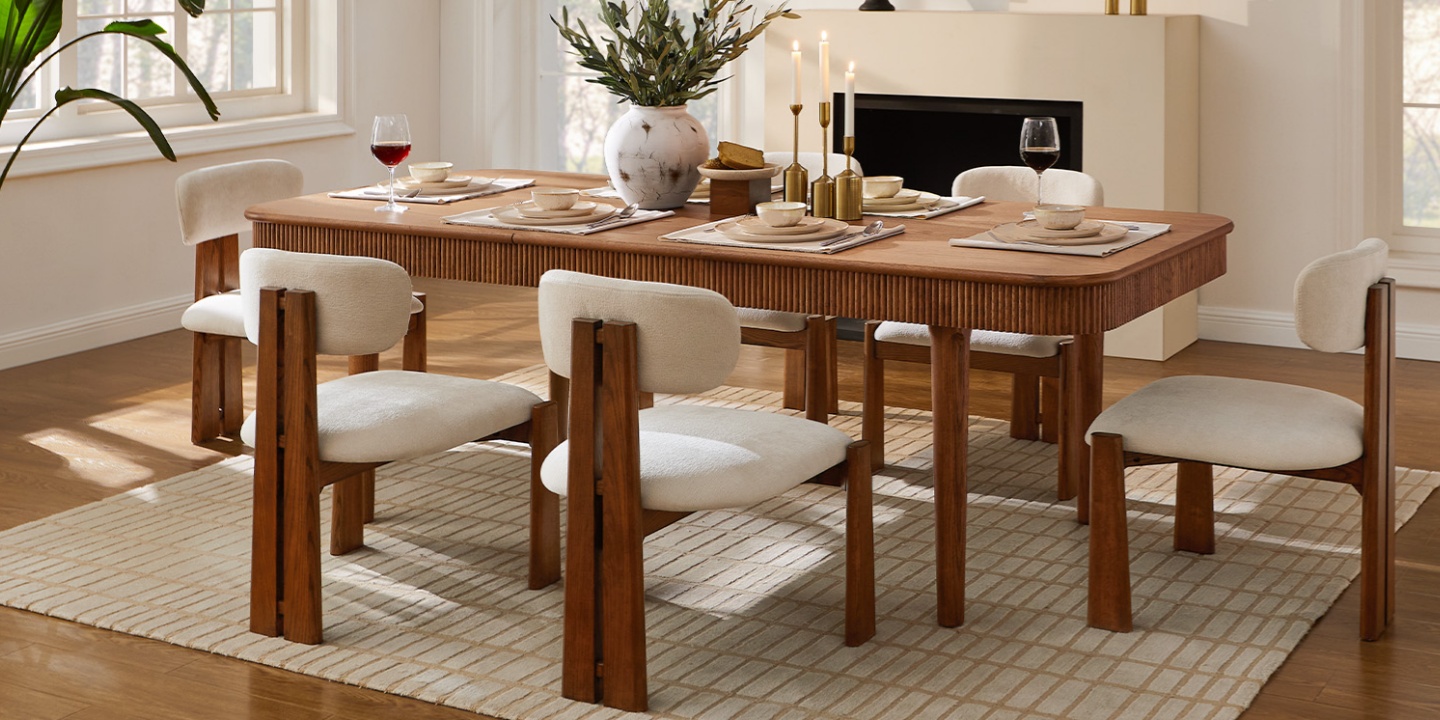
The Valo 72"–92" Extendable Dining Table is made with American solid oak, plywood, and oak veneers. It uses two self-storing extension leaves, and the wood is kiln-dried. The table is 92 inches wide when fully extended and is designed to seat 6–8 people comfortably.
The Kaden 72"–92" Extendable Dining Table uses rubber wood, engineered wood, and cherry veneers, with kiln-dried wood and two self-storing leaves. It is also designed to seat 6–8 people comfortably.
The two tables illustrate an important point: you don't have to choose between flexibility and a considered furniture design. Material composition, extension storage, dimensions, and construction can all be evaluated together.
Rectangle vs. Round vs. Oval Extendable Dining Tables
The shape you choose should follow the room as much as the style.
Rectangle Extendable Table
A rectangle extendable table is the most versatile option for many homes.
It's particularly useful when:
The dining area is long and narrow
You need to place the table near a wall
You regularly seat six or more people
You want predictable seating along the long sides
The straight profile also works naturally with modern, mid-century modern, and transitional interiors.
Round Extendable Table
A round table can work well in smaller rooms because there are no corners projecting into circulation paths.
When extended, many round designs become oval, giving you additional length without losing the softer visual profile.
Oval Extendable Table
An oval table combines some of the advantages of rectangle and round designs. It provides useful length for larger groups while maintaining softer corners.
It's a strong choice when you want a dining table to feel less visually heavy in an open room.
How Much Does an Extendable Dining Table Cost?
Extendable dining tables generally cost more than comparable fixed tables because the construction includes additional hardware, moving components, and extension leaves.
As a broad shopping guide, quality wood extendable tables often fall into the $1,000–$2,000 range, although smaller, simpler, budget-oriented models can cost less and premium designs can cost considerably more.
These are broad planning ranges rather than fixed market prices. Material, brand, size, finish, mechanism, and construction quality can move the price substantially.
The better question is not simply whether an extendable table costs more. It's whether the extra cost replaces something else you would otherwise have to buy or store.
If one table gives you a compact everyday footprint plus enough seating for holiday dinners, the flexibility can be worth paying for.
How to Choose the Right Extendable Dining Table
Before buying, work through these questions:
1. What size do you need every day?
Choose the closed size based on your normal household, not your largest dinner party.
2. How often will you extend it?
If you host once or twice a year, you may not need the most sophisticated mechanism. If you extend it every weekend, smooth operation and self-storing leaves become much more valuable.
3. Where will the table be extended?
Measure the room with the table fully open. Don't assume that a table that fits at 72 inches will automatically work at 92 inches.
4. Where will the leaves go?
If you don't have dedicated storage, choose a self-storing or butterfly-leaf design.
5. How stable is it when extended?
Check the support under the extension, the locking system, and the amount of movement in the open position.
6. What is the tabletop made from?
Look at the full construction rather than relying on "solid wood" as a single quality signal.
7. Does the style work in both configurations?
The extension should look intentional when the table is open, not like a temporary add-on.
8. Does the price match how often you'll use the feature?
If you extend the table frequently, paying more for a better mechanism can make sense. If you never extend it, a fixed table may offer better value.
Care and Maintenance for an Extendable Dining Table
Extendable tables don't require complicated maintenance, but they do have a few areas that fixed tables don't.
Keep the extension tracks and grooves free of crumbs and dust. Debris can make the mechanism harder to operate over time.
If your table has removable leaves, store them flat in a room with relatively stable indoor conditions rather than in a damp basement or very dry attic. Wood responds to changes in moisture, and large swings can affect how pieces fit together.
For the tabletop, follow the manufacturer's care instructions and use products appropriate for the specific finish. Avoid abrasive cleaners that can damage the surface.
It's also worth checking the extension hardware periodically. If a screw or fitting has loosened, addressing it early is easier than waiting until the mechanism develops noticeable movement.
Are Extendable Dining Tables Worth It? The Final Verdict
For most space-conscious households, yes.
An extendable dining table is especially useful if you:
Live in an apartment or smaller home
Host occasionally but don't need a large table every day
Use your dining area for more than dining
Want one table to handle different group sizes
Don't have room to store a second table
A fixed dining table may be the better choice if you have plenty of space, always seat the same number of people, or simply want the fewest possible moving parts.
The best extendable dining table isn't necessarily the one with the most complicated mechanism or the highest price. It's the one that fits your everyday footprint, opens smoothly when guests arrive, stays stable when extended, and uses materials and construction that make sense for the way you live.
FAQs
Are extendable dining tables worth it?
Yes, for most small homes, apartments, and households that host occasionally. They provide a compact everyday footprint while adding seating when needed. They're less useful if you have plenty of space and always seat the same number of people.
What is the difference between an extendable and an expandable dining table?
In everyday furniture shopping, the terms generally describe the same idea: a dining table that can increase its usable length. The important difference is the extension mechanism, such as a butterfly leaf, self-storing leaf, center leaf, or drop-leaf design.
How does an extendable dining table work?
Most extendable tables use a sliding or hinged mechanism. You release the lock, separate or open the tabletop, position the extension leaf, and secure the table. Self-storing and butterfly-leaf designs keep the extension pieces with the table.
Are extendable dining tables sturdy?
A well-built extendable dining table can be very sturdy. Look for adequate support beneath the extended section, a well-fitted mechanism, secure locking hardware, and a substantial tabletop and frame. Stability should be evaluated in the extended position, not just when the table is closed.
How much does an extendable dining table cost?
A quality wood extendable dining table often falls around the ,000–,000 range, although prices vary significantly by material, size, brand, finish, and mechanism. Extendable models generally cost more than comparable fixed tables because of the additional construction and hardware.
How many people can an extendable dining table seat?
It depends on the table's dimensions, chair width, leg placement, and seating configuration. As a general guide, a 72-inch table can seat about six, while an 84- to 92-inch table can often accommodate six to eight people comfortably.
What is a butterfly leaf?
A butterfly leaf is a hinged extension panel stored inside or underneath the tabletop. It folds out when needed, eliminating the need to store a separate loose leaf. It's convenient for households that extend their table regularly.
Are extendable dining tables good for small spaces?
Yes. They're particularly useful in apartments, condos, breakfast nooks, and multipurpose rooms because the table can remain compact during everyday use and expand when additional seating is needed.
Do extendable dining tables require more maintenance?
Slightly. Keep tracks and grooves clean, check the extension hardware periodically, and follow the manufacturer's care instructions for the tabletop finish. Self-storing designs also reduce the storage-related maintenance of separate leaves.