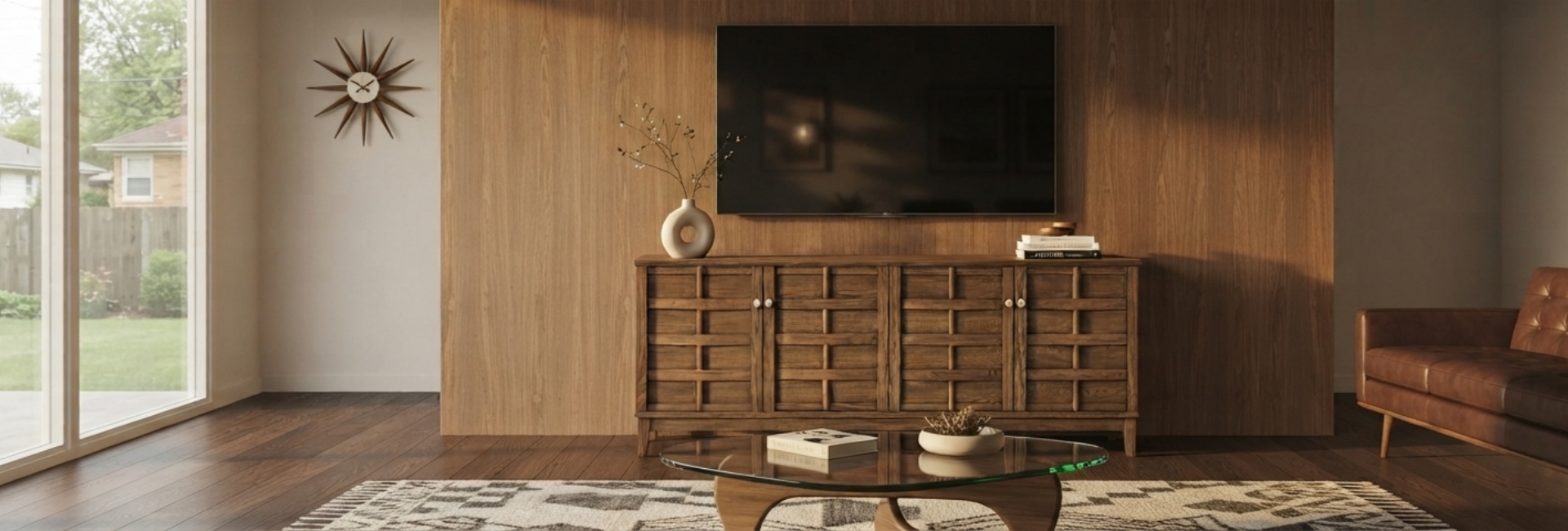
A 70-inch TV deserves a stand that fits the room—not just the screen. Choosing the right tv stands for 70 inch tv comes down to more than width: you also need to consider TV-foot placement, stand depth, viewing height, wall space, and weight capacity. For most living rooms, a 70–80 inch TV stand is a practical starting point, while an 80–84 inch console can work better in larger spaces or when extra storage is needed. In this guide, we’ll break down the ideal TV stand size, height, and depth for a 70-inch TV, plus viewing distance, room-specific tips, and common mistakes to avoid.
Quick Answer: What Size TV Stand Is Best for a 70-Inch TV?
The Short Answer: Choose a 70–80 Inch TV Stand for Most Setups
For most 70-inch TV setups, a 70–80 inch-wide TV stand is a practical starting point. A typical 70-inch 16:9 TV is about 61–62 inches wide, so a slightly wider console gives the screen better visual balance while leaving room for a soundbar, media devices, or décor.
An 80–84 inch TV stand can be a better choice for a larger wall, open-concept living room, or anyone who wants more storage. The key is to match the console to the actual TV and room—not simply the TV's diagonal size.
The Four Measurements That Matter Before You Buy
Before choosing a TV stand for a 70-inch TV, check these four measurements:
TV width: Measure the actual left-to-right width of your TV.
TV foot spacing: Make sure both feet sit securely on the console.
Stand depth: Allow enough space for the TV base, cables, and equipment.
Viewing height: Your seated eye level should guide how high the TV sits.
70-Inch TV Stand Size at a Glance
These are useful planning ranges, not universal rules. Always check your TV's exact dimensions, foot placement, and weight before buying.
How Wide Should a TV Stand Be for a 70-Inch TV?
A 70–80 inch TV stand is a practical starting point for most 70-inch TVs. A typical 70-inch 16:9 TV is about 61–62 inches wide, so a slightly wider console provides better visual balance and room for a soundbar, media devices, or décor. Always check the TV's actual width and foot spacing before buying.
How Wide Is a 70-Inch TV?
A 70-inch TV is measured diagonally, not from side to side. For a standard 16:9 screen, the display itself is roughly 61 inches wide and 34 inches tall. The full TV may be slightly wider once the bezel and frame are included.
That distinction matters when choosing a TV stand for a 70-inch TV. Before buying, check your TV's exact width and, more importantly, the distance between its feet. A TV can fit the width of a console on paper but still have feet that extend beyond its usable surface.
Why a 70–80 Inch Stand Works Well
For most 70-inch TV setups, a 70–80 inch-wide console provides a comfortable balance between the screen and furniture.
A stand slightly wider than the TV gives you:
Better visual proportion
More room for a soundbar or media devices
Space for décor without crowding the screen
Greater flexibility if your TV has wide-set feet
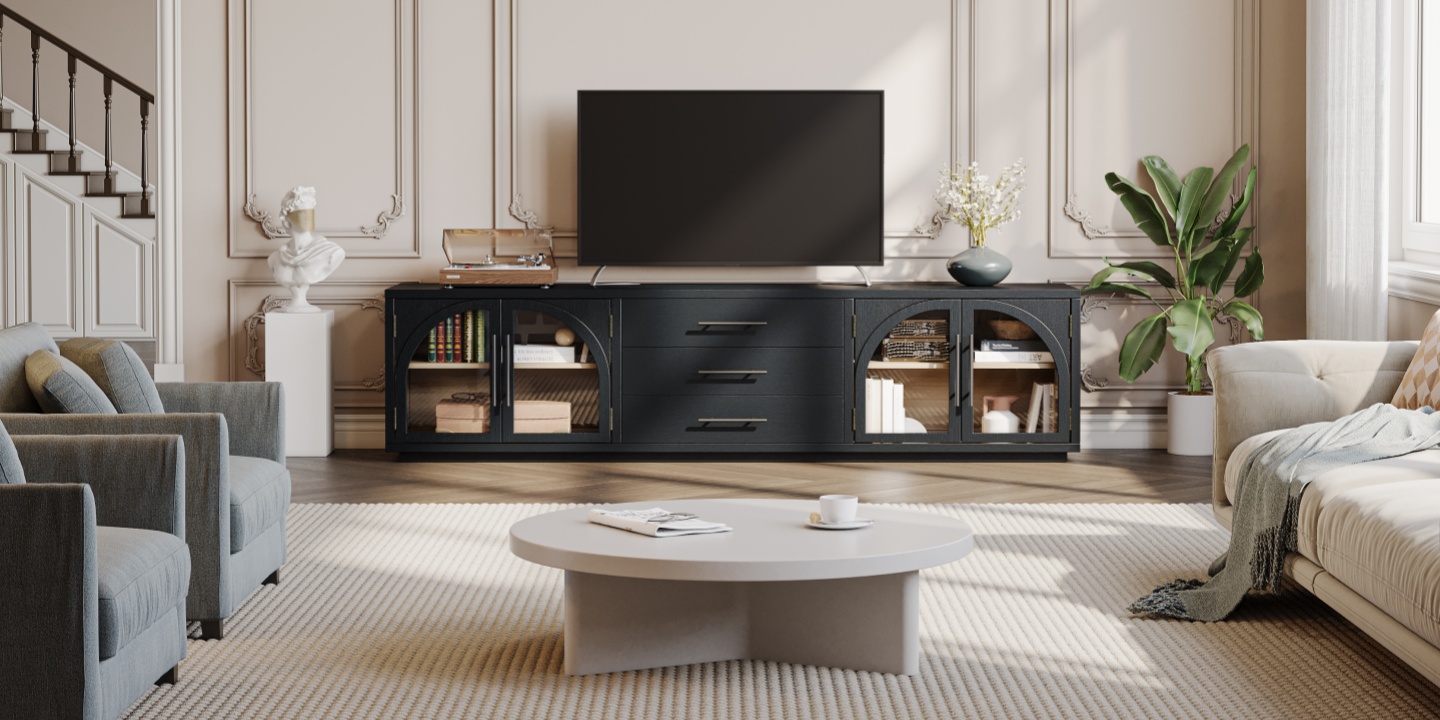
For example, the Hernest Valborg 80" Oak Media Console is 80.1 inches wide, giving a 70-inch TV a few inches of breathing room on each side.
When an 80–84 Inch TV Stand Makes More Sense
Go larger when your wall or living room has the space for it. An 80–84 inch TV stand works particularly well for open-concept rooms, wide media walls, larger sectionals, or households that need additional storage.
It can also make sense if you expect to upgrade to a larger TV later. The goal is proportion—not simply choosing the biggest console available.
What Height Should a TV Stand Be for a 70-Inch TV?
The Goal Is Comfortable Eye-Level Viewing
When choosing tv stands for 70 inch tv, don't start with a fixed stand height. Start with where your eyes naturally sit when you're on the sofa.
The goal is to keep the middle portion of the screen around seated eye level, so you can watch comfortably without constantly tilting your head up or down. Your sofa height, TV size, and whether the TV sits on its feet all affect the final measurement.
For many standard living rooms, a 20–25 inch TV stand is a useful starting range, but it is not a universal rule.
A Simple TV Stand Height Formula
You can estimate the right height with this simple calculation:
TV stand height ≈ seated eye height − half of the TV screen height
For example, if your seated eye level is about 42 inches and a 70-inch TV is roughly 35 inches tall:
42 − (35 ÷ 2) = 24.5 inches
That makes a 24–25 inch console a reasonable starting point before accounting for the TV's feet or pedestal.
The key is to measure your own sofa rather than relying on a generic number.
When a 20–25 Inch Stand Works Well
A 20–25 inch console works well for many standard sofas and low-to-medium seating arrangements. It also creates a relatively low visual profile, which can help a large 70-inch screen feel less imposing.
What Changes When the TV Is Wall-Mounted?
With a wall-mounted TV, the console no longer determines the screen's height. You can position the TV independently for comfortable viewing and choose the furniture mainly for storage, proportion, and equipment placement.
A low-profile Hernest floating console can work particularly well here, especially when you want the media wall to feel lighter and keep more visible floor space.
How Deep Should a TV Stand Be for a 70-Inch TV?
Recommended Depth: About 15–20 Inches for Many Freestanding Setups
For many tv stands for 70 inch tv, approximately 15–20 inches of depth is a comfortable planning range.
Some furniture guides suggest that 12–15 inches can work, while others recommend closer to 15–20 inches. The difference comes down to the TV base, cable connections, and equipment you intend to store.
If your TV has a deep pedestal or you use a receiver or gaming console, don't choose a shallow console just because it looks sleek.
Measure the TV Feet and Base Before Buying
Measure the TV's feet front to back, not just the distance between them.
Also check whether the feet sit completely flat on the console. A raised lip, curved top, or shallow usable surface can reduce the actual support area.
This is one of the easiest ways to avoid a return.
Leave Room for Cables, Ventilation and Equipment
Your equipment needs breathing room.
Leave enough space for HDMI and power connections, and don't pack electronic components tightly into a closed compartment. Poor cable routing can also push the TV farther forward than expected.
A beautiful console with tangled cables spilling out the back is still a bad installation.
How to Measure a 70-Inch TV and Your Room Before Buying a Stand
Choosing tv stands for 70 inch tv gets much easier once you stop relying on the TV size alone. Before ordering, grab a tape measure and check four things: the TV itself, its feet, the wall, and your seating layout.
Measure the TV's Actual Width and Height
A 70-inch TV is measured diagonally, so don't assume it is 70 inches wide. A typical 16:9 70-inch screen is roughly 61–62 inches wide and about 34–35 inches high, although the exact dimensions vary by model.
Measure the full TV from edge to edge, including the frame, and use the manufacturer's specifications when available.
Measure the TV Feet or Pedestal
This is the measurement shoppers most often overlook. Measure the distance between the feet and their front-to-back depth. Both feet need to sit securely on the console's usable surface.
If your TV uses a center pedestal, measure its complete footprint instead.
Measure the Wall and Available Floor Space
Measure the wall where the console will sit, then check nearby windows, doors, outlets, vents, and baseboards. A wider console can look great on a large media wall but feel cramped in a narrow room.
Measure the Seating Distance and Walking Clearance
Finally, measure from the sofa to the TV and leave enough room for normal foot traffic. Don't forget cabinet doors and drawers when checking clearance.
Quick rule: If the TV fits but people can't comfortably move around it, the stand is still too large.
What Is the Best Entertainment Stand for a 70-Inch TV?
What Makes a TV Stand "Best"?
The best TV stand combines the right dimensions, stable support, useful storage, and a design that fits your room. For many 70-inch TVs, an 80–84 inch media console offers a versatile balance of surface space and storage.
Then look at the details that make everyday use easier—storage, cable management, adjustable shelving, and a design that works with the rest of your living room.
TV Stand vs. Media Console: Which Is Better?
A traditional TV stand is usually the simpler option: a surface for the TV with some storage underneath. A media console tends to function more like a substantial piece of living-room furniture, offering more enclosed storage and a stronger visual presence.
For a 70-inch TV, a media console can be the better choice if you have multiple devices, want to hide clutter, or are furnishing a larger media wall. If your setup is minimal and space is tight, a simpler or floating design may make more sense.
Best Hernest Media Consoles for a 70-Inch TV
Valborg 80" Oak Media Console
At 80.1"W × 17.9"D × 25.9"H, the Hernest Valborg media console is a natural fit for a 70-inch TV. It supports TVs up to 85 inches, has a recommended weight capacity of 230 pounds, two cord cutouts, adjustable shelving, and three drawers. Its arched glass doors also bring a distinctive mid-century character to the media wall.
Ingrid 84" Slatted Oak Media Console
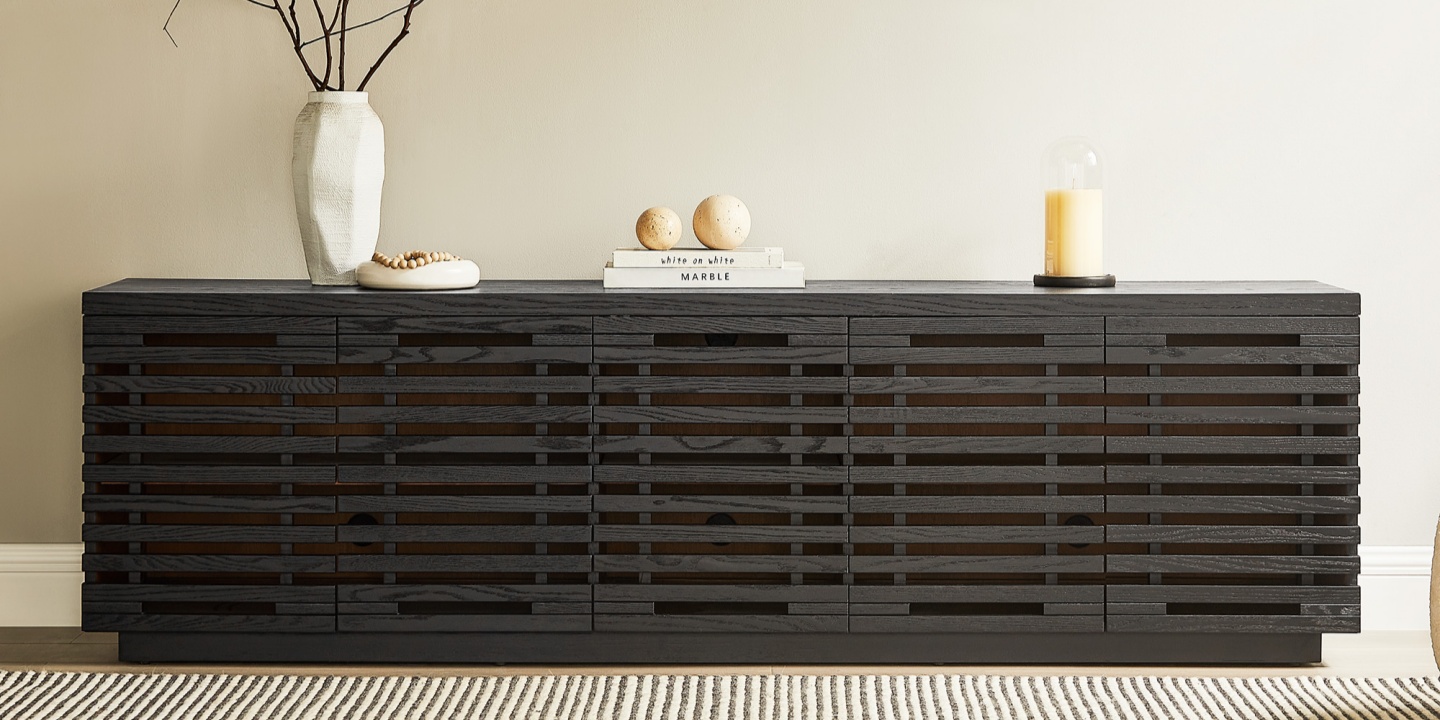
The Hernest Ingrid media console measures 84"W × 17"D × 24.4"H and supports TVs up to 85 inches. Six rear cord cutouts and adjustable shelves make it practical for a more equipment-heavy setup, while its slatted oak front adds texture without making the console feel bulky.
Lira 84" Oak Media Console
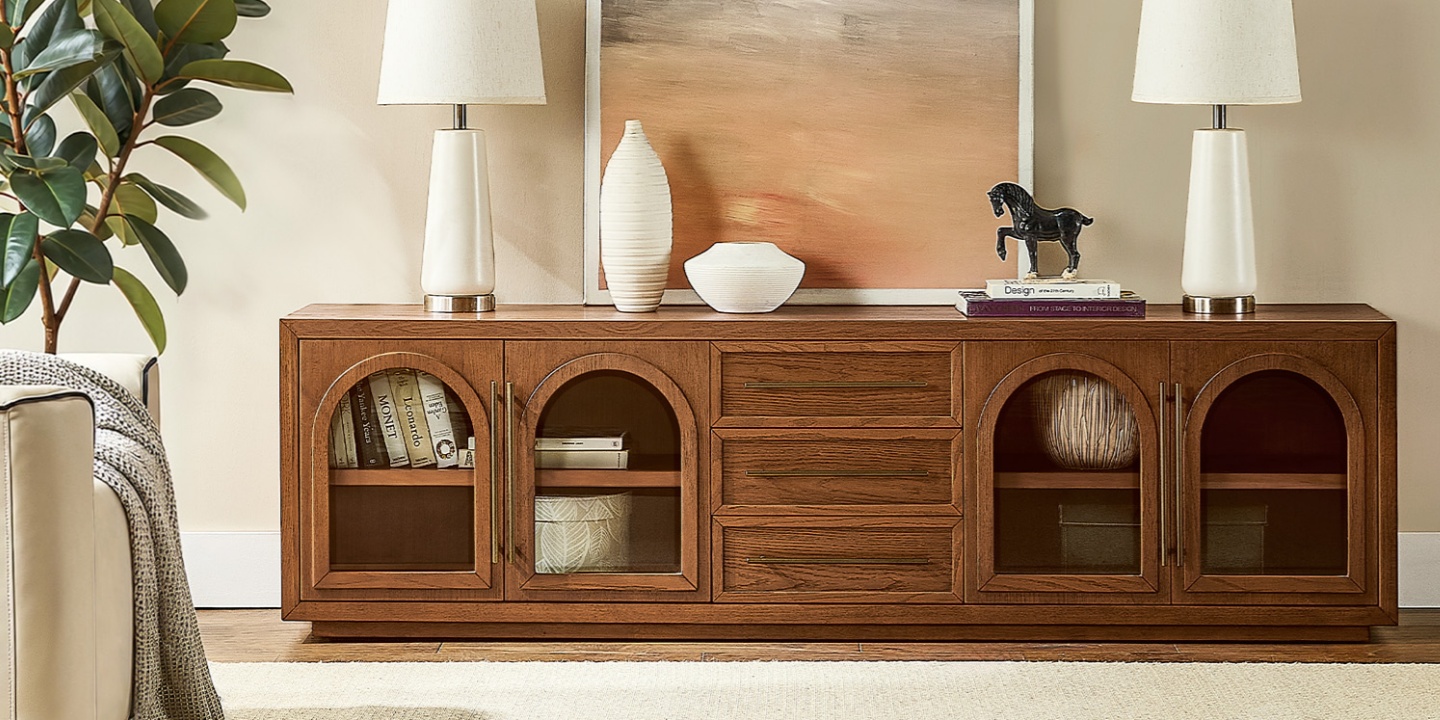
The Hernest Lira media console is 84"W × 18.1"D × 24"H, with a 230-pound recommended capacity and support for TVs up to 85 inches. Its adjustable shelving, enclosed storage, three drawers, and four cord cutouts make it a strong option when storage is high on your list.
Vigdis 84" Media Console
At 84"W × 18.1"D × 26"H, the Hernest Vigdis media console offers a slightly taller profile while maintaining support for TVs up to 85 inches. Its three cabinets, six cord cutouts, and 230-pound recommended capacity make it practical, while the sunburst carving and tapered oak legs give it a more decorative presence.
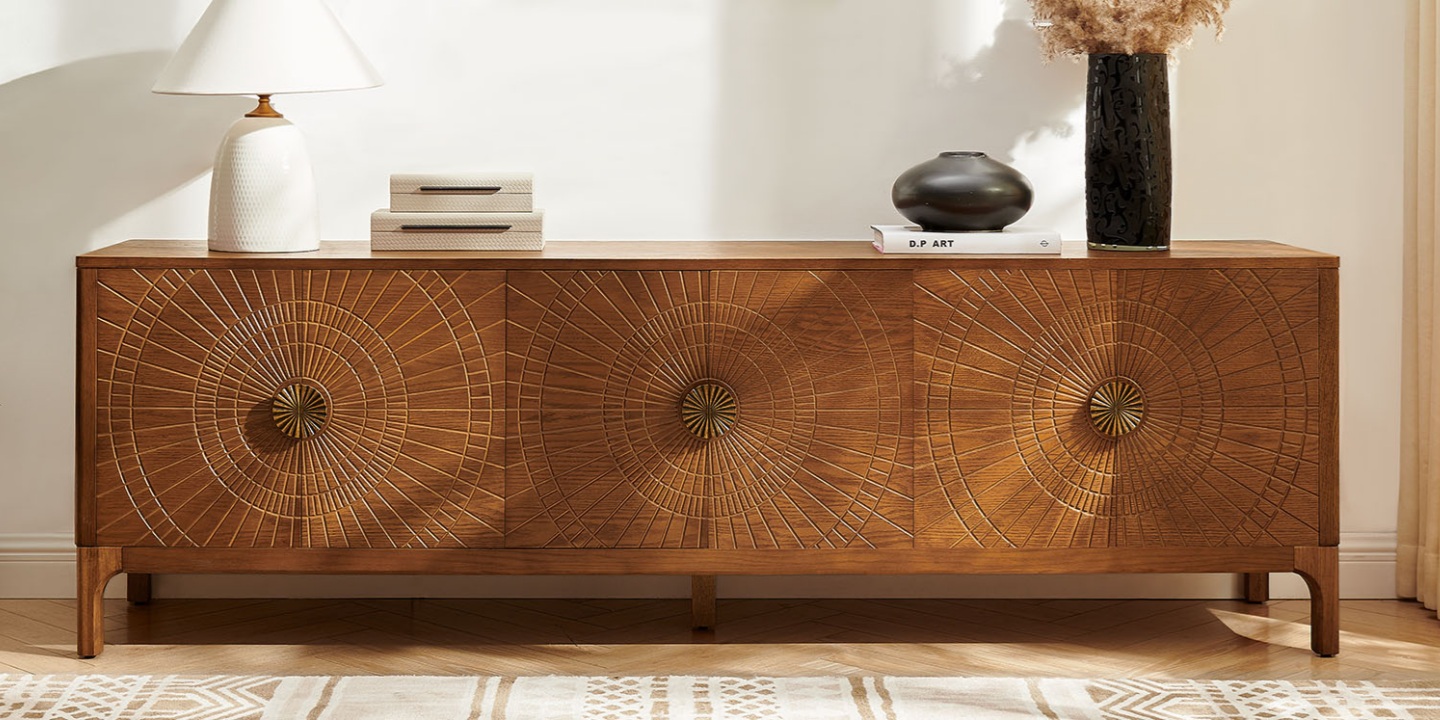
Which Hernest Media Console Fits Your Room?
For most 70-inch TV setups, Valborg 80" is the easiest starting point. If your wall is larger or storage and visual impact matter more, the 84-inch options give you additional presence without being disproportionately large for the TV.
How Far Away Should You Sit From a 70-Inch TV?
There Is No Single "Correct" Viewing Distance
Viewing distance is often presented as though there is one magic number. There isn't.
It depends on how immersive you want the picture to feel, what you watch, and your room.
For a 70-inch TV, two technically sound recommendations can produce very different distances because they use different field-of-view targets.
RTINGS' Recommended Distance for a 70-Inch TV
RTINGS uses field of view as its framework. It lists 9 feet 6 inches for a 70-inch TV at a 30° field of view, which is a useful mixed-use baseline. For a more immersive 40° cinematic experience, the distance is about 7 feet.
That gives you a useful real-world range:
~7 ft: more immersive;
~9'6": balanced mixed use;
farther away: more relaxed viewing.
Why TV Viewing-Distance Guides Give Different Answers
Different guides are solving different problems.
Some focus on visual acuity or when additional resolution becomes noticeable. Others use field of view. Furniture layouts may use simpler rules because most households are not designing a dedicated theater.
So don't panic when two reputable sources give different numbers. The methodology matters.
A Practical Viewing-Distance Range for U.S. Living Rooms
For a typical U.S. living room, around 9–10 feet is a sensible starting point for a 70-inch TV.
If you love movies and games and want the screen to fill more of your vision, moving closer toward 7–8 feet can make the experience more immersive.
RTINGS notes that the useful range generally falls between approximately 30° and 40° of field of view.
Choosing a 70-Inch TV Stand for Different U.S. Living Spaces
For Apartments and Smaller Living Rooms
In a smaller apartment, don't automatically buy the largest console you can fit.
Prioritize:
shallow depth;
clean storage;
clear walkways;
wall-mounted options;
a width that complements the wall.
An 80-inch console may work, but an 84-inch piece can become visually heavy if the room is narrow.
For Open-Concept and Large Living Rooms
Large rooms usually benefit from more substantial tv stands for 70 inch tv.
An 80–84 inch console can help anchor a large sectional and prevent the TV from looking like an isolated rectangle floating on a big wall.
For Mid-Century Modern Interiors
This is where proportions matter.
Look for warm wood, clean horizontal lines, tapered or visually light legs, slatted details, or softly rounded forms. A large screen does not mean the furniture underneath needs to look bulky.
Hernest's oak media consoles are particularly suited to this approach, combining substantial dimensions with mid-century-inspired details.
For California-Style Homes
California-inspired interiors often benefit from an airy media wall rather than a heavy entertainment center.
Natural wood, restrained styling, open floor space, and a low-profile console can keep a large TV from overwhelming the room.
A floating console can be especially effective when preserving visible floor area is part of the design.
For Larger Texas and Suburban Homes
If you have a large family room with generous wall space, don't be afraid of an 80–84 inch console.
The goal is proportion. A small 60-inch cabinet under a large television can make an otherwise spacious room feel unfinished.
TV Stand Safety: What to Check Before You Buy
Check Your TV's Weight
A large screen does not automatically tell you how much it weighs.
Check the exact TV specification and compare it with the furniture's recommended capacity.
Check TV Foot Placement
The feet should sit securely on the usable top surface.
Do not assume that a 70-inch TV fits simply because the console is labeled for a 70-inch screen.
Check the Console's Weight Capacity
For example, Hernest's Valborg, Ingrid, and Lira consoles list recommended capacities of 230 pounds, far above the weight of many individual 70-inch TVs.
Still, always compare the actual TV weight with the furniture specifications.
Consider Anti-Tip and Installation Requirements
If you have children or pets, stability deserves extra attention.
For a floating console, proper wall installation is essential. The mounting surface, hardware, and installation method must be appropriate for the furniture and wall construction.
Common Mistakes When Choosing a TV Stand for a 70-Inch TV
Choosing by TV Size Alone
"70-inch" tells you the diagonal—not whether the feet fit.
Ignoring TV Leg Placement
This is perhaps the most common practical mistake. Measure the feet before ordering.
Choosing the Wrong Height
A beautiful console is not a success if it leaves you looking upward for two hours every evening.
Choosing a Stand That Is Too Shallow
Check the TV base, cables, and equipment before committing to a slim console.
Forgetting Soundbar and Media Equipment Clearance
A soundbar needs its own space. So do game consoles, receivers, streaming devices, and power cables.
Prioritizing Style Before Function
Start with fit, stability, depth, and storage. Then choose the finish and design.
It is much easier to make a functional console look good than to make an unsuitable console work.
Final Recommendation: Finding the Right TV Stand for Your 70-Inch TV
If you want the simplest answer, start with a 70–80 inch TV stand, approximately 15–20 inches deep and around 20–25 inches high, then adjust those numbers based on your television, sofa, and room.
For a larger wall, more storage, or a substantial mid-century living room, move toward an 80–84 inch media console.
And before you click "buy," remember the rule that saves the most headaches:
Measure the TV. Measure the feet. Measure the wall. Then choose the console.
FAQs About TV Stands for 70 Inch TV
How big should a TV stand for a 70 inch TV?
For most tv stands for 70 inch tv, a 70–80 inch-wide stand is a good starting point. A typical 70-inch 16:9 TV is about 61–62 inches wide, so a slightly wider console usually provides better visual balance and more usable space.
What is the best entertainment stand for a 70 inch TV?
The best entertainment stand should be wider than the TV, stable, deep enough for the TV feet, and appropriate for your viewing height. For a larger living room, an 80–84 inch media console can provide a good balance of storage and proportion.
What are the dimensions of a 70 inch TV?
A typical 70-inch 16:9 TV is approximately 61 inches wide and 34 inches high before accounting for the exact frame and stand. Actual dimensions vary by model, so check the manufacturer's specifications before choosing your furniture.
How far away should you sit from a 70" in TV?
For a 70-inch TV, RTINGS recommends about 9 feet 6 inches for mixed viewing at a 30° field of view and about 7 feet for a more immersive 40° viewing experience.
Can I put a 70 inch TV on a 60 inch stand?
Yes, if the TV feet fit completely and securely on the usable surface and the stand supports the TV's weight. However, a 60-inch stand leaves little room for error, so a wider console is usually the safer choice.
Is an 80 inch TV stand too big for a 70 inch TV?
No. An 80-inch TV stand is often an excellent match for a 70-inch TV. The extra width creates visual breathing room and provides space for a soundbar, media equipment, or décor.
How tall should a TV stand be for a 70 inch TV?
A 20–25 inch stand works well for many standard sofa setups, but seated eye height matters more than a fixed number. A simple starting formula is: stand height ≈ seated eye height − half the TV screen height.
How deep should a TV stand be for a 70 inch TV?
About 15–20 inches deep works for many freestanding setups. Check the TV's feet or pedestal, cable connections, and equipment dimensions before choosing a shallow console.
Should a TV stand be wider than the TV?
Generally, yes. A stand slightly wider than the screen tends to look more balanced and gives you additional space for equipment. That said, the wall width and room proportions should determine how far you go.
Can an 84 inch TV stand work with a 70 inch TV?
Absolutely. An 84-inch TV stand can work well with a 70-inch TV, particularly in a large living room or on a wide media wall. It also gives you more storage and room for future TV upgrades.
Should I choose a TV stand based on TV size or TV weight?
Consider both, but check weight capacity last only after confirming physical fit. TV size determines width, foot placement, and viewing proportions; TV weight determines whether the furniture can safely support it. Always verify both against the stand's specifications.