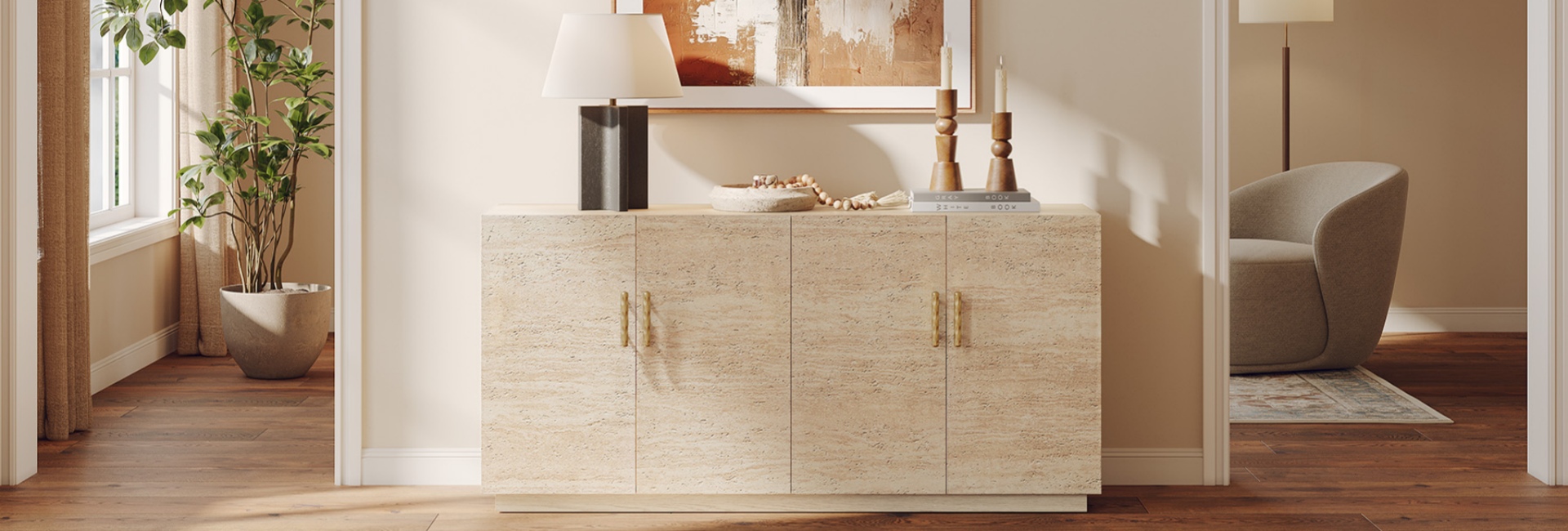
You pull the roast out of the oven and realize the dining table is already covered with plates, candles, and a half-finished cheese board. Where does the serving platter go?
That empty stretch of wall behind the table may be the perfect place for a 63 inch sideboard. At 5 feet 3 inches wide, this size gives you a useful serving surface and plenty of room for dinnerware, linens, and everyday dining essentials without taking over the room.
For many dining rooms, a 63-inch sideboard works especially well with tables around 84 to 96 inches long. But table length is only part of the equation. Wall width, cabinet depth, chair clearance, storage needs, and how you use the room all matter when choosing the right piece.
Table of Contents
- 63-Inch Sideboard at a Glance
- What Is a 63-Inch Sideboard?
- Is 63 Inches a Good Size for a Sideboard?
- How to Measure for a 63-Inch Sideboard
- Height, Depth, and Clearance: The Numbers That Matter
- Matching a 63-Inch Sideboard to Your Dining Table
- Drawers, Doors, or Open Shelves: Which Storage Works Best?
- What Material Is Best for a Sideboard?
- Sideboard Styles That Work Today
- Are Wooden Sideboards Outdated?
- Can a 63-Inch Sideboard Work as a TV Stand?
- Beyond the Dining Room: Other Uses for a 63-Inch Sideboard
- How to Style the Top of a 63-Inch Sideboard
- A Quick 63-Inch Sideboard Buying Checklist
- FAQs
- What is the standard size for a sideboard?
- Are wooden sideboards outdated?
- What is the difference between a sideboard, a buffet, and a credenza?
- How far should a sideboard be from the dining table?
- What size dining table works with a 63-inch sideboard?
- Should a sideboard have drawers or doors?
- Can a 63-inch sideboard work as a TV stand or media console?
- What material is best for a sideboard?
- How deep should a sideboard be?
- How do I style the top of a sideboard?
63-Inch Sideboard at a Glance
If you are comparing sideboards and want the key measurements first, these are useful starting points:
-
Width: 63 inches
-
Best dining table match: About 84–96 inches long for a balanced look
-
Typical depth: 16–20 inches
-
Practical depth for tighter rooms: 16–18 inches
-
Typical height: 30–36 inches
-
Chair clearance: Allow about 30–36 inches between the sideboard and pulled-out chairs
-
Best storage mix: Drawers for smaller items, doors for larger pieces
-
Common uses: Dining rooms, living rooms, entryways, and home offices
These are starting points rather than hard rules. The best 63-inch sideboard is the one that fits your room, leaves enough walking space, and gives you the storage you actually need.
What Is a 63-Inch Sideboard?
A 63-inch sideboard is simply a sideboard that measures about 63 inches wide. The term describes the width, not a specific style or storage configuration.
Most sideboards are designed with a combination of cabinets, drawers, or shelving for storing tableware, serving pieces, linens, books, electronics, or other household items. They can sit along a dining room wall, behind a sofa, in an entryway, or against a living room wall.
Furniture labels can overlap, so you may also see similar pieces described as buffets or credenzas.
These ranges are not strict industry standards. Modern furniture categories overlap, and the actual dimensions and storage layout usually matter more than the label.
For a dining room, a 63-inch sideboard is a useful middle ground: wide enough to provide meaningful storage and serving space, but compact enough to work in many standard-size rooms.
Is 63 Inches a Good Size for a Sideboard?
Yes. A 63-inch sideboard is a versatile size for many dining rooms, especially when paired with a dining table around 84 to 96 inches long.
One useful starting point is to choose a sideboard that is roughly 60% to 75% of the dining table's length. This helps the cabinet feel substantial without visually overwhelming the table.
For example:
-
A 72-inch table may pair better with a shorter sideboard, depending on the room.
-
An 84-inch table can work particularly well with a 63-inch sideboard.
-
A 96-inch table gives a 63-inch sideboard plenty of visual breathing room.
The 60%–75% guideline produces a broader mathematical range of roughly 84–105 inches for a 63-inch sideboard. In practice, however, tables around 84–96 inches are often the easiest visual match.
Room proportions matter, too. On a 100–120-inch wall, a 63-inch cabinet can leave enough space on either side for artwork, lighting, or simply some visual breathing room.
How to Measure for a 63-Inch Sideboard
Before buying a 63-inch sideboard, measure more than the wall.
1. Measure the Available Wall Width
A 63-inch cabinet needs at least 63 inches of usable wall space. If you plan to place artwork, lamps, or other furniture nearby, measure the entire wall and consider how much space you want around the cabinet.
Painter's tape can help. Mark out a 63-inch-wide rectangle on the floor or wall and live with it for a day. It is an easy way to see whether the cabinet will feel too large or too small before you order it.
2. Check Cabinet Depth
Depth affects how much floor space the sideboard takes up.
A depth of 16–18 inches is often practical when you want useful storage without making the dining area feel tight. A deeper cabinet around 20 inches can provide more interior space, but it also takes up more room.
3. Measure Chair Clearance
Pull the dining chairs away from the table as you normally would and make sure there is still enough space between the chair backs and the sideboard.
Allow roughly 30–36 inches for comfortable movement and chair use. If the sideboard has drawers or doors that you plan to open frequently, check the clearance with those fully extended as well.
4. Think About the Delivery Path
A sideboard may fit perfectly against the wall and still be difficult to get into the house.
Measure doorways, hallways, staircases, elevators, and tight corners along the delivery route. Check the product's packaged dimensions if they are available, not just the assembled size.
Height, Depth, and Clearance: The Numbers That Matter
Width gets most of the attention, but height and depth can make just as much difference.
Height: Match the Room, Not Just the Table
A sideboard around 30–36 inches high works well in many dining rooms.
A lower profile around 30–32 inches can create a more understated look, while a 34–36-inch cabinet can provide a stronger visual presence and more vertical storage.
You do not need the sideboard to match the dining table exactly. Instead, consider the proportions of the room and the height of nearby furniture.
Depth: 16–18 Inches Is Often a Practical Starting Point
For rooms where floor space is limited, a 16–18-inch-deep sideboard can provide useful storage without pushing too far into the walkway.
If you have more space, a cabinet closer to 20 inches deep can make room for larger serving pieces, appliances, or other bulky items.
Clearance: Leave Room for Real Life
A dining room needs more than a walkway between furniture.
Allow about 30–36 inches between the sideboard and the backs of dining chairs when the chairs are pulled out. Also consider the space needed to open cabinet doors and drawers.
This matters especially in smaller dining rooms, where a few extra inches can determine whether the room feels comfortable or cramped.
Matching a 63-Inch Sideboard to Your Dining Table
The easiest way to judge the relationship between a sideboard and dining table is to compare their actual lengths rather than relying only on the number of seats.
A 63-inch sideboard is often a natural fit with tables around 84–96 inches long.
For an 84-inch dining table, the sideboard is about 75% of the table length. That creates a fairly substantial sideboard while keeping the table visually dominant.
For a 96-inch table, the sideboard is about 66% of the table length. This leaves more visual space around the cabinet and can work particularly well in a larger dining room.
A 72-inch table is a different situation. A 63-inch sideboard would be nearly as wide as the table, so it may feel visually heavy unless the room is large enough to support the proportions.
Table shape matters, too. A rectangular table usually creates the clearest visual relationship with a long sideboard. Round and oval tables can work as well, but the curved tabletop changes the overall balance, so consider the sideboard's visual weight, leg design, and surrounding space.
Drawers, Doors, or Open Shelves: Which Storage Works Best?
The right storage configuration depends on what you plan to put inside.
Drawers are useful for smaller items such as napkins, placemats, utensils, candles, and serving accessories. They keep frequently used pieces easy to reach without opening a large cabinet door.
Closed doors with adjustable shelves work better for larger or less frequently used items. Plates, bowls, serving platters, glassware, and small appliances can usually be organized more easily behind doors.
Open shelves make everyday items easy to grab and give you a place to display books, ceramics, or decorative pieces. The tradeoff is that everything remains visible.
For many dining rooms, a mixed configuration offers the most flexibility: drawers for smaller essentials and closed storage for larger pieces.
When a 63-Inch Sideboard With Drawers Makes Sense
If you use your sideboard to store everyday dining essentials, drawers can make a big difference in keeping smaller items organized and easy to reach.
The Kaden 63-Inch Mid-Century Sideboard combines drawer storage with enclosed cabinet space, giving you room for everything from napkins and utensils to larger serving pieces. Its drawers feature dovetail joints, while the cabinet combines rubber wood and engineered wood with cherry veneer and tapered legs.
This combination works especially well if you want everyday items within easy reach but still need closed storage for larger pieces. It gives you the flexibility of both drawer and cabinet storage without relying on open shelving.
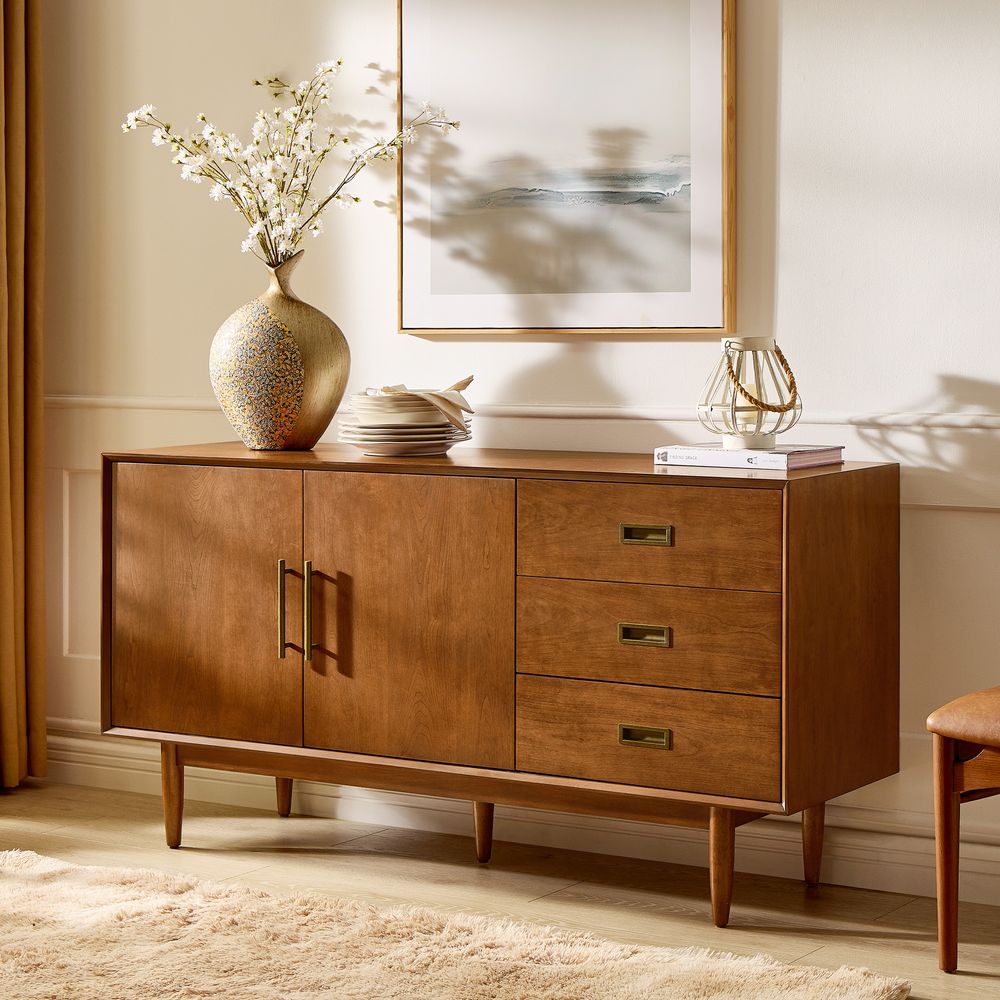
Kaden 63" Mid-Century Sideboard
View Product
What Material Is Best for a Sideboard?
There is no single material that is best for every home. Construction quality, joinery, hardware, shelf support, and finish all influence how a sideboard performs over time.
Solid Wood
Solid wood offers natural grain variation and can be a strong choice for furniture that gets regular use. Different wood species have different characteristics, so look at the actual construction rather than assuming every solid-wood piece will perform the same way.
Wood Veneer
Veneer uses a thin layer of real wood over a core material. It can provide the appearance and grain of a particular wood species while allowing manufacturers to create more dimensionally stable furniture components.
Engineered Wood or MDF
Engineered wood and MDF can provide consistent surfaces and are commonly used in modern furniture construction. Their performance depends heavily on the quality of the core, edge treatment, hardware, and overall construction.
If durability is your priority, look beyond the material name. Check how the drawers are joined, how shelves are supported, how doors are mounted, and what type of hardware is used.
For example, the Rolf 63-Inch Oak Sideboard combines American solid oak, plywood, and engineered wood with oak veneers. Its adjustable shelves provide flexibility for storing items of different sizes.
Rolf vs. Kaden: Which 63-Inch Sideboard Fits Your Needs?
Both pieces offer the same 63-inch width, but they approach storage and design differently. If adjustable shelving and cabinet storage are your priority, look at the Rolf. If you prefer accessible drawer storage and tapered-leg detailing, Kaden may be the better fit.
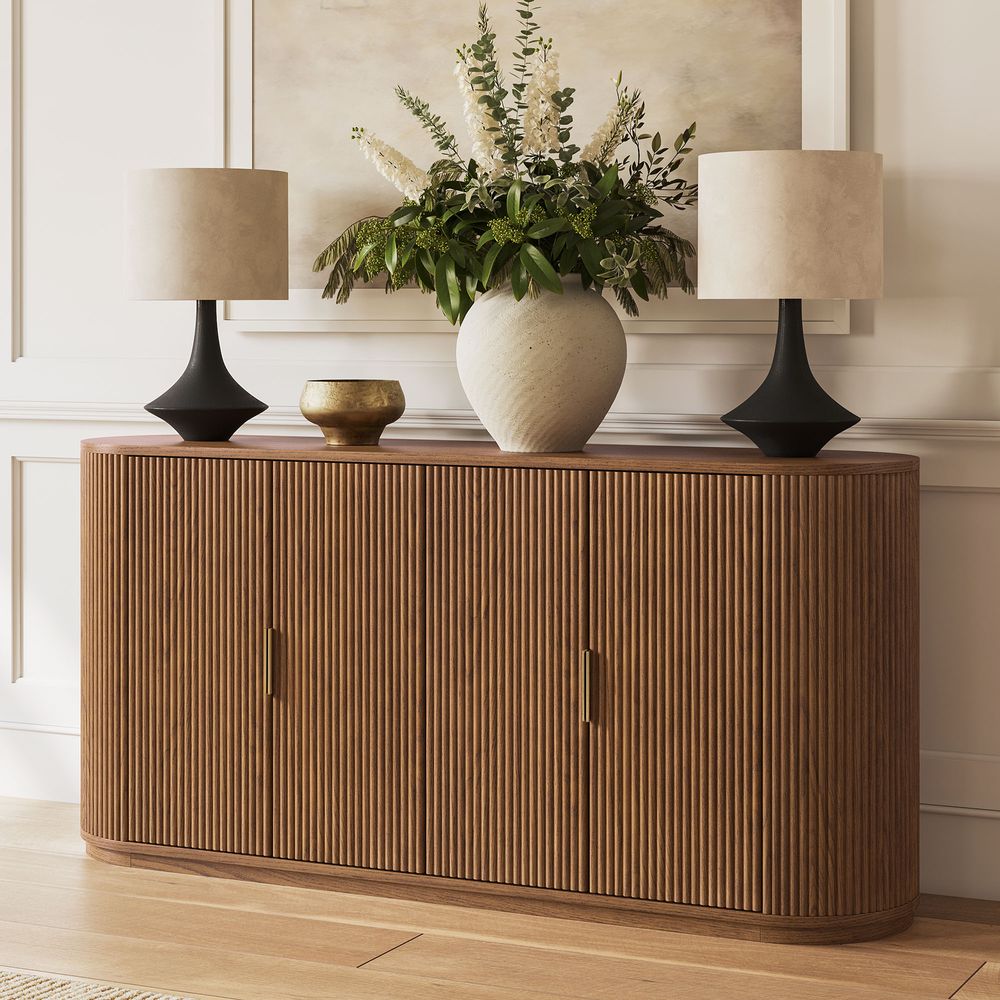
Rolf 63" Oak Sideboard
View Product
Sideboard Styles That Work Today
A 63-inch sideboard gives you enough surface area for the design details to become part of the room, so consider how the cabinet will relate to your existing furniture.
Several design details work particularly well in contemporary dining rooms:
-
Fluted or reeded fronts add texture without relying on decorative hardware.
-
Warm oak and walnut tones bring natural variation and warmth to the room.
-
Tapered legs create a lighter visual footprint.
-
Cane or woven details can introduce texture and contrast.
-
Simple slab fronts keep the cabinet clean and understated.
You do not need every piece of furniture to match exactly. Similar wood tones, leg shapes, or repeated materials are often enough to make the room feel cohesive.
Are Wooden Sideboards Outdated?
No. Wooden sideboards remain one of the most versatile choices for dining rooms and other living spaces.
The key is less about whether wood is "in" or "out" and more about the proportions and design of the piece. Warm wood tones, simple silhouettes, fluted fronts, tapered legs, and understated hardware can all work in contemporary interiors.
A well-proportioned wooden sideboard can also adapt as your room changes. If you eventually replace the dining table or chairs, a simple wood cabinet can often continue working with the new pieces.
Can a 63-Inch Sideboard Work as a TV Stand?
Yes, but check the actual TV width, weight capacity, and cable setup before using a sideboard as a media console.
A 63-inch cabinet can work well with smaller televisions, but remember that a 65-inch TV is often wider than 63 inches. If the TV sits directly on the cabinet, you should check the television's actual width and the sideboard's rated load capacity rather than relying on the screen-size number.
A wall-mounted TV gives you more flexibility because the cabinet does not have to support the television.
Storage is another consideration. If you are using the sideboard for media equipment, check whether the cabinet has enough interior clearance for your components and whether there are openings for cables. Electronics may also require adequate ventilation.
If your primary goal is television and media storage, a dedicated media console may provide a more purpose-built layout.
Beyond the Dining Room: Other Uses for a 63-Inch Sideboard
A 63-inch sideboard does not have to stay in the dining room.
Living Room
Use it against a wall for books, games, blankets, or everyday storage. It can also work beneath artwork or beside a seating area.
Entryway
A 63-inch cabinet can provide a generous landing zone for keys, bags, baskets, and other items. Just make sure the entryway remains wide enough for comfortable traffic.
Home Office
Use the cabinet to store paperwork, office supplies, printer equipment, or other items that do not need to stay on your desk.
Bedroom
A sideboard can provide additional clothing or accessory storage when a dresser alone is not enough. Check the cabinet's depth and interior configuration before deciding whether it will work for your needs.
How to Style the Top of a 63-Inch Sideboard
The 63-inch width gives you enough space to create a simple display without filling every inch.
Start by keeping roughly one-third to one-half of the surface visually clear. Then build around one taller anchor, such as a lamp, artwork, or vase.
You can add a lower grouping of books, a tray, or a few small decorative objects. A plant or other natural element can soften a room dominated by wood and hard surfaces.
If artwork or a mirror hangs above the sideboard, leave roughly 6–10 inches between the furniture and the bottom of the wall piece as a starting point, then adjust based on the size of both pieces.
The easiest mistake to avoid is over-styling. If the sideboard already has a strong fluted or textured front, keeping the top relatively simple usually creates a better balance.
A Quick 63-Inch Sideboard Buying Checklist
Before ordering, run through these questions:
-
Width: Does 63 inches work with the wall and nearby furniture?
-
Dining table: Is your table around 84–96 inches long, or does the room support a different proportion?
-
Depth: Would 16–18 inches work better, or do you have room for a deeper cabinet?
-
Height: Does 30–36 inches look right with your existing furniture?
-
Clearance: Can chairs be pulled out comfortably?
-
Storage: Do you need more drawers, cabinets, shelves, or a combination?
-
Material: Does the construction suit how heavily you will use the piece?
-
Finish: Does the wood tone or finish work with your dining table and flooring?
-
Weight capacity: Is it suitable for what you plan to place on top?
-
Delivery: Will the assembled or packaged dimensions fit through your entryway and hallways?
-
Future use: Could the piece work in another room if your needs change?
A 63-inch sideboard can be a practical choice when the proportions are right. Focus on the relationship between the cabinet, dining table, walls, and walking space rather than choosing the size in isolation.
FAQs
What is the standard size for a sideboard?
There is no single standard sideboard size. Many sideboards fall around 30–36 inches high and 16–20 inches deep, while width varies considerably. A 63-inch sideboard is a practical option for medium-to-large dining spaces.
Are wooden sideboards outdated?
No. Wooden sideboards remain versatile and work with a wide range of interiors. Simple silhouettes, warm wood tones, fluted fronts, and tapered legs can give a wooden sideboard a contemporary look.
What is the difference between a sideboard, a buffet, and a credenza?
The terms overlap in modern furniture. Buffets are often associated with dining and serving, while credenzas may be lower and used in dining rooms, living rooms, or offices. In practice, dimensions, storage, and intended use are more useful than the label alone.
How far should a sideboard be from the dining table?
Allow about 30–36 inches between the sideboard and the backs of dining chairs when the chairs are pulled out. Check additional clearance for opening drawers and cabinet doors.
What size dining table works with a 63-inch sideboard?
Dining tables around 84–96 inches long are often a good visual match. A 63-inch sideboard is about 75% of an 84-inch table and about 66% of a 96-inch table.
Should a sideboard have drawers or doors?
Choose drawers for smaller items you use frequently, such as napkins and utensils. Doors with shelves are better for larger serving pieces and dinnerware. A combination of both provides the most flexibility for many homes.
Can a 63-inch sideboard work as a TV stand or media console?
Yes, if the TV's actual width, weight, and the cabinet's dimensions are compatible. For a wall-mounted TV, the cabinet does not need to support the screen, but cable management and electronics ventilation still matter.
What material is best for a sideboard?
Solid wood, veneer, and engineered wood can all work well. Instead of focusing only on the material, look at construction details such as drawer joints, hardware, shelf support, and overall build quality.
How deep should a sideboard be?
A depth of around 16–18 inches is a practical starting point for many dining rooms, particularly where floor space is limited. Deeper cabinets around 20 inches can provide more storage but require more room.
How do I style the top of a sideboard?
Keep part of the surface clear, then combine one taller anchor with a few lower decorative pieces. Artwork, lamps, plants, books, trays, and ceramics can all work. Avoid filling the entire 63-inch surface.