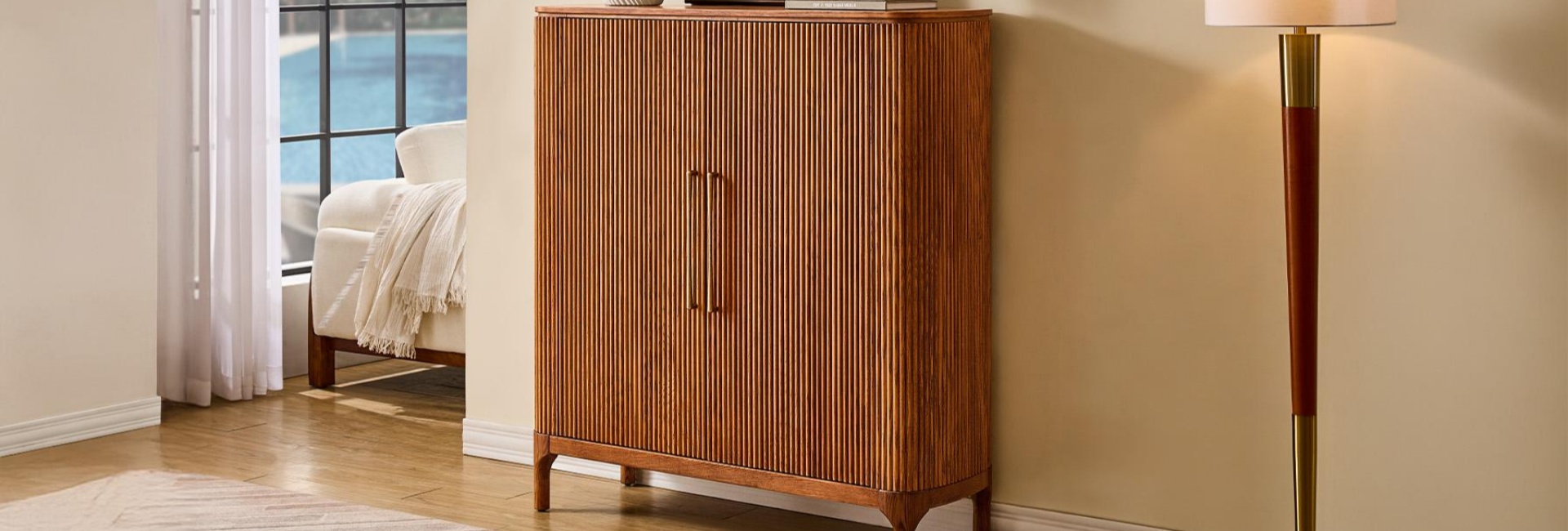
Choosing the right shoe storage cabinet dimensions starts with three measurements: width, height, and depth. Many standard shoe cabinets are around 24–48 inches wide, 30–60 inches high, and 12–16 inches deep, although slim tilt-out designs can be shallower. The right size depends on your entryway layout, the shoes you own, and how many pairs you need to store. Interior shelf measurements also matter because the usable storage space is often smaller than the cabinet's exterior dimensions.
This guide covers common shoe cabinet sizes, how to measure your available space, and what to consider when comparing different storage designs. You will also learn how to account for sneakers, high-tops, boots, and larger footwear before choosing a cabinet.
Table of Contents
- What Are the Standard Shoe Cabinet Dimensions?
- How to Measure Your Space for a Shoe Storage Cabinet
- How Deep Should a Shoe Cabinet Be?
- How to Choose the Right Shoe Cabinet Type and Size
- How to Choose Shoe Cabinet Dimensions for Different Shoe Types
- How Much Shoe Storage Capacity Do You Need?
- What to Check Before Buying a Shoe Storage Cabinet
- FAQs
- What Are the Standard Dimensions of a Shoe Storage Cabinet?
- How Deep Should a Shoe Cabinet Be for Regular Sneakers?
- How Deep Should a Shoe Cabinet Be for Boots?
- How Many Pairs of Shoes Can a Standard Shoe Cabinet Hold?
- Are Slim Shoe Cabinets Suitable for Large Shoes?
- Should I Measure the Inside or Outside of a Shoe Cabinet?
- Are Adjustable Shelves Worth Having in a Shoe Cabinet?
- How Much Space Should I Leave in Front of a Shoe Cabinet?
What Are the Standard Shoe Cabinet Dimensions?
There is no single standard size for every shoe storage cabinet. A slim cabinet designed for a narrow hallway has different dimensions from a deeper unit with flat shelves or a tall cabinet built for a larger shoe collection. However, common size ranges provide a useful starting point when planning your entryway.
Most shoe cabinets are described by three exterior measurements:
-
Width: The distance from one side of the cabinet to the other. It determines how much wall space the unit occupies and how many pairs may fit across a shelf.
-
Height: The distance from the floor to the top of the cabinet. It affects the number of storage levels and how much vertical space the unit uses.
-
Depth: The distance from the front to the back of the cabinet. It determines how far the unit extends into a room and whether shoes can fit inside comfortably.
The following table provides general reference ranges for common shoe storage formats. These are planning estimates rather than fixed furniture standards. Actual dimensions vary by manufacturer, construction, and storage mechanism.
These ranges help compare cabinet formats, but exterior dimensions alone do not indicate how many shoes will fit. A cabinet with a depth of 15 inches, for example, may have less than 15 inches of usable shelf space after accounting for its back panel, doors, and other structural components.
Standard Shoe Cabinet Width
Shoe cabinet width affects both storage capacity and placement. A narrow unit may be sufficient for one or two people who keep only their everyday footwear near the entrance. Wider cabinets provide more shelf space for households with several family members.
For a compact entryway, a cabinet around 24–30 inches wide may fit between a doorway and an adjacent wall. A unit around 36–48 inches wide provides more room for multiple pairs on each shelf, depending on its interior layout.
Do not estimate capacity from width alone. Fixed dividers, side panels, and compartment shapes can reduce usable shelf space. Wide sneakers and boots may also take up more room than flats or children's shoes.
Standard Shoe Cabinet Height
Shoe cabinet height determines how much storage you can add without increasing the unit's floor footprint.
Low cabinets and shoe benches are convenient near the front door because their tops can provide space for bags, keys, or other everyday items. Mid-height cabinets offer a balance between storage and accessibility, while tall cabinets make use of vertical wall space when floor space is limited.
Before choosing a tall shoe cabinet, check the available wall height. Avoid blocking light switches, outlets, windows, or wall-mounted fixtures. Also consider stability and follow the manufacturer's instructions for wall anchoring, particularly with tall, narrow furniture.
Standard Shoe Cabinet Depth
Depth is often the most important measurement when checking whether a shoe cabinet will accommodate your footwear.
A slim tilt-out cabinet may have an exterior depth of less than 12 inches because shoes are stored at an angle. A conventional cabinet with flat shelves generally needs more room, often around 12–16 inches. Larger footwear or shoes stored in their original boxes may require additional depth.
Keep in mind that exterior depth and usable interior depth are different measurements. Check the shelf specifications whenever possible, especially when buying a cabinet for large shoes or bulky sneakers.
How to Measure Your Space for a Shoe Storage Cabinet
Before comparing shoe storage cabinet sizes, measure the location where the cabinet will stand. A unit may fit along a wall but still interfere with a door, narrow the walking path, or block an outlet.
A tape measure and a few notes are usually enough to get started.
1. Choose the Placement
Decide where the cabinet will go. Common locations include:
-
Entryway: Convenient for everyday footwear, although available floor space may be limited.
-
Hallway: A narrow cabinet can make use of an unused wall, provided it does not obstruct the walking path.
-
Bedroom: A wider or taller unit may work for shoes that are not used daily.
-
Under the stairs: A sloped ceiling may limit cabinet height, so measure the exact area where the unit will stand.
-
Closet or mudroom: A deeper cabinet or open rack may be suitable when there is more room for access and ventilation.
2. Measure the Available Width, Height, and Depth
Measure the usable wall width at the floor level where the cabinet will sit. Account for door trim, nearby furniture, and other obstacles that could reduce the available space.
Next, measure the maximum available height. If the cabinet will sit beneath a window, shelf, or sloped ceiling, use the lowest clearance point across the planned placement.
Finally, measure the available depth from the wall to the edge of the walking area. Include baseboards or other wall features that may prevent the cabinet from sitting flush against the wall.
Record all three measurements so you can compare them with the product's exterior dimensions.
3. Check Door Swings and Opening Clearance
A cabinet's closed dimensions do not show how much space it needs during everyday use.
For a cabinet with hinged doors, check whether they can open fully without hitting a nearby wall, front door, or another piece of furniture. For drawers and tilt-out compartments, consider how far they extend into the room.
This is particularly important in narrow entryways. A cabinet that looks compact against the wall may become inconvenient when its compartments are open.
4. Account for Wall Features and Irregular Spaces
Look beyond the main wall measurements. Baseboards, radiators, vents, outlets, light switches, and door trim can all affect placement.
For example, a thick baseboard may prevent a cabinet from sitting directly against the wall, leaving it several inches farther forward than expected. In a hallway, even a small increase in depth can make the walking area feel tighter.
For an under-stair location, measure the height at the left, center, and right sides of the planned placement. If the ceiling slopes, the available height may change across the cabinet's width.
Also leave enough room to clean around the unit and access nearby fixtures.
How Deep Should a Shoe Cabinet Be?
The right shoe cabinet depth depends on how the footwear is stored. Shoes placed flat on horizontal shelves need enough interior depth to accommodate their full length. Tilt-out cabinets use angled compartments, allowing them to take up less room from front to back.
The following comparisons can help you decide which depth works for your space.
Slim Shoe Cabinets for Narrow Entryways
A shoe cabinet for a small entryway should provide enough storage without taking up too much floor space. Slim tilt-out designs are useful when hallway depth is limited, as they hold shoes at an angle rather than placing them flat on shelves.
This arrangement can work for low-profile sneakers, flats, and everyday footwear. However, the angled compartments may not accommodate bulky sneakers, high-tops, or boots.
Before choosing a slim cabinet, check:
-
The usable compartment depth, not just the exterior depth.
-
Whether the dividers can be adjusted or removed.
-
The maximum shoe size or length supported, if listed.
-
Whether bulky footwear can fit without blocking the closing mechanism.
-
How far the compartment extends when fully open.
A slim design makes sense when saving floor space is the main priority and most of your footwear fits its compartment dimensions.
Standard-Depth Shoe Cabinets for Everyday Footwear
A cabinet with flat shelves offers a different approach. Shoes sit horizontally rather than at an angle, making it easier to arrange different types of footwear.
An interior shelf depth of around 12–14 inches may accommodate many everyday shoes, although larger sizes and chunky soles can require more room.
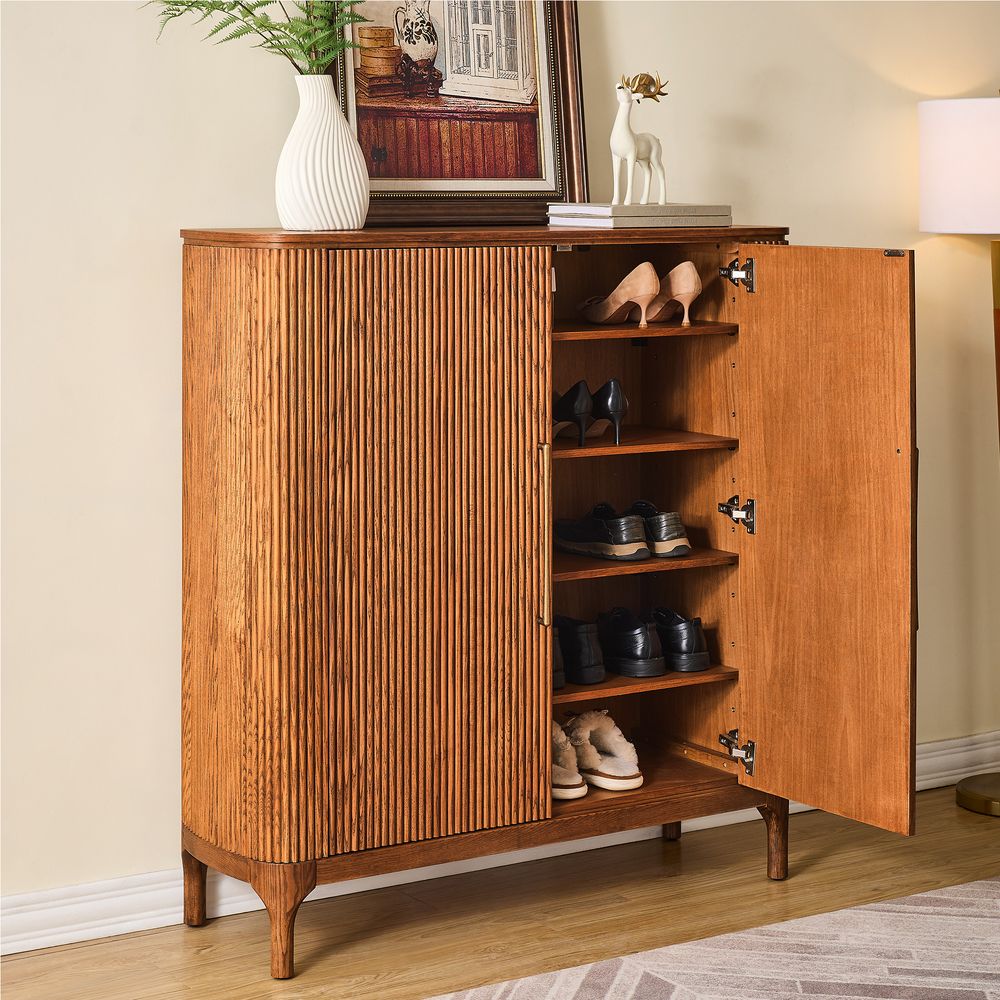
For a conventional shoe cabinet with flat shelves, the Skugga 47-Inch Oak Shoe Storage offers a useful example. It measures 47.2 inches wide, 15.7 inches deep, and 50 inches high, with an interior storage area measuring 36.5 inches wide, 13.6 inches deep, and 7.5 inches high. It has a shoe storage capacity of approximately 18–24 pairs, depending on shoe size and arrangement.
Its five-tier interior includes four adjustable shelves, allowing you to change the compartment height for different types of footwear. The 13.6-inch interior depth is particularly worth checking if you plan to store larger sneakers. Measure your longest pair to confirm the fit.
Deep Shoe Cabinets for Boots and Large Shoes
A shoe cabinet for large shoes needs enough interior depth, shelf width, and vertical clearance to accommodate bulky sneakers, wide footwear, and boots. The extra space may be needed in more than one direction.
Consider these dimensions when comparing cabinets:
-
Length: The toe or outsole may extend farther than expected.
-
Width: Bulky soles and wide forefeet can reduce the number of pairs that fit side by side.
-
Height: High-tops and boots need more vertical clearance between shelves.
-
Shape: Unstructured boots may spread outward and take up additional shelf space.
If a conventional shoe cabinet is too shallow, a deeper hallway cabinet or closet storage unit may be a better option. Prioritize the usable interior dimensions rather than relying on the advertised number of pairs.
Skugga 47-Inch Oak Shoe Storage
View Product
How to Choose the Right Shoe Cabinet Type and Size
Two cabinets with similar exterior measurements can offer different storage arrangements. Their door mechanisms, shelf layouts, and compartment sizes affect which types of footwear they can accommodate.
Flip-Down Shoe Cabinets
Flip-down cabinets use hinged compartments that tilt forward. Shoes sit at an angle inside each section, reducing the cabinet's front-to-back footprint.
They are suitable for narrow hallways where a standard-depth cabinet would take up too much floor space. However, their compact compartments are generally better suited to lower-profile footwear.
Check the maximum shoe length and compartment width before purchasing. Also consider the opening path, since the compartment needs enough clearance to tilt forward without hitting a wall or obstructing the entrance.
Door-and-Shelf Shoe Cabinets
Door-and-shelf cabinets use horizontal shelves behind cabinet doors. This familiar arrangement keeps footwear out of sight while providing space for different types of shoes.
It can work well for households with a mixture of sneakers, flats, heels, and everyday footwear. Adjustable shelves are particularly useful when some pairs need more vertical clearance than others.
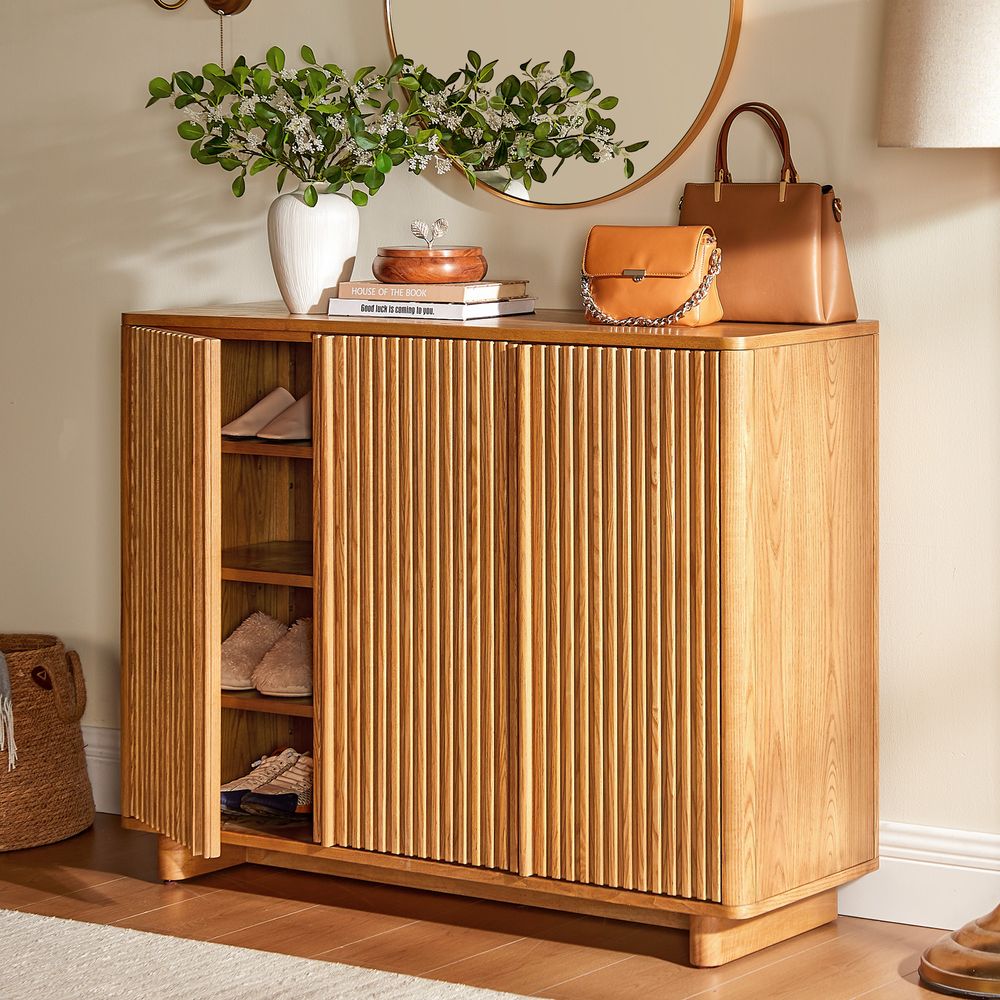
If you prefer a lower cabinet, the Sabina 48-Inch Ash Wood Shoe Storage measures 48 inches wide, 15.7 inches deep, and 36 inches high. Its interior is divided into two sections with different widths: 29.8 inches and 14.7 inches. Both sections have 14 inches of interior depth and 7.32 inches of height. The cabinet can accommodate approximately 16–20 pairs of shoes, depending on shoe size and arrangement.
This layout provides separate storage areas for organizing footwear, while the adjustable shelves allow some flexibility when arranging shoes. Its lower profile may also suit an entryway where a taller cabinet would take up more visual space.
Shoe Storage Benches
A shoe storage bench combines seating with a place to keep footwear. It can be convenient near an entryway, especially for people who prefer to sit while putting on or taking off their shoes.
Most benches are lower than enclosed shoe cabinets, so they usually provide less vertical storage. Their interiors may consist of open shelves, cubbies, or a closed compartment beneath the seat.
When comparing shoe bench dimensions, check three measurements: seat height, usable storage depth, and compartment height. The seat should be comfortable for everyday use, while the storage area needs enough clearance for the footwear you plan to keep inside.
Open Shoe Racks and Shoe Cubbies
Open shoe racks are simple, accessible, and easy to organize. They work well in closets, mudrooms, and utility areas where footwear does not need to be hidden.
Cubbies provide individual spaces for shoes, making it easier to keep pairs organized. However, compartment size matters. A cubby that fits flats may not accommodate bulky sneakers or wide shoes.
Open storage also leaves footwear exposed to dust. Although it generally allows more airflow than a fully enclosed cabinet, it may not provide the same tidy appearance as closed storage in a formal entryway.
Modular Shoe Storage
Modular storage uses separate units or compartments that can be combined to suit a particular space. This arrangement can be useful when a shoe collection changes over time or when storage is needed in more than one area.
Check the width, depth, and height of each compartment rather than assuming every module offers the same interior dimensions. When combining units, measure the full arrangement, including any gaps between sections, to ensure it fits the intended location.
Sabina 48-Inch Ash Wood Shoe Storage
View Product
How to Choose Shoe Cabinet Dimensions for Different Shoe Types
A shoe cabinet can have enough exterior space and still be unsuitable for the footwear you plan to store. Shoe size alone does not determine the finished length, width, or height of a particular pair. Sole thickness, toe shape, and upper construction also affect the space required.
Consider the largest or bulkiest pairs in your collection when comparing interior shelf dimensions.
Sneakers and Everyday Shoes
Flats, sandals, and many low-profile sneakers are generally easier to store than bulky footwear. For these pairs, focus on usable shelf depth and width.
Measure from the back of the heel to the furthest point of the toe or outsole. Compare that measurement with the cabinet's interior shelf depth.
Also check whether two shoes can sit next to each other without overlapping. A shelf may be deep enough for a pair but too narrow to accommodate them side by side.
High-Tops and Basketball Shoes
High-tops often need more vertical room than regular sneakers. Their uppers can catch on the shelf above even when the shoe's length and depth are suitable.
Check the shelf-to-shelf clearance rather than relying on the cabinet's overall height. Adjustable or removable shelves can provide additional room for taller footwear, although increasing one compartment's height may reduce the number of available storage levels.
Boots and Hiking Shoes
Boots need more than additional depth. Their shafts, soles, and overall shape can make them difficult to fit into narrow compartments.
Measure the height of each boot from the bottom of the sole to the top of the shaft. Also consider the outsole width and whether the boot can stand upright or needs to be placed on its side.
A cabinet with a taller compartment or an open lower shelf may be more practical than one with fixed, shallow sections. For particularly tall boots, a separate closet storage area may provide a better fit.
Large and Wide Shoes
Large shoes can take up more room both front to back and from side to side. A cabinet advertised for a certain number of pairs may hold fewer when the collection includes wide sneakers, thick soles, or larger adult sizes.
Compare the longest and widest pairs with the usable interior space. Check whether fixed dividers can be moved or removed if additional width is needed.
To check whether a shoe fits, place it inside the compartment without bending or forcing it into position. It should not protrude or prevent the cabinet door from closing. If the product page does not provide internal measurements, contact the retailer before purchasing.
How Much Shoe Storage Capacity Do You Need?
The number of pairs a shoe cabinet can hold depends on its width, shelf count, interior layout, and footwear type. An advertised capacity is best treated as an estimate rather than a guarantee.
Start by counting the shoes that actually need to stay near the entrance. Seasonal footwear that can be stored in a bedroom closet does not necessarily need to occupy space in the main entryway cabinet.
Next, group your shoes by type:
-
Everyday flats and low-profile sneakers.
-
Bulky running shoes and basketball shoes.
-
High-tops and other footwear that needs more vertical clearance.
-
Boots and seasonal shoes.
-
Children's shoes, if they share the same storage space.
Then compare the total number of pairs with the cabinet's usable shelf area. Consider how many pairs can fit across each shelf and how many levels remain available after accounting for taller footwear.
For example, a cabinet with several adjustable shelves may offer multiple storage levels in its default layout. If you raise a shelf to fit high-tops or boots, however, you may lose space for another row of shoes. Fixed dividers can also affect how many pairs fit across each level.
Plan around the footwear you own. Leaving some room between pairs also makes it easier to take shoes out and put them back.
What to Check Before Buying a Shoe Storage Cabinet
Once you have measured your space and estimated the capacity you need, compare the details that affect everyday use.
Internal and exterior dimensions: Confirm the overall width, height, and depth, then check the usable shelf measurements. Make sure your longest pair fits without preventing the door from closing.
Adjustable shelves: Find out whether the shelves can be repositioned or removed. Check the available adjustment positions and the maximum opening height they provide.
Divider layout: Fixed dividers can restrict the width available for bulky shoes. Check whether compartments are designed for individual shoes, pairs, or different footwear sizes.
Door and drawer clearance: Measure the space needed to open hinged doors, drawers, or tilt-out compartments. Make sure they will not block an entry door or narrow the walking path.
Ventilation and moisture: Some cabinets have slatted fronts or breathable backing to allow airflow. This can help, but ventilation does not replace proper shoe care. Let wet shoes dry before putting them in an enclosed cabinet. The NHS guidance on foot care also recommends letting shoes dry out before wearing them again.
Stability and wall anchoring: Follow the manufacturer's assembly and installation instructions. Tall or narrow furniture should be secured as directed, particularly in homes with children. The U.S. Consumer Product Safety Commission recommends anchoring furniture to help prevent tip-over injuries.
Materials and finish: Consider how the cabinet's material and finish fit the room and your maintenance preferences. Wood finishes can add warmth to an entryway, while the cabinet's surface should also be practical to dust and clean.
Assembly and delivery: Check whether the cabinet arrives fully assembled or requires installation. For a large or heavy unit, measure hallways, staircases, and door openings along the delivery path before ordering.
FAQs
What Are the Standard Dimensions of a Shoe Storage Cabinet?
Many conventional shoe cabinets are around 24–48 inches wide, 30–60 inches high, and 12–16 inches deep. Slim tilt-out cabinets can be shallower, while deeper units may be needed for large footwear. These are general reference ranges rather than universal standards, so always check the product's exterior and interior measurements.
How Deep Should a Shoe Cabinet Be for Regular Sneakers?
An interior shelf depth of around 12–14 inches may accommodate many regular sneakers. Larger sizes and chunky soles may need additional room. Measure your longest pair and compare it with the actual shelf depth before buying.
How Deep Should a Shoe Cabinet Be for Boots?
Boot storage depends on both depth and vertical clearance. A deeper shelf may be needed for bulky soles, while the compartment must also be tall enough for the boot shaft. A taller compartment or open lower shelf can provide more flexibility.
How Many Pairs of Shoes Can a Standard Shoe Cabinet Hold?
Capacity depends on the cabinet's width, number of shelves, divider layout, and shoe sizes. A wider cabinet may hold more pairs across each shelf, but bulky shoes can reduce the total. Treat listed capacity as an estimate and check the interior layout.
Are Slim Shoe Cabinets Suitable for Large Shoes?
Not always. Slim cabinets often use angled compartments designed to reduce exterior depth. Large sneakers, high-tops, and boots may be too bulky for these sections. Check the compartment dimensions, divider layout, and opening clearance before choosing one.
Should I Measure the Inside or Outside of a Shoe Cabinet?
Measure both. Exterior dimensions tell you whether the cabinet will fit in your room, while interior dimensions show whether your shoes will fit inside. Pay particular attention to usable shelf depth, shelf width, and the height of each opening.
Are Adjustable Shelves Worth Having in a Shoe Cabinet?
Adjustable shelves are useful when you store different types of footwear. They let you create taller spaces for high-tops and boots while keeping smaller compartments for flats or low-profile sneakers. However, changing shelf positions may reduce the number of available storage levels.
How Much Space Should I Leave in Front of a Shoe Cabinet?
Leave enough room for people to walk past the cabinet and for its doors, drawers, or tilt-out compartments to open fully. The required clearance depends on the hallway layout and cabinet design. Measure the unit in both its closed and open positions before deciding where to place it.