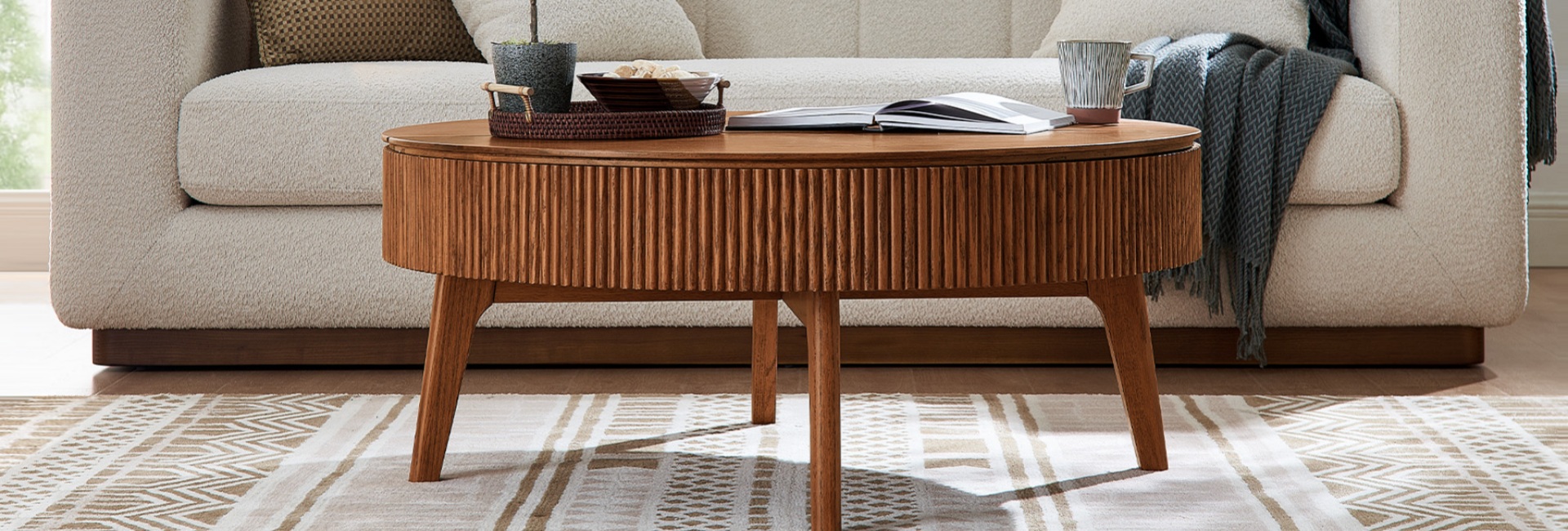
A small coffee table with storage can make a cramped living room easier to manage. It uses the floor space a coffee table already needs while giving you somewhere to put remotes, chargers, throw blankets, books, and other everyday items. The challenge is finding one that adds storage without making the room feel crowded, blocking the walkway, or sitting awkwardly against your sofa.
The right choice comes down to a few practical measurements: the table's length, height, clearance, and storage capacity. From there, the shape and storage mechanism should fit the way you actually use the room.
Table of Contents
- Quick Answer
- Why a Small Coffee Table With Storage Earns Its Footprint
- The 2/3 Rule: Sizing Your Table to Your Sofa
- Height, Clearance, and the Walkway You Can't Skip
- Lift-Top vs. Drawers vs. Open Shelf: Which Storage Fits Your Life
- Round Coffee Table With Storage: The Small-Space Shortcut
- Living Room Coffee Tables With Storage: Matching Storage to Your Layout
- Best Storage Coffee Tables: What Separates a Good Mechanism From a Regret
- Materials That Hold Up in a Small Living Room
- Visual Weight: Keeping a Storage Table From Bulking Up the Room
- The Tape Test: A 10-Minute Check Before You Order
- FAQs
- What is the 2/3 rule for coffee tables?
- Are storage coffee tables good for small spaces?
- How do I choose a small coffee table with storage?
- How tall should a coffee table be?
- How much space do I need between the sofa and the coffee table?
- What is the difference between a lift-top and a drawer coffee table?
- What can I store inside a coffee table with storage?
- Does a storage coffee table make a small room look smaller?
- Should I get a round or rectangular coffee table for a small living room?
- What should I look for when buying a small coffee table with storage?
Quick Answer
For most small living rooms, start with a coffee table about two-thirds the length of your sofa, with a tabletop roughly level with or 1–2 inches below the seat cushions. Leave about 12–18 inches between the sofa and table, then choose the storage style that fits your routine. Lift-top tables work well for laptops and meals, while drawers are better for smaller items such as remotes and chargers.
Why a Small Coffee Table With Storage Earns Its Footprint
A storage coffee table can solve two problems with one piece of furniture. You need a surface for drinks, books, or a laptop, and you also need somewhere to put the things that tend to collect around the sofa. Instead of adding a separate storage cabinet, you can use the space underneath the tabletop.
That can be especially useful in a smaller living room. Remotes can stay in a drawer. A throw blanket can go inside a lift-top compartment. Books and baskets can use an open shelf. The storage is there when you need it without taking up another section of the room.
There is a trade-off, though. More storage can mean a heavier-looking table, additional hardware, or less legroom. If you only have one or two items to put away, a simple coffee table may be enough. A storage model makes more sense when you have a few things that regularly need a home.
Before shopping, name two or three items you would actually store in the table. That simple test can help you decide whether you need a large hidden compartment, a couple of drawers, or just an open shelf.
The 2/3 Rule: Sizing Your Table to Your Sofa
Once you know you want storage, start with the table's overall size. The length is usually the first measurement to check because it determines how the table relates to your sofa.
The Math Behind the Two-Thirds
A useful starting point is to choose a coffee table about two-thirds the length of your sofa.
A table that is almost as long as the sofa can make a small seating area feel crowded. A very short table, on the other hand, may look disconnected from the seating around it. A two-thirds proportion usually gives you enough surface without letting the table take over the arrangement.
It is a guideline rather than a strict rule. The sofa's shape, the room's layout, and the available walking space all matter.
Worked Examples You Can Measure Tonight
Measure the sofa itself rather than relying on the manufacturer's listed size. Then use roughly two-thirds of that measurement as a starting point.
For a sectional with a chaise, focus on the section of the sofa that faces the coffee table rather than measuring the entire L-shaped footprint.
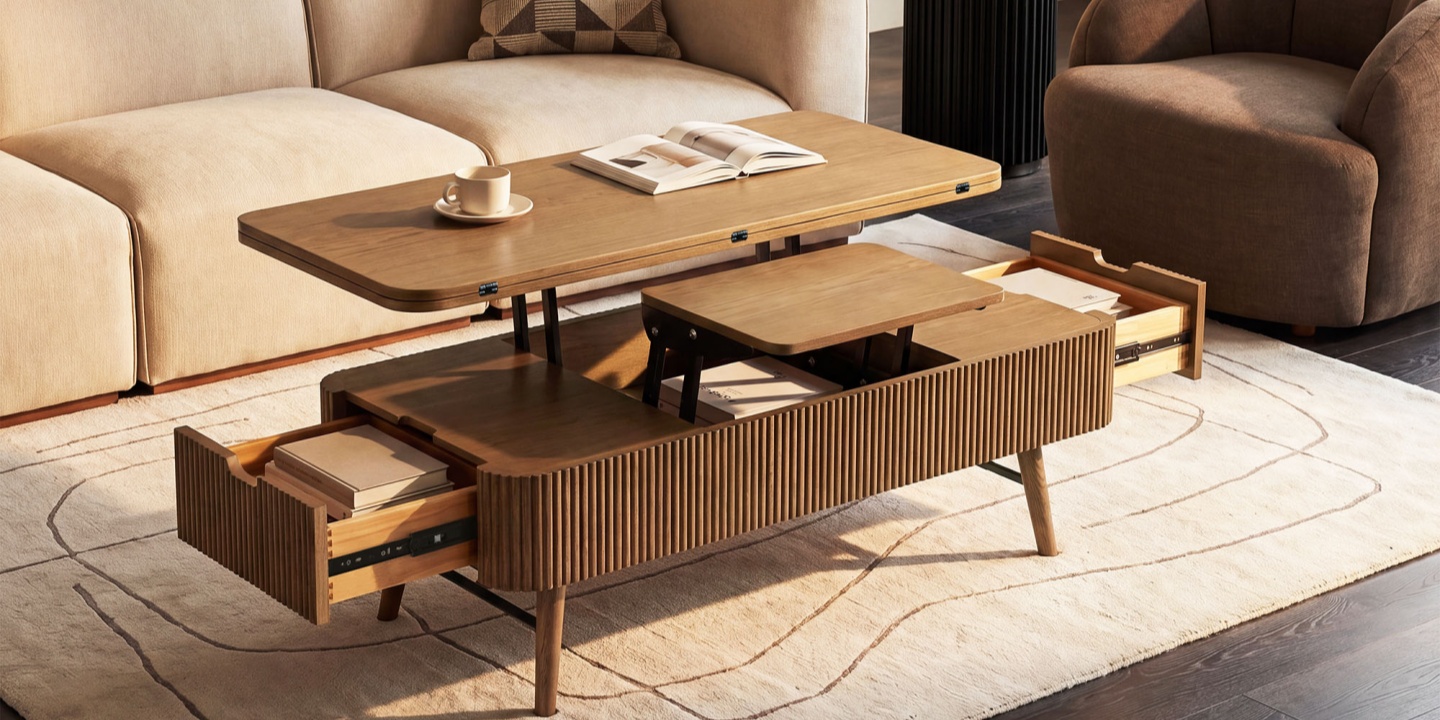
For example, a 47-inch coffee table can work well with a 72-inch sofa because it follows the same general proportion. Hernest's Magnus 47" Lift-Top Oak Coffee Table uses a similar proportion while adding concealed storage.
Height, Clearance, and the Walkway You Can't Skip
Length gets most of the attention when people shop for coffee tables, but height and clearance determine how comfortable the finished arrangement will be.
How Tall Should the Table Be?
A good starting point is a tabletop level with your sofa cushions or about one to two inches below them.
Many sofa seats are around 17 to 19 inches high, which puts a coffee table around 16 to 18 inches in a comfortable range for many seating arrangements. A lower table can work well with a low-profile sofa, while deeper, higher seating may call for something closer to the upper end of that range.
The important thing is to compare the table with the actual sofa rather than choosing a height based only on the coffee table category.
The 12 to 18 Inch Buffer
Leave about 12 to 18 inches between the front edge of the sofa and the coffee table.
Twelve inches is useful when floor space is tight, while closer to 18 inches gives you more room to sit down and stand up comfortably. You also need to consider the path around the table. About 30 inches of walking space is a useful target for a frequently used walkway.
If you have to compromise, protect the space between the sofa and table first. That is the gap you interact with every time you sit down.
Don't Forget Lift-Top Clearance
A lift-top coffee table needs more room than a fixed tabletop.
When the top is raised, part of it moves toward the sofa. The exact movement depends on the mechanism and the product, so measure the raised position rather than assuming the closed footprint tells you everything you need to know.
If you plan to use the raised surface for a laptop or meals, check the manufacturer's listed raised height as well. Then use painter's tape to mark the movement on the floor before ordering.
This small step can reveal a problem that is easy to miss in a product photo: the top may open correctly but still interfere with your knees, sofa, or nearby furniture.
Lift-Top vs. Drawers vs. Open Shelf: Which Storage Fits Your Life
The best storage mechanism depends on what you plan to put away and how often you need to reach it.
A lift-top is useful when the coffee table needs to do more than hold drinks. Raising the tabletop creates a more convenient surface for working on a laptop, eating, or writing. The storage cavity underneath can hold items you do not want left on the tabletop.
The trade-off is the moving mechanism and the additional clearance it requires.
Drawers make more sense when most of your storage needs involve smaller objects. Remotes, charging cables, reading glasses, and notebooks are easy to organize in a drawer, and the tabletop stays fixed while you open it.
When comparing drawer tables, look at the hardware rather than just the drawer count. Full-extension slides give you better access to the back of the drawer, while soft-close hardware can make everyday use quieter.
An open shelf is the simplest option. It works well for books, baskets, and decorative objects and does not require moving hardware. The downside is that everything remains visible, so the shelf can make a small room look busier if it becomes a catch-all.
If you need both a work surface and closed storage, a combination of a lift-top and drawers can be useful. For example, the Magnus 47" Lift-Top Oak Coffee Table combines a raised work surface with drawer storage.
Round Coffee Table With Storage: The Small-Space Shortcut
A round coffee table with storage can be a practical choice when the room has tight walkways or several pieces of furniture close together.
Without corners extending into the walking path, a round table can be easier to move around. It also creates a useful contrast with the straight lines of a sofa, media console, or rectangular rug.
Round tables work particularly well with sectionals and sofa-and-chair arrangements where the seating creates an open area in the middle. For many compact rooms, a diameter around 30 to 36 inches provides a useful starting point, while larger sizes need more open floor space.
Storage capacity is another consideration. A round lift-top table may have a storage cavity running around the underside of the top rather than a simple rectangular compartment. That can work well for smaller everyday items such as remotes, chargers, books, and tablets.
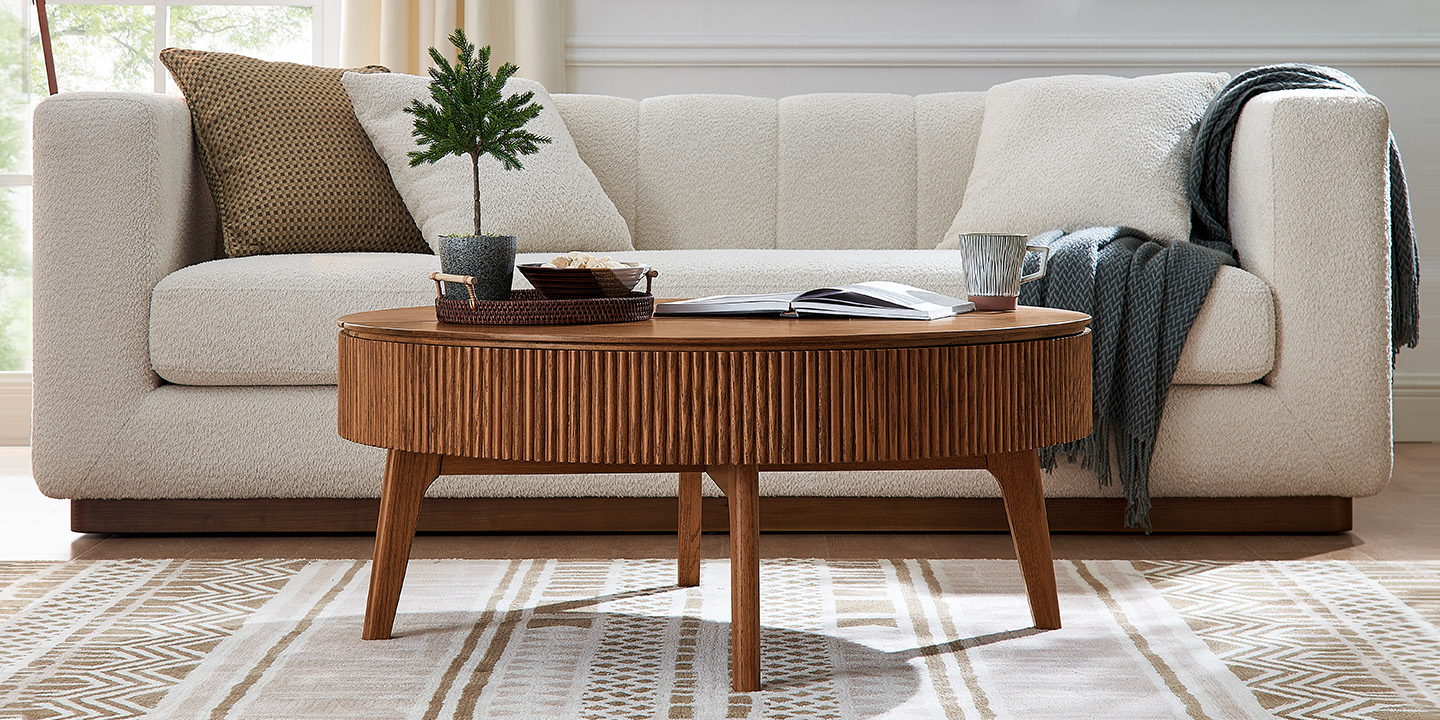
The Magnus 39" Oak Round Lift-Top Coffee Table is one example of this format. Its round footprint and lift-top design combine a compact seating arrangement with concealed storage.
Living Room Coffee Tables With Storage: Matching Storage to Your Layout
The shape of your coffee table should follow the seating arrangement and traffic pattern in the room.
A standard three-seat sofa usually works naturally with a rectangular or oval coffee table. A table around 48 inches long and 24 inches deep is a common proportion for this type of arrangement, provided the surrounding clearance works for the room.
A sectional or sofa-and-two-chairs arrangement gives you more flexibility. A square table can sit comfortably in the center of an L-shaped seating area, while a round table can make the walking route around the seating feel less restricted.
An open-concept living room can benefit from round or oval shapes as well. Curved edges break up the straight lines created by sofas, cabinets, walls, and kitchen counters, which can make the overall layout feel less rigid.
Before choosing the shape, look at where people actually walk. A table that looks perfect in a product photo may not work if its corners sit directly in a common path.
Once the layout is clear, you can browse the Hernest coffee table collection and narrow the options by storage type, shape, and size.
Best Storage Coffee Tables: What Separates a Good Mechanism From a Regret
A storage coffee table gets daily use, so the hardware deserves as much attention as the finish.
For a lift-top, look for a mechanism that raises and lowers the top in a controlled way. Gas-assisted or counterbalanced mechanisms can make a heavy tabletop easier to lift and lower. Check how far the top moves and whether the mechanism holds the top securely in the raised position.
For drawers, pay attention to the slides. Ball-bearing or full-extension slides generally provide smoother operation and better access than basic runners. Soft-close hardware is another useful feature, particularly in a living room where the table may be opened and closed frequently.
Joinery is worth checking too. Dovetail drawer joints are a traditional way to strengthen the connection between the drawer sides and front. If a product lists the type of drawer construction, it gives you more information than simply knowing that the table has drawers.
Also check the manufacturer's weight ratings. If you expect the table to support more than books, drinks, and a laptop, make sure the listed capacity matches how you plan to use it. A coffee table should not be treated as a seat or footrest unless the manufacturer specifically says it is designed for that use.
Materials That Hold Up in a Small Living Room
Material affects both the appearance of a coffee table and how it handles everyday use.
Oak is a practical choice for a busy living room. It has a durable surface, works well with modern and mid-century furniture, and can add warmth without making a compact room feel too dark.
The construction underneath the finish matters too. Solid wood, veneers, plywood, and engineered wood each behave differently as temperature and humidity change. A veneer over a stable core can help keep a large panel more dimensionally stable than a single wide piece of solid wood.
Metal can also be useful, particularly for legs or frames. Slim metal components provide structural support while keeping more of the floor visible.
Glass is another option, but it requires more upkeep and may not be the best choice for every household, especially where young children or active pets are present. Stone can create a more substantial look, but its visual weight may not suit a very compact room.
For any material, check the product specifications rather than relying on the product name alone. If the finish or material certification is important to you, look for those details in the manufacturer's specifications.
Visual Weight: Keeping a Storage Table From Bulking Up the Room
A storage table does not have to look heavier than a standard coffee table. Much depends on how the base, legs, finish, and height work together.
Start with the legs. Tapered or slender legs leave more floor visible underneath the table. A solid base that reaches almost to the floor can make the same-size table look much more substantial.
Consider the finish. Dark walnut or espresso finishes can add visual weight in a low-light room. Lighter or mid-tone wood can make the furniture feel less imposing, particularly when the floor and walls are already dark.
Keep the height proportional. A coffee table around 16 to 18 inches high works with many standard sofas. If the table is significantly taller than the seating, it can start to look more like a side table than a traditional coffee table.
Use texture carefully. Details such as fluting or ribbed wood can add visual interest without requiring a larger footprint. The key is to keep the overall silhouette simple.
The Tape Test: A 10-Minute Check Before You Order
Before ordering a small coffee table with storage, mark the proposed footprint on your floor with painter's tape.
Include the table's full width and depth, then mark the space needed to open drawers or raise the tabletop. Add the planned gap between the sofa and table as well as the main walking path around it.
Then walk through the room as you normally would.
Sit on the sofa. Stand up. Walk toward the kitchen. Carry a laptop across the room. If you have pets or children, consider how they move through the space too.
This test takes only a few minutes and can reveal clearance problems that are difficult to spot from a product image.
Also check the internal storage dimensions, not just the exterior dimensions. A table may have a large overall footprint but surprisingly little usable storage space. If you want to store a laptop, board game, power strip, or folded blanket, compare the item's dimensions with the actual cavity or drawer dimensions.
Finally, check assembly requirements and delivery details. Lift-top tables can involve more components than fixed-top designs, so knowing what assembly is required before the box arrives can save some frustration later.
FAQs
What is the 2/3 rule for coffee tables?
The 2/3 rule is a useful proportion guideline: your coffee table should be about two-thirds the length of your sofa. For example, a 72-inch sofa would pair with a coffee table around 48 inches long. It is not a strict requirement, so adjust the size if your room layout or walking space calls for it.
Are storage coffee tables good for small spaces?
Yes, when the storage serves a real need. A storage coffee table uses floor space that a standard coffee table would already occupy while providing a place for remotes, throws, chargers, books, or other everyday items. Choose the storage type based on what you actually need to put away rather than simply choosing the model with the largest compartment.
How do I choose a small coffee table with storage?
Start with the dimensions. A table around two-thirds the length of your sofa is a useful starting point, while the tabletop should generally be level with or slightly below the sofa cushions. Leave about 12–18 inches between the sofa and table. Then choose the storage style: lift-top for a work or dining surface, drawers for small items, or an open shelf for books and baskets.
How tall should a coffee table be?
Aim for a tabletop level with your sofa cushions or about one to two inches below them. Many sofas have seat heights around 17–19 inches, making a 16–18 inch coffee table a useful starting range. A low-profile sofa may work better with a lower table, while taller seating can accommodate a slightly higher design.
How much space do I need between the sofa and the coffee table?
About 12–18 inches is a practical range for many living rooms. Twelve inches can work when space is tight, while closer to 18 inches gives you more room to sit and stand comfortably. Also allow enough space around the table for the main walking route, with about 30 inches as a useful target for a frequently used path.
What is the difference between a lift-top and a drawer coffee table?
A lift-top raises the tabletop to create a more convenient surface for working or eating and usually provides a storage cavity underneath. A drawer coffee table keeps the tabletop fixed and provides accessible storage for smaller items such as remotes and chargers. A lift-top needs additional clearance when open, while a drawer mainly needs enough room for the drawer to extend.
What can I store inside a coffee table with storage?
A lift-top compartment can hold items such as folded throws, tablets, chargers, headphones, or flat board games, depending on its internal dimensions. Drawers work well for remotes, charging cables, glasses, and notebooks. Open shelves are better suited to books, baskets, and decorative items. Always check the interior dimensions before assuming a particular item will fit.
Does a storage coffee table make a small room look smaller?
It can, but the effect depends largely on the design. A solid base, dark finish, or oversized profile can make a small room feel visually heavier. Tables with visible legs, moderate height, and a lighter or mid-tone finish tend to leave more of the floor visible. When the storage is concealed, the table can maintain a relatively clean appearance while providing additional function.
Should I get a round or rectangular coffee table for a small living room?
Choose based on your seating and traffic pattern. A round table can work well in tighter walkways because it has no corners and pairs naturally with sectionals. A rectangular table usually makes more sense with a standard sofa or a narrow living room because it provides a longer surface without requiring a large overall footprint.
What should I look for when buying a small coffee table with storage?
Check five things first: overall dimensions, clearance, storage capacity, hardware, and construction. Make sure the table fits your sofa and leaves enough room to walk around it. Then confirm that the drawers or lift-top mechanism suit your routine, and check the product specifications for materials, joinery, weight capacity, and assembly requirements.