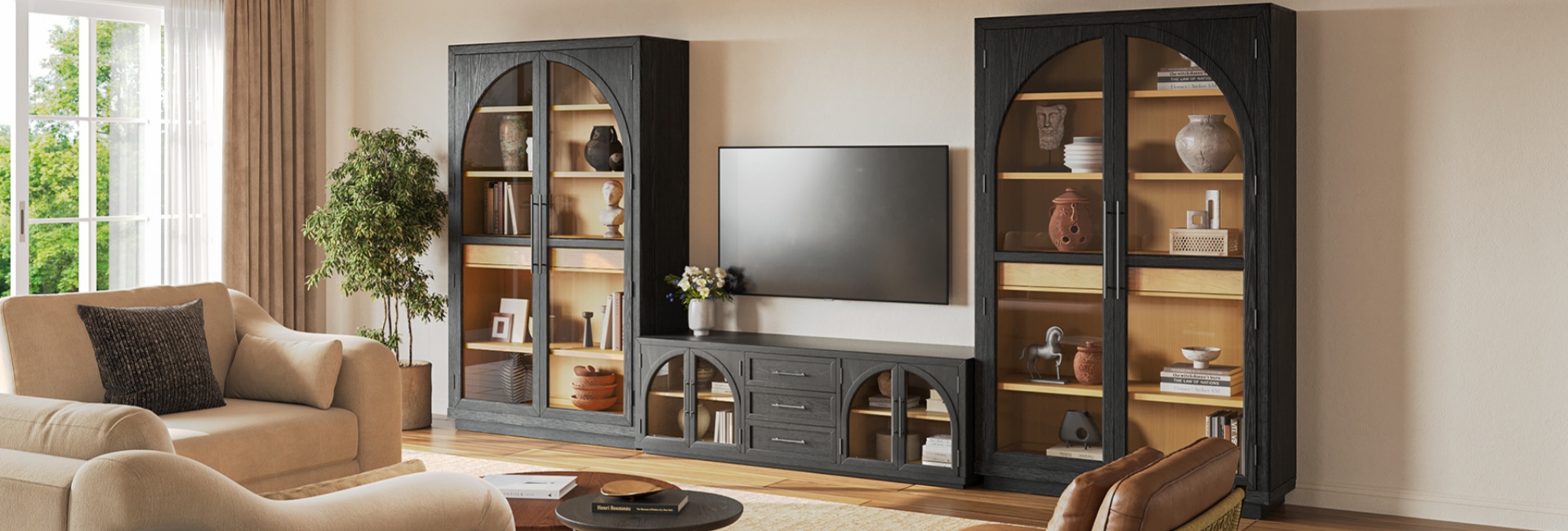
Your TV area can easily become the most cluttered part of the living room. Remotes collect on the console, cables hang behind the screen, and a large TV can leave the wall feeling unfinished. The right entertainment center can solve several of these problems while giving the room a more considered look.
The best entertainment center ideas depend on the space you have and how you use it. A small apartment may need a shallow console with concealed storage, while a spacious living room might suit a wall-spanning cabinet arrangement. You can also change the look of your TV area through wood finishes, shelving, lighting, and carefully chosen decor without remodeling the entire room.
Here are 12 ways to make your entertainment center work with your living room, from built-in-inspired layouts to simple styling changes.
Table of Contents
- 1. Create a Built-In Look With Matching Cabinets
- 2. Keep the Look Simple With a Modern Minimalist Entertainment Center
- 3. Bring Warmth With Mid-Century Modern Details
- 4. Free Up Floor Space With a Floating Entertainment Center
- 5. Combine the TV and Fireplace Into One Focal Wall
- 6. Choose a Low-Profile Entertainment Center for a Small Living Room
- 7. Make an Awkward Corner Work for Your TV
- 8. Frame the TV With Bookshelves
- 9. Mix Open and Closed Storage
- 10. Use Wood Tones to Set the Mood
- 11. Style the Top of Your Entertainment Center
- 12. Connect the Entertainment Center to an Open-Concept Living Room
- How to Choose the Right Entertainment Center for Your Space
- What to Consider Before Choosing an Entertainment Center
- Final Thoughts
- FAQs
- What is the difference between an entertainment center and a media console?
- How can I make my entertainment center look more expensive?
- What should I put on top of an entertainment center?
- Are floating entertainment centers good for small rooms?
- How wide should an entertainment center be compared with the TV?
- Can I put my TV above a fireplace?
- How can I hide cables around my entertainment center?
- How do I keep an entertainment center from looking cluttered?
1. Create a Built-In Look With Matching Cabinets
A wall of coordinated cabinets can make a TV area look custom-designed without requiring every component to be built into the wall. Start with a media console that fits your TV, then add matching cabinets on either side. Keeping the finishes, door styles, and visual proportions consistent helps the pieces read as one arrangement.
This approach works especially well on a wide, uninterrupted wall. Before choosing the furniture, measure the full wall and account for windows, doorways, outlets, and nearby seating. You want the cabinets to fill the space comfortably without making the room feel boxed in.
For example, the Thursen 144-Inch Chevron Storage Media Console Set combines a 72-inch console with two 36-inch cabinets. Its three-piece layout offers a way to create a wider focal point while separating media equipment from other living room essentials.
If you want to explore more coordinated arrangements, browse our entertainment centers for options that combine a media console with additional storage.
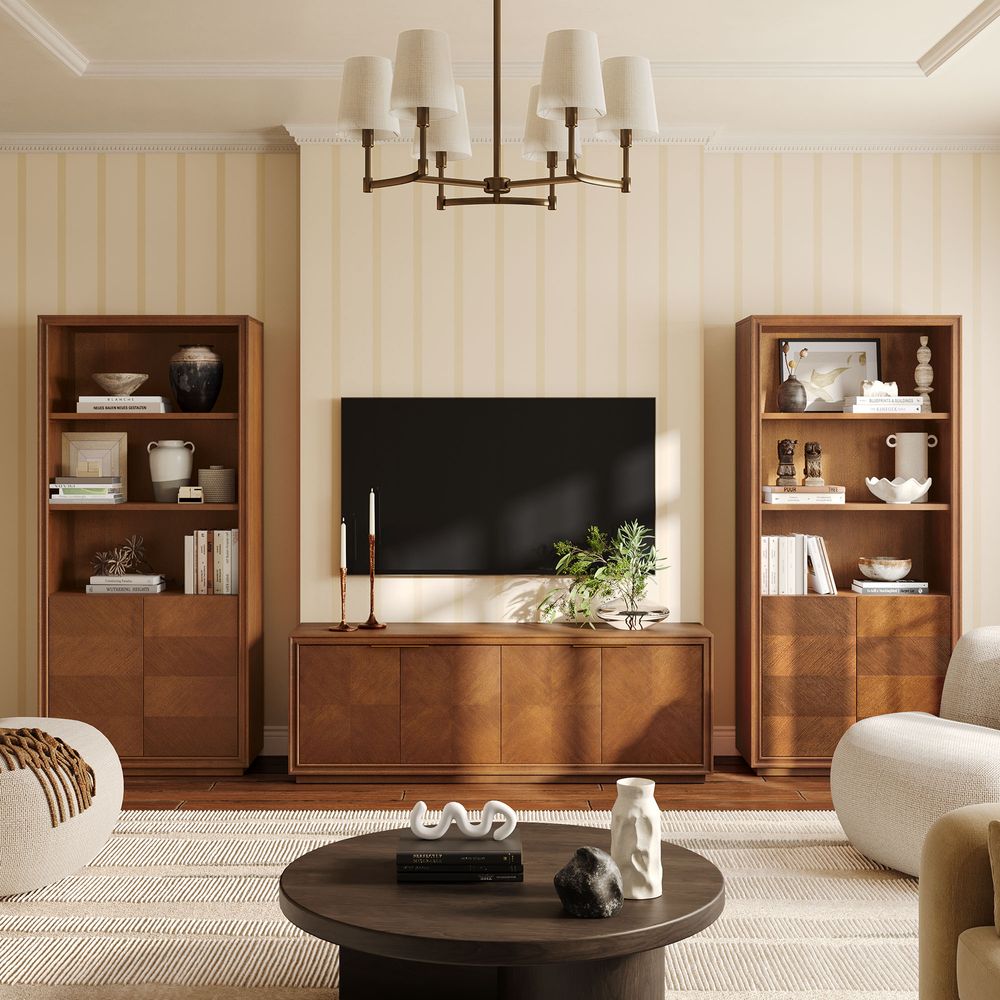
Thursen 144-Inch Chevron Storage Media Console Set
View Product
2. Keep the Look Simple With a Modern Minimalist Entertainment Center
A minimalist entertainment center is a good fit for a living room that already has plenty going on, whether that's patterned upholstery, bold artwork, or an open-plan layout. Choose a console with clean lines, restrained hardware, and a finish that works with your existing furniture.
The key is to simplify what sits around the TV, not necessarily to remove all decoration. A low ceramic vase, a small stack of books, or a single plant can add character without competing with the screen. Closed cabinets are useful for keeping controllers, remotes, and spare cables out of sight.
3. Bring Warmth With Mid-Century Modern Details
Warm wood tones, tapered legs, and geometric details can give an entertainment center a mid-century modern look. This style works well with neutral sofas, textured rugs, globe-style lighting, and a mix of wood and metal accents.
You don't need a matching furniture set to make the room feel pulled together. Try pairing a walnut-toned or oak media console with a fabric sofa and a simple metal floor lamp. Repeating one wood tone elsewhere in the room, such as on a side table or picture frame, can tie the arrangement together without making everything look identical.
For more inspiration, browse our mid-century modern TV stands for designs that bring warm wood tones and distinctive details to the TV wall.
4. Free Up Floor Space With a Floating Entertainment Center
A floating entertainment center is mounted on the wall rather than resting on the floor. The open space underneath can make a compact room feel less crowded and gives you easier access for vacuuming. It can also create a clean line beneath a wall-mounted TV.
Before choosing this setup, confirm that the console is specifically designed for wall mounting. Check the wall construction, mounting hardware, and combined weight of the unit and its contents. A freestanding console should not be assumed to be safe for wall installation.
Plan cable routes before mounting the unit, too. Nearby outlets, cord openings, and the location of streaming devices can affect where the console should sit. Once the practical details are sorted out, a subtle light strip underneath the unit can add a soft glow without taking attention away from the screen.
5. Combine the TV and Fireplace Into One Focal Wall
A TV and fireplace can share a feature wall, but the layout needs to work for both viewing and heat management. Some rooms suit a TV above the fireplace; others work better with the screen positioned beside it.
Don't decide based on appearance alone. Check the fireplace manufacturer's clearance requirements and the TV manufacturer's installation guidance before placing a screen above a heat source. Also sit in your usual viewing position and check whether the proposed screen height feels comfortable. If the TV would be too high, placing it beside the fireplace may be a better option.
To make the arrangement feel connected, repeat a material or finish across the fireplace surround, shelving, and media console. For example, a wood console can soften a wall dominated by stone, tile, or painted surfaces.
6. Choose a Low-Profile Entertainment Center for a Small Living Room
In a small living room, a low-profile entertainment center can provide storage without making the TV wall feel bulky. The console's depth matters as much as its width: a deep unit may reduce walking space when the sofa sits close to the opposite wall.
Measure the distance between the TV wall and the nearest furniture before shopping. Marking the proposed console depth on the floor with painter's tape can help you judge how much room will remain for walking. Check that cabinet doors and drawers can open without hitting the sofa, coffee table, or other furniture.
Keep the top surface useful rather than crowded. A compact lamp or one or two decorative objects may be enough. If you need more storage than a small console can provide, consider a narrow bookcase elsewhere in the room instead of adding bulky cabinets beside the TV.
7. Make an Awkward Corner Work for Your TV
A corner TV setup can help when windows, doors, or an open-plan layout leave few uninterrupted walls. It may also be practical in a multipurpose room where the TV needs to share space with a desk, dining table, or reading area.
Start by checking the view from the seats you'll use most often. A corner arrangement should let people watch without having to turn their heads uncomfortably. Measure both adjoining walls, the console footprint, and the path through the room before deciding on the placement.
If a dedicated corner entertainment center doesn't fit your style, a compact console positioned near the corner may work. Keep nearby furniture low or visually light so the TV area doesn't become a crowded cluster of large pieces.
8. Frame the TV With Bookshelves
Bookshelves can turn a plain TV wall into a display area for books, photographs, plants, and collected objects. Two similar bookcases on either side of the console create a more symmetrical look. A single tall shelf on one side can feel more relaxed and works when the wall or room layout is uneven.
The main challenge is keeping the shelves from competing with the TV. Group books in small runs, mix in a few objects of different heights, and leave some shelves partly empty. If every shelf is packed, the wall can look visually heavy.
For a more balanced arrangement, keep larger or heavier items on lower shelves and use smaller decorative pieces around eye level. If you plan to add lighting, make sure cords can be routed safely and neatly.
9. Mix Open and Closed Storage
Open and closed storage solve different problems, so a combination can be more useful than a unit with only one type. Closed cabinets hide board games, spare remotes, cables, and other items that tend to accumulate. Open shelves keep frequently used devices accessible and provide room for a few display pieces.
Make a quick list of what you intend to store before choosing the layout. Measure larger devices and check the dimensions of the compartments rather than assuming everything will fit. Streaming boxes, game consoles, and other electronics may need ventilation, so avoid squeezing them into enclosed spaces without checking their requirements.
For small accessories, use a few organizers or baskets to keep related items together. That way, the storage remains easy to use instead of becoming another place where clutter collects.
10. Use Wood Tones to Set the Mood
The finish of an entertainment center can influence the feel of the whole room. Light oak can work well with cream upholstery, pale walls, and woven textures. Medium brown wood adds warmth and can sit comfortably alongside beige, olive, or muted blue accents. A dark brown or black finish creates more contrast against light walls and lighter furniture.
Rather than trying to match every wood surface exactly, pay attention to undertones and the overall balance of the room. For example, a warm wood console can complement a walnut side table and a natural-fiber rug. If the room already contains several dark elements, a lighter console may prevent the TV wall from feeling too heavy.
For a larger arrangement, the Valborg 174-Inch Oak Storage Media Console Set offers a wide, coordinated furniture layout. Check the current product dimensions, finish, and TV-size guidance against your wall before choosing it.
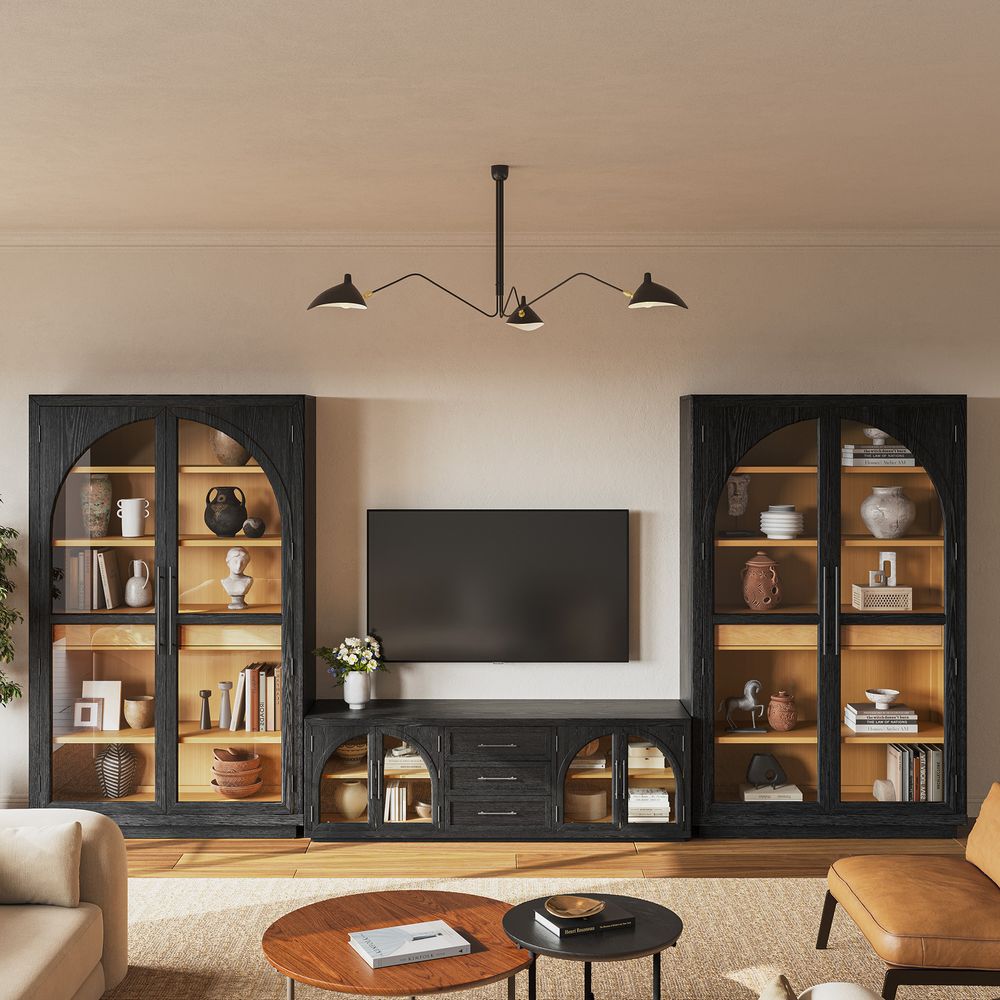
Valborg 174-Inch Oak Storage Media Console Set
View Product
11. Style the Top of Your Entertainment Center
A few well-chosen objects can make a media console feel finished. The goal is to complement the TV rather than create another display that competes with it.
Try one of these combinations:
-
Natural and relaxed: A ceramic vase, a small plant, and two or three books in muted colors.
-
Warm and layered: A table lamp, a wooden bowl, and a framed print leaning against the wall.
-
Simple and sculptural: One larger object paired with a smaller accent, leaving the rest of the surface open.
-
Personal and collected: A framed photograph, a travel souvenir, or an object with a story behind it.
Scale makes a difference. Tiny accessories can disappear on a wide console, while too many tall pieces can interrupt the view of the screen. Arrange the objects in small groups and step back to see how they look from the sofa.
Leave room for everyday items such as remotes and a soundbar. If you need to move everything before watching TV, the styling may be working against the way you use the space.
12. Connect the Entertainment Center to an Open-Concept Living Room
In an open-concept home, the entertainment center can help define the living area without adding a physical divider. The console should relate to nearby furniture, including the sofa, dining table, and sideboard, while still making the TV wall easy to identify as its own zone.
A wide console can anchor the seating area, but make sure it doesn't block a main walkway or dominate the view from the dining area. A shared finish, such as oak repeated in the console and dining furniture, can link the two zones. A rug and thoughtful sofa placement can further define the living room.
If the TV wall is visible from several parts of the home, avoid overcrowding it with small decorations. A more restrained arrangement is often easier to live with and looks more consistent from different angles.
How to Choose the Right Entertainment Center for Your Space
Once you've found a design direction, check a few practical details before settling on a particular setup.
Measure the Wall, TV, and Console
Measure the available wall width and height, then compare them with the TV and console dimensions. A console that extends beyond the sides of the TV often creates a balanced appearance, but the best width depends on the wall, surrounding furniture, and overall layout. Avoid choosing a unit so wide that it crowds doorways or walking paths.
Don't forget the console's depth. In a narrow room, this can make a bigger difference to circulation than the width does.
Check Viewing Height and Seating Position
Think about where you sit and how high the screen will be from that position. If you're considering a TV above a fireplace or on a tall entertainment center, test the proposed viewing angle before committing to the arrangement. The ideal setup should work for everyday watching, not just look good in a room photo.
Plan Cable Management and Ventilation
Identify nearby outlets and decide where cables will run before arranging the furniture. Cord cutouts, cable sleeves, and clips can help keep wires organized. For enclosed storage, check the ventilation needs of your electronic devices and leave enough room to access ports and connections.
Match Storage to Your Daily Routine
Think about what you actually use in the living room. If you own game consoles, board games, or several streaming devices, check that the console has suitable compartments and accessible cable routes. If you mostly stream content from a small device, you may prefer a simpler unit with less storage.
What to Consider Before Choosing an Entertainment Center
The right option depends on more than its appearance. A few checks can help you avoid choosing a unit that looks good online but doesn't work in your home.
-
Room size: Check that the console fits the wall without narrowing walkways or crowding nearby furniture.
-
Storage needs: Decide what needs to be hidden and what should stay accessible.
-
Materials and finish: Choose a finish that works with the room's existing colors and the level of upkeep you're comfortable with.
-
Installation: Confirm whether the unit is freestanding or designed for wall mounting. For wall-mounted furniture, follow the product's instructions and use appropriate mounting hardware.
-
Total setup: Account for any additional shelving, cable-management accessories, lighting, or professional installation you may need.
These details are easier to plan before purchasing than to fix after the console arrives.
Final Thoughts
The most useful entertainment center ideas combine a look you like with a layout that suits the way you live. Matching cabinets can create a built-in effect, a floating console can leave a small room feeling more open, and bookshelves or carefully chosen decor can give a plain TV wall more character.
Start by measuring your space and deciding what you need to store. Then choose a design direction that works with your furniture, viewing position, and daily routine. The result doesn't have to be complicated: the right console, a thoughtful layout, and a few well-chosen details can make the TV area feel like a natural part of your living room.
FAQs
What is the difference between an entertainment center and a media console?
A media console is generally a low piece of furniture designed to hold a TV and store related items. An entertainment center often refers to a larger arrangement that may include a console, cabinets, and shelving. Product naming varies, so check the actual dimensions and configuration before buying.
How can I make my entertainment center look more expensive?
Start with proportions and visual consistency. Choose a finish that works with your existing furniture, hide loose cables, and avoid overcrowding the top surface. A coordinated cabinet arrangement or a few well-chosen accessories can make the setup look more considered without requiring custom cabinetry.
What should I put on top of an entertainment center?
A ceramic vase, a small plant, a stack of books, or a table lamp can work well. Choose objects that suit the console's scale and leave room for remotes or a soundbar. Avoid accessories that block the screen or make everyday use inconvenient.
Are floating entertainment centers good for small rooms?
They can help a room feel more open because the floor remains visible underneath. However, the console must be designed for wall mounting, and the wall and hardware must support the required load. Check the product instructions before installation.
How wide should an entertainment center be compared with the TV?
Many people prefer a console that extends beyond both sides of the TV because it gives the arrangement a more balanced appearance. The ideal width depends on the available wall space, nearby furniture, and the size of the screen. Measure the entire layout before choosing a console.
Can I put my TV above a fireplace?
Sometimes, but it depends on the fireplace, the heat produced, and the clearance requirements in the relevant product manuals. Viewing height matters, too. If the screen would sit too high for comfortable watching, placing it beside the fireplace may be a better choice.
How can I hide cables around my entertainment center?
Choose a console with suitable cord cutouts or use cable sleeves and clips to organize wires. Plan the route to the outlets before moving the furniture into place. Keep connections accessible and make sure electronic devices have the ventilation they require.
How do I keep an entertainment center from looking cluttered?
Limit the number of objects on the console, group accessories by size or material, and leave some open space. Use closed storage for small everyday items and keep the area around the TV relatively clear. A simple arrangement is often easier to maintain.