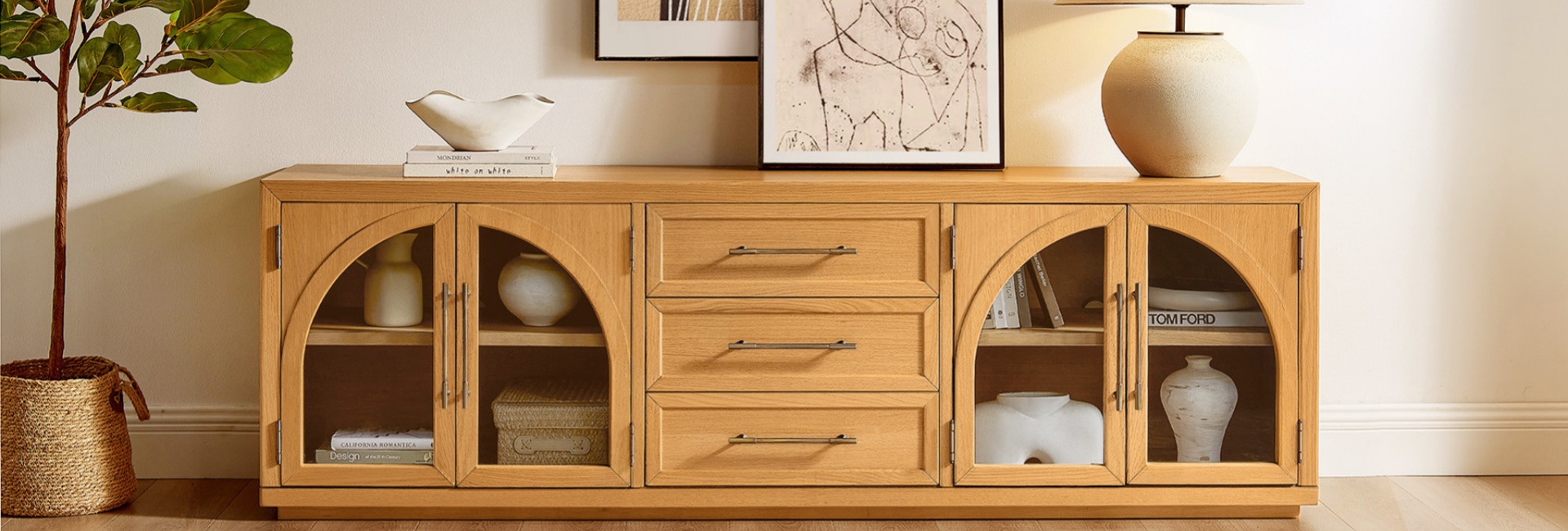
A basement can be one of the most useful rooms in a house—or the place where furniture goes to be forgotten.
The difference often comes down to what you put down there and how you arrange it. Basements tend to have less natural light, lower ceilings, and more moisture concerns than above-ground rooms. Choosing furniture without accounting for those conditions can leave the space feeling cramped, dark, or difficult to maintain.
The best basement furniture ideas start with the room's actual job. From there, think about furniture scale, moisture exposure, storage, lighting, and how each piece will get downstairs in the first place.
This guide covers the furniture choices, measurements, materials, and layout ideas that make a basement more comfortable—and help you choose pieces that actually earn their space downstairs.
Table of Contents
- What Makes Furniture Good for a Basement?
- Start With the Room's Job Before You Shop for Basement Furniture
- Basement Furniture Ideas for Low Ceilings
- Basement Sofa Ideas for Humid and Low-Light Spaces
- Choose an MCM TV Stand That Anchors the Media Wall
- How to Make a Basement Living Room Feel Bigger
- Turn the Lower Level Into a Basement Bedroom
- Basement Storage Ideas That Earn Their Footprint
- Basement Furniture Trends Worth Borrowing in 2026
- Moisture First, Furniture Second
- Maximize Space and Functionality in a Basement Living Area
- A Quick Buying Checklist for Basement Furniture
- FAQs
- What is the best sofa for a basement?
- What is the best material for a basement couch?
- What furniture works best with low basement ceilings?
- How can I make a dark basement look brighter?
- Can I use a basement as a bedroom?
- How do I stop basement furniture from smelling damp?
- How can I maximize space and functionality in a basement?
- What size TV stand should I use in a basement?
- Should basement furniture sit directly on the floor?
What Makes Furniture Good for a Basement?
Not every piece of furniture needs to be specifically labeled for basement use. What matters more is whether its construction and proportions make sense for the environment.
Look for four things:
-
Moisture tolerance: Choose materials and finishes that are easier to clean and maintain, especially in a basement with seasonal humidity.
-
A low visual profile: Lower furniture can help a room with a low ceiling feel more open.
-
Easy maintenance: Removable covers, wipeable surfaces, and durable finishes can make everyday upkeep easier.
-
Practical scale: A large sectional or oversized cabinet may fit the floor plan but still be difficult to move through a narrow stairwell.
If your basement has leaks, condensation, or persistent dampness, address those problems before bringing in new furniture. Furniture can work with a finished basement; it cannot fix a moisture problem.
Start With the Room's Job Before You Shop for Basement Furniture
A place to hang out is not a brief.
Before shopping, decide what you actually want the basement to do. Is it a living room for movie nights? A guest bedroom? A TV and gaming area? A flexible space that needs to serve several purposes?
Start with one primary function, then layer in secondary uses.
For example, a basement living room might need:
-
Closed storage
-
Layered lighting
If the basement will double as a guest room, leave enough floor space for a bed and a clear path around it.
Measure the Stairwell, Not Just the Room
This is one of the easiest basement furniture mistakes to make.
A sofa can fit perfectly on your floor plan and still get stuck halfway down the stairs. Measure the stair width, ceiling clearance, landings, doorways, and tight turns before ordering large furniture.
Modular furniture can make delivery easier because individual pieces are usually easier to move than one oversized unit.
Basement Furniture Ideas for Low Ceilings
Low ceilings change how furniture feels in a basement.
Tall furniture can make the ceiling seem even lower, while pieces with lower profiles leave more visible wall space above them. You do not need every piece to be short, but your largest furniture should generally respect the room's vertical proportions.
For sofas and sectionals, consider:
-
Lower back heights
-
Slimmer arms
-
Moderate seat depth
-
Modular configurations
-
Raised bases or legs that create visible floor space
That last detail matters more than it might seem. Seeing some floor underneath a sofa can make the room feel less visually heavy.
Choose a Media Console That Fits the Wall
The same principle applies to the TV area.
An oversized entertainment center can dominate a basement, especially when the ceiling is already low. A long, relatively low media console can give the TV wall a finished look without adding unnecessary visual height.
Basement Sofa Ideas for Humid and Low-Light Spaces
Basement sofas have to deal with more than just everyday wear.
Cooler temperatures, higher humidity, limited ventilation, and less sunlight can all affect how comfortable and easy to maintain a room feels. That does not mean you need a special "basement sofa," but it does mean material choice deserves more attention.
Compare Upholstery Materials
No upholstery fabric makes a damp basement problem disappear. If humidity is consistently high, address the environment rather than relying on the sofa material alone.
Look Beyond the Upholstery
The frame and cushion construction matter, too.
Finished hardwood, sealed engineered wood, and properly finished metal can all be practical choices depending on the design. For cushions, high-resilience or high-density foam can be easier to maintain than natural down in a space where moisture is a concern.
For high-use seating, you may also see abrasion ratings expressed in double rubs. A rating around 30,000 double rubs is often used as a useful durability benchmark for demanding residential furniture, but abrasion resistance is not a measure of moisture or mildew resistance.
A Modular Sofa Can Make Basement Delivery Easier
The Cove Modular Sectional Sofa is a practical example of why modular construction can be useful downstairs.
Its frame combines solid ash and plywood, while high-resilience foam cores are wrapped in fiber. The cotton upholstery has removable covers that can be unzipped for washing, and the modular pieces can be separated for delivery.
That combination makes the configuration easier to adapt to different basement layouts and stair access. The cotton upholstery is soft and breathable, so moisture control still matters. Keep the basement properly dehumidified and the sofa becomes a much easier piece to live with downstairs.
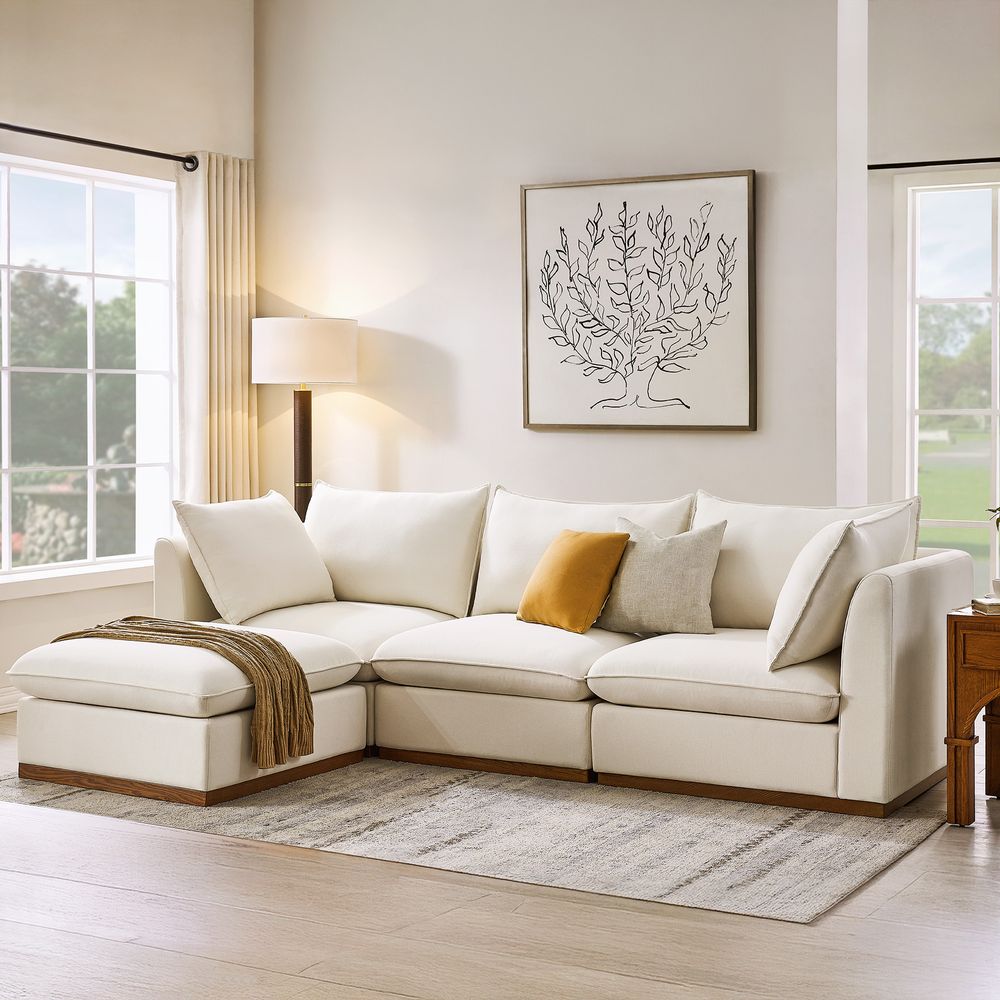
Cove Modular Sectional Sofa
View Product
Choose an MCM TV Stand That Anchors the Media Wall
A basement TV area often becomes the room's natural gathering point. The challenge is keeping the wall organized without making the entire room feel like a home theater.
A media console can hide gaming systems, remotes, cables, and other equipment while giving the TV a visual anchor.
For a basement with a lower ceiling, an MCM TV stand can also add warmth without relying on tall cabinetry. Warm wood tones and clean horizontal lines work particularly well when the goal is to keep the room visually open.
The Astrid 84-Inch MCM Slatted Media Console combines warm brown oak with slatted sliding doors, three solid-wood drawers, adjustable storage, and four cord cutouts. Its 84-inch width gives a large TV a substantial base without introducing a tall cabinet into the room.
Just make sure the console does not block HVAC vents or electrical access.
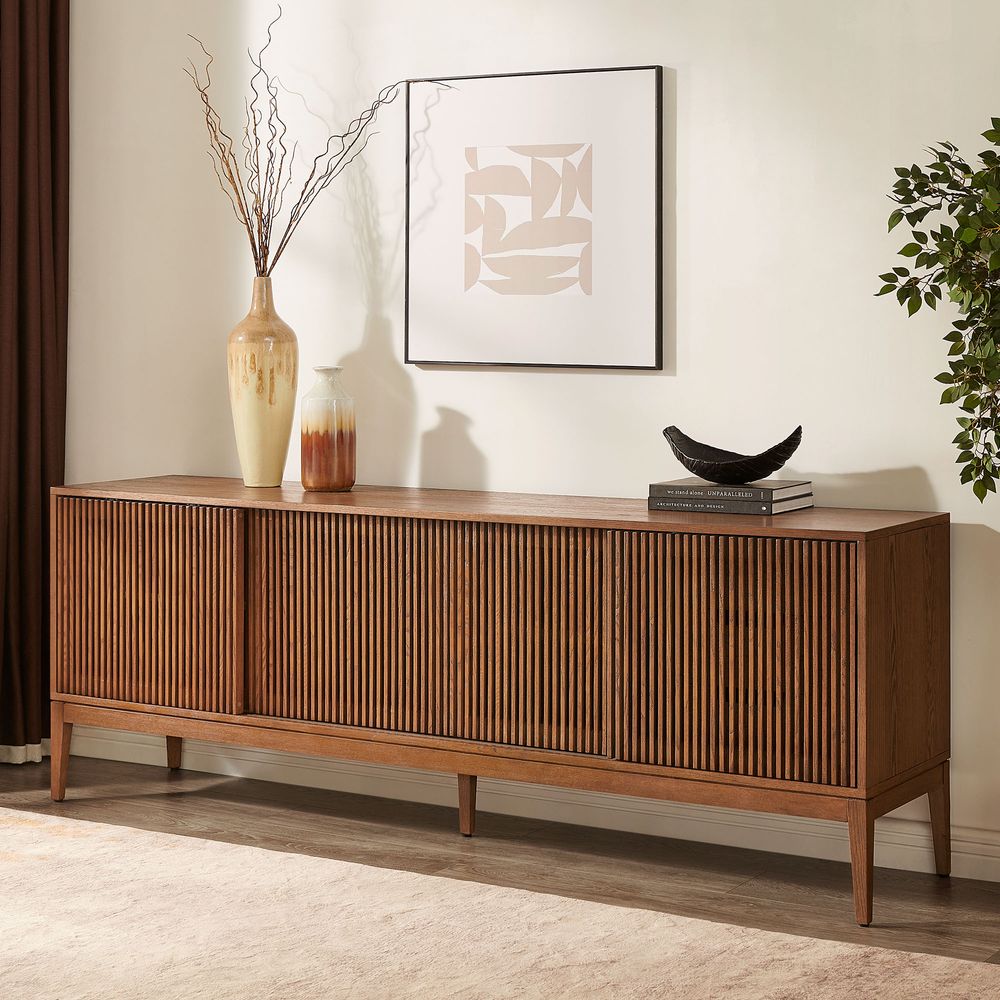
Astrid 84-Inch MCM Slatted Media Console
View Product
How to Make a Basement Living Room Feel Bigger
A basement does not necessarily need more furniture to feel finished. In many cases, it needs less visual weight.
1. Keep the Largest Pieces Low
A low-profile sofa, media console, and coffee table can create more visible wall and ceiling space.
2. Use Light Colors Strategically
Light upholstery, warm wood, and lighter rugs can reflect more available light. You do not have to make everything white. A combination of warm neutrals and natural wood can feel brighter without looking sterile.
3. Layer Your Lighting
Do not rely on a single ceiling fixture.
Combine:
-
Recessed or ceiling lighting
-
Wall sconces
-
Floor lamps
-
Table lamps
-
Task lighting
-
Dimmers where practical
Warm white bulbs around 2700K–3000K can create a more comfortable residential atmosphere.
4. Use Mirrors Carefully
A mirror positioned opposite a light source can help bounce light around the room. It can also make a smaller basement feel more visually open without taking up floor space.
Turn the Lower Level Into a Basement Bedroom
A basement bedroom needs to work as a bedroom first, not simply as a room with a bed in it.
Before furnishing the space, check your local building requirements for ceiling height, emergency escape and rescue openings, ventilation, heating, and other requirements. Rules vary by jurisdiction, and the local building department is the final authority for your project.
For example, the International Residential Code includes minimum requirements for emergency escape and rescue openings, including minimum opening dimensions and sill height. Below-grade bedrooms may also require a properly sized window well and a ladder or steps when the well is sufficiently deep.
The exact requirements depend on your location and the way the basement is constructed, so verify them before treating a basement room as a legal bedroom.
Choose Bedroom Furniture With a Lighter Visual Profile
Once the room meets local requirements, focus on furniture that does not overwhelm the lower level.
The Skugga King Size Fluted Bed has a raised frame and fluted headboard that adds texture without requiring a bulky surrounding structure. Pair it with the Skugga 26-Inch Oak Nightstand, which provides two drawers and a compact footprint for bedside storage.
Both pieces bring useful storage and structure to a basement bedroom without requiring tall furniture around the bed.
As with any basement furniture, moisture control still matters. Keep furniture away from persistently damp walls and make sure the room has adequate air circulation.
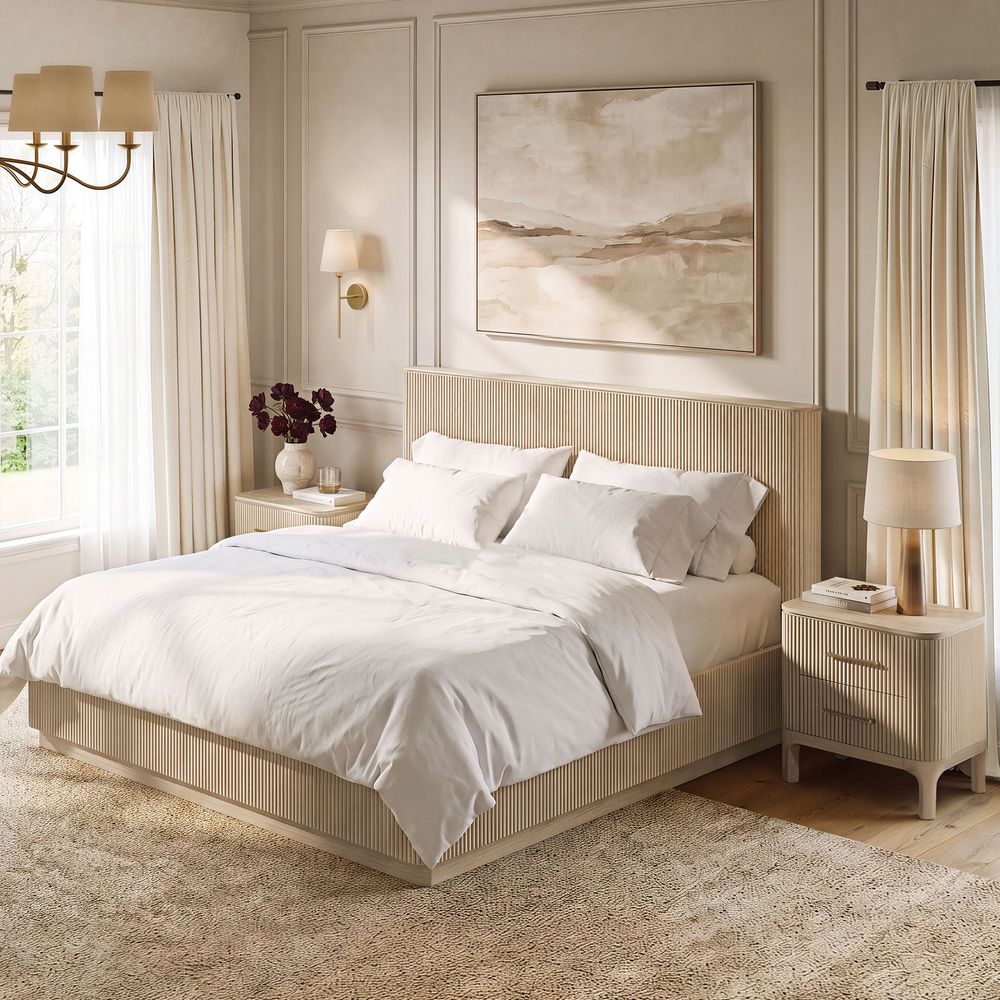
3-Piece Skugga Fluted Bedroom Set
View Product
Basement Storage Ideas That Earn Their Footprint
Basement clutter often becomes a visibility problem before it becomes a storage problem.
When everything is left in open bins or scattered across shelves, even a large basement can feel unfinished. Closed storage can make the room feel calmer while keeping everyday items within reach.
Consider a mix of:
-
Drawers for smaller personal items
-
Cabinets for items you want hidden
-
Open shelving for frequently used or decorative pieces
-
Under-stair storage for space that might otherwise go unused
Do not push furniture directly against a wall that has a history of dampness. Leaving some clearance can help with inspection and airflow.
Basement Furniture Trends Worth Borrowing in 2026
Some furniture trends work particularly well downstairs because they solve practical problems as well as aesthetic ones.
Warm Wood and Textured Surfaces
Warm wood tones can help a basement feel less cold, particularly when there is limited natural light. Slatted, fluted, and reeded surfaces add visual interest without requiring bold colors.
Pieces such as the Astrid media console and Skugga bedroom furniture use texture to give the room character while keeping the overall furniture profile relatively clean.
Flexible, Multi-Zone Layouts
A basement does not always need to function as one large room.
A sectional can define a conversation area, while a media console establishes a separate TV zone. A dresser or closed cabinet can help create storage without adding another large furniture grouping.
The goal is to give each part of the basement a job without filling every open area with furniture.
Moisture First, Furniture Second
This is the part of basement furniture planning that should never be skipped.
If the basement has active leaks, persistent condensation, drainage problems, or consistently excessive humidity, changing the furniture will not solve the underlying issue.
A better sequence is:
-
Address leaks and water intrusion.
-
Check indoor relative humidity with a hygrometer.
-
Use a dehumidifier when needed.
-
Keep furniture away from damp walls and surfaces.
-
Choose finishes and upholstery that are practical to maintain.
-
Check underneath rugs and furniture periodically.
Keeping indoor relative humidity around 30% to 50% is a commonly recommended range for moisture control, although the appropriate setting can vary with the building, climate, and season.
For a finished basement, environmental control is part of furniture care—not something to think about after the furniture starts smelling musty.
Maximize Space and Functionality in a Basement Living Area
A good basement layout should make movement feel natural.
Start by identifying the main path from the stairs or entrance to the areas you use most. Avoid forcing people to walk directly through the middle of the seating area just to reach another part of the room.
A few practical guidelines:
-
Use a rug to visually define a seating area.
-
Leave roughly 30–36 inches for major walking paths where the room allows.
-
Keep the route from the stairs to the seating area clear.
-
Avoid pushing every piece of furniture against a wall.
-
Leave enough clearance around doors, drawers, and cabinets.
For example, an 8-by-10-foot rug can help define a medium-sized seating area, but the right rug size depends on your sofa, room dimensions, and furniture arrangement.
The goal is not to fill every square foot. It is to make the available space work harder.
A Quick Buying Checklist for Basement Furniture
Before placing an order, run through these four checks:
1. Measure the Room
Record the length, width, ceiling height, door openings, stair width, and tight turns.
2. Plan the Delivery Route
Measure the entire path from the entrance to the final location. Pay particular attention to stair landings and corners.
3. Check the Basement Environment
Know whether the space has seasonal humidity, condensation, or damp areas before choosing upholstery and finishes.
4. Buy the Largest Piece First
Start with the sofa, sectional, bed, or media console that defines the room. Then build the smaller furniture around it.
For a living room, the Cove Modular Sectional Sofa can provide flexible seating. For the media wall, the Astrid 84-Inch MCM Slatted Media Console combines storage with a relatively low profile. For a bedroom, the Skugga Fluted Bed and Skugga 26-Inch Oak Nightstand provide the foundation, while the 3-Piece Skugga Fluted Bedroom Set can simplify the overall furniture selection.
The best basement furniture ideas are ultimately the ones that fit the room, the route downstairs, and the way you actually plan to use the space.
FAQs
What is the best sofa for a basement?
Look for a sofa with durable upholstery, easy-to-maintain materials, practical proportions, and a frame designed for everyday use. Modular construction can also make delivery easier when basement stairs or tight corners are involved.
What is the best material for a basement couch?
There is no single best material for every basement. Performance polyester, solution-dyed acrylic, vinyl, and faux leather can all offer practical benefits, while cotton and linen can provide a softer, more breathable feel. The basement's moisture level should be considered alongside the upholstery.
What furniture works best with low basement ceilings?
Low-profile sofas, media consoles, coffee tables, and beds can help preserve a sense of vertical space. Avoid filling the room with tall cabinets unless you specifically need the storage.
How can I make a dark basement look brighter?
Use layered lighting, lighter rugs and upholstery, warm wood tones, reflective surfaces, and strategically placed mirrors. Keeping large furniture relatively low can also make the room feel more open.
Can I use a basement as a bedroom?
Potentially, but the space must meet applicable local building and safety requirements. Check requirements for emergency escape and rescue openings, ceiling height, ventilation, heating, and other conditions with your local building department before furnishing it as a bedroom.
How do I stop basement furniture from smelling damp?
Start with the source of the moisture. Check for leaks, condensation, and excessive humidity, then improve ventilation or use a dehumidifier as needed. Keep furniture away from damp walls and inspect upholstery, rugs, and the area underneath furniture regularly.
How can I maximize space and functionality in a basement?
Give the room a primary purpose, use furniture to define zones, maintain clear walking paths, and avoid filling every open area. Modular seating and furniture with built-in storage can provide more flexibility without adding unnecessary pieces.
What size TV stand should I use in a basement?
Choose a console that is proportionate to both the TV and the room. Measure the TV width, available wall space, viewing area, and clearance around outlets and vents before choosing the console.
Should basement furniture sit directly on the floor?
Not always. Furniture with raised legs or a visible base can make a basement feel less heavy and makes it easier to clean underneath. More importantly, keep furniture away from areas that are prone to moisture or flooding.