
Choosing a king bed involves more than knowing the mattress size. While a standard U.S. king mattress measures 76 inches wide by 80 inches long, the complete bed frame may take up considerably more space, depending on its headboard, footboard, and overall design. That difference can affect where you place nightstands, how much room remains for walking, and whether the bed fits comfortably in your bedroom.
This guide explains standard king bed dimensions, shows how to measure a bed frame's overall width, length, and height, and compares king beds with queen and California king sizes. You'll also find practical room-planning examples and real Hernest bed frame measurements to help you check fit before buying.
Table of Contents
- What Size Is a King Bed?
- King Bed Frame Dimensions: Width, Length, and Height
- King vs. Queen Bed Frame Dimensions
- King Bed vs. California King: What's the Difference?
- How Much Room Do You Need for a King Bed?
- How to Measure Your Room for a King Bed Frame
- Choosing the Right King Bed Frame for Your Room
- Final Thoughts: Choosing a King Bed That Fits
- FAQs
- Is a king bed 60 by 80?
- How much wider is a king than a queen?
- What is the exact size of a king size bed?
- What is the width of a king bed frame?
- What is the standard king bed length?
- Can a king bed frame fit in a 10-by-10-foot bedroom?
- How much space should you leave around a king bed?
- Do all king bed frames fit a 76-by-80-inch mattress?
What Size Is a King Bed?
When researching king bed size, it is important to distinguish between the mattress dimensions and the bed frame's overall measurements. The mattress determines the sleeping surface, while the frame determines how much floor space the complete bed occupies.
A standard U.S. king mattress measures 76 inches wide by 80 inches long. The complete bed frame may be wider or longer because of its headboard, footboard, side rails, or other design details.
For bedroom planning, use the frame's overall assembled dimensions rather than the mattress measurements alone. For mattress compatibility, check the frame's internal mattress space. These measurements serve different purposes and should not be used interchangeably.
Standard King Bed Dimensions at a Glance
The mattress measurements are standard reference dimensions, but bed frames do not have one universal exterior size. Two king bed frames designed for the same mattress size can occupy noticeably different amounts of floor space.
For room planning, use the bed frame's overall width and length. For mattress compatibility, check the frame's internal mattress dimensions and the manufacturer's stated requirements.
King Bed Size in Feet and Centimeters
A standard king mattress measures approximately 6 feet 4 inches wide by 6 feet 8 inches long, or 193 by 203 centimeters.
When comparing bed frames, pay attention to three measurements:
-
Overall width: The maximum side-to-side measurement, including the headboard or any other protruding parts.
-
Overall length: The distance from the back of the headboard to the outermost point of the footboard or frame.
-
Overall height: The height of the highest point of the assembled bed, which may vary with the frame's design.
Product listings may use width × depth × height. In that format, depth refers to the bed's front-to-back dimension, which this guide calls overall length.
Width and length determine the frame's rectangular floor footprint. Height affects the bed's proportions and how it relates to windows, ceilings, outlets, and wall decor.
King Bed Frame Dimensions: Width, Length, and Height
The overall dimensions of a king bed frame determine whether it fits comfortably in your bedroom. A mattress may fit inside the frame, but the complete bed can take up more space than you expect.
Width of a King Bed
The standard king mattress is 76 inches wide, but the frame's exterior width depends on its construction.
A wide headboard can extend beyond the mattress on both sides. Side rails and decorative details may also affect the total width.
For example, the Hernest Skugga Fluted Bed measures 90.9 inches wide overall, including its headboard. That is 14.9 inches wider than the standard king mattress.
This difference matters when planning a bed wall. If you want nightstands on both sides, measure from the frame's outermost edges, then add the width of the nightstands and the clearance you want to maintain.
Remember that the available wall width is only part of the calculation. You should also consider whether the nightstands will leave enough space to move around the room.
King Bed Length
A standard king mattress measures 80 inches long, but the bed frame can extend beyond that length.
The Hernest Finley Fluted Bed measures 87.4 inches long overall. Its frame is 7.4 inches longer than the nominal mattress length.
That additional length affects the space between the bed and a dresser, bench, or opposite wall. If the room is relatively short, measure the full frame before deciding where to place other furniture.
When checking a product listing, use the overall front-to-back measurement rather than assuming the bed frame is exactly 80 inches long.
King Bed Frame Height
Height affects the bed's visual proportions and how much wall space remains above it.
The Finley Fluted Bed measures 60 inches high overall, while the Hernest Kaden Mid-Century Bed measures 46.8 inches high overall.
Although Kaden is 13.2 inches shorter, it is 2.2 inches wider than Finley. This illustrates why a lower bed frame does not necessarily have a smaller floor footprint.
Before choosing a frame, consider its overall height, the location of windows and outlets, and the height of your nightstands. If you plan to hang artwork above the bed, measure the available wall space as well.

Kaden Mid-Century King Size Bed
View Product
King vs. Queen Bed Frame Dimensions
A king bed provides a wider sleeping surface than a queen, but the larger size also affects the room layout.
A standard queen mattress measures 60 inches wide by 80 inches long. A standard king mattress measures 76 inches wide by 80 inches long.
These measurements describe the mattresses, not the complete bed frames. The difference in exterior dimensions depends on the design of each frame.
How Much Wider Is a King Than a Queen?
A standard king mattress is 16 inches wider than a standard queen mattress. Both have a nominal length of 80 inches.
For two people sharing a bed, that extra width provides more sleeping space from side to side. However, the wider bed also leaves less room for nightstands and walking paths if the bedroom dimensions stay the same.
When comparing bed frames, calculate the difference using their overall widths rather than assuming it will be exactly 16 inches.
When a Queen Bed Frame May Be a Better Fit
A queen bed frame may be more practical if your bedroom is narrow or needs to accommodate a desk, dresser, or other large furniture.
A king frame is worth considering when the room can accommodate its larger footprint without obstructing doors, closets, or everyday walking paths.
The best choice depends on the usable floor space and the way you plan to arrange the room, not just the total square footage.
King Bed vs. California King: What's the Difference?
A standard king and a California king have different proportions. A standard king is wider, while a California king is longer.
These are standard mattress reference dimensions. The complete bed frame may have different exterior dimensions depending on its design.
Which Bed Frame Works Better in Your Room?
A standard king may suit a room where additional side-to-side sleeping space is the priority. A California king may be worth considering if you need a longer sleeping surface and have enough room for the additional mattress length.
Before choosing either size, compare the frame's exterior width and length with your available space. Also confirm mattress compatibility, since standard king and California king mattresses are not interchangeable.
How Much Room Do You Need for a King Bed?
There is no single minimum bedroom size that guarantees a comfortable layout for every king bed frame. The amount of space you need depends on the frame's exterior dimensions, room shape, door locations, and other furniture.
A 12-by-12-foot bedroom can be a useful starting point for planning a king bed, but it does not guarantee that every frame will fit comfortably. A smaller room with an efficient layout may work better than a larger room with awkward doorways or built-in furniture.
Calculate the Bed's Floor Footprint
Start with the frame's overall width and length. Multiply the two measurements and divide by 144 to convert square inches into square feet.
For example, the Hernest Skugga Fluted Bed measures 90.9 inches wide by 86.2 inches long.
90.9 × 86.2 ÷ 144 ≈ 54.4 square feet
This is the approximate area of the frame's rectangular footprint. It does not include walking space around the bed or the space required by nightstands and other furniture.
By comparison, a standard king mattress measures 76 × 80 inches, or about 42.2 square feet. The difference illustrates why mattress dimensions alone can underestimate the space a bed frame occupies.
Leave Room for Walkways and Furniture
After calculating the frame's footprint, consider how much clearance you want around it.
Approximately 24–30 inches of clear space beside the bed can serve as a practical starting point where the room allows. Around 30 inches at the foot can also be a useful planning target. These are general layout guidelines, not fixed requirements.
Account for:
-
Nightstands on one or both sides of the bed.
-
Dresser drawers that need to open fully.
-
Bedroom and closet doors that swing into the room.
-
Windows, radiators, and other fixed features.
-
Space to change bedding and move around the bed.
-
The route needed to bring the bed components into the bedroom.
A bed can fit physically while leaving too little room for everyday use. Planning the surrounding space helps you avoid that problem.
Example: Calculate the Space Around a King Bed
Suppose a bed frame is 90.9 inches wide and you want 24 inches of clear space on each side.
The total width required before adding nightstands is:
90.9 + 24 + 24 = 138.9 inches
That is approximately 11 feet 7 inches.
This estimate does not include nightstands. Add their widths to calculate the actual wall space you need, then check whether the resulting layout leaves enough room for other furniture and access to doors.
This is why the frame's exterior width is the most useful starting point when planning the bed wall.
Can a King Bed Fit in a 10-by-10-Foot Bedroom?
A king bed frame may physically fit in a 10-by-10-foot bedroom, but the remaining space could be limited.
A 10-foot-wide room measures 120 inches across. If you place a 90.9-inch-wide frame in it, only 29.1 inches remain in total for both sides of the bed. That is before adding nightstands or accounting for an uneven room layout.
Whether the arrangement works depends on the actual frame dimensions, doorway locations, and furniture. Mark the proposed bed footprint on the floor before buying to see how much usable space remains.
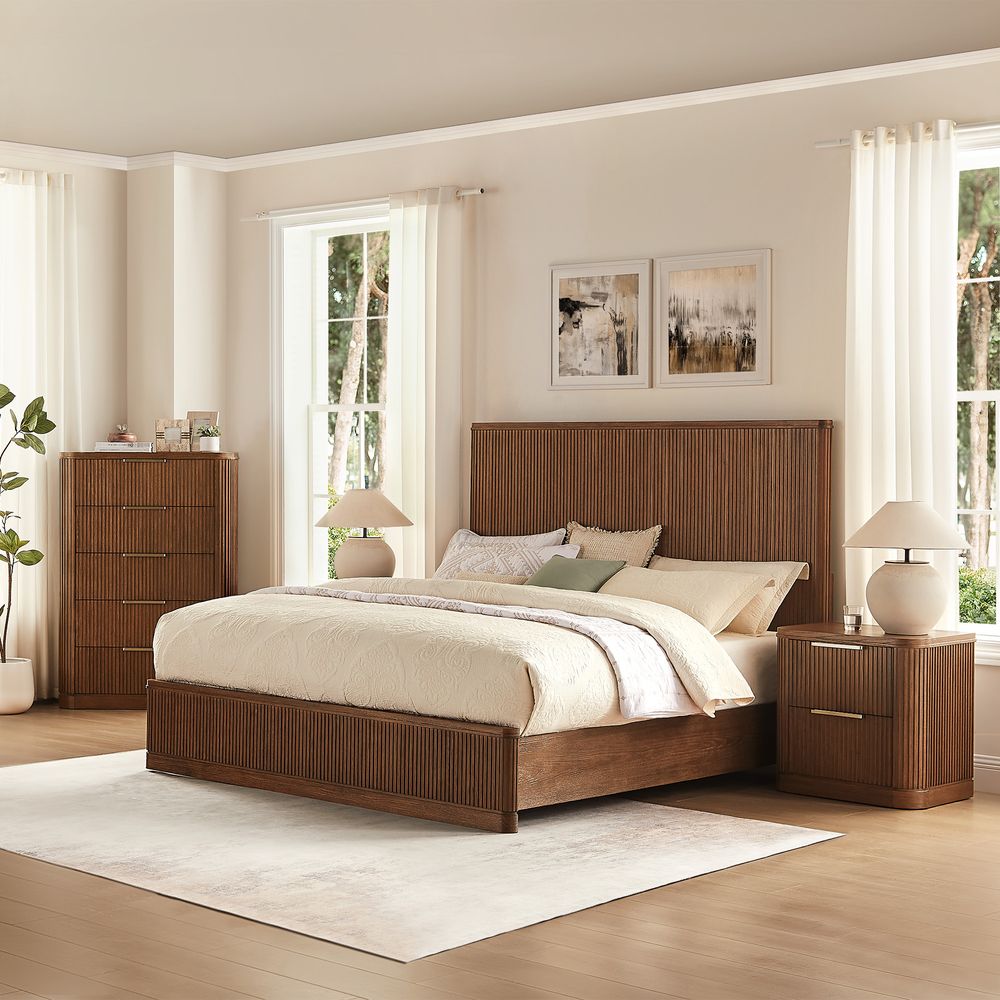
Finley Fluted King Size Bed
View Product
How to Measure Your Room for a King Bed Frame
A few measurements can help you determine whether a king bed frame will fit before you order it.
Step 1: Measure the Usable Room Dimensions
Measure the room's width and length. Note any features that reduce usable space, such as built-in closets, door openings, radiators, or other fixed obstructions.
Do not assume the entire wall-to-wall measurement is available for furniture.
Step 2: Check the Frame's Overall Dimensions
Find the assembled width, depth, and height in the product specifications. Use the largest exterior measurements, including any headboard or footboard that extends beyond the mattress.
If the listing provides separate measurements for the headboard and other components, use them to understand the frame's shape and proportions.
Step 3: Mark the Footprint on the Floor
Use painter's tape to mark the bed's overall width and length on the floor. Add outlines for nightstands and other furniture.
Walk around the marked area and check whether drawers and doors can open without hitting the bed. This is a simple way to identify layout problems before delivery.
Step 4: Check the Delivery Route
Measure the bedroom doorway, hallway, staircase, and any tight turns along the delivery route.
Check the package dimensions and assembly instructions when available. The assembled frame dimensions alone do not establish whether every package will fit through a narrow entryway.
Step 5: Confirm Mattress and Support Requirements
The frame's exterior dimensions determine its floor footprint, while its internal mattress space determines which mattress can fit.
Check the specified mattress dimensions, recommended mattress thickness, and whether a box spring is required or optional. Do not assume that every bed labeled king has identical internal dimensions or support requirements.
Choosing the Right King Bed Frame for Your Room
Once you know how much space you have, compare individual bed frames based on the measurements that matter most to your layout.
Skugga Fluted Bed: Plan Around the Headboard Width
The Hernest Skugga Fluted Bed measures 90.9 inches wide, 86.2 inches deep, and 48 inches high overall.
Its 90.9-inch headboard width makes it important to plan the entire bed wall, especially if you want matching nightstands on both sides.
The product listing specifies an internal mattress space of 76 × 80.9 inches and recommends an 8-inch-thick mattress. Confirm the current specifications and mattress compatibility before purchasing.

Skugga Fluted King Size Bed
View Product
Finley Fluted Bed: Account for Length and Overall Height
The Hernest Finley Fluted Bed measures 79.5 inches wide, 87.4 inches deep, and 60 inches high overall.
Its 87.4-inch depth is important when planning the space between the bed and the opposite wall. Its 60-inch listed overall height also makes wall clearance worth checking, particularly near windows or wall decor.
The product listing specifies an internal mattress space of 77.5 × 82 inches, recommends an 8-inch-thick mattress, and states that a box spring is required. Check these requirements before choosing the frame.
Kaden Mid-Century Bed: Compare Width and Overall Height
The Hernest Kaden Mid-Century Bed measures 81.7 inches wide, 85.8 inches deep, and 46.8 inches high overall.
Compared with Finley, Kaden is 2.2 inches wider, 1.6 inches shorter in depth, and 13.2 inches lower in overall height. These differences affect how each frame fits the room, even though both are king-size options.
The product listing specifies an internal mattress space of 77.8 × 81.8 inches, recommends an 8-inch-thick mattress, and states that a box spring is optional.
Compare the Dimensions Before You Buy
The three frames illustrate how much exterior dimensions can vary even among king-size beds. Skugga is the widest of these examples, Finley has the greatest listed overall height, and Kaden has the shortest overall depth.
Use the measurements that correspond to your room's constraints. If wall width is limited, start with overall width. If the room is short, compare overall depth. If the bed must fit below a window, check overall height and the specific component heights shown in the product specifications.
Product specifications can change, so confirm the dimensions and support requirements on the individual listing before purchasing.
Final Thoughts: Choosing a King Bed That Fits
The right king bed size depends on more than the standard mattress dimensions. A frame's overall width, length, and height determine how much floor space it occupies and how it fits with the rest of your furniture.
Before choosing a frame, measure your room, compare the full exterior dimensions, and plan for nightstands, walking space, door clearance, and delivery access. A few minutes of measuring can help you choose a king bed frame that fits your room and works for everyday use.
Dimensions in this guide are based on standard U.S. mattress reference measurements and the individual bed frame specifications listed by Hernest. Room-clearance examples are general planning guidelines; actual layouts depend on room dimensions and furniture placement.
FAQs
Is a king bed 60 by 80?
No. A standard U.S. king mattress measures 76 inches wide by 80 inches long. A 60-by-80-inch measurement is the standard queen mattress size. The overall dimensions of a king bed frame vary by design.
How much wider is a king than a queen?
A standard king mattress is 16 inches wider than a standard queen mattress. Both have a nominal length of 80 inches. The difference between their bed frames depends on the exterior dimensions of each model.
What is the exact size of a king size bed?
A standard U.S. king mattress measures 76 inches wide by 80 inches long. There is no single exact exterior size for all king bed frames because headboards, footboards, and side rails vary by design. Check the manufacturer's overall dimensions to determine how much floor space a particular frame needs.
What is the width of a king bed frame?
There is no universal exterior width for a king bed frame. The standard king mattress is 76 inches wide, but the frame may extend beyond that measurement. For example, the Hernest Skugga Fluted Bed measures 90.9 inches wide overall.
What is the standard king bed length?
A standard king mattress measures 80 inches long. The complete bed frame may be longer because of its headboard and footboard. Check the overall front-to-back measurement in the product specifications when planning your bedroom layout.
Can a king bed frame fit in a 10-by-10-foot bedroom?
It may fit physically, but the remaining walking space and furniture placement could be limited. Measure the frame's overall dimensions, account for nightstands and door clearance, and mark the footprint on the floor before buying.
How much space should you leave around a king bed?
Approximately 24–30 inches of clear walking space is a useful starting point where the room allows. The ideal clearance depends on the layout, door positions, furniture, and how you use the space. These measurements are planning guidelines rather than universal requirements.
Do all king bed frames fit a 76-by-80-inch mattress?
No. Although 76 by 80 inches is the standard U.S. king mattress reference size, individual frames have specific internal mattress-space dimensions and support requirements. Check the manufacturer's specifications to confirm compatibility before purchasing.